
Archives for December 13, 2018

Google+ to shut down early after second major security incident

After another data leak, its second such leak in a year, Google today announced it was shutting down its beleaguered social media platform, Google+. API access will shut down even sooner, within the next 90 days.

The newest vulnerability affected 52.5 million users, according to Google. Profile information, including names, email addresses, age, and occupation were all exposed. Worse, accounts set to private were still affected. Apps may have also stolen data stolen with specific Google+ users, but not publicly.

“With the discovery of this new bug, we have decided to expedite the shut-down of all Google+ APIs; this will occur within the next 90 days,” says David Thacker, VP of project management at Google, in a blog post. “In addition, we have also decided to accelerate the sunsetting of consumer Google+ from August 2019 to April 2019.”

Thacker says Google discovered the bug as part of its standard testing procedure, stating that there is “no evidence” that developers who had access to this data were aware of it, or had misused it.

Google has already begun notifying users affected by the bug.

In October, a similar Google+ vulnerability may have exposed data to app developers for as long as three years. The bug was discovered in March, but not publicly disclosed until October.

This leak, Thacker says, was discovered on its own, and live for just six days.
Intel Announces Faster Processor Patched for Meltdown and Spectre

Intel just announced their new Sunny Cove Architecture that comes with a lot of new bells and whistles. The Intel processor line-up has been based off the Skylake architecture since 2015, so the new architecture is a fresh breath for the world’s largest chip maker. They’ve been in the limelight this year with hardware vulnerabilities exposed, known as Spectre and Meltdown. The new designs have of course been patched against those weaknesses.

The new architecture (said to be part of the Ice Lake-U CPU) comes with a lot of new promises such as faster core, 5 allocation units and upgrades to the L1 and L2 caches. There is also support for the AVX-512 or Advanced Vector Extensions instructions set which will improve performance for neural networks and other vector arithmetic.

Another significant change is the support for 52-bits of physical space and 57 bits of linear address support. Today’s x64 CPUs can only use bit 0 to bit 47 for an address space spanning 256TB. The additional bits mean a bump to a whooping 4 PB of physical memory and 128 PB of virtual address space.

The new offering was demoed under the company’s 10nm process which incidentally is the same as the previously launched Cannon Lake. The new processors are due in the second half of 2019 and are being heavily marketed as a boon for the Cryptography and Artificial Intelligence Industries. The claim is that for AI, memory to CPU distance has been reduced for faster access, and that special cryptography-specific instructions have been added.

NVIDIA Sets Six Records in AI Performance

NVIDIA has set six AI performance records with today’s release of the industry’s first broad set of AI benchmarks.

Backed by Google, Intel, Baidu, NVIDIA and dozens more technology leaders, the new MLPerf benchmark suite measures a wide range of deep learning workloads. Aiming to serve as the industry’s first objective AI benchmark suite, it covers such areas as computer vision, language translation, personalized recommendations and reinforcement learning tasks.

NVIDIA achieved the best performance in the six MLPerf benchmark results it submitted for. These cover a variety of workloads and infrastructure scale – ranging from 16 GPUs on one node to up to 640 GPUs across 80 nodes.

The six categories include image classification, object instance segmentation, object detection, non-recurrent translation, recurrent translation and recommendation systems. NVIDIA did not submit results for the seventh category for reinforcement learning, which does not yet take advantage of GPU acceleration.

A key benchmark on which NVIDIA technology performed particularly well was language translation, training the Transformer neural network in just 6.2 minutes. More details on all six submissions are available on the NVIDIA Developer news center.

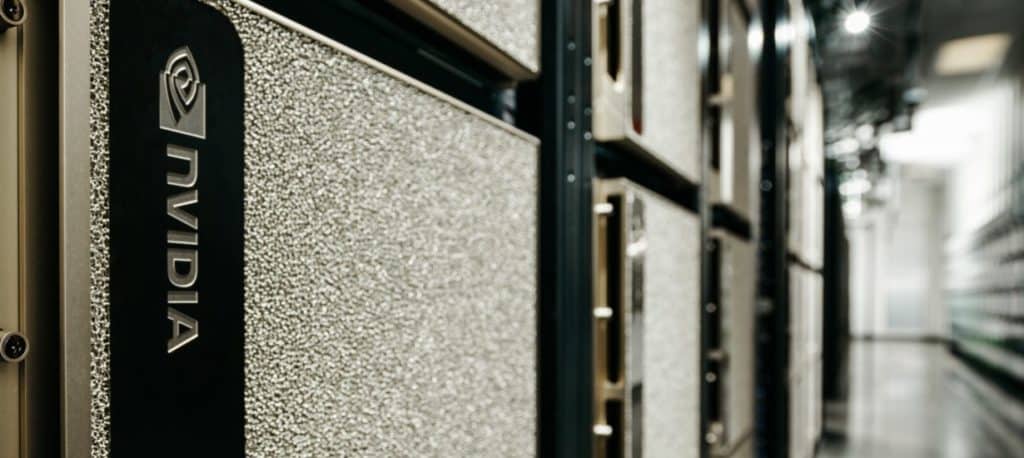
NVIDIA engineers achieved their results on NVIDIA DGX systems, including NVIDIA DGX-2, the world’s most powerful AI system, featuring 16 fully connected V100 Tensor Core GPUs.

NVIDIA is the only company to have entered as many as six benchmarks, demonstrating the versatility of V100 Tensor Core GPUs for the wide variety of AI workloads deployed today.

“The new MLPerf benchmarks demonstrate the unmatched performance and versatility of NVIDIA’s Tensor Core GPUs,” said Ian Buck, vice president and general manager of Accelerated Computing at NVIDIA. “Exceptionally affordable and available in every geography from every cloud service provider and every computer maker, our Tensor Core GPUs are helping developers around the world advance AI at every stage of development.”

State-of-the-Art AI Computing Requires Full Stack Innovation
Performance on complex and diverse computing workloads takes more than great chips. Accelerated computing is about more than an accelerator. It takes the full stack.

NVIDIA’s stack includes NVIDIA Tensor Cores, NVLink, NVSwitch, DGX systems, CUDA, cuDNN, NCCL, optimized deep learning framework containers and NVIDIA software development kits.

NVIDIA’s AI platform is also the most accessible and affordable. Tensor Core GPUs are available on every cloud and from every computer maker and in every geography.

The same power of Tensor Core GPUs is also available on the desktop, with the most powerful desktop GPU, NVIDIA TITAN RTX costing only $2,500. When amortized over three years, this translates to just a few cents per hour.

And the software acceleration stacks are always updated on the NVIDIA GPU Cloud (NGC) cloud registry.

NVIDIA’s Record-Setting Platform Available Now on NGC
The software innovations and optimizations used to achieve NVIDIA’s industry-leading MLPerf performance are available free of charge in our latest NGC deep learning containers. Download them from the NGC container registry.

The containers include the complete software stack and the top AI frameworks, optimized by NVIDIA. Our 18.11 release of the NGC deep learning containers includes the exact software used to achieve our MLPerf results.

Developers can use them everywhere, at every stage of development:

  • For data scientists on desktops, the containers enable cutting-edge research with NVIDIA TITAN RTX GPUs.
  • For workgroups, the same containers run on NVIDIA DGX Station.
  • For enterprises, the containers accelerate the application of AI to their data in the cloud with NVIDIA GPU-accelerated instances from Alibaba Cloud, AWS, Baidu Cloud, Google Cloud Platform, IBM Cloud, Microsoft Azure, Oracle Cloud Infrastructure and Tencent Cloud.
  • For organizations building on-premise AI infrastructure, NVIDIA DGX systems and NGC-Ready systems from Atos, Cisco, Cray, Dell EMC, HP, HPE, Inspur, Lenovo, Sugon and Supermicro put AI to work.

Samsung’s lightweight Notebook 9 Pen is aimed at creators

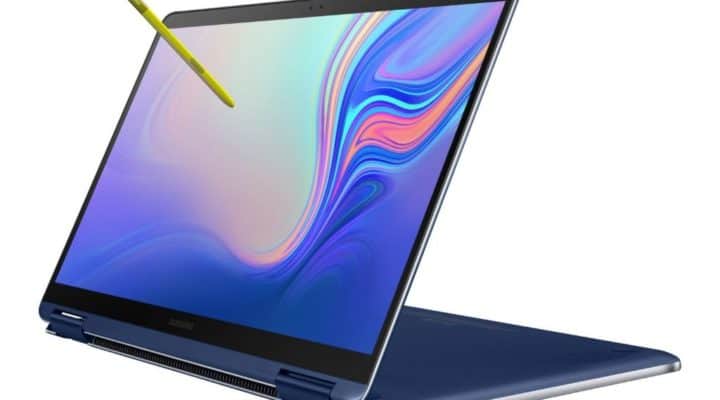
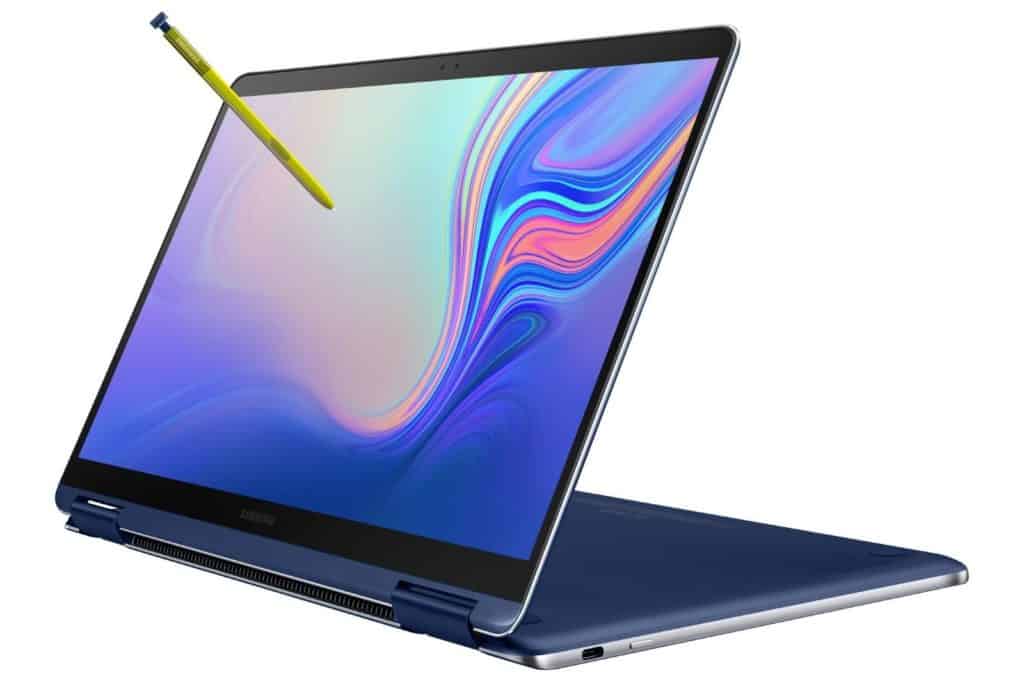
Last year at CES 2018, Samsung unveiled the Note 9 Pen, a lightweight 13.3-inch convertible aimed at artists and anyone else who needed decent power with as little weight as possible. The model is back again in a big way, with an all-new design and features that should fix what we didn’t like about it before. Most notably, it comes in both 13-inch and 15-inch versions, has more ports and packs a much bigger battery with fast-charging that lets it run for up to 15 hours.

The 9 Pen is still powered by an 8th-generation Intel Core i7 processor, but you can get the 15-inch version with 2GB NVIDIA GeForce MX150 discrete graphics. (The smaller model is limited to integrated Intel graphics.) Both have LPDDR3 RAM, GIGA WiFi, face and fingerprint recognition, two Thunderbolt 3 ports, USB-C, headphone/microphone and UFS/MicroSD ports. It’s also got a “ThunderAmp” smart amp and “studio-quality sound from speakers tuned by AKG,” Samsung said.

The 2019 Note 9 Pen also looks less cheap than the last model, thanks to a new design and all-metal/aluminum frame. Both models are still incredibly light, at 2.47 pounds for the 13-inch version, and 3.44 pounds for the larger model. The display, with 1080p resolution as before, has got slimmed-down bezels, at least on the sides.

Finally, both models have a built-in S Pen with a choice of three different tips and half the latency of the last mode. Combined with the lightweight convertible design, drawing app support and discrete graphics, that should make it a decent laptop for artists and graphics pros on the go. Samsung hasn’t announced pricing, but the last Notebook 9 Pen started at $1,400, if that helps. It’ll arrive in the US sometime in 2019.

The likelihood of a bitcoin bounce is diminishing, says analyst

Altcoins slip further, drags crypto market value to $108 billion

Bitcoin prices are moving lower on Thursday, inching closer to a fresh 15-month low.

A single bitcoin BTCUSD, -1.75% was last changing hands at $3,398.79, down 2.2% since Wednesday at 5 p.m. Eastern Time on the Kraken exchange and less than 5% from the Dec. 7 low near $3,250.

What are analysts saying
After plunging through $6,000 on Nov. 14, bitcoin has struggled for any meaningful bounce, falling four of the past five trading weeks, and according to one analyst, the longer it treads water the more susceptible it becomes to another move lower.

“Bitcoin continues to muddle along in the mid-$3k range. The longer we maintain these levels, the less likely it becomes that prices are oversold and poised for a pop,” wrote Jani Ziedins of CrackedMarket. “The public has largely written cryptocurrencies off as a fad and no new money is coming in. The lack of demand will continue to be a big liability.”

Altcoins and futures trading
Smaller cryptocurrencies—collectively known as altcoins—are moving lower with bitcoin. Ether, ETHUSD, -0.38% is down 1.7% at $88.42, Litecoin LTCUSD, -2.04% has lost 3.7% to $23.55, XRP, XRPUSD, -1.78% is down 1.7% at 30 cents, and Bitcoin Cash, BCHUSD, -3.49% is trading lower by 4.3% at $93.20.

According to data from CoinMarketCap, the market value of all cryptocurrencies is $108.5 billion.

Bitcoin futures are tracking spot prices lower on Thursday. The Cboe Global Markets December contract XBTZ8, -1.46% is down 1.3% at $3,385, and the CME Group December contract BTCZ8, -1.61% is down 1.3% at $3,375.

The tide may be turning for these two telecom stocks

Wall Street is weighing in on telecoms this week.

Morgan Stanley downgraded Verizon shares to equal weight on a valuation call on Wednesday. This comes a day after Citigroup analysts upgraded AT&T to a buy.

The stock market has picked a different winner this year. While AT&T has tumbled 22 percent in 2018, Verizon has added 9 percent.

Matt Maley, equity strategist at Miller Tabak, says AT&T’s charts show it is coming up against a tough roadblock.

“The stock has to bounce a lot more,” Maley said on CNBC’s “Trading Nation” on Tuesday. “It did try to make a double bottom down near the $29 level, but if you look at the long-term chart, it’s got to bounce a lot more before I’d really want to turn positive on the stock.”

AT&T has bounced around the $29 level since late October. It had not broken below that level since late 2011.

“It’s actually had a tough two-and-a-half years going back to the middle of 2016. It has not had a higher high since then. A move above $34 would give it that higher high, take it above its 200-day moving average and also take it above its one-year trend line. So until we get that kind of a move, even though it’s trying to make a bottom here, there’s no green flag on this one yet,” he said.

AT&T shares are a 13 percent rally from $34. They briefly traded above that level in early October but had not had a sustained stretch above there since April.

Stacey Gilbert, market strategist at Susquehanna, says AT&T’s long-term performance depends on the safety of its dividend yield.

“There’s a lot of concern, a lot of chatter that is it safe? Is it going to maintain itself? Do they have to cut?” Gilbert said on “Trading Nation” on Tuesday. “If AT&T were to maintain its dividend, this would be viewed positively. Obviously the flipside to that is if they cut it … the market is not pricing that in and that would definitely be a negative for AT&T here.”

AT&T has a dividend yield of 6.6 percent, nearly four times the 2 percent yield on the S&P 500. Verizon yields 4.2 percent.