Archives for December 5, 2018

AppWorks founder reveals why they’re moving into AI and blockchain

Jamie Lin founded the Taipei-based accelerator AppWorks in 2009. Having began coding and building his own computers at the age of 10, he co-founded his first ecommerce startup, Hotcool, in 1999 and went on to co-found Intumit, Social Sauce, and Muse Games.

Lin received his bachelor’s degree in engineering from National Taiwan University and MBA from New York University’s Stern School of Business. He blogs on Mr Jamie.

What did you do before setting up AppWorks?

The dotcom boom hit Taiwan when I was in college. I started one of the country’s first ecommerce websites with a friend in my varsity basketball team, but then the dotcom bubble burst in 2000 and everything went south. We pivoted into a SaaS company—our knowledge management software was a hit and we started selling really well.

But in 2004, SARS hit, so everything came to a halt. I decided to pursue an MBA in New York University (NYU). During that time, I was actually one of Facebook’s first 8,000 users; my class basically grew up with Facebook.

Two of my MBA friends became interested in creating a travel social network and they recruited me. We raised US$2 million but soon realized that it didn’t work because people only travelled two times a year; they didn’t need a social network for it.

In 2008, my CEO decided to pivot into a game production house. But I wasn’t a huge fan of games back then, and US companies were still struggling with the financial crisis. I also just had my son and wanted him to grow up Taiwanese.

I thought that iPhone and Android’s launch will make hardware a commodity and software more valuable, and that’s why I decided to come back and start AppWorks.

How did you get started in the blockchain space?

I started paying attention to bitcoin back in 2013/2014. As I started looking into the decentralized nature of its design and limited supply, I realized that it’s probably going to be the “digital gold.” I also felt that its design has the ability to make money supply more decentralized. I am especially bullish on the micropayment use cases.

I started writing blog posts and promoted that Taiwan should try to position itself as a cryptocurrency hub even back in 2014. And yes, I also bought a bunch of bitcoins!

Recently, AppWorks started an accelerator program for blockchain and AI startups. What do you hope to achieve?
We started with the popularity of iPhone and Android—hence the name AppWorks. But with the decline of smartphones, we can continue to be a general accelerator or we can tell founders to look at blockchain and AI: the two new paradigms that would create new opportunities. If we do this, then we might be able to spark the region to move forward and jump to the next curve.

Internally, we had a lot of debate. Some of us fear that we might not have as many applicants. Some debate that if AI blockchain startups want to join us, they would have joined us anyway.

But we feel that that’s something we can do to better serve this region, so we decided to take the risk. Even though we may lose applications, at least we can tell this region that it is time to go forward.

What are some entrepreneurial lessons that help you succeed in your current role?

When you’re a pure financial player, sometimes you feel that you can solve problems just by throwing money. But when you are or have been a founder, you realize that 99 percent of startups’ problems cannot be solved that easily with money. So, you pay more attention to building up your repertoire and having the relevant tools to help them solve the problem.

At AppWorks, we have founder communities where founders can speak to various experts that can help tackle specific problems (e.g. PR, design, recruiting).

How do you equip your people to support blockchain and AI startups?
We have internal classes and online workshops. We even gave our co-workers Ethereum so they can play with different crypto exchanges. On top of that, we also recruited a bunch of AI/blockchain founders to be our mentors.

It’s a continuous process. We’re still taking classes on blockchain up to today. We’re also continuously recruiting mentors. This industry is moving so fast, you just have to continuously get up to speed.

What needs to be done to ensure mainstream adoption of blockchain projects?
We need to have more young and smart founders and developers to participate in the development of public chains and blockchain applications.

I think the equivalent of a browser in smartphones, which would enable mainstream adoption, is not here yet. At this point, what we can do is get more young people to experience blockchain, so we can harness the platform when the time comes.

If you look at Silicon Valley, the community jumped onto iPhone and Android and developed apps on top of it because they have accumulated capabilities and experience. Ten years on, Silicon Valley still dominates the world’s mobile experiences.

In terms of growing the talent pool, what are your thoughts on helping existing internet founders to pivot and start a blockchain company?

I think we need to inspire today’s internet founders to pivot and look into blockchain opportunities. We also need to make sure they’re informed that mobile internet is saturated.

Even though right now it’s still early days, there are still things you can do to build viable, sustainable profitable blockchain businesses. There are already people making money from building companies in this industry.

What’s your daily success routine?
I wake up every day at 5 am, and I immediately start reading news until 8 am. Tech in Asia is obviously one of the sources I check.

I usually hit the gym two to three times a week, spending one and a half hours each time: run for 30 minutes or 5 km and lift weights for an hour. I feel that doing a startup is like a long run. You need to build up your body and your stamina for the long haul.

Who is your mentor(s)?

I have a lot of mentors. I learn a lot from Elon Musk to Marc Andreessen to Peter Thiel, even though they don’t know me! I watch a lot of their YouTube videos every time I hit the gym.

In the real world, I think both of my partners are really kind. They have more experience than me in the VC world, so I learn a lot from them.

I was also very lucky to have Steven Zhang, the founder of CID Group, as my mentor. He helped me review investments in my first three years as a VC. He also became a co-LP in my first fund.

What are some values you live by?

I’m very keen on championing the term “Greater Southeast Asia” as I feel that Taiwan should work together with Southeast Asia. Hopefully, I can help one more founder see the value of seeing Taiwan and Southeast Asia as one market.

Another thing is, a business can only be sustainable in the long run if the value it creates for society is much, much bigger than the value it extracts. Look at Google: the value it provides to the world is worth probably trillions, or even hundreds of trillions of dollars. But Google only extracts US$100 billion to US$200 billion of revenue every year.

Founders should try to maximize the value they create for the world. That should be the model.

Lastly, I’d like to see founders helping younger founders. Founders are a special breed of animals. If they help each other, we will have this endless positive cycle that would help the region thrive more quickly.

4 Reasons to Actually Read Your Employee Handbook

Starting a new job often means spending your first week or so filling out paperwork, meeting more new people than you can easily count, and being asked to read the 100-page monstrosity known as your employee handbook.

The purpose of an employee handbook is to spell out a company’s rules, procedures, goals, and so forth. And while most employers don’t intend to make that material overwhelmingly dull, that’s often just the way it works out. But painful as it might be to work your way through that handbook, it pays to read it in its entirety. Here’s why.

1. You’ll avoid inadvertently breaking the rules

You’re probably aware that your employer doesn’t want you to steal company property, show up late consistently, or take time off without requesting it first. But some of its rules may be less obvious, and if you don’t read that handbook, you could end up violating one accidentally.

Imagine you’re in a position to offer contracts to outside vendors. Your company might have a policy barring you from accepting thank-you gifts, or even meals, in exchange. But if you’re not aware of that policy, you might violate it and get into trouble without meaning to. And that’s a good way to start off on the wrong foot at work.

2. You’ll be better prepared to watch what you say

Over email, that is. Many companies these days have a policy of monitoring employee email, and most spell it out in their respective handbooks. It pays to understand that particular policy inside and out, so that your words don’t come back to bite you. Along these lines, figure out whether your employer claims the right to monitor communication over your personal email, provided it’s accessed on a company network.

3. You’ll discover benefits you may not have known about

The major benefits your company offers will probably be presented to you along with your salary — things like a 401(k) and health insurance plan. But you might need to read through that handbook to unearth some of the lesser-known perks you’re entitled to, like an annual fitness-equipment subsidy or money toward educational materials or courses. In other words, spending a few extra minutes (OK, hours) going through that handbook could actually put money back into your pocket.

4. You’ll get a better sense of your company culture

When you’re new to a job, it tends to take time to learn the ropes. A good way to get a sense of how your company operates and what it values is to read that handbook. Don’t just process its content, but observe its tone. Chances are, by reading it cover to cover, you’ll better understand your management team’s style and pick up on your company’s goals. And that, in turn, will not only make that transition easier, but also put you in a better position to succeed.

Your employee handbook probably isn’t the most exciting thing you’ll read this year, but do yourself a favor and tackle it anyway. This way, you’ll know all things company-related.

Dow transports suffer biggest-ever point drop, led FedEx and UPS stock selloffs

Skepticism and confusion over trade deal, flattening yield curve fuel growing concerns over economic slowdown

The Dow Jones Transportation Average tumbled to its biggest-ever point drop, fueled by growing fears of an economic slowdown.

The Dow transports DJT, -4.39% tumbled 476.37 points, or 4.4%, with all 20 components closing lower. The previous biggest-ever point decline was 445.16 points on Oct. 10. At its intraday worst, the index was down as much as 565.23 points, or 5.2%.

Factors contributing to the selloff include increasing doubts over the significance of the U.S.-China trade war truce agreement, amid confusion and skepticism over exactly what the agreement entails.

In addition, a rapidly flattening Treasury yield curve fueled fears that recession was on the horizon, as an inverted yield curve — when yields on longer-dated Treasurys fall below yields of shorter-term Treasurys — has preceded previous recessions. Some parts of the curve are already inverted, as the 5-year yield is below the three-year yield. See Bond Report.

Many on Wall Street view the DJTA as a key economic indicator, because the index helps gauge how consumers and businesses are actually taking what companies are making.

Meanwhile, the Dow Jones Industrial Average DJIA, -3.10% dropped 799.36 points, or 3.1%, while the S&P 500 index SPX, -3.24% shed 3.2% and the Nasdaq Composite Index COMP, -3.80% lost 3.8%. See Market Snapshot.

Within the DJTA, the biggest drags were the shares of UPS UPS, -7.37% sank 7.4%, the biggest decline since January 2015, and FedEx FDX, -6.31% tumbled 6.3% to suffer the deepest decline since March 2013. The stocks’ combined price declines shaved 140 points off the DJTA’s price.

Morgan Stanley analyst Ravi Shanker cut his price target on UPS to $87 from $92 and on FedEx to $230 from $240, saying he believes the market is missing the risk Amazon Air poses” to the companies. He kept his underweight rating on UPS and his equal weight rating on FedEx.

Although the rollout of Amazon.com Inc.’s AMZN, -5.87% Amazon Air is still in the early innings, Shanker estimates a 2-to-3 percentage points impact on UPS and FedEx domestic air volume growth already, with more erosion expected as Amazon Air is built out.

Separately, UBS analyst Thomas Wadewitz downgraded a number of trucking companies, citing concerns that earnings for the current quarter may not be good enough to boost the stocks after the “peak season tightening” in the freight market was more muted than expected.

Wadewitz cut his ratings on Werner Enterprises Inc. WERN, -4.41% Knight-Swift Transportation Holdings Inc. KNX, -9.86% and Hub Group Inc. HUBG, -10.11% to neutral from buy, while slashing his price target on Werner’s stock by 14% to $36, on Knight-Swift by 16% to $36 and on Hub by 24% to $48. He also lowered his targets on Schneider National Inc. SNDR, -9.47% by 16% to $26 and on J.B. Hunt Transport Services Inc. JBHT, -4.17% by 14% to $124.

“We believe that the combination of incremental expansion capacity and increasing risks to freight demand point to a softer truckload pricing environment in 2019 which could result in either low single digit pricing gains or a modest decline in rates in the 2019 bid season,” Wadewitz wrote in a note to clients.

J.B. Hunt’s stock, a DJTA component, fell 4.2%, Werner’s shares shed 4.4% and Hub’s stock plunged 10%.

Airlines shares also dropped, with American Airlines Group Inc. AAL, -7.47% shedding 7.5%, Delta Air Lines Inc. DAL, -5.29% dropping 5.3%, United Continental Holdings Inc. UAL, -4.69% losing 4.5% and Southwest Airlines Co. LUV, -2.60% falling 2.6%.

RH takes business cues from LVMH, Apple and Berkshire Hathaway

RH says it takes business cues from three notable names: LVMH, Apple and Berkshire Hathaway

RH shares rally nearly 11% in Tuesday trading

Luxury home retailer RH says there are three companies that it “studies and admires”: luxury conglomerate LVMH Louis Vuitton Moet Hennessy, Apple Inc. and Berkshire Hathaway Inc.

In a lengthy message to its “people, partners and shareholders,” RH Chief Executive Gary Friedman outlined the ways in which RH RH, +10.90% takes its cues from these three companies.

“Like LVMH, we are building a luxury platform, and in a similar fashion, we are beginning to demonstrate that we too can be rewarded with luxury brand margins that are double those of competitors targeting broader markets,” he wrote.

In addition, he thinks RH will continue to benefit from the “compounding wealth effect,” like MC, -1.28%

“In the past 12 years alone the stock market is up in excess of 80% from its previous 2007 high prior to the great recession, and similarly households with incomes of excess of $200,000 are also up approximately 80%,” he said.

Like Apple AAPL, -4.40% Friedman says RH is building an “ecosystem of businesses” that make the brand more valuable. In the case of RH, the hospitality business is an enhancement to the physical stores and interior design business.

“While each of the above businesses are relevant in isolation, as an integrated ecosystem they create a powerful customer proposition and a brand that is difficult to replicate,” Friedman said.

RH has focused its attention on stores that include cafés, wine vaults and tasting rooms, and espresso bars.

And Berkshire Hathaway provides a model for a business that is “capital efficient,” has significant free cash flow, has a “low cost of capital,” and “a culture relentlessly focused on ROIC [return on invested capital] and capital allocation.”

Friedman said RH is also thinking in the long term like Berkshire Hathaway BRK.A, -4.81% BRK.B, -4.86% .

“We all witnessed how Berkshire took advantage of the past recession, and demonstrated that those with capital in difficult markets are the ones who capitalize,” Friedman wrote. “That is precisely why we took advantage of the favorable capital markets in 2014 and 2015, executing two zero coupon convertible note transactions raising $650 million for one of those rainy days.”

RH reported third-quarter earnings that beat expectations and raised its guidance. Shares closed Tuesday up 10.8%.

“RH’s focus on profitability over growth is clearly paying off as it transforms into a luxury brand with no peer, and market share growth drivers should accelerate in 2019,” wrote Wedbush analysts led by Seth Basham in a note.

“RH’s forecasts appear reasonable in a modest macro slowdown environment.”

Even a slumping housing market doesn’t frighten RH, with Friedman noting that RH’s revenue has accelerated.

“[O]ur view is that an oversupply of high-end housing will most likely lead to lower home prices in markets with excess inventory which is surely not good for home builders and developers, but not necessarily bad for RH, as unit sales at lower price points may reaccelerate driving incremental demand for furniture and home furnishings,” he said.

Wedbush thinks RH is differentiated and has created an aspirational environment in its stores, which will help it continue to thrive.

“The company’s impressive control of its brand shines through in strong pricing power, forming the base for top- and bottom-line growth,” Wedbush wrote.

It rates RH shares outperform with a $160 price target, up from $145.

UBS analysts warn housing market problems and capital markets volatility could still have an impact.

“In order for the stock to work in a sustained way, we think the business has to consistently generate healthy same-store sales growth,” UBS wrote. “Otherwise its earnings algorithm will be in doubt.”

UBS rates RH shares neutral with a $150 price target.

On the other hand, Wells Fargo is bullish about RH.

“We believe Q3 results (and a strong FY19 outlook) serve as evidence that the macro remains favorable, RH’s model is working, and the company is successfully transforming itself to a faster growing, more profitable business,” analysts led by Zachary Fadem wrote.

Wells Fargo rates RH shares outperform with a $175 price target, up from $145.

RH stock has advanced 59% for the year to date while the S&P 500 index SPX, -3.24% is up 1% for the period.

Combining small 401(k) accounts helps preserve retirement saving

Don’t let your 401(k) disappear when you change jobs.

A private sector answer to a big problem is finally getting some traction

Good news. The Department of Labor, with its request for public comment, may be about to give Retirement Clearinghouse LLC the green light to proceed with its proposal to automatically transfer small balances from one 401(k) to another. Such an arrangement would dramatically reduce leakages from 401(k) plans.

Millions of Americans leave their jobs each year and cash out their holdings, because it can be difficult to roll money from one 401(k) to another. Others leave their money in the plan, but fail to specify what should be done with their balances. If the balances are small (less than $5,000), employers can transfer them into an IRA account, where they are invested in money market funds. Such accounts can have fees that exceed their low investment returns, causing account balances to decline.

Many years ago, Spencer Williams and Tom Johnson came up with a solution: automatically consolidate small accounts so that employees can aggregate their savings as they change jobs. They created Retirement Clearinghouse LLC to serve as the platform to consolidate balances. Consolidation helps the employees accumulate a more adequate level of retirement saving, because research shows that hitting the $20,000 milestone makes participants much more likely to preserve their balances. And consolidation helps sponsors fulfill their fiduciary duty and cut aggregate plan costs by reducing the number of stranded accounts. Consolidation helps providers to increase assets under management and reduce the headaches associated with mandatory distributions, stranded accounts, and uncashed checks for missing participants.

Williams and Johnson have demonstrated that consolidation is feasible and has a big payoff. They worked with a large health care company with more than 190,000 participants and an average turnover of more than 40,000 employees each year. To control costs and better serve employees, the health care company instituted a “roll in” program as a fringe benefit to help new or current employees consolidate their savings in the company’s plan or to help departing employees move their savings to the plan of the next employer.

According to a report from the Boston Research Group, the plan saved $6 million in costs and increased assets under management by $100 million, and participants on average rolled about $18,000 into their accounts, which greatly reduced subsequent cashouts.

While Retirement Clearinghouse has the technology to provide automatic roll ins, it needs buy-in from government regulators for two reasons.

First, potential customers wanted clarification as to who has fiduciary responsibility for this service. A DOL advisory opinion clarified that Retirement Clearinghouse is the fiduciary for these transactions.

Second, the Employee Retirement Income Security Act of 1974 prohibits fiduciaries from self-dealing. That is, fiduciaries are not allowed to earn fees as a result of their recommendations. Retirement Clearinghouse has asked the DOL for an exemption from this provision, and the DOL has asked for public comment before it proceeds.

Retirement Clearinghouse envisions charging a few dollars per month in custodial fees for the holding period between plans and a maximum $59 fee for the electronic transfer to a new plan. The goal is to keep the small balances in an IRA for as short a period as possible before transferring them to a new plan.

The cashing out and loss of small accounts is a well-defined and serious problem. Retirement Clearinghouse — and hopefully other companies out there — have a solution. It is so lovely to see a win for the 401(k) system.

Bitcoin trades higher, but struggles to regain $4,000

Cryptocurrency prices traded mostly higher Tuesday, looking to claw back some of the ground lost on Monday.

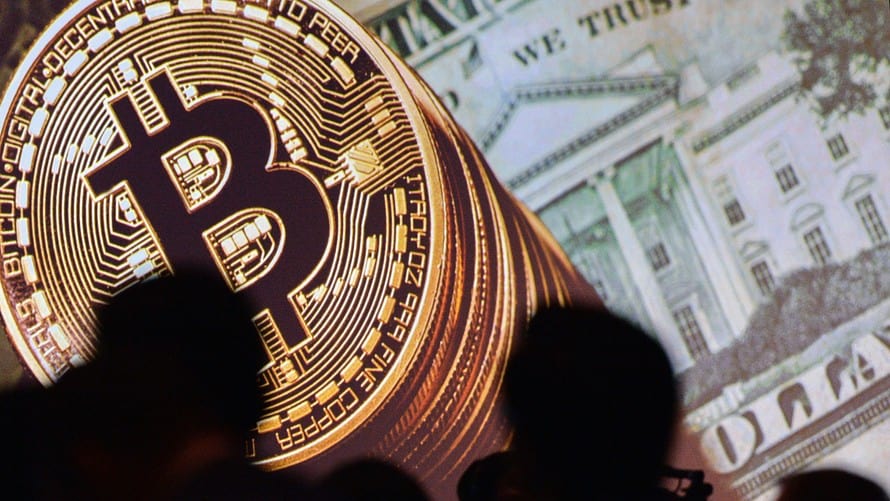
After falling as much as 8% on Monday, bitcoin, BTCUSD, -1.27% the best-known cryptocurrency, was last changing hands at $3,930.23, up 1% since Monday’s level at 5 p.m. Eastern Time on the Kraken cryptocurrency exchange.

Bitcoin mining gets cheaper

With bitcoin and major cryptocurrency prices well off their all-time highs, there has been debate about the profitability of bitcoin miners. According to Sam Doctor, head of data science at Fundstrat Global Advisors, miners are getting some reprieve as prices decline.

“Our model suggests the cash cost of mining each BTC on the Antminer S9 is now $4500, down from $5300 in September,” he wrote. The Antminer S9 refers to specialized computer hardware used to mine for bitcoins and other digital assets.

“Depreciation expense has fallen to $1300 vs. $2000 in September, reflecting a lower rig cost as newer devices have come to market. Fully loaded breakeven is now $5700, compared with a breakeven of $7300 in September.”

Bitcoin Cash struggles, other altcoins jump

Altcoins—the collection of more than 2,000 coins other than bitcoin—are mostly higher on Tuesday. Ether ETHUSD, -1.96% is trading up 0.4% at $108.85, Litecoin LTCUSD, -1.04% has gained 1.5% to $31.40, XRP, XRPUSD, -0.88% the cryptocurrency that runs on the Ripple protocol, was trading at 35 cents, up 0.5% and bucking the trend was Bitcoin Cash BCHUSD, -5.50% that is down 6.1% at $148.30.

Bitcoin futures ended Tuesday in the green. The Cboe Global Markets December contract XBTZ8, -0.85% finished up 0.9% to $3,837.50 while the CME Group December contract BTCZ8, -0.91% closed the session up 1.3% to $3,840.

The total value of all cryptocurrencies was last at $128.3 billion, according to data from CoinMarketCap.