
Archives for December 5, 2018

With Epic’s Store On The Way, Steam Is Finally Feeling The Heat

Over the years, people have pondered what a viable competitor to Steam’s dominance would look like. Who would pull it off? What would be their silver bullet, capable of hobbling even Valve’s game-slinging behemoth?

Late last week, Valve announced that Steam will take a lesser cut of revenues from games that sell $10 and $50 million worth of copies—25 percent for the former and 20 percent for the latter. Today, everyone emitted a collective “ohhhh, now I get it” upon finding out why: Unreal Engine creator and Fortnite developer Epic announced that it’s on the verge of launching its own store, one that’ll take a cut of just 12 percent of earnings from developers—way down from the industry-standard 70/30 split that Steam helped pioneer.

In an interview with GamesIndustry.biz, Epic Games founder and CEO Tim Sweeney said that, while running Fortnite and selling digital goods through the world’s most popular game, Epic realized that 70/30 isn’t necessary. “In our analysis, stores charging 30% are marking up their costs by 300% to 400%,” he said. “But with developers receiving 88% of revenue and Epic receiving 12%, this store will be a profitable business for us.”

Epic’s announcement puts more pressure on Valve, a company known for its tendency to only react out of absolute necessity, whether in regards to hate groups in Steam’s inconsistently policed community section, “fake games” taking advantage of an exploit in Steam’s trading card system, the normalization of review bombs as a viable tactic to try and tank games’ sales, or the Counter-Strike gambling ring.

Steam never had all the biggest games on PC, what with League of Legends, World of Warcraft, Minecraft, and others occupying their own mammoth chunks of the internet. Valve compensated by opening up Steam to indies and, over the years, home-growing hits that ranged from Terraria to Stardew Valley to PUBG to Rust to Undertale. But the number of big-name absences has become more conspicuous in recent years. Two of this holiday season’s biggest games, Fallout 76 and Call of Duty: Black Ops 4, both eschewed series-typical Steam releases and came out on publisher-owned platforms instead. Fortnite continues to do numbers that rival Steam all by its lonesome, Overwatch is dominating the team shooter scene on Battle.net, and EA’s Origin continues to, er, exist, which means series like Battlefield have also departed Valve’s storefront. Other competitors, too, like the Discord store have popped up, though they haven’t made many waves so far.

There’s now a blueprint out for publishers taking their 30 percent revenue cuts and going home, and more of them are starting to follow it. Valve doesn’t have one big competitor; rather, it’s surrounded by a bunch of fiefdoms that, simply by existing, call into question the necessity of publishing games on Steam at all. Smaller developers, meanwhile, are dissatisfied with a service that seems increasingly indifferent to their needs, leaving them to force their signal through the noise while surrounded by tools that an increasingly toxic community can game as they please. Many have wanted to jump ship, but there hasn’t been anywhere else to go. That feeling of helplessness has only bred further resentment as Valve has stubbornly stuck to its guns.

If they’re not careful (and sometimes, even if they are), developers can find themselves up to their necks in a quicksand of community toxicity, sagging sales, race-to-the-bottom pricing, and Valve’s notorious hands-off approach, which frequently exacerbates these issues.
Despite all that, Steam is still massive, and through everything from deals to front page carousels to discovery algorithms, Valve has tried to give developers more ways to surface and resurface their games. Getting games up on the store has become a relatively straightforward process given how many eyeballs they stand to be seen by, so in terms of bang for potential buck, Steam remains tough to beat—even with smaller, more developer-focused stores like Itch.io in the mix. Steam can still be a hit-maker—as demonstrated by recent success stories like Raft, Slay The Spire, and They Are Billions—albeit one that makes improbable underdog magic happen on an increasingly rare basis.

But Steam is also cluttered with features and games, the product of years of problem-solving through addition rather than streamlined subtraction, and the diehard portion of its user base that’s often responsible for elevating games to a place of visibility has relatively homogenized tastes, making the environment inhospitable (or even downright hostile) to games that want to explore, for example, marginalized identities, status-quo-defying politics, or even just non-traditional mechanics. If they’re not careful (and sometimes, even if they are), developers can find themselves up to their necks in a quicksand of community toxicity, sagging sales, race-to-the-bottom pricing, and Valve’s notorious hands-off approach, which frequently exacerbates these issues.

In the past, developers and publishers worked with Steam because Valve’s store offered guaranteed exposure—and hopefully, sales—to millions of users who weren’t going anywhere because they’d purchased so many other games on the service. These days, it’s not clear that getting on the platform leads to sufficient visibility, especially given how much potential trouble developers have to deal with in the process. Bigger games will, of course, rise to the top of the charts faster than others due to expensive marketing campaigns and things of the like, but even those games struggle to remain on top for long.

Now Epic is trying to do Steam one better. A 70/30 split might not be appealing to developers and publishers anymore, but how about 88/12? On top of that, Epic is touting scale-tipping features Steam developers have been requesting for years like a built-in bug-reporting system, opt-in/out user reviews, and a lack of forums and other social media to mitigate Steam’s rampant toxicity issues. Developers, it sounds like, will be able to handle things more on their own terms. In addition, if developers decide to use Epic’s Unreal Engine 4 to make their games, they don’t have to pay additional royalties to Epic—a proposition likely appealing to smaller developers already burned by Steam’s new make-the-rich-richer approach.

Contrary to popular belief, competition between behemoths is not always good. While it’s theoretically better than a virtual monopoly, it can lead to exclusives, a lack of online play between versions of the same game, and other decisions that ultimately hurt people stuck in the middle. The fact that Epic’s first salvo seems to have caused Steam to go all-in on big publishers at the cost of already incensed indies lends credence to that. Still, there’s a lot to like about Epic’s approach, and with Steam clearly feeling the heat, maybe Valve will finally fix a platform it can no longer afford to leave broken. And if not, perhaps the company will finally suffer some real consequences for its prolonged inaction.


AI-system promises better art reproductions – but not yet

A team from the Computer Science and Artificial Intelligence Laboratory at the Massachusetts Institute of Technology in the US is developing a new, deep learning-assisted system to reproduce art with a 3D printer to make more accurate, convincing reproductions.

The system combines a process known as halftoning, which uses little dots of ink, and a layering technique that has 10 different colours, rather than the usual cyan, magenta, yellow, and black of 2D printers. This keeps the ink from blotting, which happens when too much is deposited on the printing surface, and it allows the printer to produce a wider range of tones.

The technique, combined with a “deep learning model to predict the optimal stack of different inks”, results in “unprecedented spectral accuracy”, the team writes in a new paper, being presented this month at a computer graphics conference in Tokyo.

“If you just reproduce the colour of a painting as it looks in the gallery, it might look different in your home,” says Changil Kim, one of the paper’s authors. “Our system works under any lighting condition, which shows a far greater colour reproduction capability than almost any other previous work.”

The researchers they hope the project will eventually make art more available, since “our reliance on museums to exhibit original paintings and sculpture inherently limits access and leaves those precious originals vulnerable to deterioration and damage”.

“The value of fine art has rapidly increased in recent years, so there’s an increased tendency for it to be locked up in warehouses away from the public eye,” notes mechanical engineer Mike Foshey.

“We’re building the technology to reverse this trend, and to create inexpensive and accurate reproductions that can be enjoyed by all.”

The developers concede that there is still work to be done on the system, which they named RePaint, to truly render a van Gogh simulacrum. For starters, images like Starry Night use a cobalt blue that the ink library isn’t able to “faithfully reproduce”.

But paintings – particularly oil paintings – are three-dimensional works. The brush strokes leave ridges and bumps that can reflect light, throwing off the rendering. Right now, the printer reads glossy reflections as white highlights, but the team has plans to incorporate recognition of “the rich spatially-varying gloss and translucency found in many paintings”. The system will learn to use surface reflection, rather than less colour, to reproduce the gloss.

One other issue? Those glorious Monet water lilies look more like postage stamps, since the system’s reproductions are only a few centimetres across. The engineers are hoping to bring down the costs and time printing to accommodate larger reproductions.

Samsung sees biggest smartphone sales decline since Gartner started tracking it

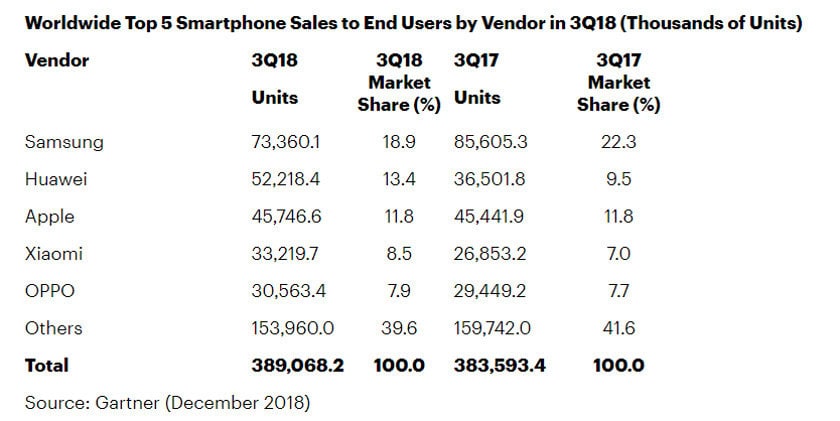
Huawei and Xiaomi were almost solely responsible for smartphone sales growing in Q3 2018, according to Gartner’s latest figures.

Gartner research director Anshul Gupta claimed that global smartphone sales would’ve been down 5.2 percent if Huawei and Xiaomi’s results were removed from the list.

The tracking firm found that Huawei firmly held on to its number two spot, hitting 13.4 percent market-share or just over 52.2 million units sold to consumers. This compared to Q3 2017’s figure of 9.5 percent market-share, or 36.5 million units sold.

Meanwhile, Xiaomi saw a more modest jump from seven percent market-share (26.85 million units sold) in Q3 2017 to 8.5 percent (33.2 million units) in Q3 2018. Fifth-placed Oppo was the only other brand in the top five to see its market-share increase, from 7.7 percent (29.4 million units sold) to 7.9 percent (30.56 million units).

Samsung took first place once again, but it suffered its biggest decline since Gartner started tracking global smartphone sales. The company went from 22.3 percent market-share (85.6 million units sold) in Q3 2017 to 18.9 percent (73.36 million units) in Q3 2018.

The pressure will be on Samsung to turn things around in 2019, as Huawei and Xiaomi eat away at its market-share. The South Korean firm is facing pressure from Huawei in particular, as the Chinese brand previously stated its intentions to grab the number one spot by Q4 2019.

Samsung has also acknowledged what it calls a “crisis” at its mobile division, but pointed to the Galaxy S10 and foldable phones as opportunities for a comeback. Nevertheless, Gartner research director Roberta Cozza reckons that the first wave of foldable phones will be expensive and have usability trade-offs.

50% of Americans Make This Mistake During the Holidays

The holidays might be a joyous time of the year, but they’re also an expensive one — so much so that more than 25% of U.S. adults have landed in holiday debt in the past. For financial reasons, a large number of Americans find this time of year overwhelmingly stressful.

The logical part of you knows that you shouldn’t let the pressure to spend extra on the holidays cause you to make poor financial decisions that haunt you in the new year. Yet 50% of U.S. adults are likely to blow their budgets to make the holidays special, according to data from Vital Smarts. Not only that, but 29% say they can’t stick to a holiday budget anyway and that they rely heavily on credit cards to get through that period.

If you’re planning to charge up a storm this holiday season in an attempt to please the important folks in your life, you’re making a mistake. And the sooner you realize it, the more likely you’ll be to take a step back and adopt a more logical approach to holiday spending.

The dangers of debt

Many people overspend on the holidays, thinking they’ll just rack up credit card balances temporarily and pay them off in the months that follow. But here’s a news flash: Paying off those bills might prove more challenging than expected. Case in point: An estimated 15% of Americans are still in the process of paying off last year’s holiday debt. And the longer you carry a balance, the more interest you’ll accrue.

Carrying debt could also hurt you in other ways — namely, by bringing down your credit score. That could be a problem if you’re planning to apply for a mortgage, an auto loan, or even a job. That’s why it’s crucial to stay out of debt in the coming weeks, even if it means having to say “no” more than you’d like.

Keeping your spending in check

Convenient as it is to shop with credit cards during the holidays (or any time of year, really), one of the easiest ways to avoid going over budget this season is to ditch the plastic and only bring cash to the stores. If you make a list of the items you’re planning to buy each time you head out and only bring enough money to cover those purchases, you’ll eliminate the option to overspend.

At the same time, think about ways you can be more frugal during the holidays to minimize your expenses. If you’re hosting a party, cooking the food you’ll be serving is a lot more economical than having that event catered. Along these lines, you can assign guests specific items to bring to avoid having to purchase all of the essentials yourself.

Gifts are a different story, but you can keep your costs down by comparison shopping before hitting stores to ensure that you’re really getting the best deal. Also, try bundling purchases to take advantage of in-store promotions and coupons. If a retailer is offering 20% off purchases of $100 or more, for example, rather than buying three $35 gifts at different stores, make all three purchases in that one location. Will that possibly mean changing course and buying something different than what you initially intended? Sure. But if it saves you money while still allowing you to be generous with a gift, so be it.

In fact, if you take the attitude that you’ll do your best this holiday season given your financial constraints, you’ll probably find that you save money by adopting a healthier attitude. It’s nice to want to make everyone happy, but you shouldn’t do so at the expense of your long-term financial well-being — because frankly, debt and stress aren’t what the holidays are supposed to be about.

How investment apps coach their customers through a volatile market

The stock market’s volatility this past week was probably easier to stomach for seasoned investors, especially those who have the luxury of calling a financial adviser for some hand-holding. But novices using low-cost micro-investment apps don’t have a reassuring human standing by to help them. So what do they get instead?

Investment apps are sending users messages telling them to stay the course, but financial advisers worry that these investors may still be inclined to make risky decisions.

The Dow Jones Industrial Average DJIA, -3.10% plunged 799 points Tuesday. And some analysts predicted that this week’s fluctuations could presage continued volatility in equities markets for weeks to come.

Amid this week’s ups and downs, investment apps like Stash and Acorns sent their users messages explaining the triggers for the market’s recent weakness and what has occurred following downturns historically.

“Recently rising bond yield and tech stocks triggered a sell-off,” Stash CEO Brandon Krieg said in an email to the app’s customers. “Although we can’t predict the future, try not to sweat the ups and downs…”

In a recent video posted to Twitter TWTR, -3.27% Acorns CEO Noah Kerner explained to users how “every downturn has ended in an upturn…the only way you lose money is if you pull your money out of the market after it’s gone down.”

The messages were clearly designed to stave off risky (and financially disadvantageous) behavior among the apps’ user bases — the sort of behavior that observers were worried about during the stock market’s correction back in February.

During that volatile period earlier this year, scores of consumers who use apps such as Stash and Acorns took to social media to lament their losses. And that’s not surprising, given that a majority of the users of these platforms are first-time investors who are only familiar with favorable market conditions.

The companies said back in February that the market’s volatility didn’t prompt a mass exodus of users or assets by any means — both Stash and Acorns said that there wasn’t any noticeable difference in terms of their buy-versus-sell flows. But financial advisers expressed concern at the time that these apps inherently could promote an active investing mentality that could be costly as the market turns bearish.

“I’ve seen it firsthand,” said Kent Schmidgall, a wealth adviser and advisory team leader with Buckingham Strategic Wealth in Burlington, Iowa. “Undisciplined investors are far more likely to attempt to time the markets during times of volatility when using an investment app, then if they used a traditional service.”

How these apps may inadvertently encourage active investing

Two of the most popular investment apps — Acorns and Stash — operate with similar models. For as little as $1 per month, users can set up accounts that will automatically invest small sums of money.

With Acorns, users’ money is invested in a highly diversified, broad portfolio comprised of exchange-traded funds across six asset classes: Real estate, large companies, small companies, government bonds, corporate bonds and emerging markets.

Stash allows for more customizing: For instance, users can choose from three mixes of investments — conservative, moderate and aggressive. Investors can also tailor their investments to specific interest, such as blue-chip stocks, tech firms or companies that support the LGBT community.

Inherent to all of these platforms is their ease of use. Getting set up is easy — as is cashing out your money. And that means users can easily make emotional decisions that will cost them. “It makes it too easy to check your investments or read about the latest shiny object,” said Joe Sallee, managing partner at Bay Capital Advisors, a wealth planning firm in Virginia Beach, Va. “This allows the user to make rash decisions based on how they feel or the latest sound bite they hear on TV.”

More assured investors might also feel emboldened to make more speculative decisions that an adviser might dissuade them from, Schmidgall said. “For first-time or undisciplined investors, using these kinds of apps during times of market crisis adds an additional layer of risk, since speculative trades can so easily be made,” he said. “Now, in a moment of passion or panic, terrible financial decisions can be executed, all while driving down the road or eating lunch at Arby’s.”

Apps focus on education — even when the market isn’t volatile

Beyond the messages they send users during volatile periods in the markets, Acorns and Stash have worked to educate their users about the stock market’s history, why the markets are volatile and how to approach investing in times like these. “We launched after the bull market started and a lot of our users only know the bull market, so we had to provide that broader context,” Jennifer Barrett, chief education officer at Acorns told MarketWatch in February after the Dow suffered its biggest point drop since 2008.

In its messages to users, Acorns linked to content from its personal-finance website Grow to educate them. The service launched a personal finance course earlier this year through Udemy and sent reassuring, informative messages to those users as well, Barrett said. The course, led by Barrett, is included in Acorn subscriptions and typically costs $75 for other consumers.

Meanwhile, Stash hosted a question-and-answer session via Facebook FB, -2.24% Live during the February correction to give users another outlet to get more information, said Ed Robinson, co-founder and president of Stash. “All the questions were about what they should be doing,” he said.

Both Stash and Acorns also make users go through an initial onboarding process to get them more familiar with how investing works. Overall, the apps hammer home messages involving similar views on investing, including the value in maintaining a diverse portfolio and the importance of a buy-and-hold approach.

Acorns users get periodic Grow newsletters and access to the aforementioned Udemy course. Customer support staff members are also well-equipped to answer questions relating to market, Barrett said. “Education is core to what we do,” Barrett said.

Stash has a feature called Stash Coach that provides ongoing guidance about investing and awards users points for following tried and tested investing rules, Robinson said.

And when a Stash user wants to sell, the app asks why. Depending on their answer, Stash will give recommendations of other investments.

For the most part, investors in these apps aren’t pouring significant amounts of money into them — the average Stash user only adds between $23 and $25 per week, Robinson said. For that reason, some advisers say it can be a great learning tool.

“These apps are a great way for first time investors to dip their toes into the investment world in a way that feels more comfortable to them,” said Grant Meyer, a wealth adviser with Fure Financial, a financial planning firm in Bloomington, Minn. “The important thing is that a person differentiates between their long-term retirement funds and some money they play around with for fun in a stock-picking app.”

Therefore, the standard advice an adviser would give a client invested in a more traditional Roth IRA applies equally well here: Users should let the dust settle before making any changes to their investments. At that point, they can choose to reassess their risk exposure — keeping in mind that the market will inevitably go up again.

During stock-market volatility, how would you invest $100,000?

After a wild on Wall Street, investors are nervous.

The Dow Jones Industrial Average DJIA, -3.10% has been on a rollercoaster ride this week, closing down 799 points Tuesday, giving investors reason to fear that the 9-year bull market, the longest since World War II, is coming to an end. Many working Americans are understandably concerned about what this means for their 401(k) accounts, but for those who have saved money as the economy has grown over the last nine years and are keen to invest their cash, it’s a particularly troubling time.

What should you do with money sitting in your bank account? Take a theoretical $100,000. How should you invest it now? “Review your portfolio to see if there are any of your assets that you should now buy more of at lower prices,” said Tim Courtney, chief investment officer of Exencial Wealth Advisors in Oklahoma City. Don’t react or act without a plan. “You should not change your current investment strategy if it was well thought out to begin with.”

Word of warning: Do not sell into a market pullback, says Greg McBride, chief financial analyst at personal-finance site Bankrate.com. “When the market pulls back sharply, it creates a buying opportunity that didn’t previously exist. Valuations become more appealing and it gives you the chance to scoop up, or add to, positions you’ve wanted to accumulate but thought the price was too high. The time to buy is when the market is on sale, not when it’s selling at full price.”

“If the bulk of your wealth is tied up in home equity, then investing in the stock market for long-term needs and cash or high quality bonds for short-term needs is entirely appropriate,” he adds. If you don’t have an adequate emergency fund to cover six months’ worth of expenses, build that before you do anything. “Don’t let short bouts of market volatility distract you from the pursuit of your financial goals,” he says. “Volatility is normal.”

The latest volatility has been attributed to a rapidly rising interest-rate environment, the corporate buyback blackout period heading into third quarter earnings, selling pressure from risk-parity funds and the tariff war with China and uncertainty surrounding the mid-term elections. “Volatility in equity markets doesn’t really disappear, it more or less goes in and out of hiding,” says Marc Dizard, investment regional manager, west region at PNC Wealth Management in Cincinnati, Ohio.

Moves of 1% up or down or not unusual in relatively quiet periods, Dizard says. What not to do is just as important as what you should do, he adds, especially if you have a six-figure sum lying around that you were keen to invest. “Do not run to put all of your cash into your favorite stock,” he says. “Do not look at this cash in isolation outside of the perspective of your entire asset base.”

Dizard says relative to bonds, equities still look attractive, but says you should ask, “What are the objectives you are solving for with your entire portfolio? Ideally, this work would have already been accomplished prior to this week’s volatility but, if not, this is a great opportunity to gain that perspective, which is likely to help with decisions like this in the future.” MarketWatch asked a range of experts how they would invest $100,000. Here’s what they said:

Seek out ‘higher quality’ dividend growth stocks

Eric Ervin, CEO of Blockforce Capital, a financial technology firm in San Diego, Calif., says given the confidence underpinning the bull market over the past eight-plus years, he expects that many investors are currently overweight in equities. As such, he says it’s a “great time” to consider alternative assets and asset classes, diversify your portfolio and reduce some exposure to equities and fixed income bucket.

Dividend growing stocks typically outperform all other categories, he says. “With price-earning ratios at historically high levels, and given the rising rate environment we’re currently in, it’s important for investors to seek out the higher-quality equity names with the best potential to continue growing their dividends,” Ervin adds, citing Divcon, Blockforce’s dividend-health rating system.

Play it safe and hold your money in cash (for now)

If and when the market undergoes a correction — which would represent a 10% decline from the Dow’s all-time high of 26,828 on Oct. 3 — Morey Stettner, a consultant, contributor to MarketWatch and author of “Skills for New Managers,” said he would invest 25% of that theoretical $100,000 in an exchange-traded fund that tracks the total market, the S&P 500 or some other diversified index — perhaps a Vanguard Total Stock Market ETF VTI, -3.27%

“I’d invest $100,000 by holding it in cash for now, such as Vanguard Federal Money Market Fund VMFXX, +0.00% which currently pays 2.03%,” he says. “With each successive 10% drop, I’d invest another 25% in the same way.” That fund invests in U.S. government securities “and seeks to provide current income and preserve shareholders’ principal investment by maintaining a share price of $1.” In other words, it’s a very conservative option.

Consider diversifying in high-quality short-term bonds

As always, make sure you have the stomach for stock-market fluctuations. “For an investment of $100,000, I would recommend the same well diversified mix of stocks and bonds across global regions and market capitalization based on a risk tolerance matched to the individual,” says Lorraine Ell, chief executive and senior financial adviser of Better Money Decisions, a financial advisory firm near Albuquerque. “This is a great time to invest.”

“Since the bond market has been more volatile than normal, make sure you are in high-quality short term bonds to counterbalance the dramatic shift in the stock market,” she says. “If you are panicking, then your risk tolerance may not be as high as you thought and this is a good time to reassess the allocation of stocks and bonds in your portfolio from an emotional perspective.” Check the expense ratios in your funds and ETFs. “High fees are a drag on performance.”

Invest your $100,000 as if Wednesday never happened

Kyle Woodley, senior investing editor at Kiplinger.com, said he would make the same decisions as he would have 48 hours ago. “Bonds are delivering almost a percentage point more income than they were a year ago, but I’m 36, I’m almost entirely in stocks, and the returns on bonds still don’t justify any shift to me. However, bonds are becoming much more enticing to any retirees who are currently shifting from wealth accumulation to wealth preservation.”

Fundamentally, not a lot has changed if you look at the Dow’s performance over the last five years. “Treasury rates are pressuring stocks some, and Barclays’ outlook on internet stocks certainly gave investors a little more pause,” he says. “But otherwise, fundamentals look great: strong economy, decades-low unemployment, lavish earnings expectations, favorable tax rate, good sentiment.” Brace yourself for more volatility, he adds.

Put most of your spare cash in the stock market

“Assuming I had no particular needs for cash flow and no goals other than maximizing a return, I would invest a minimum of $50,000 and up to $80,000 into stocks with an emphasis on assets that are trading less expensively such as U.S. value stocks and international stocks,” Courtney said. “I would keep about $20,000 in cash and short-term bonds paying about 2.5% and use these assets to buy more stocks should we experience a meaningful market pullback.”

And what would he do with the rest of that $100,000? He would look beyond equities and bonds. “That would go to buy other assets to diversify my portfolio such as real estate, MLPs, etc.,” he says. MLPS exchange-traded funds or master limited partnerships are traded on securities markets like normal stocks. Bottom line: “We always want to take into account goals and cash flows before investing,” Courtney adds.

Look into gold, real estate and other commodities

Will Rhind, the founder and chief executive officer of GraniteShares, an independent ETF issuer headquartered in New York, says real assets, like commodities — including gold, which are set for a third straight rise Thursday — and real estate, may do well in a rising interest rate environment. “Rates typically rise in the later stages of the economic cycle as monetary policy is tightened to prevent an overheating/high-inflation economy.”

Word of caution: A rising interest rate environment obviously means higher mortgage repayments. The 30-year fixed-rate mortgage averaged 4.90% in the week of Oct. 11, up from 4.71% the previous week, according to mortgage liquidity provider Freddie Mac. Many investors found more solace in the fixed-income markets after Wednesday’s sell-off, but the Dow has outperformed gold fourfold over the last 30 years.