
Archives for November 26, 2018

Family separations at border started months earlier than announced

Immigrant children housed in a tent encampment under the Trump administration’s “zero tolerance” policy are seen in June in Tornillo, Texas.

Thousands more children may have been detained, ‘60 Minutes’ finds

President Donald Trump’s policy to separate children from their migrant parents at the U.S. border began nine months earlier than the White House acknowledged and could have resulted in more families being broken up than the administration admitted, according to a report on Sunday.

The “zero tolerance” strategy that then-Attorney General Jeff Sessions announced in April actually began in the “El Paso sector” between July and November 2017, CBS News’ “60 Minutes” reported, citing government documents.

It’s unclear how many parents and children were separated during those five months, the report said.

Like the “zero tolerance” policy, which Trump ended by executive order in June, the El Paso pilot program was intended to act as a deterrent to migrant families from arriving at the border to seek asylum.

But it didn’t work as planned.

“And the reason for that is, if your child was told today by the gangs, ‘Your life is at risk unless you start running drugs for us.’ You’re thinking much more about their safety today and tomorrow than you’re thinking about, ‘What’s going to happen once we get to our destination?’” Cecilia Munoz, who worked on immigration issues in the Obama administration, told CBS.

Complicating the situation even more was that the new policy was rolled out without going through the usual review process, catching immigration officials off guard.

“Instead of patrolling and securing the border, officers had to supervise and take care of children,” said Scott Shuchart, who until recently worked at the office of civil rights at Homeland Security.

Immigration officials were caught flat-footed.

“If you’re going to separate families in the pursuit of an immigration policy – it was irresponsible to push that on top of a system that wasn’t prepared on the back end to allow the families to be reconciled later,” he said.

The White House claims that more than 2,600 children have been detained as a result of the policy, but news reports contend that more than 5,000 children have been held, CBS said.

Senior White House officials declined to comment.

Under the Trump policy announced by Sessions, prosecutors were encouraged to bring criminal charges against migrants caught illegally crossing the border.

Because the adults faced criminal charges and were placed in custody, their children could not be held with them. They were sent to foster families or placed in shelters located throughout the country.
Cyber Monday set to be biggest U.S. online shopping day in history

Be careful about buying older or discontinued smart-home device models.

The online shopping holiday is expected to generate $7.8 billion in sales this year

American consumers are about to click their way into the record books.

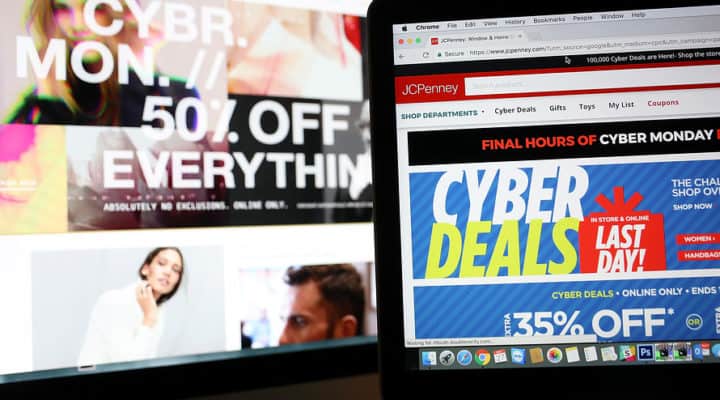
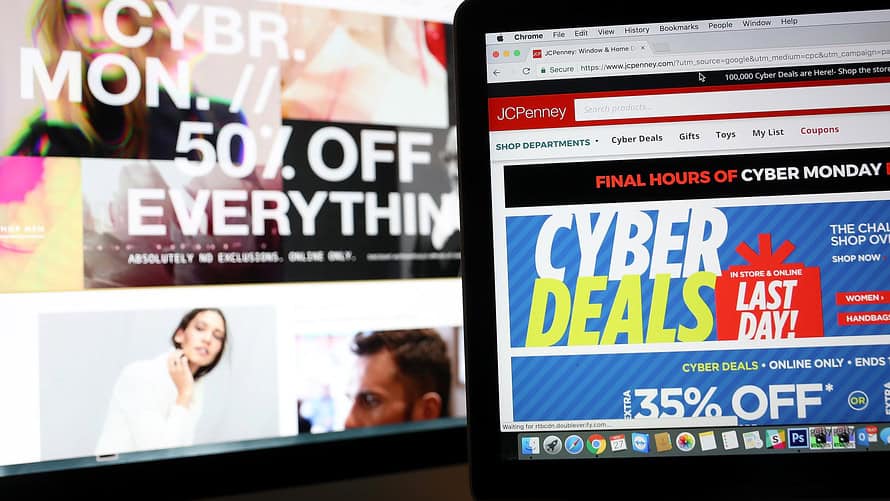
Cyber Monday is expected to generate $7.8 billion in sales, up nearly 18% on last year, which would make it the biggest online shopping day in the U.S., according to Adobe Analytics.

That’s more than the $6.2 billion in online sales for Black Friday, up nearly 24% on last year. But it still pales in comparison to China’s $30.8 billion in spending on Alibaba Singles Day last month.

Some stores started their Cyber Monday sales early. Macy’s M, +0.53% has been offering “cyber week” deals until Wednesday.

Bed, Bath & Beyond BBBY, +2.04% unveiled online discounts on Sunday and Amazon AMZN, +3.74% also let Prime members get a head start on Sunday.

Electronics tend to take the spotlight on Cyber Monday, said Sarah Hollenbeck, a shopping and retail expert at BlackFriday.com.

Stores offer better deals on laptops, desktops and gaming computers on Cyber Monday than Black Friday, and also lower prices for accessories, she said.

Some products, including smartphones, jewelry, toys, may be cheaper at other times of year (Valentine’s Day for diamonds and New Year’s Day for exercise equipment).

Experts warn against buying older or discontinued smart-home device models because they may lack customer support and security updates.

Consumer advocates also advise consumers to stick to a strict budget, avoid add-ons, and use price-comparison tools like Shopify and PriceGrabber.

To avoid retailers targeting you with products in the days and weeks after Cyber Monday, experts suggest clearing your cache.

Record holiday box office

This image released by Metro Goldwyn Mayer Pictures / Warner Bros. Pictures shows Michael B. Jordan, left, and Sylvester Stallone in a scene from “Creed II.”

Movie sequels are having their own Thanksgiving feast at the box office and fueling record industry-wide grosses for the long weekend.

“Ralph Breaks the Internet” and “Creed II” took the top two spots on the North American charts, beat the openings for the original films and helped the five-day Thanksgiving box office totals cross the $300 million mark for the first time ever.

Studios on Sunday said Disney’s “Wreck-It Ralph” sequel earned an estimated $55.7 million over the three-day weekend and $84.5 million since its Wednesday opening to take first place and become one of the biggest Thanksgiving openings of all time.

Its five-day Thanksgiving grosses are the third highest of all time, behind “Frozen” and “Hunger Games: Catching Fire.”

The film sees the return of the vocal talents of John C. Reilly and Sarah Silverman, and it scored with audiences and critics.

“We’re very thankful for this weekend,” said Cathleen Taff, who oversees Disney’s theatrical distribution. “It was a fantastic start and a great way to kick off the holiday season.”

The Rocky spinoff “Creed II,” starring Michael B. Jordan and Sylvester Stallone, placed second with $35.3 million from the weekend and $55.8 million since Wednesday, far surpassing the first film’s Thanksgiving debut in 2015. The sequel directed by Steven Caple Jr. has Jordan’s Adonis Creed fighting the son of Ivan Drago.

“This is a timeless franchise for us at MGM, and it’s a thrill to see both its legacy and new generation of audiences continue to respond to Rocky Balboa and Adonis Creed in this time when we need uplifting stories,” Jonathan Glickman, president of MGM’s Motion Picture Group, said in a statement.

Third place went to Illumination Entertainment’s “Dr. Seuss’ The Grinch,” which earned $30.2 million in its second weekend, and just barely beat out the “Fantastic Beasts” sequel, “Crimes of Grindelwald” ($29.7 million) which is also in weekend two.

Oilpatch buybacks good biz

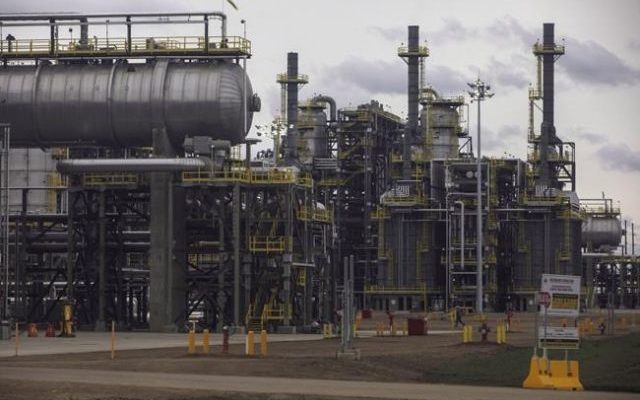
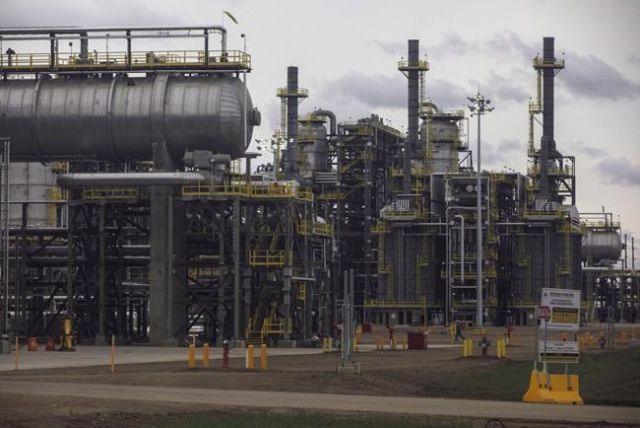
A processing unit at Suncor Fort Hills facility in Fort McMurray Alta, on Monday September 10, 2018.

Canadian oil and gas companies finding little love in the stock market are repurchasing their neglected shares, driving a rise in share buybacks that’s already reached a record high this year.

Using scarce dollars to buy your own stock instead of investing to grow the business may seem wasteful to some, but observers say it makes sense if you have money in your wallet and find your shares in the bargain bin.

“As a CEO, the way I look at it is, it’s a cyclical business. Buying back your shares when you have good cash flow and a good balance sheet, when your shares are down to really low levels, is actually good business,” said Dale Dusterhoft, CEO of Calgary-based well completion company Trican Well Service Ltd.

“But then when your multiples are up and you’re in an up cycle, using your capital to buy other things is good business as well.”

Trican bought back 9.8 million shares in October after renewing its annual buyback program. It bought the maximum allowed 10 per cent of its stock for $119 million under its 2017-18 program.

Some 627 million shares had been repurchased in 2018 for cancellation by 209 issuer companies as of mid-October, according to data provided by TMX Group, the operator of the Toronto Stock Exchange, at the request of The Canadian Press.

That’s about 135 million more shares than in all of 2017 and well ahead of the previous record high of 557 million shares in 2007, according to statistics going back to 1989.

Twenty-three Calgary-based companies involved in the upstream oil and gas sector accounted for about 184 million share buybacks this year, more than double the 76 million in 2017.

The boom in energy company share buybacks is linked to conditions in Western Canada, where a lack of pipeline capacity to carry away growing production has resulted in unprecedented discounts in oil prices versus U.S. benchmarks, said Eric Nuttall, senior portfolio manager at Toronto-based Ninepoint Partners.

“We’ve had the greatest dislocation in history between the commodity and the stocks,” he said. “Energy stocks are trading at half of their historical multiples.”

The recent decline in New York-traded West Texas Intermediate to the mid-US$50 per barrel level from peaks above US$75 in early October increases the risk of lower returns going forward and makes buybacks less appealing than simply going into “bunker mode” and preserving capital, Nuttall said.

The appeal of buybacks isn’t lost on oilsands major Canadian Natural Resources Ltd. which on Nov. 1 unveiled a new capital allocation strategy that requires half of all future cash after capital spending and dividends be spent on buybacks, with the rest to pay down debt.

It repurchased 20 million of its shares as of Sept. 30 at a cost of $874 million under a plan approved last spring to buy back up to 61 million shares over the next year.

Executive vice-chairman Steve Laut said on a conference call the “significant ramp-up” in buybacks creates “value for shareholders in current market conditions” — on Nov. 1, the company’s shares closed at $37.84, down 16 per cent from 12 months earlier.

Earlier this month, Suncor Energy Inc., Canada’s largest oil and gas company by market capitalization, said it had approval to increase its current buyback program to five per cent of its shares from three per cent.

It spent $1.98 billion to buy back 39 million shares under the program between last May and November — the increased program would cost another $1 billion if fully implemented.

In theory, reducing the number of outstanding shares in a company increases the value of the remaining shares — it should boost investor measures such as net earnings per share and production per share and therefore lead to higher market prices for each share.

That’s not how it has worked out for Trican, however.

Despite buying and cancelling 34 million shares in the 12 months ended Sept. 30, its share price lost half of its value, falling from $4.56 to $2.31.

Dusterhoft confesses to “mixed feelings” about the result but said he still believes buybacks are a strategy that will deliver good returns for shareholders in the long run.

Justices to Hear Antitrust Case Over Sale of IPhone Apps

FILE – This March 19, 2018, file photo shows Apple’s App Store app in Baltimore. Apple is at the Supreme Court to defend the way it sells apps for iPhones against claims by consumers that the company has unfairly monopolized the market. The justices are hearing arguments Monday, Nov. 26, in Apple’s effort to end an antitrust lawsuit that could force the iPhone maker to cut the 30 percent commission it charges software developers whose apps are sold exclusively through Apple’s App Store.

Apple is at the Supreme Court to defend the way it sells apps for iPhones against claims by consumers that the company has unfairly monopolized the market.

WASHINGTON — Apple is at the Supreme Court to defend the way it sells apps for iPhones against claims by consumers that the company has unfairly monopolized the market.

The justices are hearing arguments Monday in Apple’s effort to end an antitrust lawsuit that could force the iPhone maker to cut the 30 percent commission it charges software developers whose apps are sold exclusively through Apple’s App Store. A judge could triple the compensation to consumers under antitrust law if Apple ultimately loses the lawsuit.

Apple says it doesn’t own the apps or sell them. That’s the responsibility of software developers.

But the lawsuit says the Cupertino, California-based company exerts a lot of control over the process, including a requirement that prices end in .99. And iPhone apps are only available through the App Store.

The issue for the Supreme Court is whether Apple can even be sued about the apps, given prior high court rulings in antitrust cases. In other cases, the justices have said there must be a direct relationship between the seller and a party complaining about unfair, anticompetitive pricing.

Consumers can choose from among more than 2 million apps, up from the 500 apps that were available when Apple created the App Store in 2008. “The phrase ‘there’s an app for that’ is now part of the popular lexicon,” Chief Justice John Roberts noted in a 2014 decision limiting warrantless searches of cellphones by police. Apple has trademarked the phrase.

But the company says the popularity of software for iPhones and its App Store shouldn’t obscure that consumers buys apps from developers, not Apple.

“Apple is a sales and distribution agent for developers,” Apple’s lawyers said in a Supreme Court filing. “Apple’s core argument has always been that any injury to consumers necessarily depends on developer pass-through decisions, since Apple does not set apps prices.”

Apple takes a 30 percent commission on the sale of apps, but it says any complaints about its pricing structure should come from developers, not consumers, since it’s the developers who pay the commission. The Trump administration is backing Apple at the high court.

A trial court initially dismissed the lawsuit, but the 9th U.S. Circuit Court of Appeals revived it.

Lawyers for the consumers urged the high court to allow the lawsuit to proceed. Consumers “pay the monopoly prices for apps directly to Apple through its App Store,” the lawyers wrote in their Supreme Court brief. That direct relationship makes Apple the proper target of an antitrust lawsuit, they said.

A victory for Apple could severely restrict consumers’ ability to sue over antitrust violations even though Congress envisioned such lawsuits “would form a central component of enforcement of the antitrust laws,” warned 18 scholars of antitrust law in a Supreme Court filing.

A decision in Apple Inc. v Pepper, 17-204, is expected by late spring.

Air Canada to buy Aeroplan

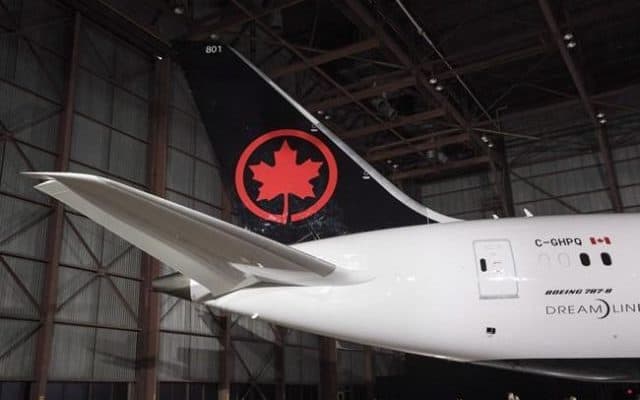
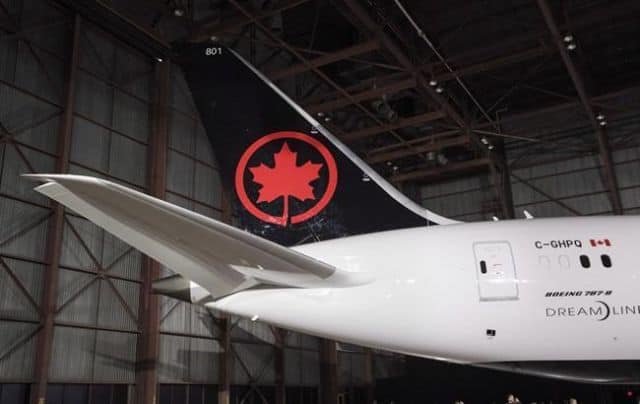
The tail of the newly revealed Air Canada Boeing 787-8 Dreamliner aircraft is seen at a hangar at the Toronto Pearson International Airport in Mississauga, Ont.

Air Canada has signed a definitive agreement to buy the Aeroplan loyalty program from Aimia Inc. for $450 million in cash.

Under the deal, Air Canada will also assume $1.9 billion of Aeroplan miles liability. The definitive agreement follows an announcement in August of a tentative sale.

Air Canada says it has also signed agreements with TD Bank, CIBC and Visa that will see them continue to be part of the Aeroplan loyalty program.

Under its deal, TD will pay Air Canada $622 million plus an additional $308 million that will be applied to future purchases of loyalty points.

CIBC will pay $200 million to Air Canada, plus an additional $92 million that will be applied to future monthly payments for Aeroplan miles. Visa will also be making a payment to Air Canada.

The airline says it is still in talks with American Express, which also issues Aeroplan co-branded cards, to secure its continued participation.