Archives for October 17, 2018

The Midwest economy is about to get pummeled again

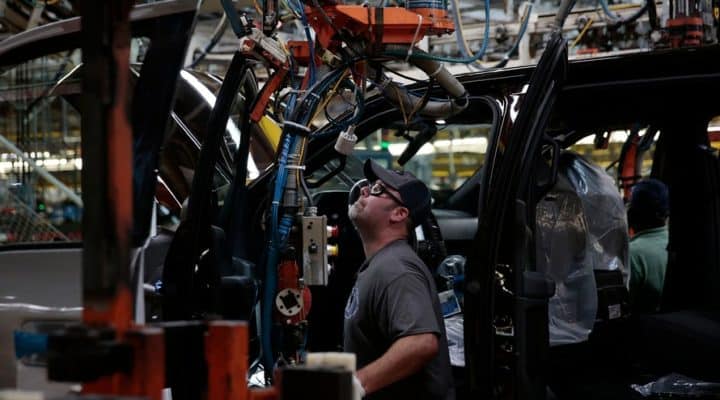
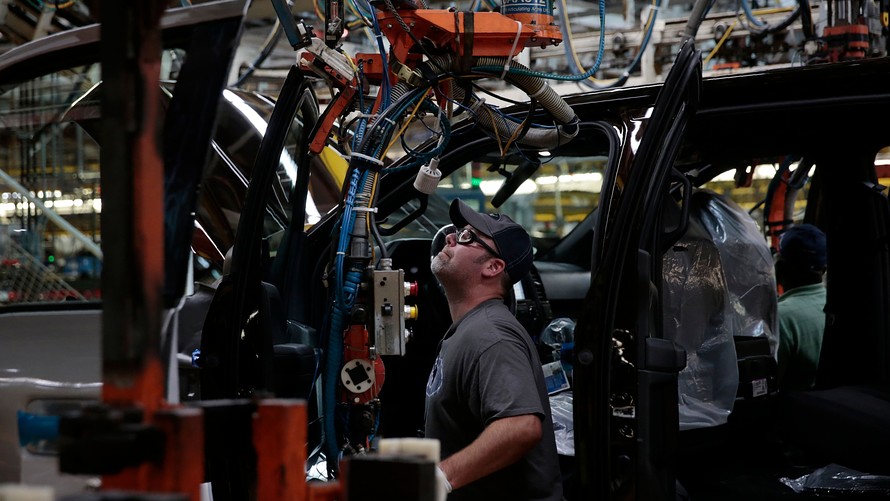
An employee on the assembly line at the Ford Motor Co.’s Rouge Complex in Dearborn, Mich.

Manufacturing jobs growth has already stalled, and the trade war will make it worse

Over the summer, Indiana’s economy showed clear signs of weakening. This same story played out across the manufacturing and farming-intensive states of the Midwest.

To be sure, it is still easy to paint a rosy picture of our economy. Jobs are plentiful, pay has finally begun to rise and tax coffers are full. We are less than a year away from tying the longest recovery in U.S. history. Still, the warning signs are clear.

Nationally, manufacturing employment growth has slowed since April, and here in Indiana, it dipped into negative territory for two consecutive months. The index of leading economic indicators declined modestly since spring, and auto sales dropped sharply across spring and summer. The manufacturing portions of the Fed’s Midwest economic index have been negative for four months.

It’s risky to draw conclusions from a single six-month period, but growing evidence suggests manufacturing growth stalled over the summer. There’s more.

This is a stunningly beautiful season in the Midwest, when combines harvesting soybeans fill the fields on warm October days. Driving by these fields, I often wonder what majesty and dignity a modern Winslow Homer might portray in this setting. However, even in these idyllic scenes, all is not good. Most of these fields contain crops that will be harvested at a painful loss. Prices are down, and that fact is revealed in the slowing purchases of farm machinery across the Midwest.

Hoosiers should view the marked slowdown of our two largest industries with alarm. That the cause of this slowdown is clearly our widening trade war, which should provide even more reason for worry. To be clear, the worst is yet to come as both tariffs and their lagging effects will plague us well into 2019.

What is worse is that this is bad medicine treating the wrong problem. Let me explain.

Over the past 50 years, American jobs have steadily moved away from factories, mimicking the shift from farm to factory in the 50 years before that. The cause of each phenomenon was largely the same: technology, automation and the associated productivity growth meant we needed fewer workers to produce even more goods.

Naturally, these changes, like those before them, disrupted households. But, the problem was never the economic restructuring or technology. Economic change is a three-century-old force across western civilization. Most people and places didn’t merely adapt, they thrived. Sadly, many places in the Midwest have neither adapted nor thrived.

The causal factor in the decline of many Midwest places was simply dogged, stubborn, almost prideful ignorance about century-long changes to the world economy.

The Rust Belt is full of households and communities who ignored decades-old trends. Peak manufacturing employment in the Midwest is nearly five decades behind us, when Chinese and Mexican exports were trivial. Yet, far too many communities continued to pursue “jobs attraction” policies that failed them since the 1960s. This was costly, in both dollars and common sense. The wholly unrealistic promise of “new factory jobs” eased the pressure on schools and families to improve the education of their children, and invited mis-spending of tax dollars.

There is no easy way to phrase the truth, so let me say it plainly. The causal factor in the decline of many Midwest places was simply dogged, stubborn, almost prideful ignorance about century-long changes to the world economy. Not only has this saddled communities with decades of mis-investment, it has mistakenly convinced millions of Midwesterners that factory jobs may once again be plentiful. They won’t; even as manufacturing production will continue to expand, employment will not.

Into this landscape of false promises, came the 2016 election. The main players, Donald Trump, Bernie Sanders and Hillary Clinton, spoke easily about the evils of trade, wholly misrepresenting facts. To their credit, the remaining GOP candidates did not. And, in an underappreciated farewell speech, President Obama made it quite plain “. . . the next wave of economic dislocation won’t come from overseas. It will come from the relentless pace of automation that makes many good, middle-class jobs obsolete.” Like him or not, that statement is as true and obvious as the rising sun.

Even as manufacturing production will continue to expand, employment will not.

Ignoring almost the whole of those truths, today we pursue a trade war. We impose tariffs without thought, and invite retaliatory tariffs by allies and foes alike. By mid-winter, our tariffs on major trading partners will approach those set during the fiasco of protectionism that marked the Great Depression. This will undo 75 years of American efforts to reduce barriers to trade across the world. It will also pummel the Midwest, early and hard.

It is ironic that the very places that ignored the economic changes of the past half-century will be the first to feel the spreading pain of this bad medicine. It is fitting, of course, but ironic nonetheless. The only good option is to claim victory and end the trade war before it claims more victims. As we are slow to learn, that is unlikely to happen. Far more likely is a recession in which millions of Americans come to understand the value of free trade the hard way.


Gold slips from multimonth high as dollar index firms

Stock weakness limits gold’s downside ahead of latest Fed snapshot

Gold futures pulled back slightly Wednesday from a finish a day earlier at the highest since July, with the precious metal nicked by a firmer dollar but supported by stock-market uneasiness.

The typically “haven” gold market so far showed little reaction to news that Russian anti-terrorism experts are investigating a blast at a school cafeteria in Crimea early Wednesday, reported to have killed at least 10 people and injured another 50, the Wall Street Journal reported. Gold has been slightly underpinned as global markets take in the handling of U.S. and Saudi Arabian relations after the disappearance and alleged murder of a journalist at the Saudi consulate in Istanbul.

December gold GCZ8, +0.11% fell $1.90, or 0.2%, at $1,229.10 an ounce. The contract settled at $1,231, the highest since July 31 according to FactSet data, a day earlier. Gold is up 2.8% so far for October, trimming its year-to-date drop to close to 6%, based on the most-active contracts. December silver futures SIZ8, +0.27% were little moved at $14.695 an ounce.

Stocks and gold have been volatile amid mounting concerns over rising Treasury rates TMUBMUSD10Y, -0.39% A rapid climb in rates also has coincided with weakness in the U.S. dollar and gold tends to gain when the dollar is weaker because the assets become comparatively more attractive to buyers using other monetary units. One popular measure of the buck, the ICE U.S. Dollar Index DXY, +0.22% was up 0.3% at 95.40 Wednesday and remains just in the red for the month of October so far. Stock futures pointed to early weakness after the battered market’s biggest one-day gain since March on Tuesday.

Recent dollar sluggishness has defied the stronger trend that has persisted in the buck in the year so far, a rise fueled by monetary policy tightening at the Federal Reserve. The popular U.S. index is up 3.1% so far in 2018, according to FactSet. The Fed has hiked interest rates three times this year and may do so a fourth time before year-end, which could provide some resistance to gold bulls because rising rates are likely to juice the dollar and make risk-free government bonds a more attractive investment when compared against bullion.

The latest clues on interest rates will come with the release of minutes from the Federal Open Market Committee’s September rate-setting meeting Wednesday afternoon, although after the gold market’s close.

Health tax moves ahead

The B.C. government is pressing ahead with its plan to eliminate Medical Services Plan premiums and replace them with an employer health tax.

The Employer Health Tax Act, which sets a tax of 1.95 per cent on the payroll of businesses with payrolls over $500,000, was introduced in the legislature Tuesday and would take effect on Jan. 1.

The government says in a news release that fewer than five per cent of businesses in B.C. will pay the full tax, overall it will cuts taxes for people and businesses by about $800 million annually and save $50 million in administration costs.

It says the majority of small businesses will be protected by the $500,000 exemption that phases out gradually, while the payrolls of charities and non-profits will be shielded through a $1.5-million exemption.

Critics of the tax say it simply transfers medical premiums to small businesses and municipalities that will have no choice but to pass costs on to consumers

Finance Minister Carole James says the new levy is similar to those in other provinces, helps lower taxes for B.C. residents and is a fairer approach.

Uber could be worth $120B

Uber may put forth an initial public offering early next year that values the ride-hailing business at as much as $120 billion, according to a media report.

The Wall Street Journal said Tuesday that Uber Technologies Inc. received valuation proposals from Goldman Sachs and Morgan Stanley. There is no guarantee Uber will fetch that valuation, or go public soon.

If it does, and at that price, the company would be worth more than Ford Motor Co., General Motors Co. and Fiat Chrysler Automobiles combined.

There are hurdles for Uber, past and present. In addition to a series of scandals including workplace sexual harassment, theft of intellectual property and the ouster of its co-founder, the company is facing increasing competition.

Bombardier on track

Bombardier Inc. announced Tuesday it is on track to meet its target for business aircraft deliveries for the year, as a lengthening order backlog points to growing demand for long-range planes.

In the third quarter, the Montreal-based company delivered 31 business jets, bringing the total to 96 so far in 2018, in line with analyst expectations.

Bombardier delivered four Learjets, 20 Challengers and seven Global aircraft during the three months ended Sept. 30.

The delivery target for 2018 is 135 business jets — the same goal as last year, which the company wound up exceeding by five planes.

Bombardier’s order backlog edged up to $14.3 billion, a 1.4 per cent increase from the second quarter of 2018 and a 3.6 per cent rise over the past nine months.

Analyst Walter Spracklin of RBC Dominion Securities Inc. said confirmation of the jet deliveries was a “positive,” though one that was expected and “incrementally positive” for shares.

It comes shortly after the plane-and-train maker confirmed its delivery schedule for the Global 7500, Bombardier’s longest-range aircraft, which is set to enter service later this year.

Transport Canada certified the jetliner last month, marking a key milestone in the transportation giant’s turnaround plan after it sold a majority share of its C Series commercial jet program to Airbus in July.

The company is aiming for US$8.5 billion in annual revenues by 2020 driven largely by Global series sales, a major bump from last year’s US$5 billion, Spracklin said.

The new Global 7500, which can fly from Toronto to Hong Kong, is sold out through 2021, noted AltaCorp Capital analyst Chris Murray, though Bombardier has not revealed the number of orders.

The delivery update Tuesday came one day after the company said flight testing for its Global 5500 and Global 6500 business jet program was 70 per cent complete, keeping it on track for delivery in 2019.

The Global 7500, along with the new Global 5500 and 6500, come partly as a response to products from rival business jet manufacturer Gulfstream Aerospace as demand for the jetliners gains elevation, Cormark Securities analyst David Tyerman said last month.

Zillow coming to Canada

U.S. real estate website Zillow is expanding to offer listings for homes in Canada for sale.

Zillow says it has agreements to receive more than 50,000 listings from Canadian brokerages and franchisors.

Users will be able to use the popular U.S. site and mobile app to search for Canadian for-sale properties by postal code, city or province.

The Canadian listings will display the home’s list price, a description of the property, photos and available home facts.

The listings will also include the listing agent’s contact information as well as link to the brokerage or franchise website.