
Archives for October 2, 2018

What Happened in the Stock Market Today


A trade deal with Canada and Mexico lifted stocks, while shares of General Electric and Tesla rose on news about their leaders.

Stocks opened higher on news that the U.S., Mexico, and Canada have reached an agreement on trade. Major benchmarks drifted lower during the day but still finished with gains. The Dow Jones Industrial Average (DJINDICES:^DJI) and the S&P 500 (SNPINDEX:^GSPC) were up but closed below record highs.

Today’s stock market

A 3% jump in crude oil prices propelled energy stocks; the Energy Select Sector SPDR ETF (NYSEMKT:XLE) closed up 1.4%. Biotech stocks fell, sending the SPDR S&P Pharmaceuticals ETF (NYSEMKT:XPH) down 3.4%.

News about the CEOs of two closely watched companies sent their stocks higher today. General Electric Company (NYSE:GE) is changing CEOs, and Tesla’s (NASDAQ:TSLA) isn’t going anywhere.

Time’s up for GE’s CEO
General Electric surprised the market by firing CEO John Flannery after only 14 months on the job, and investors applauded the news, pushing up the stock 7.1%. By unanimous vote, GE’s board named Lawrence Culp, former CEO of Danaher Corp., as Flannery’s successor as CEO and chairman, effective immediately. The board also named Thomas Horton, former CEO of American Airlines, as lead director. Both men were added to GE’s board in April.

GE also revealed that its troubled GE Power unit is performing even worse that previously expected, and as a result, the company will fall short of its full-year guidance for EPS of $1.00 to $1.07 and free cash flow of $6 billion. GE Power will also take an non-cash impairment charge of most of the $23 billion of goodwill on its books, wiping away the lingering reminder of some disastrous acquisitions.

Culp said in the press release:

“GE remains a fundamentally strong company with great businesses and tremendous talent. It is a privilege to be asked to lead this iconic company. We will be working very hard in the coming weeks to drive superior execution, and we will move with urgency.”

Urgency is clearly something investors felt was lacking during Flannery’s brief reign. Flannery was essentially asking investors for patience with a multiyear turnaround, but it’s clear from the stock’s 50% plunge during his tenure and the board’s action today that his approach just wasn’t cutting it.

Musk settles with the SEC, will stay on as CEO
After Tesla’s stock was pounded Friday on news that the Securities and Exchange Commission was suing CEO Elon Musk for fraud, reports over the weekend that Musk reversed himself and settled the lawsuit sent the stock back up 17.4%, recovering the ground it lost and more. The SEC announced that Musk agreed to a deal that was not quite as good as the one reportedly offered last Thursday, with the unpredictable entrepreneur remaining as CEO and as a board member, but agreeing to step down as the company’s chairman for three years and paying a fine of $20 million.

This week the SEC also charged Tesla with failing to have required disclosure controls and procedures relating to Musk’s communication, and the company agreed to settle as well. Tesla will add two new independent board members, put in place controls on Musk’s communication, and pay a $20 million fine. The $40 million in penalties will be distributed to shareholders that were harmed, under a court-approved process.

The fines amount to no more than a slap on the wrist for Musk and the company, but the fact that Musk will remain in Tesla’s leadership with a muzzle on his Twitter account could represent a nice win for the company’s shareholders. With the going-private distraction apparently out of the way, investor attention can now turn to Tesla’s Q3 production and delivery numbers, which could be coming out as early as tomorrow.


Why New Age Beverages Corp. Spiked Again Today


Shares of the niche drink maker rose again in anticipation of its CBD-based beverage launch.

What happened
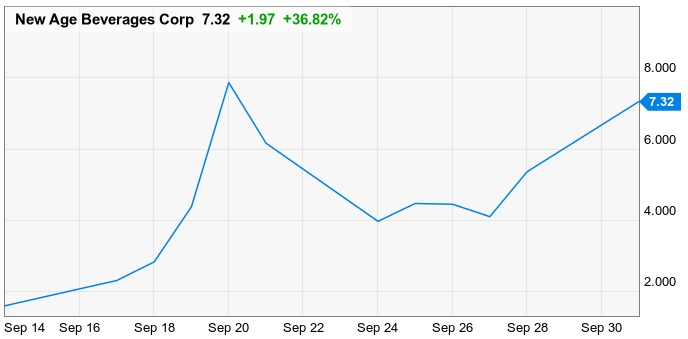
Shares of New Age Beverages Corp. (NASDAQ:NBEV) were soaring again today as excitement over marijuana stocks continues to bubble over. Though there was no specific news out on New Age Beverages, shares rose in tandem with those of the high-flying Canadian marijuana grower Tilray (NASDAQ:TLRY), which was also up double digits today. New Age stock had gained 36.2% as of 11:04 a.m. EDT.

So what
Shares of New Age, which makes beverages like kombucha, iced tea, and energy drinks, have been highly volatile for the last two weeks after rumors broke that the company was preparing to launch a cannabidiol- (CBD-) infused line of beverages. The company confirmed those reports later that week, saying it would launch the new product line at the North American Convenience Store show in Las Vegas next week.

As a result, New Age stock has rocketed back and forth, as the chart below shows, reaching an intraday trading high of $9.99 on September 21.

After coming back down, shares are now moving higher again, as the stock has become popular with day traders as anticipation for the CBD beverage launch next week seems to be building.

Stocks like New Age Beverages and Tilray might be moving higher in part due to short squeezes, as New Age Beverages has a low float, with only 29 million shares available to the trading public, and volatile marijuana stocks like these have attracted short-sellers. Before noon today, already 41 million shares had been traded, indicating heavy day-trading activity.

Now what
There is plenty of evidence that marijuana stocks are in a bubble, but there’s also a justification for New Age’s rally. Coca-Cola has expressed interest in cannabis-based beverages, meaning New Age could be an acquisition target, especially if its new CBD beverage line is successful. Also, several other beverage companies, including Constellation Brands and Molson Coors, have forged alliances with marijuana growers, indicating significant opportunity in marijuana beverages.

With New Age’s CBD beverage launch set for next week and Canadian legalization of recreational marijuana scheduled for Oct. 17, expect continued volatility in New Age shares.

What GE’s Surprise CEO Swap Means for Investors

John Flannery is out and Larry Culp is in. Here’s why that may not be the silver bullet for the industrial giant’s underperformance.

Well, that was fast.

Pulling its own version of an “October surprise,” industrial behemoth General Electric (NYSE:GE) announced on the first of the month that it was immediately replacing CEO John Flannery — who had been on the job for just over a year — with board member H. Lawrence Culp, Jr., former CEO of fellow industrial conglomerate Danaher.

Here’s why the board lost confidence in Flannery, what it may be hoping to gain by hiring Culp, and what it’s likely to mean for investors.

The fall(en) guy
GE was already in trouble when Flannery took the helm in August 2017. Thanks to underperformance in its flagship power segment, an oil and gas segment that had been decimated by the oil price slump, and widespread dissatisfaction with then-CEO Jeff Immelt’s leadership, the company’s stock price had fallen from above $30 per share to the mid-$20s.

Sometimes, the stock market is willing to give the new guy a break. (For example, this morning when GE announced that Flannery was out and Culp was in, GE’s shares rose nearly 13%.) For Flannery, there was no such honeymoon, as investors concerned about a potential dividend cut continued to exit the stock.

Flannery did his best with a weak hand, setting in motion radical changes to GE’s operations. He did end up cutting the dividend in an attempt to shore up GE’s ailing finances. He also pulled the plug on Immelt’s digital program, and set in motion plans to sell GE’s low-margin consumer lighting business as well as spin off its troubled oil and gas business and its solid healthcare business. He intended to continue to cut back on GE’s corporate costs to free up resources for its remaining power and aviation businesses.

But new and unexpected problems continued to crop up, including the discovery that Immelt’s 2018 guidance had been overly rosy, a previously unforeseen insurance charge for GE Capital, and a shutdown-causing failure of one of its HA power turbines that raised further concerns about the power unit.

Although Flannery made big changes — and it takes time to turn a massive ship like GE — they apparently weren’t happening fast enough for GE’s board, which unanimously voted for his ouster. Ultimately, Flannery may have been a victim of poor timing more than anything else. He took the helm as GE was on the way down, and encountered several unpleasant surprises during his year at the top, finally exiting as some analysts said GE had likely hit bottom and could be a buy.

Lucky Larry
If Flannery is a victim of the poor timing that has plagued GE for years, new CEO H. Lawrence Culp is likely to be the beneficiary. A lot of the unpleasant work — including a major dividend cut and multiple rounds of lowered guidance — came during Flannery’s brief tenure. So, what is the board anticipating from Culp?

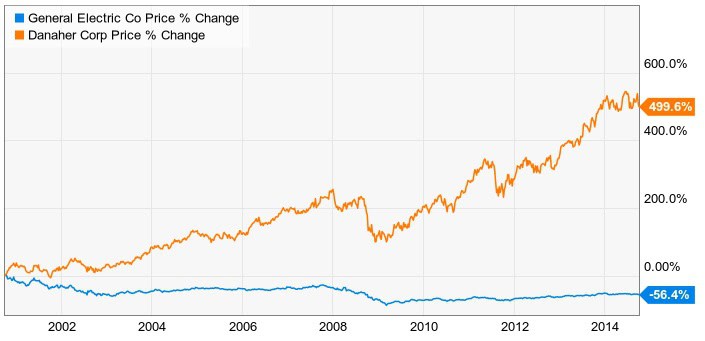
Well, they’re hoping for a repeat performance of Culp’s tenure at Danaher, certainly. As CEO of Danaher from 2000 to 2014, Culp was highly successful, as the stock chart of both companies from this period shows:

Danaher’s shares soared by 500% while GE’s sank more than 50%. Since then, Danaher’s shares have continued to rise while GE’s have fallen further.

In a press release, GE was effusive in its praise for Culp:

During his tenure he led the highly successful transformation of [Danaher] from an industrial manufacturer into a leading science and technology company. Under Mr. Culp’s leadership, Danaher executed a disciplined capital allocation approach, including a series of strategic acquisitions and dispositions, a focus on investing for high-impact organic growth and margin expansion, and delivering strong free cash flow to drive long-term shareholder value. During his 14 years at the head of Danaher, the company’s market capitalization and revenues grew five-fold.

But perhaps the biggest point in Culp’s favor is that he’s a GE outsider. He only joined GE’s board in April 2018 as part of a major board shakeup. Of the new members, he was hailed by analysts as a particularly good choice given his background. After a pair of GE insiders — Immelt and Flannery — failed to deliver the performance investors were demanding, it’s logical that the board would try an outsider in the role.

Moving forward
So, now what?

Well, we don’t really know what Culp’s plans are: Will he continue the operational streamlining (read: business sales and spinoffs) begun by Flannery, or even accelerate it? During his tenure at Danaher, the company completed many acquisitions, so Culp may decide to go that route instead. All we have to go on for now is the anodyne statement he made in a press release:

GE remains a fundamentally strong company with great businesses and tremendous talent. It is a privilege to be asked to lead this iconic company. We will be working very hard in the coming weeks to drive superior execution, and we will move with urgency. We remain committed to strengthening the balance sheet including deleveraging. Tom [Horton, former chairman of American Airlines, who was just named GE’s lead director] and I will work with our board colleagues on opportunities for continued board renewal. We have a lot of work ahead of us to unlock the value of GE. I am excited to get to work.

This statement seems to be sending the message to investors that there are no sacred cows, and that radical change is a distinct possibility. This is exactly what investors want to hear. Of course, for GE, radical change has already been underway for years. It just hasn’t panned out as hoped. So, perhaps Culp’s biggest asset is that he isn’t Flannery (just like Flannery’s biggest asset may have been that he wasn’t Immelt).

Big changes ahead?
Culp has signaled a desire to make big changes to GE, and investors have already responded by bidding up shares. His successful tenure as longtime CEO of another industrial conglomerate makes him an attractive choice to lead GE out of the wilderness. But the same fundamentals that crippled Flannery — a sagging power unit, complex corporate structure, and balance sheet concerns — won’t vanish just because a new guy’s in the corner office. In particular, I want to hear details from Culp about how he will turn around — or cut loose — the power unit before I make a further investment.

Like everyone else, I’ll be watching and waiting to see what Culp’s ultimate strategy is. Until then, though, GE remains a troubled company with a tough road ahead, and no clear path to outperformance. This could be a turning point for GE… or it could be August 2017 all over again.

3 Beaten-Up Stocks That Could Bounce Back in Q4

The market has had a modest move up this year, but not every stock is drifting higher. There are plenty of stocks that haven’t participated in the rally, and dozens that have actually seen their values cut by more than half in 2018.

Lumber Liquidators (NYSE:LL), Camping World Holdings (NYSE:CWH), and Sohu.com (NASDAQ:SOHU) have taken a beating this year. They’re among the biggest losers through the first three quarters of 2018. Let’s go over why I think they have a shot at bouncing back in the next three months.

Lumber Liquidators: Down 51%
The retailer of hardwood and other flooring solutions just hasn’t been the same since a scathing 60 Minutes report called out the toxicity of some of its China-sourced laminates in early 2015. It finally seemed to be turning things around last year. The stock nearly doubled in 2017 as it settled painlessly with the California Air Resources Board and the U.S. Consumer Product Safety Commission over the allegations. Sales moved higher after back-to-back years of declines.

The good times didn’t last. Lumber Liquidators has given up all of last year’s gains in 2018. Sales continue to move in the right direction, and comps were positive in its latest quarter. The sticking point for investors has been margins. The company fell well short of Wall Street profit targets in the first two quarters of this year, and analysts see the margin pressure continuing in the near term.

There is still time to get things right. The housing industry is still strong and the economic means to spruce up a home’s flooring are still in play. Wedbush analyst Seth Basham even noted last month that Lumber Liquidators has the best upside potential among the five home improvement retailers he covers following Hurricane Florence, in light of the spike in demand for flooring following the storm’s massive flooding.

Camping World: Down 52%
Selling RVs in a country where retirees are living longer and hungry to explore blue highways seems like a slam dunk. Having a business celebrity as your CEO is icing on the cake. Camping World went public at $22 two years ago, more than doubling by the end of 2017. It’s now back below its IPO price.

Camping World is holding up better than one would expect. Revenue and adjusted earnings rose in the low double digits in its latest quarter. Consolidating the highly fragmented RV retail market is helping boost Camping World’s profile, but investors were more concerned about shrinking EBITDA and folks spending less on RVs. The market still hasn’t been won over by its move earlier this year to acquire outdoors retailer Gander Mountain. The integration hasn’t been as seamless as it’s been for purchases of mom-and-pop RV sellers. However, making a bigger bet on outdoor gear makes sense. It will pay off sooner rather than later, and the sell-off this year is overdone.

Sohu.com: Down 54%
Chinese stocks have taken a beating in recent months, but there aren’t many that have shed more than half their value, the way that Sohu has in 2018. The provider of online advertising, search, and gaming in the world’s most populous nation is trading at 12-year lows.

Slowing growth is a problem. Revenue rose 5% in its latest quarter, clocking in at the low end of its earlier guidance. A juicy 45% increase in search revenue was almost canceled out by double-digit-percentage declines in gaming and brand advertising.

Investors have grown tired of Sohu’s continuing quarterly deficits, and taking its gaming and (more recently) search segments public is just making it easier for investors to pick the parts of the company that they want to ride. The real dagger last time out was guidance implying that revenue will decline in the third quarter based on the midpoint of its forecast.

Chinese growth stocks have corrected sharply, only to bounce back even higher. Sohu has a few problems that are unique to its business, but it’s a much larger and relevant company now than it was in early 2006 — the last time that its share price was in the teens.