Archives for May 28, 2018

Better Buy: Walmart vs. Target

The retailing world is going through a dramatic shift as customers move their spending toward online sales channels. But the recent results from major companies have shown that physical stores still have a big role to play in the market.

Sure, e-commerce will likely keep climbing from its current position of accounting for 10% of total retailing sales (up from 4% a decade ago). But that doesn’t mean sellers like Walmart (NYSE: WMT) and Target (NYSE: TGT) can’t succeed in the new multichannel selling environment.

With that bigger picture in mind, let’s stack the two retailing giants against each other as stock investments.

Sales and profits

Both companies have been enjoying steadily improving sales results that have mainly come at the expense of profitability. In its most recent quarter, Target logged its best quarterly traffic rate in a decade, which allowed comparable-store sales, or sales at existing locations, to rise 3% and nearly match the stellar rate it managed in the previous quarter. Likewise, Walmart notched its best sales growth performance in eight years at the end of 2017 and followed that up with a solid start to fiscal 2018 as comps improved by 2.1%.

Profits are a different story. Walmart’s operating income dipped last quarter, just as it has for more than a year. And Target is on track for a second straight year of declining profitability, too.
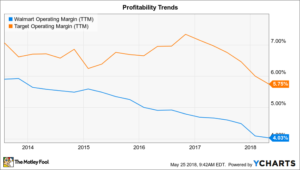
Both retailers are keeping their prices low in a bid to protect customer traffic trends. At the same time, they’re ramping up spending on digital sales, which in most cases are occurring at lower profit margins. These trends, plus rising costs on wages and store remodels, are likely to continue pressuring profitability for both Target and Walmart.

Why Walmart looks stronger over the long term

Target’s business seems more attractive than Walmart’s in a few keys ways. It’s growing faster, for one, and it sports a higher profit margin thanks to the fact that its portfolio tilts more toward products like apparel and home goods while Walmart’s focuses on consumer staples like groceries.

A woman choosing between two detergents.

Target also pays a dividend that’s about a full percentage point above Walmart’s 2.4%. Finally, the stock is valued at a discount at 13 times expected earnings compared to 16 times for its larger rival.

However, there are good reasons for investors to have assigned that premium to Walmart. As a truly global retailer, it is far more diversified than Target, which failed in its last attempt to expand into Canada. Walmart’s $28 billion of annual operating cash flow, meanwhile, isn’t far from Target’s entire market capitalization. And that financial strength gives it the resources to make big bets on future growth. These include acquisitions like its $16 billion purchase of India-based Flipkart and the aggressive push it’s making into a grocery delivery service in the U.S.

In my view, that flexibility helps make Walmart stock a better long-term bet today. For an era that’s likely to pair more industry pressure with plenty of opportunities for growth, I’d rather own the industry leader than its smaller peer. Yes, shares are pricier, but Walmart has a clearer track toward consistent earnings growth after transitioning into a multi-channel retailer.

3 Things to Watch in the Stock Market This Week

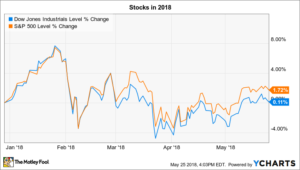
Stocks inched higher last week, with both the S&P 500 and the Dow Jones Industrial Average rising by less than 0.5% as some of the nation’s biggest retailers announced positive first-quarter earnings results. The indexes are just slightly higher so far for the year with about seven months to go in 2018.

^DJI data by YCharts

The week ahead includes earnings reports from a few more major retailers, including Costco (NASDAQ: COST), Ulta Beauty (NASDAQ: ULTA), and lululemon athletica (NASDAQ: LULU). Below, we’ll preview these highly anticipated announcements.

Costco’s membership fees

Costco will announce its fiscal third-quarter results after the market closes on Thursday. So far, this has been an excellent year for the warehouse retailing giant. Sales jumped 7% over the last six months, which translated into significant market-share gains as rivals like Walmart have been growing at closer to 3%.

A shopper pushing a cart walks through a warehouse aisle.

Walmart and other major retailers including Home Depot announced a slight slowdown for the first-quarter period, but Costco apparently bucked that trend. The company announced in early May that April’s sales growth held steady at a healthy 7% rate.

There will still be plenty for investors to digest in Thursday’s report, though, including profitability, along with updates on Costco’s e-commerce business, membership sales pace, and subscriber renewal rates. Given the retailer’s apparent success at packing its stores with customers this year, the outlook is bright for each of these important metrics.

Lululemon’s profitability

Lululemon’s shares have trounced the market so far this year as investors gained faith in its operating rebound. The yoga clothing specialist soared past management’s targets over the key holiday shopping season thanks to the combination of a modest customer traffic boost and a 44% spike in e-commerce sales that, together, sent revenue up 11% in the period.

In contrast to many other brick-and-mortar retailers who are transitioning toward digital sales, Lululemon’s profits aren’t being pinched by this e-commerce shift. Instead, gross profit margin rose by 2 percentage points last quarter to pass 53% of sales for the full year. Operating margin hit a new high of 27.6% of sales, too.

The retailer is going through major changes in its executive ranks, with CEO Laurent Potdevin having abruptly stepped down in early February 2018 and a new CFO joining in late April. Details on that transition will capture most of investors’ attention this week, but shareholders are likely to give Lululemon plenty of room to determine its next strategic steps as long as sales and profits keep marching higher.

Ulta Beauty’s 2018 outlook

Investors initially punished Ulta Beauty’s stock after the beauty retailer warned in March that 2018 profitability won’t be quite as high as management had hoped. But shares have rebounded nicely since then and are beating the market heading into the company’s first-quarter report on Thursday.

Key metrics to watch will include customer traffic, which expanded at a strong 6% pace last quarter, and e-commerce sales, which spiked by 50% over the holidays. Investors will be looking for those gains to continue, but they’ll mostly be focused on management’s reading of the core makeup segment, whose slowdown has caused sales growth to decelerate for three consecutive quarters.

CEO Mary Dillon and her team have found ways to keep revenue churning higher with help from a popular loyalty program and exclusive product offerings in stores. Yet they’ve had to engage in more price promotions to keep inventory moving in a weakening sales environment. We’ll find out on Thursday whether those price cuts were still required at the start of Ulta Beauty’s fiscal 2018.

3 Stocks Cashing in on Fortnite Fever

For the uninitiated, the battle royale genre, originally popularized by PlayerUnknown’s Battlegrounds (PUBG), are video games in which up to 100 players do battle in an effort to be the last person standing, similar to the plot of the 2012 hit movie Hunger Games. When Epic Games released Fortnite last year, the title had mostly positive reviews, but it wasn’t until the free-to-play battle royale was introduced several months later that the game really took off.

The surge in popularity of the battle royale genre has created an opportunity for investors to benefit from the craze. Here’s why I believe NVIDIA Corporation (NASDAQ: NVDA), Tencent Holdings (NASDAQOTH: TCEHY), and Activision Blizzard (NASDAQ: ATVI) are best positioned to profit from this growing trend.

A screenshot of the video game Fortnite, with an avatar alone in a field.

The processor that makes it all possible

NVIDIA may not immediately come to mind as a beneficiary of the Fortnite phenomenon, but the company gains from any increased adoption of gaming, particularly those that call for its industry-leading graphics processing unit (GPU).

In its most recent quarter, NVIDIA’s gaming segment grew 66% year over year, making up 54% of the company’s $3.2 billion in revenue. Responding to questions about what drove the surprisingly strong performance, NVIDIA’s founder and CEO Jen-Hsun Huang credited the growing adoption of the battle royale genre:

As you probably know, Fortnite and PUBG are global phenomena. The success of Fortnite and PUBG are just beyond comprehension, really. Those two games are a combination of Hunger Games and Survivor has just captured imaginations of gamers all over the world. And we saw the uptick and we saw the demand on our GPUs from all over the world.

Huang expects the combination of pent-up demand and new players joining the ranks will continue to invigorate sales.

Brother, can you spare a dime?

China’s Tencent may very well be the biggest social media and gaming company you’ve never heard of, sporting a market cap of nearly $500 billion. Its social messaging service, WeChat, has more than a billion users and mobile gaming is an integral part of the experience. In its most recent quarter, Tencent grew revenue 48% year over year to about $11.7 billion, while profits jumped 61% to about $3.7 billion.

So how does Tencent stand to gain from the fervor over Fortnite? Simple — the company owns a 40% stake in Fortnite creator Epic Games, and has developed and recently debuted two similar games in China based on licensed IP from PUBG. Tencent is also seeking government approval to release Fortnite to Chinese gamers.

Since there’s no cost for the free-to-play version, Epic Games makes money from the sale of virtual items, such as character costumes and emotes — emoticons that are used by gamers to express a thought or feeling. Add in the merchandising, and some analysts suggest that Fortnite could generate as much as $2 billion in revenue this year.

A scene from Call of Duty: Black Ops 4 featuring Ajax avatar.

They nearly had a Blackout

Video game publisher Activision Blizzard (NASDAQ: ATVI) is known primarily for its megahit World of Warcraft, but the company actually boasts eight $1 billion franchises in its stable of popular games, including such hits as Overwatch, Call of Duty, and Candy Crush. In its most recent quarter, the company reported record first-quarter revenue, net bookings, and earnings per share of $1.96 billion, $1.38 billion, and $0.65, respectively.

The company just announced plans to capitalize on the Fortnite frenzy by adding a battle royale mode — called Blackout — to Call of Duty: Black Ops 4, which is scheduled to debut in October. In a press release, Activision said: “Blackout, where the Black Ops universe comes to life in a massive battle royale experience featuring iconic characters and locations from all four Black Ops games in a one-of-a-kind offering that is uniquely Black Ops.”

Activision is one of the first major game publishers to announce a battle royale mode for an existing franchise. While there is no way to know for sure how this strategy will play out, the company could be enticing new players to Call of Duty, while providing incentives for current gamers to stay.

The small print

It’s important to note that investors shouldn’t buy any stock based on its exposure to the battle royale genre. While there is strong demand now, it may turn out to be a fad — does Pokemon Go ring any bells? On the other hand, it could be the next Minecraft. While each of these companies will benefit from the popularity of Fortnite and other last-person-standing games, they also have existing businesses with strong growth, and any benefit derived from this emerging trend, however long- or short-lived, is just a bonus.

Could Skyworks Solutions Be a Millionaire-Maker Stock?

Best known for supplying connectivity chips for smartphones, Skyworks Solutions (NASDAQ: SWKS) has been leveraging its success into new markets. However, even after doubling many times over in the last decade, the stock could still have plenty left in the tank to make investors money.

What is Skyworks Solutions?
Though making chips for various smartphone manufacturers like Apple is still Skyworks’ bread-and-butter, the world is quickly moving to a new mobile era where everything is connected to the internet. That is creating widespread demand for the company’s connectivity chips and helping it find new sales outlets beyond phones.

An artist’s illustration of the Internet of Things, various common devices and objects getting connected to the internet.

For example, during the last earnings call, management mentioned several new deals that helped propel growth. Skyworks partnered with a leading auto manufacturer to connect its global fleet to the internet. Production was increased for Alphabet’s Nest connected security cameras, as well as for other smart home “mesh network” devices that don’t need a central hub for connectivity. Skyworks also provided parts for upcoming high-end all-in-one notebooks.

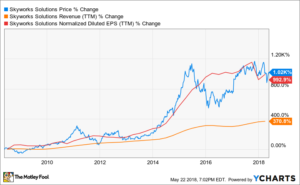
All of that led to year-over-year revenue growth of 7%. That’s a slowdown from times past, and that has led to earnings per share contracting 28% so far during the current fiscal year. Part of that is due to increased research and development expense, as well as some one-time tax expenses related to U.S. corporate tax reform passed at the end of 2017. On an adjusted basis, earnings are up 19% for the fiscal year.

Data by YCharts.

Why is now the right time for the stock?

Skyworks expansion into new markets could be just beginning. In the U.S. and other developed countries, 4G mobile networks are old news, but for a large portion of the world 4G hasn’t yet arrived. Skyworks continues to develop technology to get emerging markets caught up to the latest in mobile capabilities, providing a solid foundation for its smartphone business.

In addition to that, 2018 will go down as the year that 5G networks arrived. The next-gen mobile platform is faster, has lower latency, and thus will help power the billions of devices that are expected to get hooked up to the internet over the next decade. To that end, Skyworks recently unveiled its Sky5 line of products enabling 5G connections.

Management has been positive in its outlook, but it backed that up with a new $1 billion share repurchase plan through January 2020. That’s a big number considering Skyworks’ entire current market cap is $18 billion and nicely complements the current dividend yield of 1.3%. Share repurchase plans are another way to return extra cash the business generates to shareholders, but it’s also a vote of confidence from management that its own stock is a good use of money.

It is worth noting that, due to the smartphone industry slowing and worries over a protracted trade war between the U.S. and China, revenues are expected to come in slightly down to flat in the next quarter. However, sales growth is expected to pick up once again late in 2018, and earnings are expected to continue climbing even during the sales slowdown due to better profit margins on products, a lower tax rate, and that previously mentioned share repurchase plan.

Though Skyworks has already provided huge returns to early buyers of the stock, there is potential for new owners to be richly rewarded. The chipmaker is still relatively small, and the fast-growing number of connected things around the world is helping diversify revenue beyond just smartphones. The stock looks like its worth owning for the long term.

A Swiss weedkiller robot could curb our dependence on herbicides

It takes a lot of work to keep produce aisles stocked in grocery stores — there’s the planting, tending, picking, and shipping. And even though most of these tasks rely on human labor, farms are becoming increasingly automated.

Researchers at the University of Illinois have developed a Roomba-like robot that can tend to crops autonomously. At Carnegie Mellon, they’re building a suite of A.I. and drones to take on some of agriculture’s most demanding tasks. And just last year, a team of automated machines farmed an acre and a half of barley, from planting to harvesting, without a single human setting foot on the field.

A Swiss company called ecoRobotix recently unveiled its contribution to automated agriculture — a robotic weed-killing machine. The four-wheeled robot doesn’t look like much more than a mobile table top, but Reuters reports that the unassuming machine may reshape the way we approach agriculture.

Some $26 billion is spent on herbicides each year. These chemicals are often indiscriminately sprayed over entire fields of crops that have been genetically modified to resist the chemical onslaught. And it’s agrochemical giants like Bayer, DowDuPont, and Syngenta that usually create both the genetically modified seeds and the chemicals that are sprayed on them.

The ecoRobotix weeder could undercut the agrochemical complex by spraying herbicides more precisely. Powered by a series of solar panels, the robot coasts across the field, using GPS to navigate. A camera extends up from the robot like a long neck, using computer vision sensors to search the ground ahead and distinguish weeds from crops. On its underside, two spider-like arms spray microdoses of herbicide wherever necessary.

At under 300 pounds, the machine has a much smaller footprint than typical farm equipment. It can run autonomously for 12 hours and be also be configured and controlled manually via a smartphone. The company claims a team of its machines can use up to 20 times less herbicide than conventional spraying systems.

The swiss company isn’t alone in its precision spraying approach. A Silicon Valley startup called Blue River develops a device that use sensors to identify weeds and apply efficient amount of herbicides as it’s pulled behind a tractor. The green and yellow farm equipment giant John Deere acquired Blue River last year for $305 million.

Army builds robot attack tanks and ground war drones

File photo – Troopers with the U.S. Army 2nd Armored Brigade Combat Team, 3rd Infantry Division fire the main gun round at a target during unit gunnery practice with newly acquired M1A1-SA Abrams tanks at Fort Stewart, Georgia, U.S. March 29, 2018. Picture taken March 29, 2018. (U.S. Army/Handout via REUTERS)

The Army is engineering high-tech autonomy kits designed to give “robot” tanks and other armored combat vehicles an ability to operate with little or no human intervention, bringing new tactical and operational dimensions to the future of ground combat.

Unmanned systems, utilized in a fast-evolving, high-threat ground combat operation, could enable robot vehicles to carry supplies, test enemy defenses and even fire weapons – all while manned vehicles operate at a safer distance.

“A kit of hardware and software can be installed into different ground platforms to increase the level of autonomy,” Osie David, Chief Engineer for Mission Command, Communications-Electronics Research, Development and Engineering Center, told Warrior Maven in an interview.

The technology kits, which can integrate on a small unmanned ground vehicle or a wide range of larger combat vehicles, use emerging computer algorithms, on-board processing and artificial intelligence to gather and organize sensor information.

“Ground combat autonomy is the hardest level of autonomy possible. You are talking about shifting terrain and changing enemy movements,” Maj. Gen. John Ferrari, Director, Program Analysis and Evaluation, Office of the Deputy Chief of Staff, G-8, told Warrior Maven in an interview.

Robot vehicles, often referred to by Army weapons developers in the context of “manned-unmanned” teaming, are a fast-growing element of the developmental calculus when it comes to future combat platforms.

Having unmanned assets operating in tandem with manned assets in combat introduces a range of new tactics available to commanders. If robot “scout” vehicles could operate in a forward position to identify enemy threats or test defenses, manned tanks might be able to operate at lighter weights, making them faster and more maneuverable in combat.

In fact, senior Army weapons developers have told Warrior Maven that virtually all future combat vehicles now in development will likely be engineered with various new levels of autonomy.

Using things like embedded infrared optical payloads, unmanned vehicles can use machine-learning technology to process key combat details, independently organize them and then send information to a human in the role of command and control, David explained.

AI enables computers to instantly draw upon vast data-bases with millions of pieces of information to perform real-time data analytics before sending useful information to combat commanders.

The advantage is that combatant commanders can quickly receive integrated intelligence or sensor information from a range of sources, analyzed and condensed to enable faster decision-making.

“Instead of sending bits of information back up to a command post, the autonomy kits can enable sensors to perform detection and object identification in real time…and then push that information up to a human,” David said.

Also, advanced integrated sensors, fortified by AI and greater levels of autonomy, can connect aerial and ground assets to one another – to ID and hand off-targets, send real-time video of nearby enemy activity or pass other intelligence data to vehicle crews.

It is certainly within the realm of the technically feasible for a future tank to simultaneously control a small fleet of unmanned robotic “wing man” vehicles designed to penetrate enemy lines while minimizing risk to soldiers, transport ammunition or perform long-range reconnaissance and scout missions.

In fact, Army modernization strategy documents specifically cite autonomy enabled platforms, speed and maneuverability as fundamental to future armored warfare.

“As the armored BCT fields new systems, it will replace main battle tanks, howitzers, and mortar indirect fire platforms. Far-term initiatives aim to solve the absence of the armored BCT’s ability to deploy rapidly. The Army assesses the feasibility and application of autonomous or semi-autonomous sub-systems, manned and unmanned teaming, and autonomy enabled combat platforms,” the Army documents read.

CERDEC and other Army entities are working on these projects with the Army’s Tank Automotive Research, Development and Engineering Center to prototype, test and advance these technologies. The current effort is an extension, or next-generation iteration, of a previous TARDEC effort described as “leader-follower” algorithms. This technology, evolved and successfully tested in recent years, enables an unmanned tactical truck or vehicle to precisely follow a manned vehicle in front of it.

The concept with “leader-follower” algorithms is to free up vehicle crew members such that they can focus on other pressing, threat-conscious tasks without needing to expend all their energy navigating the vehicle. These newer kits, however, bring the concept of autonomy to an entirely new level, enabling unmanned systems to maneuver quickly in response to fast-changing ground combat circumstances – without needing human intervention.

The current “autonomy kits” effort is a new Army program, slated to gain traction and begin testing this year, Army developers said.

“TARDEC will decide which platforms are used. Some sort of tank is being evaluated, as well as smaller platforms,” David explained.

David explained that the autonomy kits are now being worked on for the Army’s Next-Generation Combat Vehicle program – a future combat vehicle effort planning to engineer new platforms for the 2030s and beyond.

“We are closely tied with them (NGCV program) and we are looking to see how we can insert this kit onto these future platforms,” he explained.

The kits are also being engineered to help ensure that combat vehicles can continue to function in the event that GPS communications are jammed or destroyed by enemy forces. Gyroscopes and accelerometers, for instance, can help ground forces navigate in the absence of GPS, David explained.

“These technologies are focused on how you actually navigate and detect your position in a GPS denied environment where there is challenging terrain or an enemy is jamming you,” he said.

This article originally appeared on Warrior Maven.