Archives for May 9, 2018

Better Buy: International Business Machines (IBM) vs. Oracle (ORCL)

The technology industry has changed dramatically over the decades, but many giants from previous eras are still around, playing important roles. International Business Machines (NYSE: IBM) and Oracle (NYSE: ORCL) have both had to take critical looks at their businesses to identify new areas into which they could successfully expand, or else run the risk of becoming obsolete.

From an investment standpoint, IBM has struggled for years, while Oracle has shown clearer signs of having successfully evolved toward a more sustainable business model. Yet the question for investors is which of these tech veterans makes the better stock buy today. Comparing them on some common metrics, and considering the potential rewards each could reap from a full turnaround, should shed some light on which deserves a more prominent place in your portfolio.

White coffee mug with blue IBM logo on it under an espresso machine.

Stock performance and valuation

Neither IBM nor Oracle has delivered a particularly impressive performance for shareholders in the past 12 months. Oracle’s stock price is just above the break-even mark, and that’s quite a bit better than the nearly 8% dip IBM shares have taken over the same time frame.

When it comes to earnings-based measures, investors need to avoid giving companies too much credit or blame for year-over-year performance shifts currently. Most companies’ fiscal stats have been dramatically impacted by the changes to tax laws that took effect at the beginning of 2018. One the one hand, the benefits of lower corporate taxes rates are creating a host of artificially enhanced comparisons; on the other, large one-time tax bills on years of foreign earnings that are now being repatriated (at a low 15.5% rate) are skewing some multinational players’ numbers to look worse than they otherwise would.

IBM’s current price/earnings ratio of 23 compares favorably to Oracle’s ratio of more than 50. But when you look at forward earnings projections rather than trailing P/E, the comparison gets better — and closer. IBM’s valuation still looks cheaper at 10 times forward earnings, but Oracle’s ratio of less than 14 is also attractive relative to the broader stock market.

Dividends

Tech stocks aren’t generally known for their dividends, but IBM and Oracle both pay their shareholders well. That said, IBM’s yield of about 3.6% is more than double the 1.7% that Oracle stock yields right now.

IBM has also done a better job than Oracle of delivering consistent dividend growth over the long run. For 23 straight years, Big Blue has boosted its payout annually, most recently with a 5% boost this month. Oracle’s streak of nine years of dividend increases is more modest, but it’s been more aggressive lately, with a 27% payout boost last spring.

Growth prospects and risks

Both companies are working hard to keep up with the rapid pace of innovation in technology. For years, IBM’s year-over-year sales declined quarter after quarter; only recently has it managed to reverse the trend and push revenue higher. Big Blue’s aggressive moves into the areas it has determined will be its “strategic imperatives” — among them, cloud computing, data analytics, quantum computing, and artificial intelligence — have had a degree of success. The company has also seen good results from its latest efforts to develop blockchain technology, as well as addressing the growing need for cybersecurity products and services. Yet some revenue gains have come from the release of a newly updated mainframe system. After this upgrade cycle peaks, IBM could once again face some of the same pressures that have dragged its top line down in the past.

Oracle, meanwhile, has done a better job of reorienting its business to the cloud, but the fiscal third-quarter results it reported in March revealed that strategy has its limits.

The Q3 numbers showed that the software company’s efforts to compete with some of the strongest players in cloud-computing services had mixed success. Its new cloud infrastructure and autonomous database products helped promote solid growth for the division. Yet Oracle said its revenue will rise only because of favorable currency impacts in 2018 — it projects adjusted sales will land in a range from flat to down 2% for the year. Investors were particularly unhappy about the company’s much slower cloud revenue growth, as it suggests that this highest-growth segment of Oracle’s business could stall out.

While it faces similar growth challenges, IBM’s lower valuation and higher dividend make it a better pick right now. Nevertheless, both of these companies face major hurdles that will require decisive action to overcome, if they hope to recover some of their former glory.
Has Monster Beverage’s Recovery Fizzled?

Monster Beverage (NASDAQ: MNST) has been one of the most successful stocks of the past 20 years. Yet that comes as little consolation for those who’ve bought shares of the energy-drink giant over the past three years, as the company has struggled to get itself back on its former growth trajectory. Now that health-conscious consumers have mixed feelings about energy drinks in general, Monster has had to pivot to stay in touch with its customers’ preferences, and after a good year in 2017, shareholders have seen recent gains slip away.

Coming into Tuesday’s first-quarter financial report, Monster Beverage investors were at least hoping to see a pick-up in growth rates from what had been a discouraging fourth quarter of 2017. Monster’s results did show some signs of recovery, but they still fell short of what its most ardent supporters wanted to see. Without even better performance during the rest of 2018, investors could start to doubt whether Monster Beverage has the ability to mount a full recovery from its malaise.

Word Mutant with stylized letter M beneath.

How Monster Beverage fared

Monster Beverage’s first-quarter results didn’t have a lot of surprises in either direction. Net sales rose nearly 15% to $850.9 million, and that growth rate roughly doubled from what it posted in the fourth quarter. Net income climbed 21% to $216.1 million, and that resulted in earnings of $0.38 per share. That was $0.01 less than the consensus forecast among those following the stock.

There were big disparities across Monster’s different lines of business. The core Monster Energy drinks division was the strongest in the company, with sales climbing nearly 17% from year-ago levels. By contrast, the strategic brands division — consisting of beverages Monster took control of as part of its strategic alignment with Coca-Cola (NYSE: KO) — saw a 3% sales decrease. Some of that downward shift stemmed from changes in accounting rules, but even if you adjust for that impact, sales growth was much weaker there than for Monster’s legacy brands. The catch-all other segment, which includes the American Fruits & Flavors business, saw revenue slide 16%.

Other fundamental metrics were mixed. International growth came to 27%, accounting for about half of Monster’s overall revenue increase for the period. Gross margin took a four percentage point hit on the heels of higher promotional allowances to Monster’s partners, as well as sales mix and accounting issues. Yet the beverage giant managed to keep many costs in check, especially general overhead expenses. Case volumes rose 15% to 92.3 million cases, and per-case sales fell only a fraction of a percent to $9.17 per case.

What’s next for Monster Beverage?

CEO Rodney Sacks kept his eyes on his company’s long-term efforts. “We continued to progress our strategic alignment with the Coca-Cola system bottlers,” Sacks said, taking almost the identical sentence from last quarter’s report and switching the word order.

Yet the CEO did go into detail about the moves that have already happened and those yet to come. In the first quarter, the state of Minnesota completed the switch, and the company launched Monster Energy in Argentina and a key market in India thanks to Coca-Cola bottlers there. In the coming months, Monster expects to roll out launches in Uruguay and several Middle Eastern and African countries, along with a transition within the Ecuadorian market.

Monster’s stock buyback efforts also continued. The company spent $250 million on repurchasing 4.3 million shares of stock, paying an average of almost $58 per share. That’s quite a bit higher than the $53 per share that the stock fetched immediately before the earnings report, but Monster now has a new $250 million program that it can use for future buybacks.

Monster Beverage shareholders weren’t happy with the company’s results, and the stock dropped 6% in after-hours trading following the announcement. Some acceleration in growth was good to see, but Monster will have to redouble its efforts to fully satisfy those who’ve been waiting for a new wave of growth similar to what the beverage company enjoyed earlier in its history.

Why BJ’s Restaurants Inc. Stock Jumped 24% Last Month

What happened

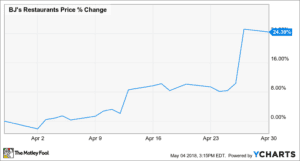
Shares of BJ’s Restaurants Inc. (NASDAQ: BJRI) were flying higher last month after a strong first-quarter earnings report gave the stock a boost. According to data from S&P Global Market Intelligence, shares finished April 24% higher.

As you can see from the chart below, the bulk of the stock’s gains came on April 27.

BJRI data by YCharts.

So what

Shares of the casual-dining chain jumped 13.4% after it beat estimates in it first-quarter earnings report and posted solid numbers across the board.

Five beers in BJ’s beer lineup.

After comparable sales had fallen in five of the last six quarters, the key metric surged this time around as same-store sales were up 4.2%. Guest traffic only increased 0.4%, but management said an improvement in sales mix, with the help of higher-priced menu items from its new slow-roasted menu, helped drive the increase in comps

Overall revenue increased 8%, to $278.5 million, beating estimates at $274.5 million. Earnings, meanwhile, benefited from lower commodity food costs, as well as the increase in comparable sales, and adjusted earnings per share increased from $0.42 to $0.67 with the help of the new tax law, easily topping expectations at $0.53.

CEO Greg Trojan said the company’s strong performance was “led by our slow roast menu items, Daily Brewhouse Specials, our handheld server tablets and investments in our off-premise channels.”

Now what

Shares of BJ’s approached an all-time high as investor enthusiasm for the stock returned following a sustained lull in its performance. Shares dipped slightly in the first week of May, but management seemed optimistic about the rest of the year. Trojan said that middle-income consumers were visiting its restaurants more and spending more, and delivery continues to lift revenue, as off-premise sales were up 30% in the quarter.

While the company didn’t give specific guidance, investors should expect momentum to continue into the upcoming quarters. Considering BJ’s still anticipates doubling its store base over the long term, the stock has plenty of room to run.

3 Potential Oil Stock Winners After Trump Plans to Impose “Powerful” Sanctions on Iran

In a classic case of “buy the rumor and sell the news,” oil prices gave back some of their recent gains on Tuesday, falling about 2.4% after President Trump officially announced his decision to pull the U.S. out of the Iran nuclear agreement while imposing “powerful” sanctions on the country. However, crude prices had risen steadily in advance of that announcement, recently topping $70 a barrel in the U.S. under the assumption that Iranian oil exports will decline as a result of the president’s actions. Because of that, they could resume that rally as more details emerge on the extent of the sanctions.

As things stand right now, analysts anticipate that at least some Iranian oil will come off the market as a result of the sanctions. That lost output would further tighten an oil market that suddenly has little margin for error thanks to red-hot demand and tame supply growth. That’s the recipe for higher oil prices and could make top-tier U.S. oil stocks Anadarko Petroleum (NYSE: APC), Devon Energy (NYSE: DVN), and ConocoPhillips (NYSE: COP) big winners in the coming years.

An oil pump at dusk.

Getting ready for the gusher

On one hand, Anadarko, Devon Energy, and ConocoPhillips don’t need higher oil prices to thrive. In fact, all three spent the past few years repositioning their businesses so they can prosper at $50 a barrel. At that price point, each one can generate the cash they need to grow oil production and cash flow at a more than double-digit compound annual rate over the next three years.

However, the upside of their ability to thrive at $50 oil is that they stand to reap a windfall with crude in the $70s. In Anadarko Petroleum’s case, it’s on pace to produce $3 billion to $4 billion in excess cash over the next three years, and that’s assuming $60 oil. Devon Energy, meanwhile, could generate more than $2.5 billion in free cash over that same timeframe, again at just $60 oil. ConocoPhillips, likewise, will cash in above $50 a barrel.

Sending back the bounty

Because of that, these oil companies are already making plans to send a large portion of this money back to shareholders. All three increased their dividends this year — including a stunning 400% increase from Anadarko — as well as plans to repurchase shares. Anadarko and ConocoPhillips started buying back stock last year after selling assets. However, both recently boosted their buyback plans by $500 million for 2018 because oil prices are above their $50 baseline level. Devon Energy, meanwhile, recently authorized a $1 billion buyback. All three will likely buy back even more shares if oil remains above $50 a barrel.

These increasing cash returns have already started paying dividends for investors as shares of both ConocoPhillips and Anadarko are up 20% since the start of the year. However, even with those big gains, these oil stocks remain undervalued given the cash their businesses can generate in the coming years at current oil prices, suggesting much more upside from here.

A powerful combination

Because Anadarko, ConocoPhillips, and Devon reset their businesses to run on $50 oil, they’ll produce a gusher of excess cash at current prices and even more if Trump’s sanctions cause crude to continue rising. With all three planning to return the bulk of that windfall to investors, they could be among the biggest winners from Trump’s decision to pull out of the Iran deal, making them ideal oil stocks to consider buying now.

Yukon College students will be part of a real space mission

Students will design and launch a small cube satellite, with help from the Canadian Space Agency

An example of a cube satellite, or ‘CubeSat.’ Yukon College is still in the planning stages of what its CubeSat will accomplish in space. (NASA)

Yukon College students will be teaming up with students from Aurora College in Inuvik and the University of Alberta to design, build and operate a miniature satellite.

The school is one of 15 colleges and universities selected by the Canadian Space Agency to participate in its “CubeSat” project. The agency has awarded a $250,000 grant for the “YukonSat” project.

“We will be starting from scratch, right from the design process, in collaboration with our partners,” said Alison Anderson, project lead for Yukon College.

The satellite will be about the size of a loaf of bread and will orbit the earth for nine months, starting in 2020 or 2021.

“We got a lot of pitches from different teams around the country to build these tiny satellites,” said Canadian astronaut Jenni Sidey, who is with the Canadian Space Agency.

“They are just larger than a Rubik’s Cube — about 10 centimetres cubed — and on it you can put any kind of instrumentation or whatever you want.”

The cube satellites, or CubeSats as they’re called, are commonly used in low earth orbit for remote sensing or communications.

Sidey says for the participants in the project, it could launch an entire career.

“That’s what we are really hoping for — is that beyond this, these projects and satellites themselves, that we are just getting people involved,” she said.

Anderson says Yukon College is still in the planning stages of what its CubeSat will accomplish in space.

The 15 grants awarded by the Canadian Space Agency range from $200,000 to $250,000. Other northern recipients include Aurora College, and Nunavut Arctic College in collaboration with Western University in Ontario.

A ‘cooler space than your normal playground’ is sliding into CityPlace in 2019, councillor says

Toronto’s 2nd indoor playground will be designed by the Ontario Science Centre with kids in mind

An indoor playground in the new Canoe Landing Community Recreation Centre will be designed by the Ontario Science Centre. (ZAS Architects)

In a city starved for indoor play areas for children during Toronto’s harsh winters, a new recreation area planned for the downtown area boasts a “cooler space than your normal playground,” a city councillor says.

The indoor playground will be built as part of a new community centre in CityPlace, with completion scheduled for fall 2019.

Joe Cressy, whose ward includes CityPlace, announced Tuesday the Ontario Science Centre has signed on to help design the indoor playground in the Canoe Landing Community Recreation Centre.

“It’s all about encouraging learning as part of play,” Cressy said of the playground’s potential use of light, colours, bugs and even a possible rainforest.

CityPlace is home to some 20,000 residents in 24 high-rise towers. Many have been forced to wait years for these promised amenities.

Plans for a community centre, two schools (one public, one Catholic), two child-care facilities with 52 spots, two large parks and a library were finalized in the 1990s.

“One of the things we hear a lot in downtown Toronto, if you’re living in a condo, the community centre becomes your playground, just like the park becomes your backyard,” Coun. Joe Cressy told CBC Radio’s Here and Now.

“We currently don’t have adequate park space or community facilities to service that growing population.”

This 160,000-square-foot structure in CityPlace will contain the new Canoe Landing Community Recreation Centre, a public and Catholic elementary school, and a child-care centre. (ZAS Architects + Interiors)

Work on an empty lot that remained vacant for decades has begun.

The indoor playground will be 15,000 square-feet and designed for children aged 12 and under.

Cressy said the space will be “more creative and more self-directed” because of the science centre’s input.

He is hopeful the indoor playground will make the city’s downtown area more “livable” for young families who have been priced out of Toronto’s steep real estate market.

“It’s about designing play spaces that are more than just places for kids to have fun, but also spaces for kids to explore their creativity, to learn while they’re playing,” said Cressy.