Archives for April 10, 2018

1 Reason to Buy Himax Technologies Stock, and 1 Reason to Stay Away

Himax Technologies (NASDAQ: HIMX) hasn’t recovered from the beating that it took late last year after a negative research report from short-seller Citron Research. The chipmaker’s fiscal fourth-quarter results haven’t helped matters, either, as the weakness in Chinese smartphone demand weighed on its finances and guidance.

In all, there’s a lot of negativity around Himax that’s led to some investors selling their positions in recent months. While there’s still one very good reason to consider Himax despite its recent troubles, investors may want to take a wait-and-see approach.

The case for Himax

Himax has been betting big on the demand for 3D sensing chips in smartphones. In February, the company announced its 3D sensing chip solution — SLiM — for Android smartphones that will allow OEMs (original equipment manufacturers) to enable facial recognition and possibly other augmented reality (AR) solutions in the future.

Himax has developed SLiM in association with Qualcomm as a part of a partnership that was struck in August last year. Himax’s new solution is all set to hit the market, with an initial production capacity of two million units a month, and is expected to be deployed by several Tier 1 smartphones OEMs in the first half of 2018 itself.

Himax claims that it has the “best performing 3D sensing and face recognition” solution for Android smartphones at present. This claim isn’t outrageous since the company has already supplied its 3D sensing solution to enable the Face ID feature in Apple’s iPhone X. As a result, Himax’s smartphone revenue had shot up 30% sequentially during the third quarter that ended in September last year.

Himax is now looking beyond the premium end of the smartphone market as far as 3D sensing is concerned. The company is developing a low-cost alternative to enable facial recognition and other 3D features in mass-market Android smartphones, and it expects to start shipping this product by the end of the current fiscal year.

The adoption of facial recognition technology in mass market smartphones will be a boon for the industry. TrendForce estimates that sales of 3D sensing modules will grow from just $1.5 billion last year to $14 billion in 2020. Himax is well-placed to make the most of this opportunity thanks to its relationship with Apple and its moves into the Android market with Qualcomm.

The case against Himax

The problem with Himax is that it has a history of failing to deliver on their claims. The chipmaker was expected to win big from Alphabet’s now discontinued Google Glass project, but it never materialized. Next, Himax made a lot of noise about augmented reality and expected Microsoft’s HoloLens to bring some dough.

But AR technology has so far failed to take off as expected, and Himax has ended up paying the price. As it turns out, Himax is still feeling the effects of its failed AR venture in the form of the phasing out of some old customer programs that have been hurting its top line in recent quarters. Additionally, Himax management accepted on the latest earnings call that it has failed to convert some of its design wins into actual contracts.

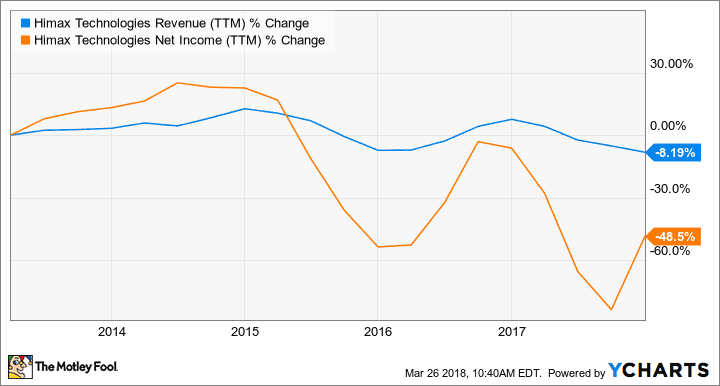
In fact, Himax has failed to find a significant catalyst to boost its business in the past five years, as evident from the following chart:
HIMX Revenue (TTM) data by YCharts

Finally, Himax’s current valuation isn’t enticing enough to make a bet on a turnaround — it trades at 41 times last year’s earnings as compared to the industry average price-to-earnings (P/E) ratio of 22.6. Additionally, the company recently raised its capital expenditure budget by 31% to $105 million to build capacity for meeting SLiM shipment demand, and it is yet to see the fruits of this labor.

This again brings a sense of deja vu as Himax had spent money, while also receiving an investment from Google, to build out capacity for the Google Glass five years ago. But those investments didn’t ultimately deliver. So, if history repeats and Himax’s new solutions don’t take off, then its investments will go down the drain, and the stock could slide further.


Artificial Intelligence Is Driving Big Tech

Over the last several years, artificial intelligence (AI) has emerged as one of the most important trends in technology. The AI techniques of deep learning and machine learning have resulted in everything from improvements in search, to image recognition, to voice-controlled digital assistants, to self-driving cars.

While the prospects created by this technology are enormous, estimates vary as to the size of the market. Deep learning, the most promising area of AI research, was forecast to generate $4.8 billion in 2017, growing to $261 billion by 2027, achieving a compound annual growth rate of 49% according to a report by Persistence Market Research.

Even if those estimates are overly optimistic, they serve to illustrate the massive opportunity created by AI. It also explains recent announcements by Microsoft (NASDAQ: MSFT), Alphabet (NASDAQ: GOOGL) (NASDAQ: GOOG), and Apple (NASDAQ: AAPL), that each is placing additional emphasis on the nascent technology.

Profile of human head with brain showing through overlaying computer circuitry.

Doing the corporate shuffle

Late last month, Microsoft announced a major reorganization that focused the company’s resources squarely on its biggest opportunities — artificial intelligence (AI) and cloud computing.

Microsoft will organize its efforts behind three engineering teams. The first team will be dubbed Cloud plus AI Platform and focus on emerging high-growth technologies and will divided into four business units: business AI, universal store and commerce platform, AI perception and mixed reality, and AI cognitive services and platform.

The second will be called Experiences and Device and will include Surface products as well as Windows and Office. The team will be working to create a unified experience across a multitude of devices, and it will be broken down into four segments: devices, Windows, new experiences and technology, and enterprise mobility and management.

The existing third team, AI plus Research, will continue as it has for the past two years, focusing on “the adoption of AI innovations from research into product.”

This shouldn’t be too surprising, as Microsoft’s AI-based Azure cloud computing operations grew 98% year over year in its most recent quarter, and the company has become the most significant competitor to Amazon Web Services (AWS), the current leader in the space.

Google follows suit

It was surprising, however, to learn that just days later, that Alphabet subsidiary Google began its own reorganization, according to CNBC. John Giannandrea, who has run Google’s search and AI group for the last two years, is stepping down, and the company is splitting its search and AI units in two, creating a new business unit to house all of the company’s AI efforts. Heading this new segment will be noted deep-learning expert Jeff Dean, the co-founder of the Google Brain and responsible for much of the company’s pioneering AI research. Ben Gomes, in charge of search engineering, will lead the search group. Google has not yet confirmed the move.

Google’s loss is Apple’s gain

The former head of Google’s search and AI efforts wasn’t unemployed for long. Apple confirmed just one day later that it has put Giannandrea in charge of its “machine learning and AI strategy.” The former Googler had helped integrate AI into many of the search giant’s products, including Gmail, search, and the company’s AI-infused digital assistant.

Apple’s AI efforts are perceived to be trailing the leaders due to the company’s focus on privacy and security — an issue that was touched on by Apple CEO Time Cook in an email about the hiring. “Our technology must be infused with the values we all hold dear. John [Giannandrea] shares our commitment to privacy and our thoughtful approach as we make computers even smarter and more personal.”

A lot at stake

While the market for AI presents enormous opportunities, not all of those will be easy to quantify. Google has used AI to improve its search, Microsoft has imbued its cloud operations with the technology, and Apple has made AI central to innovations for its flagship iPhone.

The groundbreaking nature of AI is significant enough that every major tech company is organizing their business efforts around these futuristic algorithms, so investors should definitely take note.

The 3 High-Yield Utility Stocks With the Safest Dividends

Utility stocks can provide a solid cornerstone to an investor’s income-focused portfolio. In fact, if you pick the right ones, they will reliably provide you big dividends and very little excitement, which is likely your goal. American Electric Power Company, Inc. (NYSE: AEP), Consolidated Edison, Inc. (NYSE: ED), and CenterPoint Energy, Inc. (NYSE: CNP) are three such stocks that offer a combination of high yields in the utility space backed by financially strong businesses. Here’s why dividend investors will love them.

1. American Electric Power

AEP provides electricity to 5.4 million customers across 11 states. The utility has three main business, regulated utilities, regulated transmission and distribution utilities, and AEP Transmission. It has increased its dividend each year for eight consecutive years and offers investors a 3.7% dividend yield. That’s well above the roughly 2% yield the broader market is offering investors today and toward the high end of the utility group.

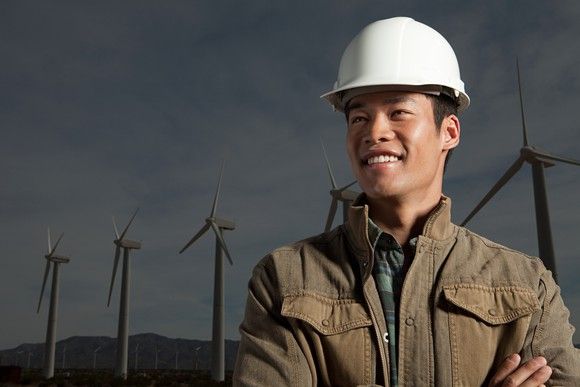
A man standing in front of windmills

Leverage at AEP is relatively modest for a capital intensive industry, with a debt to equity ratio of just 1.06 times. That’s a level that’s been fairly consistent over the past decade. The company is investment grade rated, as well, at A-. The payout ratio, meanwhile, was a strong 62% in 2017.

AEP is projecting earnings growth of between 5% and 7% a year. The dividend should track along with those gains, extending the company’s streak of annual hikes along the way. Capital spending of nearly $18 billion backs those projections over the next two years. Better yet, the dividend growth of 5% plus will outpace the historical rate of inflation growth.

2.Consolidated Edison

ConEd serves 3.6 million electric and 1.2 million natural gas customers in New York City and its surrounding suburbs. It breaks its business into utilities, transmission (which owns assets that move both natural gas and electricity), and renewable power (which sells renewable energy under long-term contracts). The utility has increased its dividend for an incredible 44 consecutive years. Like AEP, ConEd’s current yield is roughly 3.7%.

Consolidated Edison’s debt to equity ratio is the lowest of this trio at just 0.96. It’s been below one on that metric in nine of the last 10 years, proving that management is focused on maintaining a solid balance sheet. The utility’s credit rating is investment grade at A-. The payout ratio, meanwhile, was around 70% in 2017. It’s held at around that level for the past decade.

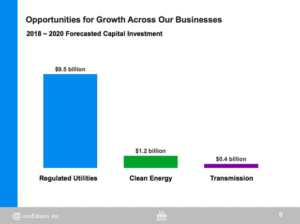
A bar chart showing ConEd’s spending plans, with a heavy emphasis on its regulated utility business

ConEd’s capital spending plans are heavily weighted toward its most important business.

The company plans to spend around $11 billion on capital projects between 2018 and 2020, with the vast majority going toward its regulated utilities business. Although ConEd hasn’t provided longer-term earnings and dividend growth projections, it believes 2018 adjusted earnings could rise by as much as 5% and it has already increased the dividend by 3.5%. That’s not a huge dividend hike, but it’s above inflation and backed by a rock solid utility.

3. CenterPoint Energy

CenterPoint provides electricity to 2.4 million customers in Texas and natural gas to 3.5 million customers across six states. It also owns roughly 54% of the common units of Enable Midstream Partners, LP which it jointly controls with OGE Energy Corp, a midstream infrastructure specialist. CenterPoint’s yield is 4.15%, more than twice the broader market’s yield. The utility has increased its dividend annually for 13 consecutive years.

Although CenterPoint’s debt to equity ratio is higher than AEP’s and Con Ed’s at 1.75 times, its debt to EBITDA ratio is slightly lower. That suggests it isn’t particularly over leveraged relative to these peers, particularly when you compare it to industry giants like The Southern Company and Duke Energy, which have much higher debt to EBITDA ratios. CenterPoint also has a solid A- investment grade credit rating. The payout ratio in 2017, meanwhile, was roughly 75%, which provided ample coverage for the dividend.

CNP Financial Debt to EBITDA (TTM) data by YCharts

CenterPoint is targeting 5% to 7% earnings growth through 2020. Backing that is an $8 billion capital spending plan between now and 2022, split roughly 60%/40% between its electric and natural gas businesses. In recent years the dividend has grown at around 4% as the utility has worked to reduce its payout ratio. It’s likely that dividend growth will remain at that level for now, a move that would continue to increase the security of the payout.

Core dividend holdings

AEP, ConEd, and CenterPoint each have solid utility business with investment-grade credit ratings. Relatively low leverage and ample dividend coverage should leave most income investors confident that the dividends will keep flowing from this trio. Add in above market yields and it’s likely that at least one of these utility stocks could find its way into your portfolio.

Thinking of Selling Facebook Stock? First, You Need to See This Chart

To say Facebook (NASDAQ: FB) had an uncharacteristically poor quarter would be an understatement. The bombshell report that Cambridge Analytica had access to the personal data of at least 50 million Facebook users, most of whom did not agree to it, has dragged the high-flying stock down to earth.

Recent company actions appear reassuring. After a week of seeming to avoid facing the controversy and fallout in a meaningful way, CEO Mark Zuckerberg finally took strong ownership by reassuring investors, the media, and users via a conference call with reporters. After committing to stronger privacy controls and data security, Zuckerberg noted that the scandal and subsequent #DeleteFacebook campaign haven’t had a “meaningful impact” on user behavior or ad revenue.

What should long-term investors do? If past is prologue, take a deep breath and do the hardest thing in investing: nothing. Facebook has had negative quarters before and rebounded to reward long-term investors.

All things considered, this wasn’t a horrible quarter for Facebook

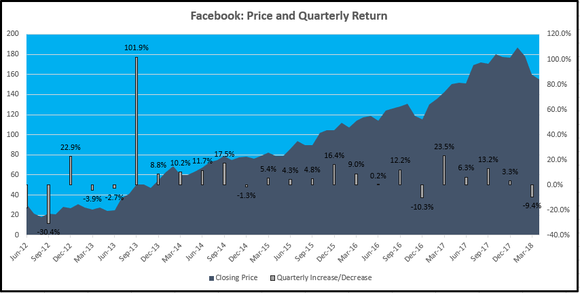
Facebook had a poor first quarter, with its stock losing 9.4% of its value from the quarter ended in March. But even considering the damaging headlines, this was not Facebook’s worst quarter. In fact, it wasn’t even Facebook’s worst quarter in two years; that designation goes to the quarter ended December 2016, when investors saw a loss of 10%. Below is a chart with Facebook’s stock price and quarterly returns for the entirety of its publicly traded history.

Facebook price and quarterly return chart

Chart by author. Return data from Yahoo Finance. Quarterly return denotes percentage return from closing price of last day of prior quarter to last day’s closing price of quarter denoted on chart.

Looking over Facebook’s recent history, you can understand why many investors may be nervous — they’ve mostly been spoiled. Last quarter was only the third quarterly loss the stock had endured in four years. Historical perspective is needed, specifically for the performance before that incredible four-year run.

A brief Facebook history lesson

In 2012 Facebook stock was considered dead money at best. The stock had turned off investors with a botched IPO (not the company’s fault), and analysts’ concerns were mounting about the company’s desktop-first experience in an increasingly mobile world and Zuckerberg’s spendthrift ways: The CEO agreed to pay $1 billion for a little-known photo-sharing app named Instagram at a time when the service had no revenue.

The bearishness reached a crescendo in the quarter ended September 2012 with a quarterly loss of 30%, and that was followed by negative returns in two of the three following quarters.

And how did that work out? Really well for long-term investors: By the following September, shares had rewarded them with returns in excess of 100%. Instagram is now considered a steal as it provides significant revenue and user growth; Facebook makes most of its ad money through mobile; and concerns about the company’s botched IPO are a footnote in the stock’s history.

Focus on the long-term opportunity

Like all companies, Facebook is going to have a few ugly quarters. But as the chart shows, long-term investors who did not overreact and sell during these periods have been handsomely rewarded. Although Zuckerberg has been faulted for his sluggish response to this issue (and rightfully so), I expect the company to provide a more-secure experience with better data protection … and quickly.

In the long run, I expect Facebook stock to recover once this issue is addressed because the company’s leadership position in digital advertising (along with that of Alphabet) is nearly impervious to existing competitors. As more brands shift from television to digital ad spend, the company is uniquely suited to benefit. Facebook investors should ignore the short-term chatter and focus on the long-run opportunity.

Leap Motion’s prototype augmented reality headset includes hand tracking

leap motion augmented reality hmd prototype revealed ar headset

Leap Motion just revealed a new prototype headset that mixes hand tracking with augmented reality. The device, dubbed as North Star, relies on ellipsoidal reflectors, which are typically sections cut from a larger, curved ellipsoid mirror. In this case, the reflectors are based on optical-grade acrylic coated with a thin layer of silver.

For the first version of Leap Motion’s prototype, the company mounted these reflectors inside a huge head-mounted device seemingly ripped out of a 1980s mad scientist movie. On each side of the helmet’s inner wall was a 5.5-inch LCD panel along with bulky ribbon cables connecting to display drivers mounted on the top of the HMD. Needless to say, it wasn’t sleek and compact like Microsoft’s HoloLens.

“While it might seem a bit funny, it was perhaps the widest field of view, and the highest-resolution AR system ever made,” the company says. “Each eye saw digital content approximately 105 degrees high by 75 degrees wide with a 60 percent stereo overlap, for a combined field of view of 105 degrees by 105 degrees with 1440 × 2560 resolution per eye.”

Sound confusing? Imagine putting on a helmet, and inside you see two reflective surfaces curving outward, with one end connecting close to the bridge of your nose, and the other end extending forward and out. Meanwhile, there is an LCD screen mounted to the left and right of your eyes, reflected on the curved mirrored surface. This provides a huge field of view both horizontally and vertically.

Eventually, the team whittled the headset down from a mad scientist contraption to something that looks more like a current VR headset. The prototype now relies on two fast-switching 3.5-inch LCD screens manufactured by BOE Displays that are powered by an Analogix display driver. While it has fewer parts than the previous gargantuan prototype, Leap Motion managed to preserve “most” of our natural field of view.

In its current state, Leap Motion’s prototype provides a 1,600 x 1,440 resolution for each eye — lower than the hulking first-gen model — running at 120 frames per second. It also sports a field of view “covering over a hundred degrees” with the two screens combined. Meanwhile, the hand-tracking runs at 150 frames per second over a 180- x 180-degree field of view.

According to the post, the team pulled the reflectors away from the user’s face just slightly to make room for a disassembled wide field-of-view camera manufactured by Logitech to record the augmented reality headset in action. But they’re still not done — other refinement tasks include better cable management, better curves, additional room for enclosed electronics and sensors, and more.

Once Leap Motion makes those refinements, there are other details that could improve the headset’s AR experience, such as inward-facing cameras for precise augmented image alignment, face tracking, and eye tracking. Head-mounted ambient light sensors would support 360-degree lighting estimation while directional speakers would provide “discrete” localized audio feedback. Micro-actuators could be used to adjust the displays.

Leap Motion plans to release this design to the open source community next week.

iRobot wants its Roombas to be the eyes and roving sensors of your smart home

iRobot Roomba 980

To get something approaching a responsive home — that’s a smart home that reacts to you instead of you initiating actions — you have a few options. There’s a device called Kirio that, along with sensors and other devices, are built into the house during construction or remodeling. Vivint can do something similar after a home’s been built for a monthly monitoring fee. With the DIY approach, you can use If This Then That to make your smart-home devices work together, but it will take time and patience to set it all up. Even then, your smart thermostat and lightbulbs won’t really know if they’re operating inside a one-bedroom apartment or three-story house.

“If you think about the smart home and the variety of connected devices on the market today, they’re overwhelmingly static devices: tabletop sensors or thermostats that are connected to the wall,” Chris Jones, iRobot’s VP of technology, told Digital Trends. “They don’t have a broad view of home they could really benefit from in order to more effectively do whatever task it is that that individual connected device can do.”

The benefit of a mobile robot like the Roomba, he said, is that it requires a map of your house to function — something that gives your other devices a better idea of how they should be functioning.

Right now, in most cases, if you want to tie your smart bulbs to your motion detectors, it’s on you configure each one. The end result will mean you don’t have to flip the switch when you walk in and out of the room, but it’s lot of effort up front.

“The consumer won’t program their home to do that,” Jones said. “The average consumer is not going to spend the time to program the dozens and dozens of logical rules to allow the motion sensors to orchestrate lights within their home to give them that experience.”

But if your lights and motion sensors could use your robot vacuum’s map and understand how they’re related in terms of proximity, “that setup of that motion-activated lighting scenario can actually be very simple,” he said.

It’s just one example of how a mobile sensing device could improve smart-home products’ efficiency. Roving temperature sensors could give your thermostat a better idea of how every corner of each room is being heated or cooled. Even if you have individual sensors in your bedroom and living room, they’re still only monitoring a single spot. And iRobot isn’t the only company thinking about this: LG wants you to use its Hom-Bot vacuum as a security camera — and hackers want to use it to spy on you.

There are a few technologies the Roomba 980 series takes advantage of to map your house. To keep track of wheel revolutions and how the robot moves, the vacuum has an odometer, gyroscope, and floor-tracking sensor, which Jones compares to an optical mouse that uses a light source and detector to detect movement. There’s also a smartphone-quality camera that perceives objects.

“Don’t imagine that the robot is recognizing your Ikea chair and using that as insight into where it is in the home today,” Jones said. “You can think of it kind of like celestial navigation, almost.” Your chair will register as a patch of pixels that then figure into a “constellation” of other objects’ pixels, and your Roomba understands its position based on their position to each other. Pick up the vac and put it on the other side of the chair, and it will use the new visual cues to determine its new location.

Right now, iRobot’s vacuums process their images onboard the robots. They aren’t sent to the cloud, and they are discarded once the bot is zeroed in on its position.

“It’s very important to note that of course we take our consumers’ privacy very seriously,” Jones said. “We have very explicitly designed the robot and the entire system with that in mind.”

There was some confusion last year when iRobot’s co-founder Colin Angle told Reuters about the vacuums’ maps and how they could be used in future smart homes; the company had to later clarify it never had plans to sell that information.

“It should be clear that we we do not sell customer data. That’s not our business, not how we make make money,” Jones said. While he thinks there are potential benefits to your Nest or Hue products having the map, it would be up to the user whether or not they want to opt in.

Of course, we’re very used to granting apps permissions, without necessarily realizing the repercussions of, say, Google tracking your every move. On the one hand, there’s the convenience of the automated home. On the other, there’s the icky idea of six, seven, 15 companies knowing you sat on the couch all afternoon, binge-watching The Golden Girls because they’re all sharing your motion-sensor and other data.