Archives for April 2, 2018

3 Top Dividend Stocks for the AI Revolution

Dividend stocks overall have been shown to outperform their non-dividend-paying peers, but there always seems to be a tug of war between growth and income. The allure of owning a stock in a fast-growing industry with the potential for significant gains can be tempting, as this approach can also help investors reach their financial goals. There’s an opportunity, however, to get both the potential for large-scale growth while still generating an ongoing income stream.

Artificial intelligence (AI) is still in its infancy, but the technology can be found everywhere. The systems are used for everything from powering the voice responses on your smartphone to tagging friends on social media to providing the brains behind self-driving cars. While estimates vary, the market for artificial intelligence is expected to produce annual growth of 45% and exceed $19 billion by 2022.
Dollar bill with center torn out and the word “dividends” showing through.

These dividend payers are at the forefront of the AI revolution. Image source: Getty Images.

More importantly for income investors, there are a number of stable dividend-paying companies that are developing the technology. With that in mind, let’s look at three companies that provide the possibility of significant returns from advances in AI that pay shareholders while they wait — Apple (NASDAQ: AAPL), Microsoft Corporation (NASDAQ: MSFT), and Intel Corporation (NASDAQ: INTC)

Don’t count out Apple

Don’t make the mistake of thinking that Siri is Apple’s one-and-only AI technology. With the release of the iPhone X late last year, Apple leapt ahead of the competition in smartphone AI. The device boasted the A11 Bionic Chip, taking AI technology out of the cloud and into the smartphone itself, as well as cutting-edge facial recognition enabled by AI. Apple has also been testing self-driving car technology, though it has been keeping most of its progress in that area under wraps. AI in the Apple Watch is also being used in a number of health studies and is currently being tested to detect a life-threatening heart condition.

An iPhone X with water splashing around the sides.

iPhone X has impressive AI capabilities. Image source: Apple.

While Apple’s yield of 1.5% may seem meager, it’s important to remember that Apple has gained over 160% in the past five years compared to the 70% gain of the S&P 500. At the same time, Apple has increased its dividend by 66% since re-instituting its payout in 2012 and raised the payout by 10% in each of the last three years. The company is only paying out 25% of its profits to fund the dividend, so there’s plenty of opportunity for future increases.

More than just Windows

Microsoft is known primarily for its Office suite of products and Windows operating system, but the company is quickly making a name for itself in the emerging fields of cloud computing and artificial intelligence. The company was among the first to integrate AI capabilities into its cloud offering, and its Azure is now the second most popular cloud platform. The company’s intelligent cloud segment generated a whopping 27% of Microsoft’s revenue in its most recent quarter.

Microsoft also has expanded its AI-based Cortana digital assistant to nearly every device that contains the company’s software — an estimated 145 million monthly active users. AI is now integrated into everything from its Xbox gaming platform to its Bing search. It also has a suite of 29 AI technologies, like voice recognition and computer vision, which are available to developers.

Microsoft logo outside company campus.

The company’s dividend currently yields 1.87%, though Microsoft has gained 230% over the last five years, far outpacing the 70% return of the broader market. Microsoft has increased its dividend by 82% in the past five years, and most recently by 8%. When adjusting for the one-time charge related to recent tax reform, the company is paying out just 48% of profits to fund the dividend, boding well for future increases.

AI inside

Intel became a household name by providing the processors that power most home computers. Now, the company has plans that could conceivably change its mantra from “Intel inside” to “AI inside.” The company has been working on a number of chips specifically designed for AI applications.

Intel supplied the field-programmable gate array (FPGA) processor that’s the backbone of Microsoft’s cloud AI system. The company also acquired start-up Nervana, which developed purpose-built processors that could handle the most common computations done by deep-learning AI programs. Finally, Intel acquired Mobileye, a company that develops sensors and cameras for self-driving cars. These moves put the company squarely into some of the biggest areas of AI.

Intel’s dividend currently yields 2.3%, and the stock has doubled the return of the broader market over the past five years, gaining 140%. The company has paid a dividend going back to 1992 and increased its payout by 33% over the past five years, most recently by 10%. Adjusting for recent tax reform, Intel is paying out just 34% of its profits, leaving lots of room for future increases.

Still in development

It’s important to point out that artificial intelligence is still a quickly evolving field and there are no guarantees that these companies will be able to capitalize on AI. Additionally, this technology may only end up augmenting existing products and may not result in new or additional revenue streams.

That said, recent developments show the vast potential for AI, and owning stocks that pay a dividend while waiting for these advancements to materialize can be a smart way to approach a rapidly evolving technology.

3 Top Dow Dividend Stocks You Can Buy Right Now

If you’re looking for solid dividend stocks to buy, the 30 members of the Dow Jones Industrial Average index is a pretty good place to begin your search. The Dow contains the bluest of blue chip stocks — and all of them pay dividends. But some of those dividends are certainly better than others.

Three of the top Dow dividend stocks, in my view, are IBM (NYSE: IBM), Pfizer (NYSE: PFE), and Verizon Communications (NYSE: VZ). Here’s why they’re solid picks right now for long-term investors.

Dow spelled out in blocks in front of bar chart

IBM

IBM’s dividend currently yields 3.95%. The technology giant has paid a quarterly dividend every year since 1916 — an enviable track record. IBM is also only three years away from qualifying as a Dividend Aristocrat, potentially joining an exclusive club that includes only S&P 500 members that have increased their dividends for a minimum of 25 consecutive years.

At first glance, IBM’s payout ratio of 96% could be alarming. However, the company’s dividend should be relatively safe. IBM’s earnings, which constitute the denominator in the payout ratio, were artificially lower in 2017 due to a big one-time tax payment. Dividend payments over the last 12 months used up less than 43% of IBM’s free cash flow, which indicates the company shouldn’t have a problem keeping those nice dividend checks flowing.

It’s true that IBM has faced challenges in recent years. Prior to 2017’s fourth quarter, the company had reported year-over-year revenue declines for 22 consecutive quarters as it struggled to respond to new market dynamics. Even with the tech giant’s return to growth in Q4, it still won’t generate huge growth.

But for income-seeking investors, modest growth isn’t a problem. IBM has shown in the past that it can adapt and survive. The company has placed big bets on technology, including artificial intelligence (AI), blockchain, and quantum computing, that should pay off over the long run. I suspect Big Blue will retain its blue chip status for a long time to come.

Pfizer

Pfizer pays a dividend with a current yield of 3.82%. For many years, Pfizer claimed a spot among the Dividend Aristocrats. However, in 2009 the big pharma company slashed its dividend to help fund the acquisition of Wyeth. Pfizer returned to steady dividend hikes in subsequent years.

The prospects for more dividend increases from Pfizer in coming years appear to be good. Pfizer currently spends less than 54% of its free cash flow to fund the dividend program. The company’s executives consistently rank dividend payments as the top priority for capital allocation.

Pfizer’s earnings growth should also improve. Between 2005 and 2010, the drugmaker launched two blockbuster drugs. Over the next five years, Pfizer launched five blockbusters. But between 2017 and 2022, the company thinks it can win approval for as many as 15 new drugs or new indications for existing drugs with blockbuster potential.

In addition, Pfizer should move past some of the issues that have weighed on its performance in recent years. The negative impact from loss of exclusivity for older drugs should decrease in the future. Pfizer also expects to make progress in alleviating product shortages that have caused weakness for its sterile-injectables business. The combination of resolution of these problems and the potential for its pipeline should help Pfizer remain one of the best big pharma dividend stocks on the market.

Verizon Communications

Verizon’s dividend yields 5.03%, the highest of these three Dow stocks. The telecommunications company has increased its dividend in each of the last 11 years.

But can Verizon keep the dividends coming? The normal metrics used to answer the question could be deceiving. The company currently has a payout ratio below 32%. However, that’s skewed lower by a large one-time income tax benefit recorded in the fourth quarter of 2017. Verizon spent more on paying dividends than it generated in free cash flow over the last 12 months. That imbalance, though, was the result of some major capital expenditures last year. Overall, Verizon’s dividend appears to be a pretty safe bet.

The telecom business is intensively competitive. However, Verizon has been able to attract customers without resorting to bundling video streaming services with its unlimited data plans. The company also has lower customer churn than its big competitors.

Verizon’s biggest opportunity is probably in 5G wireless technology. With its new high-speed 5G networks, Verizon could offer new bundled products such as smartphone service with home internet, TV, and connections to cars. There are only a handful of telecom companies with the financial resources to build out 5G networks. Verizon is one of them — and that should bode well for the company long-term.

My favorite

I like all three of these Dow dividend stocks. My personal favorite, though, is Pfizer.

Unlike IBM and Verizon, Pfizer has grown revenue consistently over the last three years. The company appears to be in good position to pick up the pace even more over the next few years, with strong products like cancer drug Ibrance and anticoagulant Eliquis. I also expect Pfizer to make additional acquisitions that fuel even more growth. I own shares of Pfizer and intend to hold on to them for a long time.

How Safe Is Coca-Cola’s Stock (KO) and Dividend?

Six years ago, I wrote a fictitious account for fool.com about a woman named Glon Mert — an anagram of the words “long term.” Glon’s father bought a single share of Coca-Cola (NYSE: KO) for her in 1920 for $21. By 2012 — after including dividends reinvested and stock splits — that single original investment of just $21 was worth…over $9 million!

The point of the article was simple: While Coke might not be a sexy stock, the simple power of compounding dividends and the strength of the company’s brand could produce life-altering wealth for those who are patient.

But my tune has changed as far as Coke is concerned. I sold my shares long ago. And if you’re looking for a stock to provide solid, safe dividends for a few decades to come, I think there are better options out there.

Here’s why…

A glass of soda with ice and a straw.

First, let’s examine the business

There’s no denying the strength of Coke’s brand. According to Forbes, Coke has the fifth-strongest brand in the world, valued at over $56 billion. And Coke is much more than just its namesake beverage: The company owns Minute Maid, Powerade, Odwalla juices, Vitamin Water, and Dasani — to name just a few “healthier” options.

But my concerns about the company aren’t limited to the fact that its primary product is basically sugar-water, and that as we become more health-conscious, we’ll be allowing less of the stuff in our bodies. Although, to be clear, that’s still an important concern.

No, instead, I think there’s an even larger problem afoot: the death of the power of big brands in consumer goods. As former hedge fund manager Mike Alkin has demonstrated, the baby boomers who are brand-loyal will be spending less in retirement and the millennials filling their shoes are brand-agnostic.

The pricing power that Coke has enjoyed for almost a century is being pulled from underneath the company’s feet. The signs are showing.

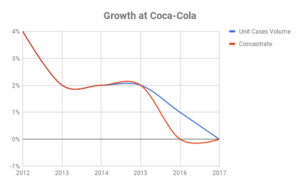
While it’s not instructional to look at revenue figures alone as the company has refranchised its bottling operations, the overall volume of unit cases of drinks and concentrate have been in slow decline.

Chart showing volume growth at Coke from 2012 to 2017.

Chart by author. Data source: company annual reports.

Your eyes aren’t deceiving you: Volume didn’t grow at all last year. Business in Latin America is shrinking, and it’s at zero unit cases growth in North America. The Asia Pacific region is what’s keeping the company from decline right now. The company was able to grow organic revenue 3% last year thanks to price increases.

Overall, this wouldn’t be a huge deal if such negative headwinds were baked into the company’s stock price. But I don’t think that’s the case. Shares currently trade for 35 times trailing free cash flow! Even where we sit now — nine years into a historic bull market — that’s expensive.

About that dividend

Then, of course, we have the company’s dividend. Currently yielding 3.7% and with a history of 55 consecutive years of dividend increases, it seems like a sure thing. But when we dive into the weeds, things appear much more perilous

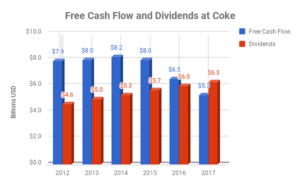
When it comes to dividends and their sustainability, there’s no metric more important to watch than free cash flow — and the percentage of free cash flow being used to pay shareholders. For a long time, Coke had a very safe payout ratio, never using more than 80% of free cash flow to make its payments.

That, however, has changed in the past two years.

Chart showing Coke’s free cash flow and dividend payments since 2012

Chart by author. Data source: SEC filings. All figures rounded to nearest tenth of 1 billion USD.

In 2012, only 58% of free cash flow was used to pay the dividend. By last year, that figure more than doubled. The dividend ate up 119% of free cash flow!

Management claims that work on the bottling investments reduced free cash flow by up to $1 billion last year. Coke currently has enough cash — a net $12 billion position — to continue paying the dividend without investors having to worry over the short term. But the trends have been in a long-term decline.

Those who buy Coke stock now are likely hoping for meaningful dividend increases for decades to come. As things stand, it’s tough to see how the company could continue inching its payouts up without running the risk of becoming financially fragile, meaning it will break in times of chaos.

I’m not necessarily encouraging investors to short Coke, i.e., bet on a drop in price, but I am hoping that any near-retirees — who would be looking for income investments and not have decades to wait for a stock bet to pay off would enter into this investment with eyes wide open. I won’t be buying shares anytime soon — and even then, only if there are meaningful changes in the company’s growth and free cash flow situation. I have voted for the company to underperform the broader market in my CAPS profile, and I think there are better options for your money.

10 Dow Stocks Currently Testing Blockchain Technology

Last year, the cryptocurrency market was unstoppable, with the aggregate value of all virtual currencies soaring by nearly $600 billion. The major catalyst to thank for this surge is blockchain technology.

The buzz about blockchain technology

Blockchain is the digital, distributed, and decentralized ledger that records transactions in a transparent and unchanging manner, without the need for a financial intermediary. In even plainer English, it’s a transparent means of transferring money from one party to another, or of recording data, without the need for a bank or third-party intermediary. It also means that data is stored on computers all over the globe, as opposed to one central hub, so as to ensure that no single entity, be it a business or hacker, can gain control of a network.

A person touching an encrypted block on a digital screen that’s part of a larger blockchain.

Image source: Getty Images.

The entire reason we’re even talking about blockchain right now is that developers view the current payment system as flawed. Banks get to act as third parties and collect fees for transactions run on their networks, while at the same time taking up to five business days to settle cross-border payments. To some, that’s just not acceptable.

With blockchain, transactions have the potential to be processed in real time, or within a matter of seconds, at least as it pertains to remittances. Transactions are also broken down into a bare-bones structure whereby financial institutions are removed from the equation, potentially reducing transaction fees in the process.

However, blockchain has plenty of applications beyond just currency-based remittances. It can be used to oversee supply chains, regulate networks, create digital IDs, maintain loyalty rewards, manage energy trading platforms, and so much more.

These 10 Dow stocks have an open mind when it comes to blockchain technology

The potential for blockchain is so great that even some of the largest U.S. multinational companies in the iconic Dow Jones Industrial Average have come around to testing its application or filing for blockchain-based patents. Here are 10 Dow stocks currently working with blockchain to some varied degree.

A woman holding a credit card while pondering an online purchase.

Image source: Getty Images.

American Express

Global payment processor and credit card issuer American Express dove headfirst into blockchain when it announced a partnership with Ripple and Banco Santander in mid-November. Under the terms of the deal, American Express users sending non-card payments over AmEx’s FX International Network to U.K. Santander accounts will have those payments processed over Ripple’s blockchain almost instantly. No more multiday waits for validation and settlement. Since blockchain is expected to be most useful for the financial services industry, American Express’ test with Ripple seems logical.

Cisco Systems

In October, networking kingpin Cisco Systems (NASDAQ: CSCO) filed for a trademark with the U.S. Patent and Trademark Office (USPTO) for a blockchain platform that would regulate the Internet of Things (IoT), i.e., interconnected devices that can send data to and from each other. The idea here is that Cisco’s blockchain would be capable of recognizing devices on a wireless network and continuously assessing their trustworthiness. Additionally, Cisco’s proprietary blockchain would need to do this for devices entering and leaving the network, such as smart cars or smartphones. It has the potential to bring new levels of safety and security to the IoT.

Walmart

With consumers pushing online sales through the roof, it’s probably no surprise that the king of brick-and-mortar retail, Walmart (NYSE: WMT), is facing shipping challenges when it comes to perishable products. About a month ago, an application from the USPTO shows that Walmart aims to develop a so-called “smart package” that would include a device capable of registering information to a blockchain. This info would include the contents of the package, weather conditions, its location, and also key addresses so it could be ascertained who last had the package. Walmart is looking at blockchain to make its supply chain more efficient as well.

Boeing

When we think of Boeing (NYSE: BA), we probably envision an industrial powerhouse with massive commercial airplanes. However, Boeing is also dipping its toes into the water by recently filing for a patent application with the USPTO for a blockchain platform that would act as a backup for in-flight GPS receivers. Using blockchain as an immutable and transparent log of GPS data would ensure that pilots would have a way to maintain their course even if their equipment malfunctioned, or if hackers “spoofed” the GPS receivers into thinking they’re in a different location. We’re talking about a potentially big step forward in travel safety.

IBM

Perhaps no Dow stock has embraced blockchain more than IBM (NYSE: IBM). In October, IBM announced a partnership with Stellar and KlickEx to process remittances over its proprietary network in the South Pacific region. Stellar’s Lumens coin is being used as the intermediary currency to expedite cross-border transactions among 12 major banks in the South Pacific.

In addition, IBM recently announced a joint venture with A.P. Moller-Maersk (known more commonly simply as Maersk) to create blockchain-based solutions for the shipping industry. The company that’ll be spun off will look for ways to make shipping supply chains more transparent, as well as remove paper from the equation, which should expedite approvals and the entire shipping process. In other words, IBM is a real blockchain leader within the Dow.

Microsoft

Though Microsoft (NASDAQ: MSFT) is best known for its dominant Windows operating system, it’s also making a name for itself as a blockchain pioneer. Via a blog post in February, Microsoft announced that it’d be working to create digital blockchain-based IDs to help the more than 1 billion people worldwide who face identity challenges. Such a decentralized system would make the verification of personal credentials more efficient, as well as allow individuals to control their own digital identities. It may even allow apps and services to be customized to the point where less personal info is needed in order to log into an application.

A field worker drinking a Coca-Cola.

Coca-Cola

When not selling beverages in all but one of the world’s 200-plus countries, Coca-Cola (NYSE: KO) is busy testing out blockchain as a means to improve the rights of global workers. Last month, Coca-Cola announced that it was partnering with the U.S. State Department, Emercoin, Bitfury Group, and Blockchain Trust Accelerator to create a decentralized blockchain-based registry for global workers. For its part, Coca-Cola agreed to 28 country-level studies on child labor, forced labor, and land rights by 2020 in its sugar supply chain. This blockchain registry, which comes complete with smart contracts – protocols that aid in the enforcement, facilitation, or verification of a contract — may have the potential to coerce businesses to honor contracts with their employees.

Merck

Even Big Pharma is getting in on the action. Merck is using blockchain technology as a means to track and authenticate returned drugs. The Drug Supply Chain Security Act requires pharmaceutical companies ensure that counterfeit medicines don’t make it onto pharmacy shelves when some $2 billion to $3 billion in prescription drugs is returned each year. Blockchain gives Merck a way of referencing these prescription medicines based on their serial number, batch number, and expiration number. And since blockchain is immutable, there’s no concern that hackers will tamper with the data.

McDonald’s

Back in September, the home of the Golden Arches, McDonald’s, announced that it was partnering with Omise to be its exclusive payment gateway for its Thailand website and McDelivery Thailand mobile app. What’s unique about this deal is that it allows transactions to be white-labeled, which essentially means they won’t be rerouted, pushing for quicker execution and validation. Omise’s network will also allow mobile app users to securely store their credit card information to expedite transactions in the future.

Apple

It appears that even the largest publicly traded company in the U.S., Apple (NASDAQ: AAPL), is tinkering with blockchain. A Dec. 7 patent filing that became public shows that Apple is working on a platform that would incorporate blockchain technology to verify timestamps and protect “secure elements,” such as SIM cards and microSD cards. The long-winded application points out that global position systems and network servers reliant on network time protocols could be adversely impacted by hackers. This patent application from Apple would create a platform where falsified timestamps would be rejected, leading to only true timestamps being accepted.

The only question left is, which Dow stock is next?

NASA’s latest tech investments include shapeshifters and biobots

NASA is no stranger to backing unusual technology if it’ll help with exploring

NASA is no stranger to backing unusual technology if it’ll help with exploring the cosmos, and its latest move is proof of that adventurous mindset. The administration has invested in 25 “early-stage” tech proposals that could improve both human and robotic exploration, and some of them are particularly inventive. The Shapeshifter concept you see above, for instance, envisions a horde of robots that combine into different forms to explore virtually every surface on Saturn’s moon Titan. It could form an aircraft for high-altitude missions, a ball on the ground or a torpedo for under-liquid expeditions.

Another proposal, Biobot, would offload some of an astronauts’ life support and consumables to a companion robot tethered by an umbilical system. While it might seem disconcerting to trust your survival on a hostile world to a robot, the machine could let explorers last for days before returning to base. They could even use the mechanized helper to haul gear and communicate with people back on Earth.

Other projects include Marsbee (a swarm of flying robots that would assist Mars rovers), SPARROW (a steam-propelled robot for exploring oceans) and PROCSIMA (beamed propulsion for interstellar missions).

The initial investments dole out $125,000 each over the space of nine months to help determine the feasibility of the concepts. If the projects are viable, the teams can apply for a second phase to further develop their work. We’d expect only some of these concepts to make the initial cut, let alone reach real-world use, but they illustrate NASA’s thinking — it’s willing to try oddball ideas if they solve problems more effectively than conventional technology.

This article originally appeared on Engadget.

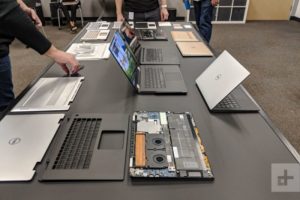
The XPS 15 2-in-1 is Dell’s version of a concept car. Here’s how it was built

The Dell XPS 13 is hands-down our favorite laptop, and it’s the kind of product we recommend to just about anyone. But what if you’re interested in something even more forward-thinking? What about a PC that’s a bit more…experimental?

From a distance, the XPS 15 2-in-1 might not look like that device. It carries over many design characteristics from the XPS 15, along with the convertible form factor of the XPS 13 2-in-1. In fact, from the outside, you might not be able to tell them apart. Convertible form factors are as common today as traditional clamshells, and they are often added to existing designs like a feature, morphing an existing design into a 2-in-1 with minimal tweaks.

Not the XPS 15 2-in-1. For Dell, it isn’t just a 2-in-1 version of the XPS 15 — it’s a way of experimenting with future technology without having to sacrifice the familiarity of its premium laptop line. When you look at it, you see the future of the XPS line – or, at least, one possible future.

The horsepower you didn’t know you needed

As an experimental product, Dell chose to implement a brand-new type of processor from Intel — and it’s the first 2-in-1 (or laptop) to use it. The Intel G-series processors are a new breed, integrating an Intel CPU with AMD Vega graphics, all on the same component.

“It allowed us to do something that we couldn’t have done with a traditional implementation of discrete graphics,” said Donnie Oliphant, the Marketing Director of XPS over at Dell. “You take a GTX 1050 Ti or 1060 and try to put it into this form factor — it doesn’t fit.”

Adopting this new chip gives the XPS 15 2-in-1 surprising graphics capability in an impressively thin form factor. But regardless of how thin, small, or light Dell wants to make the XPS 15 2-in-1, that was never the primary drive. The designers, engineers, and executives in the XPS team seem much more interested in holding performance and size in balance. There are certain aspects, most notably, in build quality and performance, that Dell wasn’t willing to compromise on.

“I always joke with folks, saying that if I I’ve ever brought you the thinnest or lightest of anything, I’ve lost my mind,” says Oliphant. “I’ve just traded off that the customer cares about. We can always do the thinnest — it’s just decisions. Being the best? That’s difficult.”

The XPS team has a history with gaming-capable laptops, most notably, with the previous XPS 15. It offered an optional GTX 1050, which could play many games at acceptable framerates. With the XPS 15 2-in-1, however, Dell wasn’t interested in throwing in a cheap graphics card, like other manufacturers have done. Asus, for example, has released a couple of very thin laptops that use a discrete Nvidia MX150 to power the graphics.

“We’re interested in driving new experiences, not just doing something for the sake of doing it,” says Frank Azor, a VP Dell. “A lot of those MX150 implementations are leaning on Nvidia’s brand equity to fool customers into thinking that machine is capable of doing something it really can’t, which is play games decently. It’s not a very decent gaming machine. If we could do something like that in the form factor here, but deliver a true gaming-capable proposition, then we’d probably do it. We’re not there yet.”

Azor is a gamer himself, starting at Alienware as a teenager before growing with the company through the acquisition by Dell. He now oversees the XPS, Alienware, and Dell Gaming lines. Will the implementation of the Intel G-Series chip, Azor is bringing gaming to systems that seem far too small and versatile to handle a round of Fortnite.

“What we’ve done in this 15-inch space is truly gaming-capable. I play Overwatch, PUBG, and a bunch of stuff on these. They are great gaming computers. Not as good as what we build on Alienware or even G7 gaming, but very capable. Hard to do that with a MX150 here, especially when you put a 4K screen on it.”

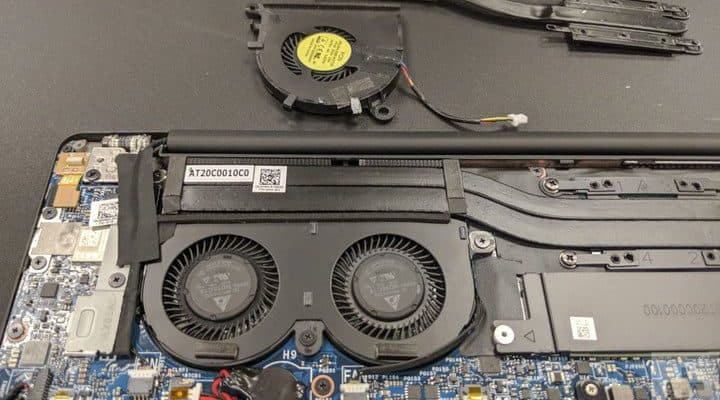
Of course, high-performance graphics always comes at a cost. A monetary cost, yes — but also a thermal cost. Dell had to pioneer an experimental cooling solution to make sure every last drop of performance could be eked out of the G-series chip.

The magic materials that keep it cool

Dell has boasted about its specialized implementation of Gore material since it was announced in the XPS 13 at CES. On the XPS 15 2-in-1, Dell has used even more Gore to act as a unique cooling agent that weighs almost nothing.

“It is literally, no exaggeration, space age material,” says Oliphant. “The aero-gel, which is mixed in with this material to create the thermal barrier, was used on the Mars rover. NASA uses this to insulate their devices from extreme heat or extreme cold. We use it in conjunction with graphite, which is a heat spreader. We’ll put the Gore on the aluminum side and use graphite on top to spread the heat over the Gore, and the Gore insulates that heat from getting to the customer.”

Because the XPS 15 2-in-1 is an experimental platform, Dell doesn’t seem afraid to dump some extra money into the technology here. Just how much? Well — Donnie Oliphant stated that there’s around three or four times as much as Dell would typically put in a system like this.

“There’s over 60 dollars of thermal material in this product,” said Oliphant. “Three heat pipes, one of the largest RAGs we’ve shipped in a non-gaming or Precision device. There’s a tremendous amount of technology and cost that we invested in the thermal solution alone here. It’s the most complex thermal design we’ve done for a consumer product.”

Oliphant and Azure assured us Dell is investing heavily in the thermal components of this unit on a financial level. He was clear the amount of money spent wasn’t something the company would immediately implement at the volume of more mainstream XPS units.

These aren’t improvements that many people who buy an XPS 15 2-in-1 will notice, but they will notice improved performance. For that reason, these are investments and financial risks the XPS team seems ready to take.

“Customers don’t care,” said Oliphant. “But those are the investments we will make in XPS.”

An experimental keyboard

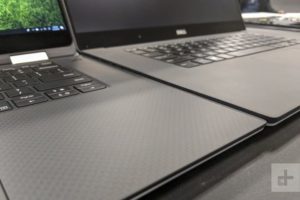
While the graphics and thermal solution won’t turn anyone off, the XPS 15 2-in-1’s keyboard will be more divisive. Rather than using a traditional, higher-travel keyboard, Dell went with something closer to the butterfly switch keys of recent MacBooks.

Reception to Apple’s keyboard wasn’t universally loved, but Dell didn’t shy away from taking the conceptual framework behind that keyboard and running with it.

“This is a new frontier,” says Oliphant. “I’m glad Apple did what they did a couple of years ago. They started to pave a path for alternatives. Magnets were the idea of a replacement to deliver a perfect deflection curve that’s tuneable, while making it feel like it’s more than the 0.7mm travel that we have in the design.”

The feel of the keyboard will be strange unless you’re coming straight from a MacBook. Even Azor admits that it needs a couple of hours to become used to. With just 0.7mm of travel, the keys feel more like clicky buttons than traditional switches. While fans of high-travel keyboards will no doubt cringe at how quickly they bottom out, the keys do inspire confidence in quick, precise typing, thanks to the feedback mechanism of the magnets.

“It’s always a value trade-off between thin system versus a long-stroke keyboard experience,” says Justin Lyles, the VP of Consumer Design. “I say that specifically with the long stroke because what we’re trying to push here is to change the paradigm of having to have a long stroke to have a good keyboard. We’re trying to find the sweet spot. You can actually go to a shorter stroke if you focus on other things like the force curve of the key — the feedback you get when you push the key.”

While the keys use a similar butterfly-like scissor mechanism to attach the keys to the base, the feedback pressure is provided by an entirely new system that uses magnets. The magnetic system is the end of a winding research path that had several dead ends.

“Five or six years ago, we were chasing down a different technology path, which was the angled travel. It was on a ramp,” says Lyles. “The keys didn’t go vertically down, they actually ramped down towards the user at an angle. From a force stand point, you could go on an angle with 0.7mm stroke, it felt like double that. We chased that for a while, but it didn’t really pan out very well. That’s when we shifted gears and moved into magnetics.”

Dell seems certain this is the future of keyboards. Lyles is looking ahead, anticipating the kind of trends in technology that will shape the future of input methods. Fans of long keystrokes won’t be happy about what he sees in his crystal ball.

“In the future, you’re going to start seeing a lot more interesting things,” he says. “Maybe the key doesn’t have to travel in z-direction at all. Maybe it travels in different directions. Maybe you can retract and lock the key when you don’t need it. There are different things you can do that’ll be very interesting.”

Dell is betting its experiments will pay off

Thanks to the success of the thinned bezels and relocation of the webcam, the XPS team is now taking risks with a bit more confidence. That, however, doesn’t mean Dell is ready to implement these advanced, expensive technologies on the bread-and-butter XPS products. The XPS 13 and XPS 15 will always remain the more mundane options — and Dell isn’t planning to retire them anytime soon.

“To early adopters, they’ll be like, ‘This is fucking amazing.’ And it is,” says Azor. “To folks who are a little more conservative, it might not be the right solution for them. We’ll see.”

The XPS 15 2-in-1 won’t sell as many units as the XPS 13, and it was never meant to. But it is a glimpse into the future of laptops – or at least, Dell’s vision of it.