
Archives for March 16, 2018

Figure skater Adam Rippon’s No. 1 trick to save more money

Occasionally, Olympic figure skater Adam Rippon likes to treat himself.

Last year, he splurged on a $6,000 Cartier Love Bracelet. “A year ago, I broke my foot and I just needed a little pick me up, so I bought myself this bracelet,” Rippon, 28, tells CNBC Make It.

But he hasn’t always been able afford such indulgences. Before drawing attention at the 2018 Winter Olympics, Rippon was often broke, living in his coach’s basement and stealing apples from his gym because he couldn’t afford groceries.

So despite his success, Rippon says he maintains a frugal mindset with most things. And to stick to his budget, he uses a simple trick anyone can try.

What does he do?

“I’ll see something that I really like and I kind of want … and I’ll be like, you know what I’m just going to go get it,” Rippon says.

But then he stops himself.

Instead, “I see how much the price was of the thing I wanted, and I take that price and I take [that amount of money] out of my [checking] account and put it right into my savings,” he explains.

By reshuffling funds, Rippon says you still get the rush of spending with the long-term benefit of squirreling away cash.

“If I felt like I could live without that chunk of money, then I’m just going to take it out of the account like I bought it, but I’m going to put it in my savings account,” he explains.

For many people, building a nest egg of savings is a challenge. Only 39 percent of Americans could pay for a $1,000 emergency with savings, according to a 2018 report by Bankrate. A 2017 survey by GOBankingRates found 46 percent of young millennials (defined as those aged 18-24) had no money in a savings account. For older millennials (ages 25-34), 41 percent had zero put away.

So money tricks like Rippon’s may just be the motivation you need to start saving.

“It works … because you still have that exhilarating, ‘this is a lot of money’ feeling, but you’re just moving money around,” he says. “When you look at your savings you’re like, ‘Oh, she can budget.’”

65% of Americans save little or nothing—and half could end up struggling in retirement

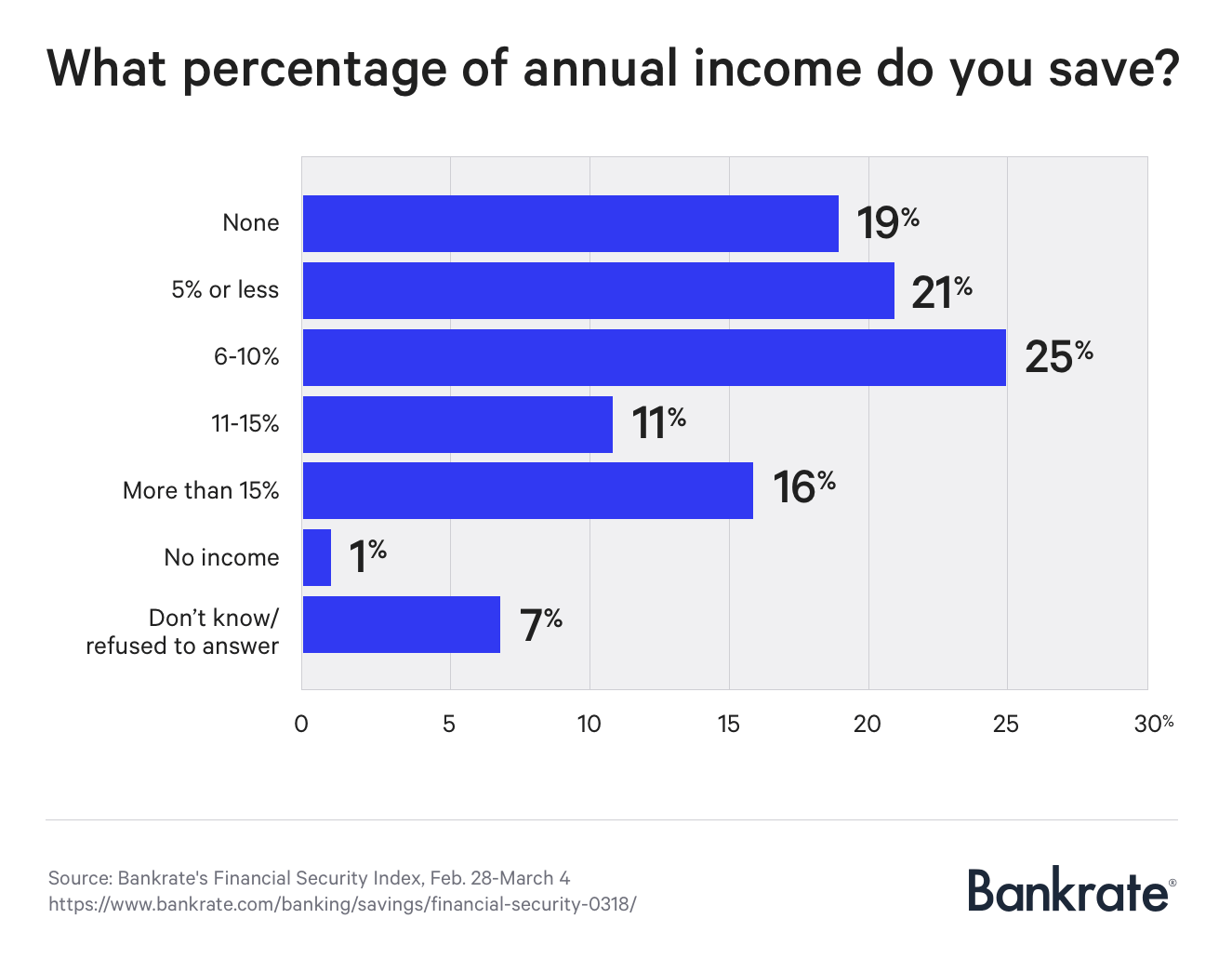
Despite a low unemployment rate and increasing wage growth, Americans still aren’t saving much. That’s according to a new survey from Bankrate.com, which found that 20 percent of Americans don’t save any of their annual income at all and even those who do save aren’t putting away a lot.

Only 16 percent of survey respondents say that they save more than 15 percent of what they make, which is what experts generally recommend. A quarter of respondents report saving between 6 and 10 percent of their income and 21 percent say they sock away 5 percent or less.

At this rate, many people could be setting themselves up to fall short in retirement, Bankrate warns.

“With a steady, significant share of the working population saving nothing or relatively little, it’s virtually guaranteed that they’ll be unable to afford a modest emergency expense or finance retirement,” says Mark Hamrick, senior economic analyst at Bankrate. “That amounts to a financial fail.”

The economy might be prospering now, but that won’t last forever: “The party has to stop sometime, and when it does, employers will lay off workers,” the study says.

In fact, Bankrate estimates that half of the American population won’t be able to maintain their standard of living once they stop working. A report from GoBankingRates found similar results: Over 40 percent of Americans have less than $10,000 saved for when they retire.

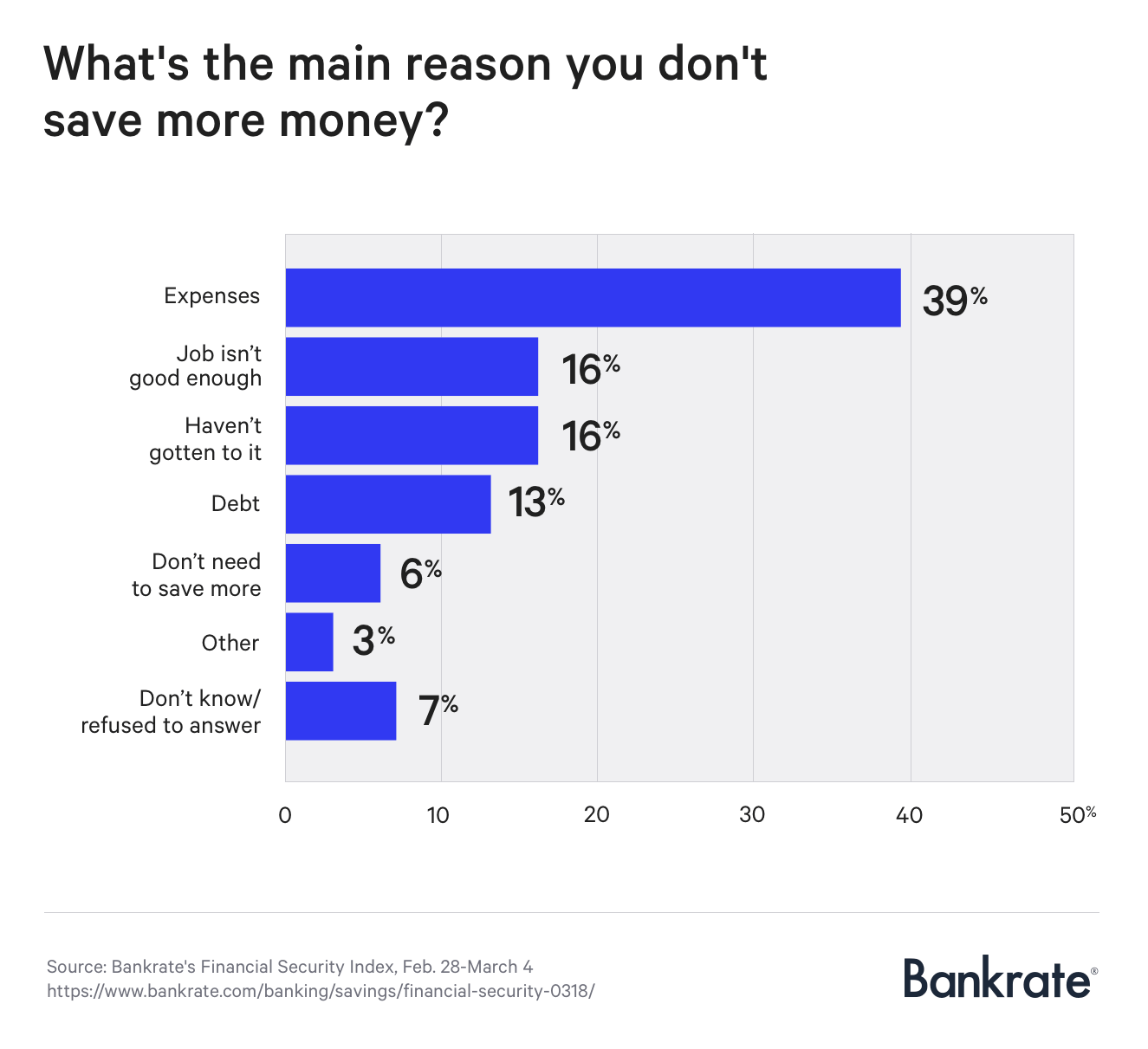
What’s keeping Americans from saving? “Expenses” was the No. 1 answer of 39 percent of respondents. Another 16 percent say they don’t have a “good enough job” to be able to save, which presumably means they aren’t earning enough.

“The average American has less than $5,000 in a financial account, a quarter to a fifth of what you should have, and those aged 55 to 64 who have retirement savings only carry $120,000 — which won’t last long in the absence of paychecks,” the survey reports.

But saving money for retirement doesn’t have to be as hard as it seems. For starters, anyone looking to lower their expenses can consider downsizing their home, trimming their grocery bill or making it a priority to eliminate debt.

Those with the capacity to take on additional work can also bring in extra cash each month by renting out spare rooms, reselling items online or taking on freelance work. Here’s how much the most common side hustles pay.

5 Simple Tips for Getting Stellar Hotel Service

The service at that hotel you just stayed at was so-so. Your friend’s experience at the same property, on the other hand, was spot on. Why the disparity? It may be more than chance.

According to Joshua Bush, a hotel industry expert and the chief executive officer of Avenue Two Travel, while good service at a hotel, even a pricey one, isn’t a guarantee, there are a few ways to increase your odds of getting treated well.

Set Realistic Expectations

Keep in mind that most luxury hotels have an ingrained service culture, while budget and mid-tier properties often don’t. “It’s unreasonable to stay at a three-star property and expect the staff to run around for you because they’re not necessarily trained in providing individualized service,” Mr. Bush said. That doesn’t mean you can’t have a stellar experience at a budget hotel — you should just be reasonable with your desires and demands before you book.

The staff at luxury hotels, however, are usually trained in anticipatory service, and the need to please their guests. They may even have a budget to “wow” guests with surprise gifts such as a bottle of their favorite Champagne, complimentary meals or included activities, or other amenities designed to make a stay at a luxury hotel live up to the luxury price tag.

Pick the Right Property

Good service is in the eye of the beholder and, as a result, choosing the right hotel goes a long way in your interpretation of service. “It’s possible to spend $1,000 a night in two different renowned hotels and have completely dissimilar service experiences because properties have different service philosophies,” Mr. Bush said.

Some high-end hotels, for example, take pride in offering formal and traditional white glove service. Others have a more colloquial approach where the staff greet guests by their first names. Also, some hotels train their staff to constantly check in on guests while others do so with less frequency. Some travelers find the first approach too overbearing while others may perceive the latter as bad service. Consider what you personally prefer, and read up on what type of service the hotel provides before you decide where to stay.

Reach Out Ahead of Your Stay

Getting in touch with your hotel’s concierge in advance of your stay can go a long way toward a stellar service experience. Let them know why you’re coming, and what you’re looking for from your experience.

“Hotels love making your stay above and beyond so if you’re celebrating a birthday or other occasion, make sure to tell the property,” Mr. Bush said. “The more you communicate to the hotel about why you’re there, the better the stay can be.”

Speak Up If Something Goes Wrong

Say your room service order took over an hour to arrive, or housekeeping missed cleaning your room. Mishaps happen, even at the best properties, and Mr. Bush advised informing the hotel’s duty manager right away when something goes wrong.

“A hotel can try to fix the issue or at least make it up to you,” he said. “Too often, guests don’t bother to complain and end up feeling like they had bad service.” But be respectful and calm when you’re explaining the situation. The nicer you are to staff, the nicer they will be to you.

Book Through a Travel Agent

Travel agents, especially those part of large networks such as Virtuoso or Signature Travel Network, can often get their clients free amenities, such as property credit or free breakfasts. You pay a premium to use a travel agent, but in addition to the other services they provide, the added perks can be worthwhile.

Also, when a booking comes in through a travel agent, hotels flag those guests as V.I.P.s, according to Mr. Bush, and they typically enjoy better service during their stays. “You can’t V.I.P. yourself, but an agent has the ability to do that for you,” Mr. Bush said.

Budget-Friendly Healthy Finds at Big-Box Stores

You may have shied away from Costco, Sam’s Club or other warehouse stores if you are single, or shopping for a small family. If so, you could be missing out. With a wide assortment of produce, organic, and fair trade products, even singles can get bargains beyond the 36-roll toilet paper packs.

We priced out these healthy grocery items. All items were more budget-friendly at no-frills warehouse stores than at supermarkets, discount stores such as Walmart and Target, or often even Amazon. Prices will vary, so price out your favorite items, and then compare at warehouse stores, including smaller warehouse stores like ALDI.

Cottage Cheese

If you go through a typical 24-ounce cottage cheese container in three days, the warehouse-store-sized 48-ounce (or even 80-ounce) tubs are for you. We found it priced per ounce at half the cost of grocery stores.

Plain Greek Yogurt

While our favorite is the 2% version for the potential health benefits of dairy fat, you can also get 40-ounce containers of name-brand fat-free plain Greek yogurt for less than $5.00. Even if your household is small, this is a steal for something you’ll use often in smoothies and baking.

Eggs and Milk

It’s tricky to get refrigerated items at online retailers. So browsing for bargains in the refrigerated section of the store is a good idea. A pack of 36 eggs can sell for about $0.11 per egg. And remember, eggs can safely be eaten 3 weeks past their ‘sell by’ date. When milk costs only about $2.00 a gallon, it’s hard not to stock up. Milk is good 7-10 days past the expiration date if properly refrigerated.

Dried Fruit

Especially if you shop for the organic versions of dried fruits like raisins, dates, and figs, prices at warehouse stores will likely be better than you’ll find elsewhere. And while raisins may come in a four-pound box, the box usually contains two resealable packages. Plus, dried fruits are super shelf-stable

Nuts

How about a 2.5-pound package of almonds for only about $12.00? Price nuts out carefully. Some nuts are less expensive at big-box stores…others, not so much. Large quantities of nuts do last well in the refrigerator or freezer.

Organic Produce

If buying organic is important to you, check out the variety of fruits and vegetables at warehouse stores. Again, compare prices. Other fun finds are new produce varieties. We’ve discovered new types of apples in warehouse stores that aren’t yet found in supermarkets. Sometimes produce companies have exclusive deals with big-box stores to test market new forms of single-serve produce packaging too.

Whole Grains

A 3-pound bag of quinoa was priced at only around $3.00 per pound. We’ve also seen budget-friendly large bags of brown rice. Stick with non-seasoned varieties for the best value.

Frozen Foods

As in the regular supermarket, good buys may be found in the freezer case. If your freezer can hold a 4-pound bag of blueberries, snatch it up at $10.00. (Or, share it with friends.) Fish can be grabbed a great cost savings; we like the high-quality of frozen fish in general with today’s flash-frozen-at-sea technologies.

Coffee and Dark Chocolate

You can find less-expensive fair-trade coffee K-cups…just be prepared to carry home a package of 100. And because warehouse stores generally carry only a few brands of most grocery items, they often have information posted (online or in in-store magazines) about why they carry certain ‘responsible’ brands of coffee, baking cocoa, and chocolate chips.

Spices

Spices in some supermarkets can be notoriously stale. But if a spice doesn’t sell well, it’s not sold in warehouse stores., so spices are generally fresh. That said, purchase only quantities of spices you will use in 6-8 months. We like to buy garlic powder, black pepper in the grinder, and dried oregano. Plan to divvy up the large 21-ounce-sized container with friends.

Coconut, Olive and Other Oils

These large jars can be a bargain, but only if you can share with neighbors. And if you pour the oil into your friends’ recycled glass jars, you’ve reduced a little packaging in the world.

Now, a few words on budgeting: avoid impulse buys. While snack mixes and granola bars may be healthy, they may also be more inexpensive shopping elsewhere — or they may not. Compare prices before purchasing, or make your own. Lastly, Costco and Sam’s Club have a yearly membership (ALDI does not.) Membership is usually around $45-60, so make sure you figure this into your budgeting. Take advantage of the free opportunity to walk around stores to compare prices before purchasing a membership.