
Archives for January 14, 2018

Pelican spiders lived 165 million-years-ago and they are ‘spider assassins’

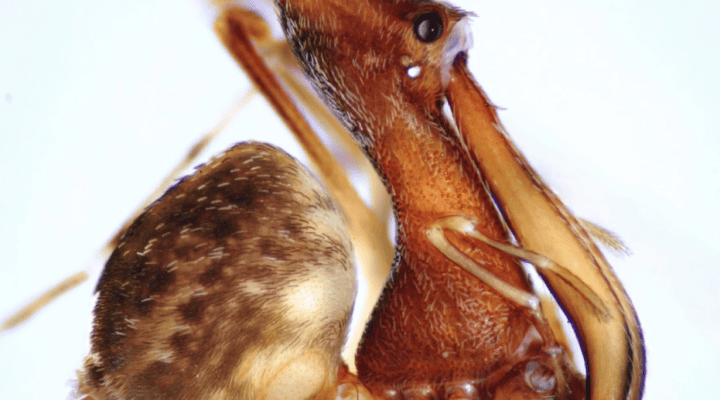
The pelican spider’s long neck and beak-like pincers give it an almost birdy appearance. Don’t be fooled: they’re stone cold killers. Credit: Hannah Wood, Smithsonian

Once upon a time, 165 million years ago, there lived a spider who looked like a pelican. About the size of a grain of rice and just as quiet, the pelican spider tiptoed under foliage in the leafy parts of the world, looking for prey to impale with the fanged, beak-like pincers at the end of its long neck. Its favorite meal: other spiders.

The happy ending to this tale (for arachnophiles, at least) is that pelican spiders still exist today — and in much greater variety than biologists previously thought. According to a new paper published today (Jan. 11) in the journal ZooKeys, there are at least 26 known species of pelican spiders (family name Archaeidae) still creeping around Madagascar and South Africa alone, 18 of which have never been described before. [5 Spooky Spider Myths Busted]

“I think there’s going to be a lot more species that haven’t yet been described or documented,” Hannah Wood, curator of arachnids and myriapods at the Smithsonian Institution’s National Museum of Natural History and author of the study, said in a statement. After years of collecting pelican spiders from Madagascar and studying them in museum collections, Wood and colleague Nikolaj Scharff of the University of Copenhagenin Denmark described the bizarre hunters in unprecedented detail.

Spider assassins caught in the act

How the pelican spider got its name is no mystery. When not hunting, the spider often folds its fanged pincers, called chelicerae, down against the long, neck-like appendage connecting the arachnid’s head to its body. As a result, the pelican spider looks more like a bird than a spider in profile. Unlike a bird, however, the spider’s mouth is situated at the bottom of its neck, putting the opening at perfect range to feast on whatever the spider manages to catch on the tips of its chelicerae.

Pelican spiders are active hunters, the paper said. Rather than spinning their own webs, they prefer to stalk the trails of silk left behind by other spiders scuttling around their leafy habitats. At night, pelican spiders follow these silky bread crumbs, moving slowly and often upside down through the leaves. While the spider’s back six legs do the walking, their front two legs sweep through the air, feeling for prey. After finally reaching the edge of another spider’s web, pelican spiders can wait for hours for the right time to strike (earning them the moniker “assassin spiders”).

Then, they strike with deadly efficiency. The spiders swing their chelicerae away from their bodies in a rapid, 90-degree arc tojab the pincers into their prey. Thanks to the spider’s long necks and pincers, they keep their prey held harmlessly at arm’s length while deadly venom pumps through the predators’ chelicerae and into their victims.

“Then,” Wood told Science News in 2014, following publication of a previous pelican spider study, “they pull out one chelicera and leave the other one hanging out there with the spider prey impaled on it.” Feasting follows.

Pelican spiders are unusual, even by arachnid standards, the statement said, but their methods are time-tested. Wood calls today’s pelican spiders “living fossils,” as the arachnids appear remarkably similar to species preserved in the fossil record dating back up to 165 million years.

Most modern specimens of pelican spiders have been collected from Madagascar, South Africa and Australia. This wide distribution suggests the species’ arachnid ancestors once lived on the supercontinent Pangaeabefore it began breaking apart roughly 200 million years ago.
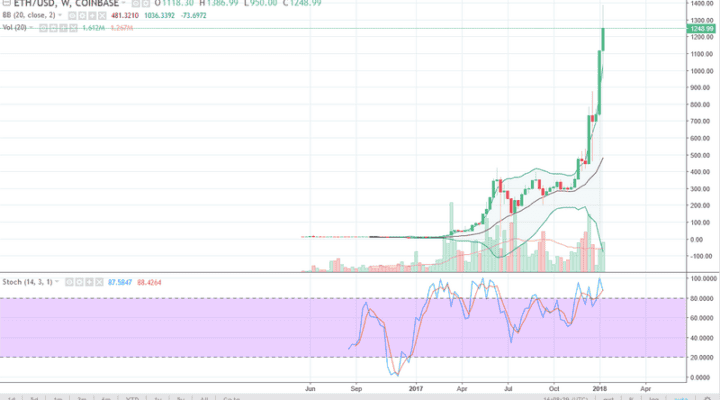

ETH/USD Price forecast for the week of January 15, 2018, Technical Analysis

ETH/USD weekly chart, January 15, 2018

Ethereum markets rally during the week, reaching towards the $1400 level but failing. I believe that the market continues to find bullish pressure overall, but longer-term traders will probably be looking for pullbacks to take advantage of value. We are overstretched add just about any metric you measure it by, so having said that I think that it’s very likely that the markets will offer plenty of opportunities going forward. I believe that the $800 level should be an area that offers plenty of support, and would love to see this market drove down to that level. However, we may not get that opportunity based upon the momentum. Because of this, adding slowly is probably the way to go for longer-term traders, using dips as entries.

Adding as it goes in your favor off of short-term charts probably makes the most sense, as longer-term traders will certainly be looking to hold on to the gains, but I think if you are cautious and look at lower time frames, you can get better pricing on your trade, which at the end of the day leads to better profits. Obviously based upon the chart, there’s almost no way to short this market, at least not from a longer-term perspective. Ethereum is probably the strongest looking crypto currency that I follow, and with that being the case it makes sense to make this a “buy only” market. Expect volatility, but with an upward slant.

Virtual Credit Card – What You Need to Know

Here are the pros and cons that experts say you should keep in mind when using a virtual credit card.

Virtual credit cards have been around in one form or another for years now, but their use has yet to truly take off among consumers.

A crop of new start-ups however, such as Pay With Privacy and Token Payments, are poised to change that.

These two companies may not be household names but perhaps they should be. Both are joining the effort to help consumers beat credit card fraudsters at their game at a time when the list of blockbuster data breaches seems to be growing longer by the day.

For those not familiar with virtual credit cards, they come in various forms but are typically temporary, randomly generated, credit or debit card numbers. Often the numbers link to a real payment account, such as a credit card, debit card or checking account.

In many cases, the cards are designed for a single use. They’re known as “burners” meaning they expire immediately after use (though some can be scheduled to last for up to one year). There are also virtual cards that can be created and locked for use with only a single merchant and virtual cards that allow for setting a maximum charge amount.

The beauty of such cards is that if a hacker gets hold of the information, it doesn’t matter, because the damage that can be done is minimal.

Originally developed to make online credit card purchases more secure, the cards are now also being used with increasing frequency in brick and mortar stores thanks to the rise of mobile wallets such Apple Pay, Google’s Android Pay and more.

Here are the pros and cons that experts say you should keep in mind with this payment technology.

Refunds and Disputes Can Be a Hassle

Most refunds for purchases made with a credit card are made directly to the account that was used for the original purchase, notes Chargebacks911 co-founder and COO Monica Eaton-Cardone.

However, with disposable credit cards that “account” will no longer exist if the purchase was made with a virtual card and the number has already expired.

“That can create headaches for users,” says Eaton-Cardone.

The solution to this issue can range from the merchant in question providing a cash refund to you being required to accept a store credit.

Another issue to keep in mind, said John Buzzard, an industry fraud specialist at CO-OP Financial Services, is that virtual cards offer little consumer protection in the case of a dispute for services not rendered or received.

Associated Fees

Read the fine print when using virtual credit cards, and understand how they operate including the various fees charged.

For instance, some companies allow you to load money onto the card, explains Eaton-Cardone. But you may be charged a monthly fee if the balance dips below $25.

“There’s a bunch of things they do because they want to make sure you are incentivized to keep money on the card,” explained Eaton-Cardone

Some of the cards have expiration dates, (also noted in the fine print), which can lead to inadvertently allowing the card to expire while there’s still money on it.

Other disposable cards include foreign transaction fees or fees for paper copies of documents that have already been provided.

Verification May Be a Problem – Particularly for Travel Related Transactions

Virtual credit card numbers can certainly be used to book such things as car rentals and hotel rooms online through sites such as Expedia, Orbitz and more. But when you show up to pick up that rental vehicle, you’ll be required to have an actual credit card to swipe.

“With disposable credit cards, the account numbers won’t match,” says Eaton-Cardone.

When booking hotel rooms online with a disposable card, you may be able to request that the property in question charge the cost of the room to the card you used to make the reservation. However, you will still need to present an actual credit card to be swiped upon check-in to cover incidentals.

Virtual Credit Cards and Mobile Wallet Technology

One of the growth spaces for virtual credit cards is in conjunction with mobile wallet technology such as Apple Pay, Android Pay and more.

A virtual card can be issued instantly, even while standing in line at a brick and mortar store, and some can be delivered to your Apple Pay account, explained Jason Gardner, CEO of Marqeta, a fintech firm that enables companies to issue and manage virtual cards.

The card can be preconfigured with a spending limit instantly, funded, unloaded, suspended or cancelled, all in real time, granting the cardholder complete control.

“These cards create a lot of choice for consumers, different products that fit different constituencies,” said Gardner. “You are seeing a significant decline in private label cards. The growth of these virtual credit card companies is undeniable.”

For the digital obsessed Millennial demographic in particular, it’s an option that is very appealing. If you look at Millennials and the top 50 brands they focus on, there’s not a single bank, or credit card company among the list. Companies like Facebook, Amazon, and Twitter are all taking over, making digital and virtual products more mainstream.

In such a world, virtual credit cards are a natural fit.

“Most millennials are not carrying credit cards now,” said Gardner. “But they all have mobile phones. And the ability to instantly make a credit decision and pay with the mobile phone is beautiful consumer experience and it also generates choice.”

One last downside however, is that mobile wallet payments are still not widely accepted by merchants. But that too may be changing in 2018 and beyond.

Vote: What city is most worth visiting in Canada?

Toronto is playing in the big leagues now after it’s included in a list of top 10 cities to visit in the Americas.

Canadians awakened to some shocking news yesterday morning as the venerable New York Times listed Saskatoon, Sask. as one of it’s 52 places to visit in 2018. While being the only Canadian city to make the cut, the paper of record highlights some new attractions that the country’s 16th-largest city has to offer outside visitors.

Unbeknownst to most Canadians, a number of iconic 20th century artists, like Pablo Picasso and Georges Braque, are among the artists whose work is displayed among the 8,000 pieces of artwork held by the museum. According to Tourism Saskatoon, the city earns $350 million a year from 2.1 million annual visits. The Times also highlighted that the city is currently developing its riverfront and the recent upgrades made to the city’s airport.

So far, Saskatoon’s selection as the only Canadian destination has drawn little controversy, at least judging by the online reaction.

The poll does beg the question of why other Canadian locations weren’t selected. Many of the places named by the New York Times weren’t specifically cities but regions or entire countries.

Larger regions could’ve been highlighted, like the Okanagan Valley or Niagara’s wine country. Or the hundreds of national parks from coast to coast to coast that dot the country. Or any of the 15 Canadian cities with populations larger than Saskatoon’s. Toronto, for instance, is one of the top 10 cities to visit in the Americas, according to a new report by business intelligence company Euromonitor International. Then again, the Times did name the entirety of Canada as a top spot for travellers to visit last year. So who knows what their game is.

Nevertheless, a lingering question must be put to a vote. What Canadian city do you think is most worth visiting?

How to Avoid Credit Card Theft while Traveling

Whether you plan to travel now or in a year, you should take steps to protect yourself from identity theft and credit card fraud while you’re on vacation. Tourists are often victims of theft, including passport and credit card theft—both of which can compromise personal information. Thieves can gain data by physically taking belongings the old-fashioned way or by hacking into your phone or computer.

By following these six tips before and after you travel, you could save yourself years or even a lifetime of credit and financial nightmares.

1.Notify Your Creditors of Your Travel Plans

Before you travel anywhere, call your credit card companies and your banks to let them know where you will be and when you plan to travel. Many banks and credit card companies keep track of your spending habits, so any purchases out of the norm may prompt them to lock down your account—this could be especially frustrating if you are out of the country and have no way of reaching your bank or credit card company.

If you do end up going overseas, find out the best way to get in touch with your creditors should your credit card or bank card get lost or stolen while you are away. Keep this information and all creditor phone numbers in a safe place that is separate from your cards—then you’ll have it on hand no matter what happens to your wallet or purse.

2. Set Up Email or Text Alerts

As you prepare to travel, subscribe to mobile email or text alerts. By doing so, you will be notified of all activity on your accounts. Receiving email or text alerts on your phone can stop credit card fraud in its tracks, since transaction information is sent to you almost instantaneously. This timely warning can help you resolve unauthorized purchases on the spot.

3.Make Copies

Whenever you travel, make photocopies of both the front and back of your credit cards. Give the copies to a trusted family member or friend at home. In the unfortunate event that your credit card is lost or stolen, you can quickly obtain all the information you need to cancel your credit card.

If you prefer to store copies digitally, you can scan and upload your copies to a secure cloud storage site, such as Google Docs or Dropbox. Should you access your documents while traveling, make sure you are connected to a secure network and not to an open Wi-Fi connection where hackers can steal your passwords and get into your accounts.

Whatever you do, do not keep copies in your luggage. Should your luggage get lost or stolen, you are putting yourself at risk for credit card fraud as your credit card numbers can be used to make fraudulent purchases.

4.Check Your Credit Card and Bank Accounts Often

If you haven’t done so already, sign up for online access to your bank accounts and credit card statements. Consider downloading the mobile apps for your bank and credit cards for easy and convenient access to your accounts. With these apps, you can not only view your bank balances and credit limits but also see all current transactions.

As soon as you see anything suspicious, immediately contact your bank or credit card company to report the questionable charge. Once you’re home, review the transactions from your trip to ensure you didn’t miss any unusual activity that should be reported.

5.Update Your Account Passwords and PINs

If you can’t remember the last time you updated your password or account PIN, it’s probably a good idea to do so now. Create passwords that are long and unique to each credit card and bank account. Updating your passwords and PINs may be a cumbersome task, but the time you take to do so will be well worth the extra protection and security.

6.Stay Alert at All Times

With the recent Equifax data breach, many are on high alert and constantly looking out for suspicious activity. But with time, people may grow lax and check their accounts less often—and this is when a credit card thief’s strike will hurt the most.

Some thieves may sit on your information in hopes of catching you unaware. So it’s important to continually monitor your credit and keep your files and important documents in safe and secure locations where thieves may not think to look.

If you’re thinking of taking a trip, use these tips to avoid credit card theft and protect your financial standing. Credit card fraud can be damaging if not handled properly, so don’t be afraid to check your accounts frequently or err on the side of caution. You can never be too careful.

Lucky find gives Archeologists Glimpse into Early Hunting Technology in Yukon

Lucky find gives archeologists glimpse into early hunting technology in Yukon

Yukon archeologist Greg Hare says it was just luck that led him in 2016 to find a nearly 1,000-year-old hunting artifact, half exposed in a remote patch of ice.

Recent radiocarbon dating confirms that the arrow blade point is one of the earliest examples of copper metallurgy ever found in Yukon.

Hare was travelling with a documentary film crew over the ice patches near Carcross, Yukon, in July 2016 when they spotted some caribou on a hillside. Hare had been showing the crew some of sites where he and other archaeologists have been finding ancient First Nations hunting weapons over the last 20 years.

They were flying in two helicopters, and Hare’s helicopter decided to land to get out of the film crew’s shot. While waiting on the ice patch, Hare and his team spotted an antler arrow point half buried in the ice. It looked like it had just been fired from a bow.

They pulled it out and discovered a copper end blade attached.

“It was so fortuitous that those caribou were on that patch, that the television crew wanted to film that, that we landed at this little scruffy patch,” said Hare.

“We would have never have stopped there any other time because that ice patch melted right away.”

In fact, Hare said he went back a few weeks later to look for more artifacts and says the ice patch had completely melted leaving nothing but some semi-frozen caribou dung.

Early bow and arrow technology

The arrow point end blade proved to be quite a find, though.

“This is one of the oldest copper elements that we ever found in the Yukon,” Hare said.

For thousands of years, caribou took refuge in the summer up high on the alpine ice patches to escape the heat and swarms of harassing insects. That made those ice patches good areas for ancient hunters to get close to the caribou.

Some weapons would miss their marks and disappear in the snow and ice, over time building a treasure trove of artifacts now revealed by the melting ice. Archaeologists have found ancient hunting tools made of wood, antler bone, and now copper.

“The significant part of the story is that [the arrowhead] is so old, and it is such a beautiful expression of copper metallurgy,” Hare said. “Copper only first shows up in the Yukon about a thousand years ago and this is almost at the beginning of that technology.”

“That technology” refers to the bow and arrow, which replaced the atlatl (also known as a throwing dart) around 1,100 years ago as the main weapon used by Indigenous hunters.

“Most people when they think of First Nation hunters, they associate with bow and arrow hunting. But in fact, for almost 8,000 years First Nation hunters in the Yukon were using the throwing darts, the Atliatli,” said Hare.

“Then all of a sudden there was quite a sharp change in the technology, for whatever reason. People stopped using the throwing dart and they started using bow and arrow.”

Recent radiocarbon dating of the copper arrowhead pegs it at 936 years old, meaning it would be among the earliest examples of bow and arrow technology ever recovered in Yukon.

Hare says it’s made of a copper nugget and is 99.9 percent pure. It would have been locally found, he said.

“It is not a European alloy. It is an entirely copper-made, from a placer nugget of copper that would have been recovered from one of the creeks in southwest Yukon,” he said.

‘Links to the past’

The Carcross/Tagish First Nation’s heritage consultant Jennifer Herkes says the find supports the oral traditional knowledge elders have passed on.

“They act as kind of a physical tangible evidence of the links to the past. They support all of the traditional knowledge and the stories the elders share about the connection to the land and the connection to their neighbours,” she said.

Hare says he can only guess how long it took the hunter to make the copper arrowhead.

“When you look at how much work that went into making this arrow point, it probably represents two weeks of work on somebody’s part,” he said.

“So my question at the time we found it was, how long did that person spend looking for it, after they lost it. I think they would have looked for two weeks.”

He says it would have been a significant loss at the time for the hunter, but lucky for the caribou.