Archives for November 27, 2017

Exxon Mobil chief revamps refining, chemical operations – spokeswoman

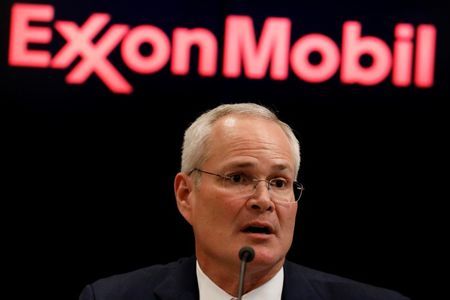
Darren Woods, Chairman & CEO of Exxon Mobil Corporation speaks during a news conference at the New York Stock Exchange (NYSE) in New York, U.S., March 1, 2017. REUTERS/Brendan McDermid


By Ernest Scheyder and Erwin Seba

HOUSTON (Reuters) – Exxon Mobil Corp Chief Executive Darren Woods is reorganizing the company’s refining and chemical operations, part of a push to boost profits amid volatile oil and natural gas prices, a spokeswoman said.

The changes at the world’s largest publicly traded oil producer are the most sweeping to date by Woods, who became chief executive in January after former chief Rex Tillerson resigned to become U.S. secretary of state.

Woods has moved first to reshape the businesses he knows best, according to sources familiar with the matter. Before taking the helm at Exxon, Woods ran Exxon’s refining operations and earlier in his career was a senior executive in its global chemicals unit.

The reorganization aims to squeeze more profits from the fuel and chemicals businesses as the company works to improve its exploration and production operations, which have struggled since 2014 to adjust to lower oil and gas prices.

The restructuring, disclosed internally last month, will combine the fuels and lubricants division with the supply and refining divisions.

Financial responsibility for the merged operation will rest with country and regional chiefs who report to Exxon’s Irving, Texas, headquarters rather than divisional bosses as previously, according to people familiar with the matter.

The changes are designed to simplify operations and increase accountability for profitability, the sources said.

Exxon spokeswoman Charlotte Huffaker confirmed the overhaul in a statement, adding the company expects it will “improve decision making and enhance performance in the market.”

It was not immediately clear if the changes will involve job cuts or executive departures. Huffaker said she could not say if there would be any impact on jobs.

REFINING STRENGTH

Exxon’s refining and chemical operations have grown in stature under Woods, delivering steady earnings compared to its oil and gas production.

Exxon operates 22 refineries in 14 countries, processing nearly 5 million barrels of oil per day. The firm builds chemical and refining plants in the same location, allowing managers to shift production between fuels or chemicals based on demand.

The changes come as Exxon expands the refining division. The company is investing $20 billion through 2022 to expand its chemical and oil refining plants on the U.S. Gulf Coast.

The refining and chemicals arms contributed more than $4.2 billion apiece to 2016 earnings, compared with a $196 million profit from exploration and production. Last year’s results were affected by sharply lower crude prices.

In some quarters, Exxon would not have made any money were it not for its refineries.

This year, the company’s oil and gas business bounced back to a $5 billion profit during the first nine months on stronger crude prices. Refining earnings were $4.03 billion and chemicals $3.25 billion, respectively, for the first three quarters this year.

Some staff members have raised questions as to whether there is any need to alter a system seen as largely successful, said the sources who declined to be identified.

It was unclear if the changes would impact an internal accounting practice known as general interest principle. That rule permits certain transactions to be loss-making for a local division if they are beneficial for the corporation as a whole.

Exxon did not comment on any potential accounting changes.

Apple’s Stock Set to Rip Higher Well Into December: Must See Chart

There’s no two ways about it — 2017 has been a magnificent year to be an Apple Inc. shareholder.

Since the calendar flipped to January, shares of Apple are up more than 50%, more than triple the return of the rest of the S&P 500 over that same time frame. But with Thanksgiving right around the corner this week, the thing Apple investors should be most thankful for might actually be the upside that’s still left in shares of Apple in the final stretch of the calendar year.

As Apple heads deeper into the seasonally strong holiday quarter, consumers are being greeted by a product catalog that includes a pair of popular new iPhone models, and analyst estimates that could make it the firm’s most profitable quarter in history.

But that’s not the immediate-term driver in shares of Apple right now.

Instead, it’s the price action that’s signaling buyers are still very much in control of things for this tech giant this fall.

To figure out how to trade it, we’re turning to the chart for a technical look.

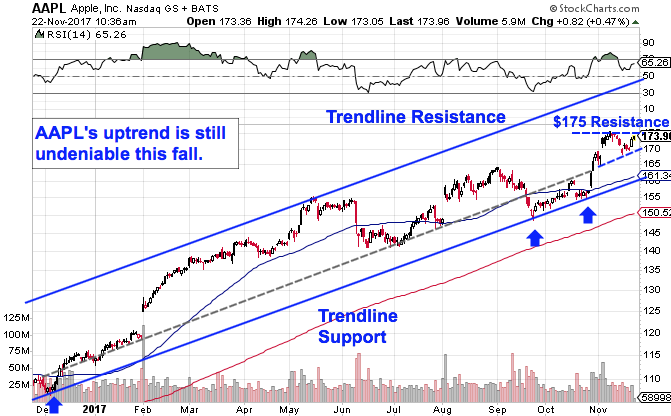
Glancing at Apple’s chart, it’s not hard to spot the overarching price trend in this big stock right now. Shares have been bouncing their way up and to the right in a well-defined uptrending channel since the end of last year — and that uptrend remains very much intact right now.

Shorter term, Apple is forming a pretty textbook example of an ascending triangle pattern, a bullish continuation setup, within the context of that uptrend. The ascending triangle is formed by horizontal resistance up above shares at $175, and uptrending support to the downside (formed by the dashed lines on the Apple chart above).

Simply put, as shares have bounced in between those two technical levels all month long, they’ve been getting squeezed closer and closer to a breakout through that $175 price barrier – once that happens, we’ve got a refreshed buy signal in shares. Apple is within grabbing distance of that $175 price tag today.

If you’re looking for a buying opportunity in shares of Apple, it makes sense to wait for shares to push through $175. On the other hand, if you already own this stock, it makes a lot of sense to hold on as we finish up November and head toward December. Long term, buyers are still clearly in control of the price action in this stock, and shares are on the verge of a new short-term buy signal as well.

There’s still a lot of upside left in Apple this fall.

Energy Tycoon to Pour $4.6 Billion Into Southeast Asia’s Boom

Energy Tycoon to Pour $4.6 Billion Into Southeast Asia’s Boom
  • Sarath Ratanavadi’s Gulf Energy plans to add power plants
  • Gulf’s IPO is turning Sarath into newest Thai billionaire

Gulf Energy Development Pcl’s billionaire founder Sarath Ratanavadi plans 150 billion baht ($4.6 billion) of investment in power plants over the next four years after the company’s listing this month.

The initial public offering’s proceeds will help fund some of the outlay, with the rest coming from loans, Sarath, the company’s chief executive officer, said in an interview in his Bangkok office. His net worth is about $2.2 billion based on Gulf Energy’s $733 million IPO, according to the Bloomberg Billionaires Index.

“Gulf Energy will have stronger financial leverage for more expansion following the IPO, as new power plants require a large amount of money,” Sarath said on Friday. “The company is looking at a number of opportunities in Thailand and neighboring countries.”

Sarath Ratanavadi

The firm is studying projects in such countries as Myanmar, Laos and Vietnam, where faster economic growth will boost demand for electricity, he said. Southeast Asian nations are enjoying an economic boom, spurred by a global recovery that’s buoying exports.

Read about how Gulf’s IPO minted Thailand’s second billionaire in a month

Sarath said the investment plan will focus on gas-fired electricity and probably cover acquisitions of existing power plants and green-field projects. Gulf Energy generates almost all of its power from natural gas and will double output to 4,647 megawatts by 2024, according to a filing.

Coal faces regulatory curbs due to pollution and returns on renewable energy are comparatively low, Sarath said. Such risks underscore the need for measured expansion, he added.

The IPO is the largest first-time share sale in Thailand since Jasmine Broadband Internet Infrastructure Fund priced a $1.7 billion offering in 2015, according to data compiled by Bloomberg. It adds to the $2.5 billion of first-time share sales in the country this year, up from $1.5 billion during the same period in 2016, the data show.

Index Providers Rule the World—For Now, at Least

Decisions about what to include are leaving some on the outs.

In September 2015, Peru’s then-finance minister abruptly changed his plans and hopped on a jet to New York. By the time ­Alonso Segura Vasi landed in the U.S., officials from the country’s central bank and ­securities regulator were also en route to join him.

What prompted a bevy of Peruvian officials to make the eight-hour journey wasn’t a matter of urgent statecraft or diplomacy. Instead, it was a rumor that the financial company MSCI Inc. might oust the South American country from its widely followed emerging-markets index, a prospect that Vasi knew required ­immediate intervention.

“Peru is not a name for the frontier market,” says Vasi, who’s now the finance director at Pontifical Catholic University of Peru. While he says that Peru has a small presence in the ­emerging-markets index, reclassifying it as a frontier market—turf occupied by Vietnam, Croatia, and Kenya, among others—would have created an unfortunate imbalance. “It would have been more than a fifth of the index,” he says.

Something else that might be described as imbalanced: the growing clout of index providers such as MSCI, FTSE Russell, and S&P Dow Jones Indices. In a market increasingly characterized by passive investing, these players can direct billions of dollars of investment flows by reclassifying a single country or company, effectively redrawing the borders of markets, shaping the norms of what’s considered acceptable in international finance, and occasionally upsetting the travel plans of government ministers. (Bloomberg LP, the parent company of Bloomberg News, owns the Bloomberg Barclays-branded bond indexes, the most widely followed measure of fixed-income performance worldwide.)

Benchmark indexes trace their history to the late 1800s, when Charles Dow, co-founder of Dow Jones & Co., created the first as a way to gauge the general direction of the market (and to sell newspapers). Today the number of benchmarks outnumbers that of individual stocks. “The problem is that a lot of investors assume that the benchmarks are almost God-given and that they’re ­problem-free. Most of the time they’re not,” says Mohamed ­El-Erian, chief economic adviser at Allianz SE and a Bloomberg View contributor. “It’s a crucial issue. And it’s becoming even more important as more and more people migrate to passive products.”

In the realm of emerging markets, the power of index providers has been on display in recent months with prominent and sometimes controversial reclassifications involving countries such as China, Argentina, and Venezuela. Yet even as the influence of these companies swells, there are those who would seek to unseat them—including some passive fund managers.

Not many remember that the modern borders of Kuwait were created by a British colonialist named Percy Cox as a way of placating an ambitious Saudi Arabia, whose eponymous ruler, Ibn Saud, wanted to expand his own territories. Almost a century later, there’s a “Kuwait problem” of a different sort—frontier-market investors wanting less Kuwait in a widely followed index. The tiny Gulf state accounts for almost 19 percent of the MSCI Frontier Markets Index, typically used by investors willing to stomach risk in exchange for rapid growth. Kuwait, with a population of 4 million and gross domestic product expansion in the low single digits, arguably doesn’t fit the bill.

“Frontier investors would like more frontier stuff in the index and less Kuwait,” says Andrew Howell, strategist at Citigroup Inc. “They want more of countries like Bangladesh or Vietnam, large populations with lots of development potential.”

The Kuwait problem is emblematic of the disagreements that can erupt in an area of finance that prides itself on its objectivity. Index providers say their decisions to include or exclude certain stocks, bonds, or countries are rules-based, driven by impartial analysis of the size, liquidity, and overall “investability” of respective markets. “When we build an index, we want to make sure that it is representative of the opportunities that can be invested in,” says Chin Ping Chia, MSCI’s head of Asia-Pacific research. “Think of us as a mirror that reflects the various needs of investors and also to facilitate that communication process.”

The worry, however, is that passive investing effectively ­passes the proverbial buck. These decisions can be especially noteworthy in emerging markets, where index providers must weigh the desires of investors hoping for early exposure to growth with the realities of underdeveloped capital markets. And for every Argentina—which made it back into JPMorgan Chase & Co.’s bond index earlier this year, despite a history of serial defaults—there’s a poster child of another sort. The moral quandaries of financing the Venezuelan government, for instance, recently exploded into the public consciousness, with critics deriding the inclusion of the country’s debt in various indexes.

“Somebody is making very active decisions about which stocks will be in each index or ‘passive’ product,” says billionaire investor Howard Marks, co-founder of Oaktree Capital Management LP. According to him, passive investors are outsourcing decisions about portfolio allocation. “They’re not making decisions as to which stocks to invest in,” he says. “Instead, the people who create the indices are deciding which stocks will be invested in.”

Making those decisions has become big business. Passive vehicles, especially cheap exchange-traded funds, rake in an average $3 billion per day. Every passive fund must replicate and track an index—it wouldn’t be passive otherwise—then pay license fees to third-party index providers, boosting the influence of the companies as well as their bottom lines. Index revenue at S&P Global, MSCI, and FTSE Russell surpassed $1 billion in the six months through June, up from $858 million the year before.

“We’re not activists,” says Mark Makepeace, head of FTSE Russell, which this year banned companies that don’t give shareholders enough voting rights from joining its gauges. “We’re setting the minimum standards that investors generally will accept, and our role is to build consensus amongst that investor community as to what that minimum standard should be.” FTSE Russell upgraded Kuwait to its own emerging-markets stock index in September, a move that’s expected to spur as much as $822 million of inflows.


Michael Buek
 who works within Vanguard Group Inc.’s vast equity indexing group, has watched MSCI wrestle with whether to include mainland Chinese shares in its key emerging-markets benchmark. Buek says he wasn’t surprised that the country remained excluded in 2014, 2015, and 2016. “I knew based on the trading costs and investability it would take longer,” he says.

MSCI finally unveiled plans to slowly add China’s domestic shares to its emerging-markets index last June. Of course, some investors want greater exposure—and faster. Others are still wondering why a market that remains marked by capital controls and restrictions on foreign investors has been included at all.

Yet few decisions by index providers catch Buek by surprise. While he and other passive industry players are working increasingly closely with the third parties to form benchmarks, Buek says the “hypercompetition” among providers means that if Vanguard doesn’t like your index, there are plenty of others to choose from. (For its part, Vanguard parted ways with MSCI in 2012.)

Another option has become increasingly tempting for ETF providers as they try to cut costs and escape the third-party stronghold: self-indexing. In October, State Street Global Advisors ditched FTSE Russell indexes for three of its SPDR products, opting to build propriety equity indexes instead. While the move sent ripples through the market, it also meant that State Street, freed from licensing fees, was able to slash prices on the funds to as low as 3 basis points, making them some of the cheapest such products available. In the race to lower charges for investors, eliminating payments made to third-party index providers may ultimately prove the last step toward reaching the holy grail of zero percent fees.

“I look at self-indexing as just another tool or opportunity when we evaluate new funds or changes to funds,” says Noel Archard, head of global product at State Street’s SPDR ETF business. “I view it as a future option, but it’s not something where we’re thinking, Yep, everything is going self-indexing or, There’s going to be no third party.”

Despite the pressure to lower fees, ambivalence about the future of self-indexing can be found at most of the largest ETF providers. They’ve spent decades working with third parties such as S&P Global, forging the success of passive investing alongside one another. BlackRock, State Street, and Vanguard, which together control more than 80 percent of ETF assets, all have said that they don’t have any plans to convert completely—or even predominantly—to in-house indexes.

“One of our close partners is MSCI,” says Mark Wiedman, global head of iShares and index investments at BlackRock Inc. “Often it’ll be MSCI that brings us to a client. In that case, they’ve delivered huge value to us, and their client tends to think in MSCI terms.”

But even if self-indexing fails to make much of an immediate dent in the dominance of major benchmark index providers, another threat looms in Europe. Benchmark regulation will subject the decisions of index providers to supervision and “added controls,” according to the European Securities and Markets Authority. It’s unclear what that might mean for self-indexing funds, which are striking out on their own just as regulators are taking an interest in third-party providers. But already there’s a hint of tension. “In Europe, we’re all about to be regulated. Self-indexing has not been called out directly, but a lot of the regulations in Europe are around eliminating conflicts of interests,” says Alex Matturri, chief executive officer of S&P Dow Jones Indices. “The idea of self-indexing is contrary to the concept of independence.”

More controversial decisions by index providers are nearing, including the potential inclusion of Saudi Arabia’s stock market in the MSCI Emerging Markets Index as early as next year. If included, the kingdom would essentially leapfrog frontier-market status and head straight into the bigger and broader ­emerging-markets bucket, enjoying an estimated $4 billion of flows from new investors along the way. China’s domestic bonds are also up for inclusion in major indexes run by companies such as JPMorgan.

In the meantime, market participants will mull just what the growing number of indexes, and the expanding sway of their providers, really means—especially when there’s a sense of unease that markets at record highs are being driven by investors chasing inflows rather than fundamentals.

“People often say, what would happen if the world were all index? My great-grandchildren will face that question,” says BlackRock’s Wiedman. Like many managers of passive funds, he argues that too much indexed money will self-correct as active managers find more opportunities to outperform.

Peru might feel differently. After government officials personally showcased the country’s planned market reforms, MSCI demurred from downgrading it to a frontier market. According to former Finance Minister Vasi, it was a narrow miss that would have generated cataclysmic outflows based on “incomplete information” of Peru’s plans.

“You couldn’t take a chance,” Vasi says of his run-in with index providers. “Investors’ decisions to invest in the market are significantly guided by their decisions, whether they put you in the index or do not put you in the index. They do control the fates of companies’ and countries’ access to capital markets.”

Nvidia Scores Key Artificial Intelligence Deal With GE’s Healthcare Division

Nvidia continues to rack up big wins for its advanced computing technologies. The newest one comes with General Electric’s healthcare division.

The two companies issued a joint press release on Sunday revealing Nvidia’s processors will be used in GE Healthcare’s 500,000 imaging devices globally. GE says the partnership will help drive lower radiation doses for patients, faster exam times and higher quality medical imaging.

“Healthcare is changing at remarkable speed, and the technologies that will transform the industry should reflect that pace,” said Kieran Murphy, President and CEO of GE Healthcare in a statement. “By partnering with Nvidia, GE Healthcare will be able to deliver devices of the future – intelligent machines capable of empowering providers to improve the speed and accuracy of diagnoses for patients around the world.”

For Nvidia, the deal is another feather in its cap in a year that has seen its stock price skyrocket 112%. The deal highlights efforts by the healthcare community to tap AI to improve patient care.

Ultimately, Nvidia continues to prove that it’s more than a play on Bitcoin and gaming. Inking more deals like this one may get an already bullish Wall Street thinking whether Nvidia’s shares are a bargain, even at 46 times forward earnings estimates.

Nvidia and General Electric are holdings in Jim Cramer’s Action Alerts PLUS Charitable Trust Portfolio. Want to be alerted before Cramer buys or sells NVDA and GE? Learn more now.

U.S. oil dips on increased drilling, but OPEC cuts support global markets

FILE PHOTO: Equipment used to process carbon dioxide, crude oil and water is seen at an Occidental Petroleum Corp enhanced oil recovery project in Hobbs, New Mexico, U.S. on May 3, 2017. Picture taken on May 3, 2017. REUTERS/Ernest Scheyder/File Photo

By Henning Gloystein

SINGAPORE (Reuters) – U.S. oil prices dipped on Monday, easing from two-year highs on the prospect of increased U.S. output, although global markets were slightly better supported by expectations an OPEC-led supply cut will be extended.

U.S. West Texas Intermediate (WTI) crude futures were at $58.65 a barrel at 0252 GMT, down 30 cents, or 0.5 percent, from their last settlement. Brent crude futures <LCOc1> fell just 13 cents, or 0.2 percent, to $63.73 a barrel.

U.S. crude production <C-OUT-T-EIA> has risen by 15 percent since mid-2016 to 9.66 million barrels per day (bpd), not far from top producers Russia and Saudi Arabia, and increasing drilling activity for new production means output is expected to grow further, traders said.

U.S. energy companies last week added oil rigs, with the monthly rig count rising for the first time since July, to 747 active rigs, as producers are attracted by climbing crude prices.

WTI touched a 2015 high on Friday at $59.05 a barrel, partly driven higher by the closure of the 590,000 bpd Keystone pipeline connecting Canada’s oil sand fields with the United States following a spill, which reduced stocks.

LONGER CUTS EXPECTED

In global markets, Brent crude oil futures were stronger than WTI due to an effort by the Organization of the Petroleum Exporting Countries (OPEC) and a group of other producers, including Russia, to withhold 1.8 million bpd of output since January.

The deal to cut output expires in March 2018, but OPEC will meet on Nov. 30 to discuss its policy.

“With the OPEC meeting occurring this week, oil traders are expecting an extension to the production cuts,” said William O’Loughlin, analyst at Rivkin Securities.

Russian Energy Minister Alexander Novak said on Friday that Russia would discuss the details of an extension on Nov. 30, but made no mention of how long this should last beyond its March expiry.

The uncertainty of how committed Russia is to ongoing cuts, as well as rising production in the United States, mean crude prices are being prevented from rising much further, traders said.

“There is plenty of room for disappointment … Should the outcome of the next OPEC meeting fall short of expectations, the large net-long speculative position on oil futures can unwind, sending prices lower and volatility higher,” BNP Paribas warned.