
Archives for February 27, 2020

Nearly Half of 40-Somethings Are Making a Huge Mistake With Their Retirement Plans

Retirement accounts give you some pretty awesome tax breaks, but they come with a catch. When you put the money in your account, you’re agreeing that you won’t take it out again until you’re at least 59 1/2. If you withdraw funds from your retirement accounts early, you usually pay a 10% early withdrawal penalty, plus income tax if the money came from a traditional IRA or 401(k).

There are exceptions to the penalty for large medical bills, first-home purchases, and qualifying educational expenses, among other things. But just because the government isn’t throwing salt in the wound doesn’t mean these withdrawals don’t hurt you over the long term.

Early withdrawals impede the growth of your retirement savings, but that hasn’t stopped a lot of people from doing it anyway. Approximately 46% of 40-somethings reported withdrawing money from their retirement accounts, according to a recent T.D. Ameritrade survey. Let’s take a closer look at why that’s a problem and what you can do instead if you’re in need of some quick cash.

The real costs of an early retirement account withdrawal

Let’s say you need $5,000 to help you make a down payment on your first home. You don’t want to wait to save up, so you take the money from your IRA. A first-home purchase is a qualifying exemption to the 10% early withdrawal penalty, so you won’t have to worry about that, though you will have to pay taxes on that $5,000 unless it comes from a Roth IRA. Still, it doesn’t seem that bad, right?

What most people fail to consider is that you’re not just giving up $5,000. If you’d left that $5,000 in your retirement account for another 10 years and it earned a 7% average annual rate of return, it would be worth about $9,836. If you left it alone for 20 years and it earned the same rate of return, it would be worth $19,348. And if you left it alone for 30 years, it would be worth $38,061. In addition to the $5,000, you’re giving up all of the investment earnings you could’ve earned on that sum if you’d left it where it was. Now, you’ll have to save more per month going forward in order to have enough to achieve your retirement goals. 

Some 401(k)s allow loans, where you withdraw money from your account temporarily but pay it back with interest. This may not seem as bad as an early withdrawal — and it’s not — but it doesn’t mean you’re not still costing yourself money.

Consider the same $5,000 scenario we described above. You borrow the money through a 401(k) loan that has a five-year repayment term and a 6% interest rate. You’d pay back the initial $5,000 plus another $800 in interest. That’s not bad, but if you left the money alone and earned a 7% average annual interest rate, you’d end up with $168 more. It seems like a small difference, but again, you’re forgetting about the foregone investment return on that $168, which could add up to a lot more over a few years or decades.

How to get the money you need without tapping your retirement savings

There might be times when you have no other choice but to tap your retirement savings or risk going into debt. In that case, it might be the right move. But you can avoid this tough choice by planning and saving for large expenses now.

Everyone should have an emergency fund containing enough money to cover at least three months of living expenses. Six months is even better. You can use this money to cover emergency costs, like an unplanned medical bill or your living expenses following a job loss. This way, you won’t have to dip into your retirement savings.

For other goals you can plan for, like a new home or car, figure out how much you need and decide how much you can afford to put toward this goal each month. If you have a deadline, divide the amount you need to save by the number of months you have to figure out what you must save each month.

Tapping your retirement savings is better than letting yourself fall into debt and losing your current financial security. But it’s a risky trade-off because by withdrawing your money now, you could be jeopardizing your future financial security. You can avoid this by building up an emergency fund today and creating a plan for your long-term goals using your extra money each month instead of your retirement savings.


Here’s how to appeal higher Medicare premiums

The annual income of older Americans could drop significantly from one year to the next for a variety of reasons. It might be retirement or the death of a spouse, perhaps, or the sale of a business.

Yet it might take Medicare — which charges higher earners more for premiums — a couple years to adjust when income falls below the threshold.

If you’re paying more than the standard amounts for Medicare Part B (outpatient services) and Part D (prescription drugs) through so-called income-related monthly adjustment amounts, or IRMAAs, the difference can reach into the hundreds of dollars per month. And, the surcharge is often based on your tax return from two years prior — which may not accurately reflect your current financial situation.

“We see it all the time,” said Danielle Roberts, co-founder of insurance firm Boomer Benefits in Fort Worth, Texas. “They end up having to contact Social Security and show they’re not earning that amount anymore.”

Of Medicare’s 62 million beneficiaries, about 7% — 4.3 million people — pay those monthly surcharges, due to various legislative changes over the years that have required higher-earners to pay a greater share of the program’s costs.

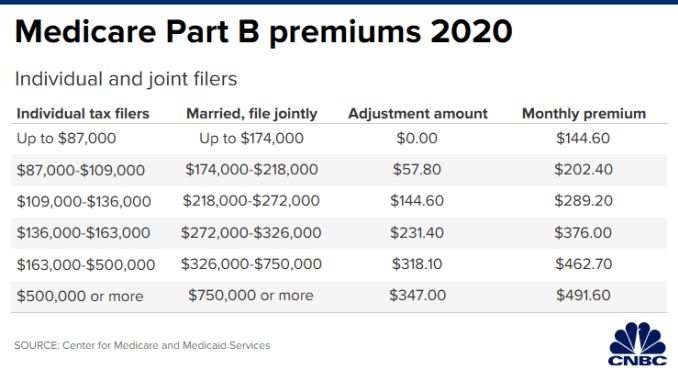
For individuals, IRMAAs kick in if your modified adjusted gross income is more than $87,000; for married couples filing joint tax returns, they start above $174,000.

The standard monthly premium for Part B this year is $144.60, which is what most Medicare beneficiaries pay. (Part A, which is for hospital coverage, typically comes with no premium.) The surcharge for higher earners is from $57.80 to $347, depending on income. That results in premiums ranging from $202.40 to $491.60.

CH 20191227_medicare_part_b_premiums_individual_and_married_jointly.png

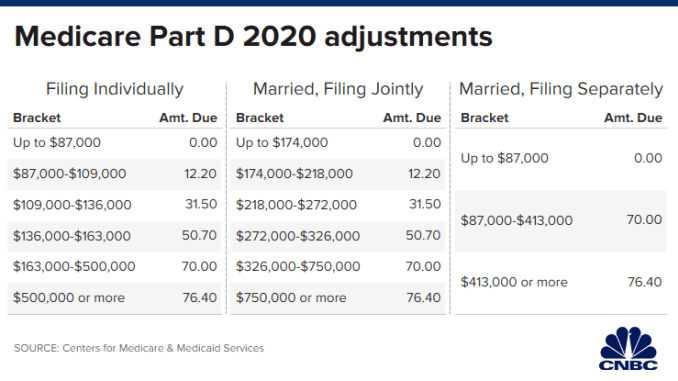
For Part D, the surcharges range from $12.20 to $76.40. That’s in addition to any premium you pay, whether through a standalone prescription drug plan or through an Advantage Plan, which typically includes Part D coverage. While the premiums vary for prescription coverage, the average for 2020 is about $42.

As mentioned, the Social Security Administration relies on your most recently filed tax return — which often is from two years prior — when determining whether you’ll be charged the extra amounts. In other words, for 2020, that would have meant your 2018 tax return was used.

“They did the adjustment late last year and, at that point, they only had your 2018 tax return because you hadn’t prepared your 2019 return yet,” explained Roger Luchene, a Medicare agent with Hammer Financial Group in Schererville, Indiana.

CH 20191227_medicare_part_d_2020_adjustments

The process to prove that your current income is lower involves asking the agency (either over the phone or in writing) to reconsider their assessment. You also have to fill out a form and provide supporting documents. While it depends on your situation, suitable proof may include a more recent tax return, a letter from your former employer stating that you retired, more recent pay stubs or something similar showing evidence that your income has dropped.

The required form includes a list of “life-changing” events that qualify as reasons for reducing or eliminating the IRMAAs, including marriage, death of a spouse, divorce, loss of pension or the fact that you stopped working or reduced your hours.

As long as you meet one of the qualifying reasons, “most of the time it gets adjusted,” said Elizabeth Gavino, founder of Lewin & Gavino in New York and an independent broker and general agent for Medicare plans.

If it doesn’t, you can appeal the decision to an administrative law judge, although the process could take time and you’d continue paying those surcharges in the meantime, Roberts said.

Additionally, the SSA reevaluates your situation every year, which means the IRMAAs (or whether you pay them) could change annually, depending on how volatile your income is.

Roberts said she’s seen some Medicare beneficiaries who take no medications simply decide to not sign up for coverage, in order to avoid paying so much for a Part D plan that they think they’ll never use.

Be aware, however, that the decision could leave you financially vulnerable if your long-term health unexpectedly changes or a one-time health event requires prescription drugs. You also could face late-enrollment penalties, as well, if you don’t qualify for an exception. (The same goes for enrolling late in Part B.)

“You’d be caught without coverage and have to pay out of pocket,” Roberts said. “And, you’d have to wait until the next [enrollment] period to get into a plan.”

4 Ways to Recession-Proof Your Finances

Many financial experts believe a recession is coming soon. While it’s impossible to predict when or if an economic downturn will hit, it’s certain that one will arrive eventually since every economy goes through boom and bust cycles.

Since no one knows when the economy will go south, the best thing to do is to always be prepared. To help you make sure your personal finances stay stable even if the economy doesn’t, here are four tasks you may want to undertake.

1. Diversify your portfolio

When the economy performs poorly, it’s inevitable that some stocks will go down. if you’re too heavily invested in a particular company or even a particular market sector, you could see your portfolio value take a huge tumble during tough economic times. 

But if you have a diverse mix of assets, chances are good some of your investments won’t do as poorly during a recession — and some might even increase in value. You also want to have at least some of your money in safer investments than stocks.

The right mix of different kinds of investments can depend on your age and your risk tolerance. One shortcut to determine the amount of your portfolio that should be in stocks is to subtract your age from 110. This will give you the percentage to put into the market.

Once you’ve done this calculation, choose an appropriate mix of investments. Our model portfolios can help you easily build a diversified portfolio of ETFs if choosing individual companies is too complicated. 

2. Have an emergency fund

Recessions can sometimes result in job losses. You don’t want to be unprepared if you’re left without income, so aim to build an emergency fund with enough to cover three to six months of living expenses. If you find yourself without a steady paycheck, this money can supplement your unemployment benefits and buy you time to find work.

3. Avoid debt

Debt can make it harder for you to pay the bills if you do lose your job since some of your money will have to go to creditors. Recessions also often lead to a tighter credit market, which could make it more difficult to refinance your debt if you need to. 

If you steer clear of high-interest consumer debt, such as credit cards, and you keep mortgage and car loan balances as low as possible, you shouldn’t have to worry as much about how you’ll cover what you owe your creditors if you find your income reduced by a recession. 

4. Develop multiple income streams

A cut to your salary can cause big problems, but you can reduce the risk by developing multiple sources of income. Extra income could come from a side gig or freelance work or from investments such as income-producing stocks or real estate. If you have money coming in from different sources, the loss of one job won’t be as big a problem. 

Your finances can withstand an economic downturn if you’re prepared

A recession doesn’t have to wreak havoc on your finances if you have the right mix of assets, low debt levels, and ways for income to keep flowing even if your primary employer has to downsize. The sooner you take steps to recession-proof your finances, the better — the next downturn could be right around the corner! 

Here’s how much millennials at every age need to have saved right now to retire at 67


You may have heard that you need to save $1 million over the course of your lifetime to retire comfortably. But it can be confusing to know how much that means you need to be saving right now.

Financial analysts at Blacktower Financial Management Group did the math for you, and it turns out that you can probably squeak by with a little over a third of that $1 million benchmark saved if you invest it well.

Blacktower calculates that the average person will need to put away $386,100 of their own money over their lifetime to retire at 67, assuming you want an annual income of about $35,100 in retirement, which is just under 75% of the national median income of $48,700, according to the Bureau of Labor Statistics. Depending on how you invest that money, it could last up to 50 years.

To reach a total of $386,100 by 67, the youngest millennials (age 24) need to have $8,775 already set aside, while the oldest millennials (age 39)should have about $140,400 stashed away in retirement savings. Here’s a breakdown by age:

Doing the math on retirement savings

Blacktower’s calculations assume you’ll earn an average return of about 6%. To get to that number, Blacktower notes that the average annual return of the S&P 500 Index is historically at around 10% and takes into account the adjusted 2.25% of long term inflation. While the data shows that the average real return would consequently sit at 7.75%, Blacktower’s analysts would conservatively average this down to a target rate of 6% per year to account for market fluctuations.

That means if you start saving $8,775 a year, or about $730 a month, in a retirement account like a 401(k) over the course of the next 44 years, that $386,100 in savings will grow to over $1.7 million thanks to compound interest. Again, that’s assuming you earn about a 6% rate of return. With that kind of savings, you’ll have enough for about 50 years of retirement.

If you set aside that same $730 a month in a savings account paying 1% interest, you’ll earn less and only have about 13.7 years before the money runs out. And if you stick your savings under a mattress, which is not recommended, you’ll likely run out of money by 78, which is roughly the average life expectancy, according to the current estimate from the Centers for Disease Control and Prevention.

Yet whether or not $35,100 a year will buy you a comfortable retirement is also up for debate. In addition to any personal retirement savings, the average Social Security retirement benefit is currently about $1,470 a month, or about $17,640 a year, according to the Center on Budget and Policy Priorities.

However, the typical American spent about $3,900 a month last year on basics such as food, housing, utilities, transportation and health care, according to the latest consumer spending data from the Bureau of Labor Statistics. That adds up to about $46,800 a year, which means that there’s not a lot of room for luxuries, such as travel, if you’re trying to stick to a $35,100 budget plus Social Security.

How to boost your retirement savings

If you don’t have Blacktower’s recommended amount saved, you’re not alone. Older millennials (ages 32 to 37) had about $1,000 saved in their 401(k) accounts in 2016, which is the most up-to-date data on file, according to progressive think tank the Economic Policy Institute.

Older Americans didn’t fare much better. Those 56 to 61 had a median balance of $21,000 in their 401(k)s. That total reflects almost 30 years of savings.

For millennials, the good news is that it’s not too late to jump-start retirement savings. First, evaluate your income and expenses. It can help to create a written monthly budget and carefully manage your credit. Once you have a fairly modest monthly budget, consider living below your means as long as possible.

Young people need to be very careful about dramatically raising their standard of living, says Bart Brewer, a certified financial planner with California-based Global Financial Advisory Services. “It’s much harder to ratchet down after you’ve ratcheted up.”

Another big boost: Immediately enroll in your employer’s retirement plan if you’re eligible and start adding funds if you haven’t already. If you’re self-employed or working as a contractor, consider investing using a solo 401(k) or a SEP IRA.

If you have a 401(k) through work, your company may offer to match the amount of money you put in, up to a certain point. If you put 5% of your salary into your 401(k), your employer may also contribute 5%, for example, depending on the type of program. Make sure you’re contributing at least enough to take advantage of any match your company may offer.

If you do want to plan to have a more robust budget or any income after 78, it’s also worth considering to work longer and delay claiming Social Security until later. “Benefits from Social Security are 76% higher if you claim at age 70 versus 62, which can substitute for a lot of extra savings,” according to Olivia S. Mitchell, a professor and executive director of Wharton’s Pension Research Council at the University of Pennsylvania.

It actually may be worth delaying full retirement indefinitely, Mitchell says. “If you can keep working, do so. If you can’t work full-time, work part-time. Every little bit helps.”Toggle panel: Insert Script to <head>

Facial recognition startup Clearview AI says its full client list was stolen

Facial Recognition System

Most of the company’s customers are law enforcement agencies.

You might expect a high-profile (and controversial) facial recognition startup like Clearview AI would have its data locked down, but it turns out it’s just as vulnerable as almost any other company to malicious individuals. In a notification obtained by The Daily Beast, the company says a recent vulnerability allowed someone to gain “unauthorized access” to a list of all of its customers. Clearview works with approximately 600 law enforcement agencies across North America, including the Chicago Police Department.

That same intruder also knows how many accounts those organizations set up, as well as how many searches they’ve conducted in the past. The company claims its servers weren’t breached, and that it was able to shore up the vulnerability. Thankfully, it doesn’t appear the intruder was able to access Clearview’s database of three billion images.

“Security is Clearview’s top priority,” Tor Ekeland, an attorney for the company, told The Daily Beast. “Unfortunately, data breaches are part of life in the 21st century. Our servers were never accessed. We patched the flaw, and continue to work to strengthen our security.”

Clearview came under intense public scrutiny earlier this year when The New York Times published a report on the company. Clearview reportedly built its database by scraping publicly available photos from websites like Facebook, Instagram, YouTube and Venmo. Following the report, the companies that operate those websites, including Google and Facebook, sent cease-and-desist letters to Clearview. CEO Hoan Ton-That told CBS This Morning the company plans to challenge the letters in court by arguing that it has a First Amendment right to public information.

Logitech and Herman Miller team up to design ergonomic gaming furniture

Their first gaming chair could be ready as soon as this spring.

Plenty of gaming chairs look cool, but whether or not they’re actually good for your back is another question. Furniture company Herman Miller and Logitech’s gaming hardware brand Logitech G want to change that. They’re teaming up to create a line of ergonomic furniture for gamers, starting with a gaming chair that could arrive as soon as this spring.

Like traditional athletes, the companies say, esports athletes, professional streamers and gamers need the right gear to perform at their best. Plus, uncomfortable chairs can lead to a loss of focus and hurt overall performance. To get the right mix of form and function, the companies plan to incorporate feedback from esports teams like Complexity Gaming, TSM and NaVi.

Herman Miller is perhaps best known for its Eames Lounge Chair, but the company has been in the smart-furniture business for years. We knew that Herman Miller had its sights set on gaming, but the Logitech G partnership is new. It’s not yet clear what other types of furniture the partners might design.

“We’re excited to combine our ergonomic, research-driven approach with Logitech G’s excellence in technology and innovation,” said Tim Straker, Herman Miller’s chief marketing officer. “Together, we’ll develop high-quality solutions that provide gamers and esports athletes with the utmost support and comfort.”

This is part of a larger trend of non-gaming companies trying to tap into the lucrative esports industry. Puma now has “active gaming footwear” (aka socks), and Louis Vutton’s League of Legends line includes a $5,650 biker jacket. Gaming chairs in particular can be big-ticket items, with Acer’s Predator Thronos Air selling for $14,000. Herman Miller and Logitech G will face growing competition from companies like Acer and even Nissan — the automaker once considered car-themed gaming chairs.