Archives for February 18, 2020

How To Write A Personal Check

In today’s era of Venmo and Zelle, where you can transfer money to your friends with the press of a few buttons, personal checks can feel very antiquated.

And they are!

But some people, and companies, still require you to write them a check.

Just the other day, we had to write a check to pay a mere $4 for our son’s recorder. Sometimes that’s just the way it is.

So if you’ve been asked to send a personal check, but aren’t exactly sure how to do it, we have you covered.

Here are the steps to filling out a personal check.

6 Easy Steps to Filling Out A Personal Check

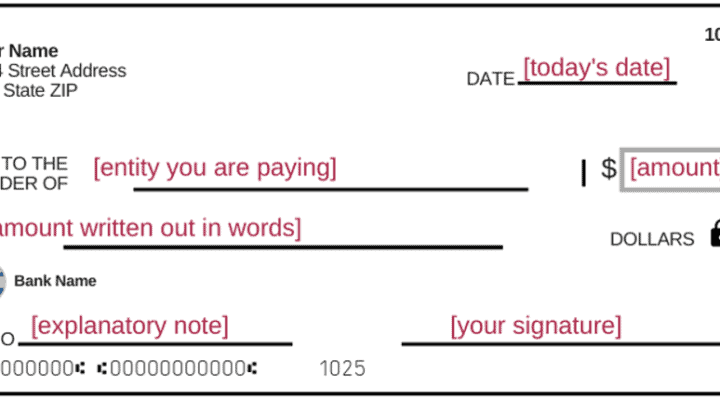
As you can see in the above example, the steps are pretty easy and straightforward:

  1. Write in the date for the check, typically today. You can put a day in the future, thus “post dating” the check.
  2. Write in the name of the payee (you are paying this person) on the “Pay to the Order Of” line
  3. Write in the amount of the check, in numbers, in the box to the right.
  4. Below the “Pay to the Order Of” line, write in the amount of the check in full words. So, $2,345.67 would be written as “Two thousand, three hundred forty five and 67/100”
  5. Write a short note in the Memo line if necessary. Some companies ask you to put your account number or your name in this field.
  6. Sign it.

A personal check has a lot of security features and it’s important you fill it out properly or the bank could reject the check.

For example, the amount in the box has to match the amount written out on the check itself. It’s to prevent someone from adding numbers to the box after the fact.

How to Void A Check

Sometimes you’ll need to give someone a “voided” check. If this is the case, you can just write VOID in big letter across the check. This makes sure the bank won’t accept it as a valid check.

In many cases, they want a voided check so they get your bank details so don’t cover up the routing number and account numbers at the bottom of the check.

For example, if your company’s HR department wants a voided check to set up direct deposit, they’ll ask for a voided check.

Try to Avoid Using Checks

I try to avoid using personal checks because of how much sensitive information is on the check itself. The check has your address, your bank’s information, plus your account number on it.

If you can avoid it, use other payment methods but sometimes that’s all a company accepts.

2 Investing Tricks to Double Your Money

Wall Street loves to overcomplicate the process of investing.

Throw enough arcane financial terms at a soon-to-be-retiree, ask them to choose between “variable annuities” and “covered call options,” or artificially segment their investing strategies into growth, value, and income holdings and chances are you will confuse your client so thoroughly that they will happily hand over a 2% annual fee to manage their money just so they don’t have to think about it!

Here at The Motley Fool, though, we do our best to keep investing simple. Simple enough that anyone can understand it. Simple enough that anyone can do it. And in that spirit, today I’m going to tell you two simple investing tricks you can use to double your money.

Be forewarned, however: Both these tricks require you to exercise a bit of patience, and to stay the course.

Image source: Getty Images.

Double the money in your portfolio

Have you heard about the rule of 72?

It’s a very simple formula for figuring out how long it takes for the money in your stock portfolio (or checking account, or savings account) to double. Take the rate at which you expect your stocks to “go up” annually, or the interest rate you are earning on your bank account, and divide that number into 72. The result is roughly how many years it will take for your money to double, assuming it grows steadily at the given rate.

For example, over the past century or so, the stock market has tended to grow about 10% in value annually. Divide 10 into 72, and voila — you can expect a simple stock investment such as an S&P 500 ETF to double in value every 7.2 years. Conversely, if you’ve got all your money stashed in a bank checking account paying you 0.01% in interest, it’ll take you about 7,200 years to double your nest egg.

Hint: This is why here at The Motley Fool we really think you’re better off investing in stocks. You can buy a really big basket of ’em, and limit your risk through diversification, by investing in the SPDR S&P 500 ETF (NYSEMKT: SPY).

Double the money in your dividend check

Do you prefer cash that’s available to use when you need it so that you don’t need to sell a stock to get ahold of it? Here’s another trick to double your usable money — the kind that arrives every quarter in the form of a dividend payment from stocks that you own.

Say you own a stock that pays about a 2% dividend yield today (which is average for this market). Say too that it is growing its profits steadily, and thus able to grow the size of the dividend it pays in tandem. Finally, say it keeps on growing that dividend consistently, year-in and year-out. There are plenty such stocks that do this, by the way. We call a certain segment of them dividend aristocrats, and they include such well-known names as aerospace and defense company General Dynamics (NYSE: GD), retailer Target (NYSE: TGT), and water heater manufacturer A.O. Smith (NYSE: AOS).

If such a stock were priced at $100 a share, it would be paying you $2 in dividends a year per share in the form of four quarterly dividend payments of $0.50 each. If priced at $50 a share, it would be paying you $1 a year per share; if $200 a share, $4 a share.

Now, whatever the actual dollar value of the dividend payment today, how long do you think it would take for that dividend amount to double?

The answer to that question could involve a lot of math, and vary with the size of each year’s dividend increase, the rate at which earnings are growing, and even changes in the stock’s price. But rather than bore you with math, let’s look at some examples of how dividends have doubled in practice (with a little help from the data miners at S&P Global Market Intelligence).

Back in 2012, General Dynamics was paying its shareholders $2.04 per share in annual dividends. Today, it pays $4.08 per share — a clean double in just eight years. General Dynamics’ dividend yield is still just 2.2% — not much more than the market average. Yet it pays its shareholders twice as much money in dividends today as it did eight years ago. (Incidentally, General Dynamics’ stock price has also more than doubled in that time.)

Want another example? Okay. How about Target? From 2012 to today, Target’s annual dividend has grown from $1.10 a share to $2.58 a share — that’s just eight years to get more than a double.

And A.O. Smith? For dividend investors, this is the best story of all. As recently as 2016, A.O. Smith was paying its shareholders a modest $0.48-per-share annual dividend. Today, its dividend stands at $0.90. It’s yearly dividend nearly doubled in size … in just three short years!

Granted, not every stock will grow its dividend as fast as A.O. Smith has done — nor even as fast as General Dynamics or Target. But the dividend aristocrats list shows us that nearly five dozen companies have grown their dividends consistently over time, and given enough time, those dividends can and will double.

Turns out doubling your money in the stock market isn’t so much a matter of “tricks” as it’s really just a matter of “time.”

What factors determine your credit score?

While most Americans have a credit score that is generally considered “good,” it may be helpful for those looking to raise their rating to know exactly which factors agencies use to calculate it.

According to Experian, the average FICO score in the second quarter of 2019 was 703, though scores tended to vary by age. Americans between the ages of 20 and 29 had the lowest average score, 662, compared to people aged 60 and over, whose scores averaged 749. The state with the highest average credit score as of the second quarter – 733 – was Minnesota.

The average FICO credit score reached 704 in 2018, which was an all-time high.

But do you know what aspects of your financial history go into calculating your credit score?

According to FICO, there are a number of factors that are taken into account when your credit score is calculated ,and the importance of each factor varies.

Among each person, the weight placed on each category will be different based on things like the length of an individual’s credit history.

Here’s a look at what the primary considerations are, for the average person, according to FICO:

Payment history (35 percent)

Comprising the largest chunk of your credit score is your payment history, which measures whether you have paid what you owe on time. This helps a potential lender evaluate how likely you are to repay and thus how much risk lending to you would be.

Amounts owed (30 percent)

The second largest factor used to determine the credit score of a typical American is the amount of available credit you use. If you are using a lot of your credit line, banks are likely to assume you are at a higher risk of default.

Length of credit history (15 percent)

People with longer credit histories tend to have higher credit scores.

The score factors in the average age of all your accounts, how long specific credit accounts have been established and how long it has been since accounts were used.

Credit mix (10 percent)

A FICO score takes into account your mix of credit cards, retail accounts, installment loans, mortgage loans, etc. It is not necessary to have one of each.

New credit (10 percent)

FICO notes that opening a number of new credit accounts over a short span of time represents a greater risk for a lender.

This is the No. 1 Reason for Overspending Among Older Households

Overspending is a common problem for seniors. In fact, a recent study from the Employee Benefit Research Institute found that while average spending among single retired individuals was $5,000 below household income, median spending exceeded median income by $3,000.

Unfortunately, seniors generally aren’t overspending on extravagant trips or spoiling grandkids. Instead, when they spend more than their income, it’s often because of a medical issue.

As EBRI found, 85% of all seniors who spent at least 20% of their income on medical expenses experienced a budget deficit, compared with just 20% who spent 5% or less on care.

Because medical expenses typically aren’t optional, they’re something you need to plan for to ensure your own expenditures don’t exceed income available in your later years.

How can you plan for medical expenses as a senior?

Healthcare spending inevitably rises with age. Preparing for this inevitability is something you should do throughout your working life.

If you have a qualifying high deductible health insurance plan, investing money into a health savings account is typically the best way to prepare for medical spending in retirement.

Contributions to a HSA are tax deductible up to annual limits, and the money you put in can be invested and grow. It can be withdrawn tax-free at any time to pay for medical expenses, or withdrawn for any purpose after age 65 (but you’ll be taxed at your ordinary rate).

Not everyone is eligible to contribute to a HSA though. And HSA contributions alone may not be sufficient to fully fund your care as a senior. To make sure you have the money you need, consider healthcare costs when setting retirement savings goals.

Research has suggested a couple may need as much as $285,000 to $369,000 to fund out-of-pocket healthcare costs in retirement. So if you think you’ll need $500,000 to maintain your standard of living, you may want to set a retirement goal of $785,000 or more, with some of that money specifically earmarked for medical care.

You could up 401(k) contributions to make sure you have enough, or open a separate IRA that you save in just to fund future healthcare needs.

How to handle medical expenses as a senior

If you’re in retirement or close to it, the ship has probably sailed on saving hundreds of thousands of dollars just for healthcare. But there are still things you can do to try to keep costs down.

During Medicare open enrollment, make sure you choose a plan that meets your family’s needs. If you or your spouse is sick, and you anticipate needing a lot of care, your most affordable option may be to pay high premiums for the most comprehensive Medigap or Medicare Advantage Plan available.

You can also ask your doctor about money saving options, or see if you can qualify for government help, such as Medicaid benefits.

Don’t let your medical needs mess up your retirement plans

Spending more than your income on medical care as a senior could cause big problems. You could end up spending your savings too quickly, and even going into debt. It’s best to plan ahead to ensure you have enough money for even expensive medical care so this doesn’t happen to you.

If you’re already retired and struggling, making sure you can get the care you need must always be a top priority. Cutting other things from your budget or even relocating to a cheaper area could become necessary.

Try to react quickly if you find yourself in this situation, to stave off a financial shortfall and avoid becoming one of the millions of Americans with a budget deficit due to healthcare expenses.

RCS messaging comes to Windows 10’s Your Phone app

Starting with the upcoming Samsung Galaxy S20.

When Samsung’s new Galaxy S20 phones make their way to stores early next month, they’ll be able to relay RCS messages to Windows 10 PCs. It’s all thanks to Microsoft’s Your Phone app, which the company is updating to enable it to send and receive RCS texts when paired with Samsung’s Messages app. That means you’ll be able to enjoy the protocol’s tentpole features, such as typing indicators and read receipts, from your computer — provided the person you’re texting also has an RCS-capable device.

According to Microsoft’s Roberto Bojorquez, the new RCS functionality is available “starting with” the Galaxy S20, suggesting the feature will work with other Samsung devices (and perhaps other Android phones) in the future. The integration comes as part of Samsung and Microsoft’s ongoing partnership, which has in the past seen the South Korean company integrate apps like OneDrive into its devices.

If you don’t plan to buy the S20, you can still send RCS messages on your computer by using the Google Messages web client. But as with everything RCS-related, there are a lot of requirements both you and the person you’re texting have to meet before you can see the protocol at work. While it’s a small step, efforts like the one Microsoft is making here help make the platform more useful.

You can make your own rotary cellphone

Modern tech meets vintage dialing.

As convenient as modern cellphones are, there’s a certain charm to spinning an old-fashioned rotary dial to make a call — and now, there’s a cellphone that caters to that nostalgia. Brookhaven National Lab engineer Justine Haupt has developed a rotary cellphone that’s not only functional, but available to make with the help of a $240 do-it-yourself kit. It’s effectively a throwback to the days when phones were for calling and nothing else, plus a few present-day creature comforts.

At its heart, the phone is based on a custom ATmega2560v mainboard, Adafruit Fona 3G cellular equipment and a rotary dial from a Western Electric Trimline phone, all stuffed into a 3D-printed casing. You won’t have to endure 1960s-era limitations, though. A flexible 2.1-inch e-paper display can show missed calls and other vital messages, while shortcut buttons let you quickly dial favorite contacts. You can also check the battery life (good for about 24 hours) and signal strength with “near instantaneous” displays.

You’ll have to do some shopping if you’re going have a rotary cellphone of your own. The kit only includes the mainboard and the 3D-printed housing. You’ll have to buy everything else, and that might be tricky when Trimline rotary dials aren’t exactly common. And did we mention that the design is most definitely not waterproof? Still, it might be your best bet if you’re determined to have the tactile feel of a rotary phone and don’t mind giving up data and texting.

Haupt certainly doesn’t mind. For her, this is a passion project and her personal phone. It’s meant to go “as far from having a touchscreen” as possible, eliminating the complexity for someone who just wants to call people with minimal fuss (and, we’d add, a bit of whimsy). Think of it as the handset for those who find even basic flip phones to be too much of a hassle.