
Archives for January 18, 2020

GoPro’s Media Mod is an upgrade for vloggers on the go

Two mic options, HDMI out and more.

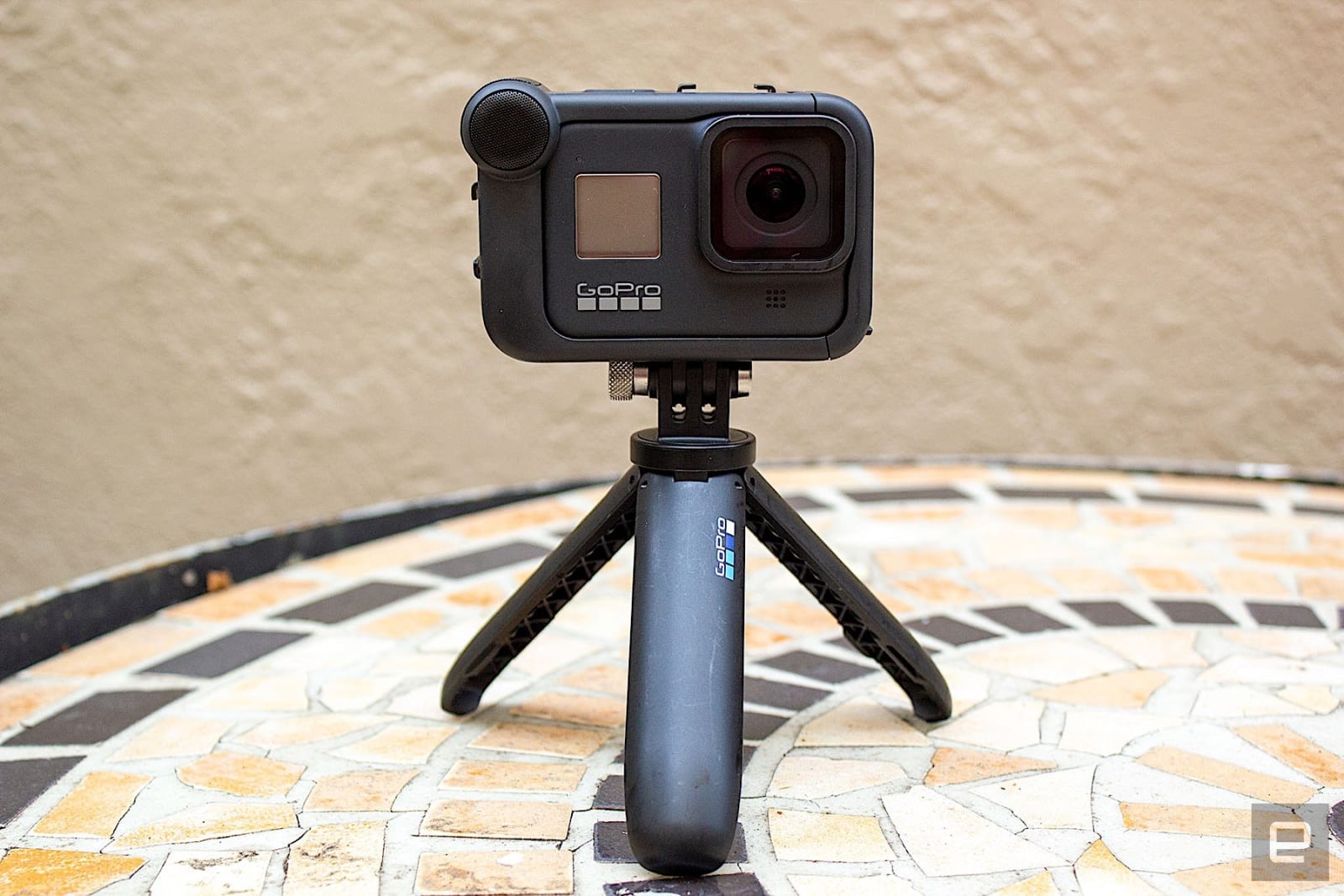
When GoPro revealed the Hero 8’s “mod” accessories, there was a clear favorite: The Media Mod ($80). The light and the fold-out screen looked handy, but the Media Mod added much-needed functionality beyond the action realm. Most notably, a dedicated shotgun mic, an HDMI output and a 3.5mm (mic) input. Vloggers rejoice! Finally, it’s here, and we’ve had a chance to see how it stacks up to our expectations.

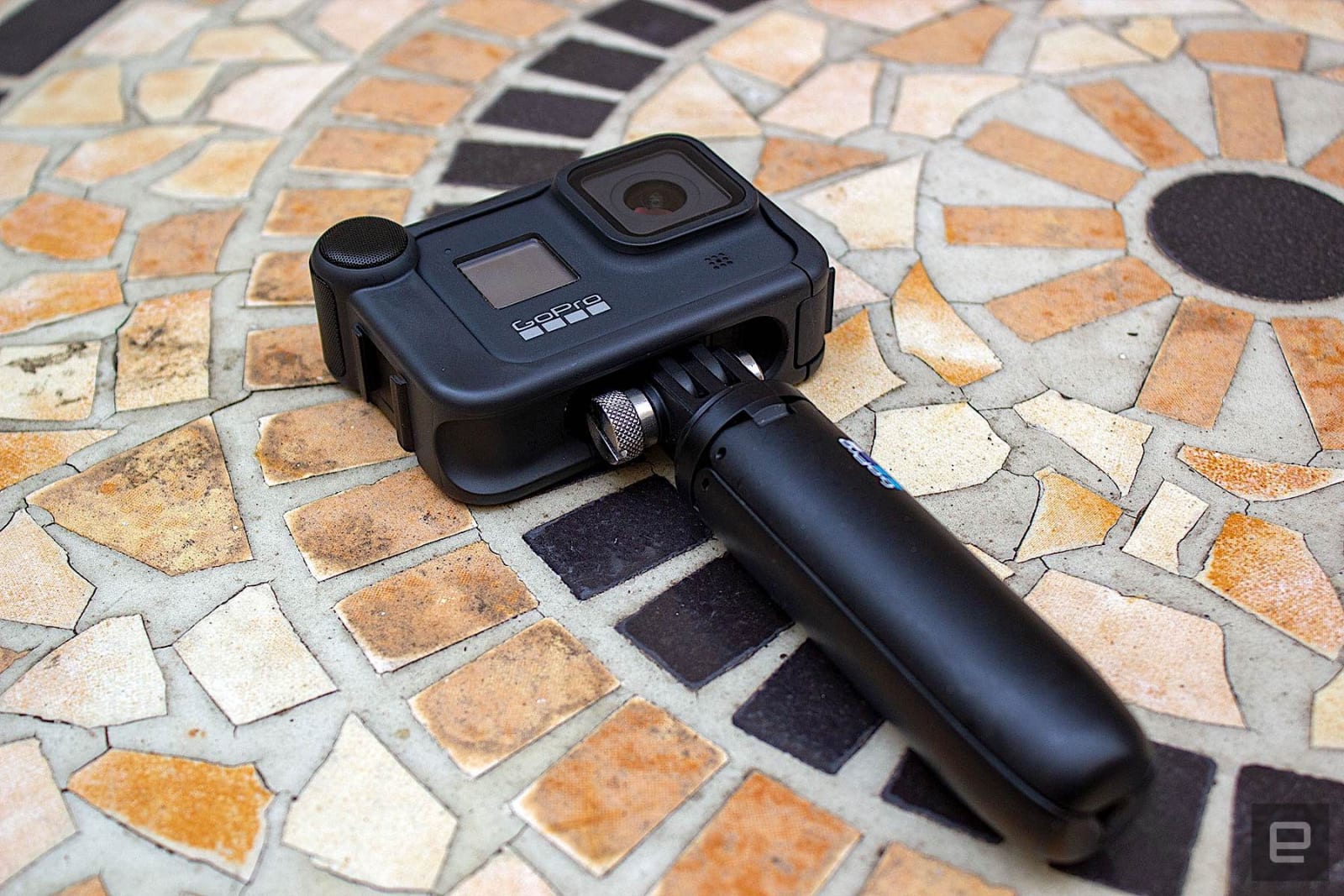
If you ever used GoPro’s Karma grip, the Media Mod will give you deja-vu. Aesthetically, it’s similar to the part that housed the camera. Including the fact you’ll have to remove the GoPro’s battery cover to connect to the USB-C port. That makes sense, but it also means you don’t have easy access to the memory card, which was a prime perk of the Hero 8’s new design (as you no longer needed a “frame” mount).

There are two other quirks that you’ll instantly encounter. The Media Mod has a cutout at the bottom so you can access the camera’s built-in mount fingers, but the thickness of the mod means you don’t have much room to access/tighten the mounting pin below it — especially if it’s a shorter style one. It’s even worse if you have the pin on the right as you look at the camera, as the mod appears to be designed for the pin to go on the left. It took me almost five minutes to remove a mount the first time I did it the “wrong” way. Thankfully, most pins can be tightened with a screwdriver/penny/key, but it makes for a slower, clumsier experience if you’re changing the mount on the fly.
GoPro Media Mod

The second thing you’ll notice, if you have the light accessory and want to add it to the top cold shoe on the Media Mod, is that you then won’t be able to remove the GoPro without removing the light mod first. Its position up top prevents the latch door from fully opening. There is, however, another cold shoe on the side, so using that one would avoid that situation.

The mod also adds a little bit of weight and heft, but the setup is still easily pocketable, especially if you’re using a small mount like the Shorty. Take note: the Media Mod isn’t waterproof in any way, so this is a dry land only gig. I’m not sure who was planning to use this while surfing exactly, but at least know you can’t leave it on if your vlog takes you into the water.

And vlogging very much is what the Media Mod is about. People have always used GoPros for video blogs, but they came with certain challenges. Challenges GoPro has been steadily squashing — most notably with the addition of HyperSmooth stabilization in the Hero 7. With that one feature, the newer GoPros became more viable self-shooting options for those looking for a small setup.

One trade-off that remains (until now?) was audio. The GoPro’s internal microphones do a decent job for ambient sound, but if you wanted better audio for your monologues you needed to use an external mic. This either meant recording into something else entirely (and synching it later in post), or buying a mic connector accessory. Not only was this an extra spend, but it also hung out the side of your GoPro in an ungracious manner.

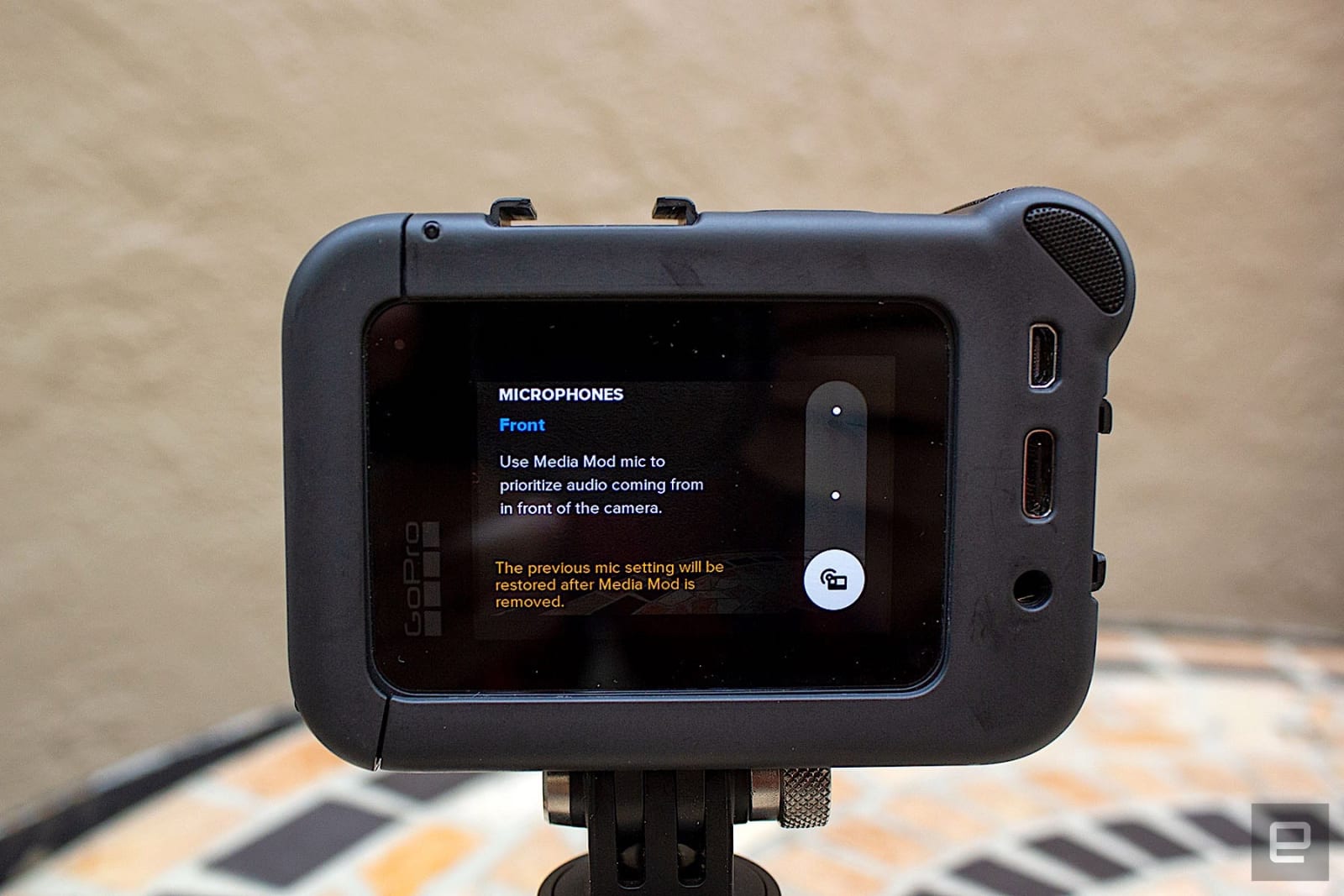
With the Media Mod, you actually get two solutions to this problem. First, there’s a built-in microphone. GoPro says it’s actually two mics in a cardioid array, so you can choose whether to record from in front of the camera or behind it. You’ll need to dive into settings to swap, but it’s good to see both options here — especially for those of us who prefer to remain behind the camera.

The second option is the aforementioned 3.5mm jack. It’s placed around the back, so the cable won’t get in the way of the lens, and you can wear your favorite lav mic as you run and gun. I guess, technically, you could feed other 3.5mm sources in here (like music) if you’re feeling experimental.
GoPro Media Mod

For the most part, the built-in mic is going to be your go-to option. It’s a serious upgrade from a GoPro’s internal microphone and doesn’t require you bring a mic (one with a cable at that). With the mod connected, you’ll dive into settings and choose whether to record from the front or the back. There’s an option for “stereo,” too, but that’s just putting you back to the camera’s microphones (but good to have the choice should you need it).

In my testing, the difference between the mic on the mod and the GoPro’s native mics is stark. I might stop short of saying you won’t need your expensive Rode mic (or similar), but for a solid upgrade with a tiny footprint, it’s really going to make your video blogs sound less “roomy” and more professional.

When I recorded the same audio using a GoPro in the mod and one without the difference is clear. The recording from the mod has more focus on the voice, and more gain, but there’s also more noise — it’s not a lot, but it’s there. With the native GoPro audio, my voice was muddier and roomier, but with less noise. This was while testing at home at my desk.

If you venture outside, the difference is even more pronounced. The same characteristics carry over (more gain, a bit more noise but also fuller, thicker voice recording). I took it to a supermarket (I don’t know why, but I had to start it… somewhere). As I moved around talking to my friend, our voices remained clear, while background noise seemed to be pushed further away. In the mod-free GoPro, the level of our voices was much lower and thinner.
GoPro Media Mod

In one final test, I did the walky-talky vlogger thing in the street. It’s here where I feel the mod really shined. When you listen to the native GoPro audio first, it sounds fine, but switching to the Mod’s audio and closing your eyes, it sounded much more professional.

The difference is also (maybe even more) apparent when testing the same setup, but speaking from behind (with the Media Mod set to “rear”). With the mod, audio is clear as if someone is narrating the clip. Without, it’s more like someone is speaking in the room… somewhere.

Despite the wealth of third-party accessories for GoPro, most shotgun mics are designed for DSLRs or cameras with a shoe mount. To work with a GoPro, they’d also need the aforementioned mic adapter accessory. In this context, the Media Mod is an elegant solution that comes with added perks (that 3.5mm port or HDMI output, for example).

There are a few practical quirks, but you’ll likely get used to them soon enough. But if you frequently swap your GoPro between mounts, or want fast access to the memory card, you’ll want to factor that in. Most of all, the Media Mod sets the stage for the GoPro becoming much more versatile, as the other two mods (display and light) rely on it to mount to the camera. If you’re curious about expanding the functionality of your Hero 8, therefore, this is the logical place to start. Or at least once it starts shipping later this month (January 23rd).

This machine keeps transplant livers alive for a week

Current methods typically preserve livers for about 24 hours.

With current technology, a human liver donated for transplant can only be kept alive for 24 hours, and often, if the liver is damaged or diseased, it cannot be considered for transplant. That could soon change. Liver4Life, a Wyss Institute project, has developed a liver perfusion machine that can preserve injured human livers for one week and can even repair damage.

In a paper published in Nature Biotechnology, researchers from University Hospital Zurich, ETH Zurich and the University of Zurich, explain how the perfusion machine mimics core bodily functions in order to keep livers alive. The device injects insulin and glucagon to control glucose levels, a function usually overseen by the pancreas. In place of the kidneys, a dialysis membrane provides waste removal. An oxygenator fills the role of the lungs. Nutrient infusions replace the bowels, and a pump serves as a stand-in heart. The machine moves the liver continuously to mimic movements that would be caused by the diaphragm.

The researchers first tested the perfusion machine using pig livers. Then, they obtained 10 human livers that were declined for transplantation by all hospitals in Europe and would have otherwise been discarded. Six of the 10 livers recovered to full function and were successfully preserved for one week. That’s much longer than is possible with the current methods, which entail cooling a liver to reduce metabolic function. The six livers also showed a decrease in injury and inflammation markers, usually after one or two days in the machine.

There is plenty of work to do before livers preserved in this machine can be transplanted into humans, but the technology could make more livers available for transplantation. That could save the lives of many patients suffering from liver disease and various cancers.

Going even further, because livers are known to regenerate, the technology might one day make it possible to remove a small piece of healthy liver from a patient, grow it in a perfusion machine and transplant the regenerated liver back into the original patient, while removing the remaining diseased portion. Or, a healthy donor liver might be split apart. Each piece could then be grown in the perfusion machine, yielding more than one transplantable organ.

Medtronic Sees Unusually Large Options Volume (NYSE:MDT)

Medtronic PLC (NYSE:MDT) was the recipient of some unusual options trading activity on Tuesday. Stock traders bought 43,944 call options on the stock. This is an increase of approximately 786% compared to the typical daily volume of 4,960 call options.

Several equities analysts recently weighed in on the stock. Morgan Stanley raised their price objective on shares of Medtronic from $116.00 to $123.00 and gave the company an “equal weight” rating in a research report on Tuesday, December 17th. Citigroup lowered shares of Medtronic from a “buy” rating to a “neutral” rating in a research report on Thursday, January 2nd. Guggenheim upgraded shares of Medtronic from a “neutral” rating to a “buy” rating and set a $135.00 price objective on the stock in a research note on Thursday, January 2nd. They noted that the move was a valuation call. Argus raised their price objective on shares of Medtronic to $135.00 and gave the stock a “buy” rating in a research note on Monday, November 25th. Finally, Oppenheimer lifted their price target on shares of Medtronic from $118.00 to $123.00 and gave the stock an “outperform” rating in a research note on Wednesday, November 20th. Six analysts have rated the stock with a hold rating and seventeen have issued a buy rating to the stock. The stock has a consensus rating of “Buy” and an average price target of $119.90.

NYSE:MDT traded up $0.17 during trading hours on Friday, hitting $119.03. The company’s stock had a trading volume of 4,893,167 shares, compared to its average volume of 4,158,431. The stock has a fifty day simple moving average of $113.96 and a 200-day simple moving average of $107.77. The company has a market capitalization of $156.88 billion, a P/E ratio of 22.80, a PEG ratio of 2.84 and a beta of 0.60. The company has a debt-to-equity ratio of 0.49, a current ratio of 2.77 and a quick ratio of 2.28. Medtronic has a twelve month low of $82.77 and a twelve month high of $119.84.

Medtronic (NYSE:MDT) last posted its earnings results on Tuesday, November 19th. The medical technology company reported $1.31 EPS for the quarter, beating the consensus estimate of $1.28 by $0.03. The firm had revenue of $7.71 billion during the quarter, compared to the consensus estimate of $7.66 billion. Medtronic had a return on equity of 14.52% and a net margin of 15.11%. The business’s quarterly revenue was up 3.0% on a year-over-year basis. During the same period last year, the company earned $1.22 earnings per share. On average, equities analysts predict that Medtronic will post 5.6 EPS for the current fiscal year.

The company also recently announced a quarterly dividend, which will be paid on Friday, January 17th. Shareholders of record on Friday, December 27th will be paid a $0.54 dividend. The ex-dividend date is Thursday, December 26th. This represents a $2.16 annualized dividend and a dividend yield of 1.81%. Medtronic’s payout ratio is presently 41.38%.

In other Medtronic news, EVP Robert John White sold 52,165 shares of the firm’s stock in a transaction dated Friday, November 1st. The shares were sold at an average price of $109.33, for a total value of $5,703,199.45. The sale was disclosed in a legal filing with the Securities & Exchange Commission, which can be accessed through this hyperlink. Also, Director Richard H. Anderson bought 5,000 shares of the firm’s stock in a transaction on Friday, December 6th. The stock was purchased at an average price of $111.13 per share, with a total value of $555,650.00. The disclosure for this purchase can be found here. In the last three months, insiders have sold 106,433 shares of company stock worth $11,704,539. 0.28% of the stock is owned by corporate insiders.

Institutional investors and hedge funds have recently modified their holdings of the business. Aviance Capital Partners LLC raised its stake in shares of Medtronic by 5.1% during the 2nd quarter. Aviance Capital Partners LLC now owns 5,098 shares of the medical technology company’s stock valued at $496,000 after purchasing an additional 247 shares during the period. LaFleur & Godfrey LLC grew its position in Medtronic by 10.5% during the second quarter. LaFleur & Godfrey LLC now owns 6,341 shares of the medical technology company’s stock worth $618,000 after buying an additional 600 shares in the last quarter. Massmutual Trust Co. FSB ADV grew its position in Medtronic by 3.6% during the second quarter. Massmutual Trust Co. FSB ADV now owns 71,462 shares of the medical technology company’s stock worth $6,960,000 after buying an additional 2,505 shares in the last quarter. Equitable Trust Co. grew its position in Medtronic by 10.8% during the second quarter. Equitable Trust Co. now owns 239,657 shares of the medical technology company’s stock worth $23,340,000 after buying an additional 23,345 shares in the last quarter. Finally, Colonial Trust Advisors grew its position in Medtronic by 2.2% during the second quarter. Colonial Trust Advisors now owns 35,473 shares of the medical technology company’s stock worth $3,455,000 after buying an additional 764 shares in the last quarter. Hedge funds and other institutional investors own 80.65% of the company’s stock.

Medtronic Company Profile

Medtronic plc develops, manufactures, distributes, and sells device-based medical therapies to hospitals, physicians, clinicians, and patients worldwide. It operates through four segments: Cardiac and Vascular Group, Minimally Invasive Therapies Group, Restorative Therapies Group, and Diabetes Group.

Theravance Biopharma (NASDAQ:TBPH) PT Raised to $30.00

Theravance Biopharma (NASDAQ:TBPH) had its price objective hoisted by equities researchers at HC Wainwright from $25.00 to $30.00 in a research report issued to clients and investors on Wednesday, January 8th, The Fly reports. The brokerage presently has a “buy” rating on the biopharmaceutical company’s stock. HC Wainwright’s price objective would suggest a potential upside of 19.19% from the stock’s previous close.

Several other equities analysts also recently issued reports on TBPH. ValuEngine raised shares of Theravance Biopharma from a “hold” rating to a “buy” rating in a report on Friday, January 3rd. Piper Jaffray Companies cut their price target on shares of Theravance Biopharma from $55.00 to $40.00 and set an “overweight” rating for the company in a report on Wednesday, November 6th. Robert W. Baird raised shares of Theravance Biopharma from an “underperform” rating to a “neutral” rating and dropped their target price for the stock from $22.00 to $18.00 in a research note on Wednesday, November 6th. Finally, BidaskClub downgraded shares of Theravance Biopharma from a “strong-buy” rating to a “buy” rating in a research note on Tuesday, January 7th. Two investment analysts have rated the stock with a hold rating and five have given a buy rating to the company’s stock. The company has an average rating of “Buy” and a consensus price target of $34.40.

TBPH traded down $0.29 during trading on Wednesday, hitting $25.17. The stock had a trading volume of 2,833 shares, compared to its average volume of 266,740. The firm has a market cap of $1.45 billion, a PE ratio of -6.32 and a beta of 1.85. The company has a 50 day simple moving average of $23.49 and a 200-day simple moving average of $20.22. Theravance Biopharma has a 12 month low of $15.18 and a 12 month high of $28.44.

Theravance Biopharma (NASDAQ:TBPH) last posted its quarterly earnings results on Tuesday, November 5th. The biopharmaceutical company reported ($1.05) earnings per share (EPS) for the quarter, hitting the consensus estimate of ($1.05). The company had revenue of $12.43 million during the quarter, compared to analyst estimates of $13.33 million. As a group, research analysts forecast that Theravance Biopharma will post -4.09 EPS for the current year.

Institutional investors have recently added to or reduced their stakes in the company. Quadrant Capital Group LLC acquired a new position in shares of Theravance Biopharma in the third quarter valued at approximately $32,000. Tower Research Capital LLC TRC boosted its holdings in shares of Theravance Biopharma by 68.7% in the third quarter. Tower Research Capital LLC TRC now owns 1,798 shares of the biopharmaceutical company’s stock valued at $35,000 after buying an additional 732 shares during the period. Simplex Trading LLC boosted its holdings in shares of Theravance Biopharma by 30.1% in the third quarter. Simplex Trading LLC now owns 5,043 shares of the biopharmaceutical company’s stock valued at $98,000 after buying an additional 1,167 shares during the period. Wolverine Trading LLC acquired a new position in shares of Theravance Biopharma in the second quarter valued at approximately $203,000. Finally, Cubist Systematic Strategies LLC boosted its holdings in shares of Theravance Biopharma by 117.1% in the second quarter. Cubist Systematic Strategies LLC now owns 28,969 shares of the biopharmaceutical company’s stock valued at $473,000 after buying an additional 15,627 shares during the period. Institutional investors own 79.64% of the company’s stock.

About Theravance Biopharma

Theravance Biopharma, Inc, a diversified biopharmaceutical company, discovers, develops, and commercializes organ-selective medicines. The company offers VIBATIV, a bactericidal, once-daily injectable antibiotic to treat patients with serious, life-threatening infections due to staphylococcus aureus and other gram-positive bacteria, including methicillin-resistant.

LiveRamp (NYSE:RAMP) Lowered to “Buy” at ValuEngine

ValuEngine cut shares of LiveRamp (NYSE:RAMP) from a strong-buy rating to a buy rating in a report released on Tuesday, December 24th, ValuEngine reports.

A number of other equities research analysts have also weighed in on the company. Morgan Stanley reduced their price objective on LiveRamp from $64.00 to $58.00 and set an overweight rating on the stock in a research report on Wednesday, October 16th. Needham & Company LLC began coverage on LiveRamp in a research report on Friday, December 20th. They set a buy rating and a $67.00 price objective on the stock. Finally, First Analysis upgraded LiveRamp from an outperform rating to a strong-buy rating in a research report on Friday, September 20th. One investment analyst has rated the stock with a hold rating, five have issued a buy rating and one has given a strong buy rating to the stock. LiveRamp presently has an average rating of Buy and a consensus target price of $62.67.

NYSE RAMP traded up $0.64 during midday trading on Tuesday, hitting $45.76. The company had a trading volume of 698,401 shares, compared to its average volume of 675,254. LiveRamp has a twelve month low of $37.30 and a twelve month high of $63.23. The company has a market capitalization of $2.93 billion, a PE ratio of -33.40 and a beta of 1.48. The firm has a 50-day moving average price of $47.89 and a 200-day moving average price of $45.81.

LiveRamp (NYSE:RAMP) last posted its quarterly earnings results on Wednesday, November 6th. The company reported ($0.59) EPS for the quarter, topping analysts’ consensus estimates of ($0.67) by $0.08. LiveRamp had a negative return on equity of 10.49% and a net margin of 280.55%. The company had revenue of $90.14 million during the quarter, compared to analysts’ expectations of $87.08 million. As a group, equities analysts predict that LiveRamp will post -2.24 EPS for the current fiscal year.

In other news, insider James F. Arra sold 14,737 shares of the stock in a transaction that occurred on Wednesday, December 11th. The stock was sold at an average price of $49.43, for a total value of $728,449.91. Following the completion of the sale, the insider now directly owns 160,271 shares of the company’s stock, valued at $7,922,195.53. The sale was disclosed in a document filed with the SEC, which is accessible through the SEC website. Also, Director Clark M. Kokich sold 1,000 shares of the stock in a transaction that occurred on Wednesday, January 15th. The shares were sold at an average price of $43.18, for a total value of $43,180.00. Following the sale, the director now directly owns 67,427 shares of the company’s stock, valued at $2,911,497.86. The disclosure for this sale can be found here. Over the last ninety days, insiders have sold 17,737 shares of company stock worth $867,200. 5.18% of the stock is owned by company insiders.

Several institutional investors and hedge funds have recently modified their holdings of the stock. FMR LLC grew its holdings in LiveRamp by 7,200.2% during the first quarter. FMR LLC now owns 456,701 shares of the company’s stock valued at $24,923,000 after purchasing an additional 450,445 shares during the period. KBC Group NV grew its holdings in LiveRamp by 2,115.4% during the second quarter. KBC Group NV now owns 83,942 shares of the company’s stock valued at $4,070,000 after purchasing an additional 80,153 shares during the period. Advisor Group Inc. grew its holdings in LiveRamp by 100.0% during the second quarter. Advisor Group Inc. now owns 536 shares of the company’s stock valued at $27,000 after purchasing an additional 268 shares during the period. Envestnet Asset Management Inc. bought a new position in LiveRamp during the second quarter valued at $246,000. Finally, Swiss National Bank grew its holdings in LiveRamp by 2.7% during the second quarter. Swiss National Bank now owns 120,600 shares of the company’s stock valued at $5,847,000 after purchasing an additional 3,200 shares during the period. 99.91% of the stock is owned by institutional investors.

About LiveRamp

LiveRamp Holdings, Inc provides identity and data connectivity for powering exceptional customer experiences. The company offers IdentityLink, an identity resolution platform that connects people, data, and devices across the physical and digital world, powering privacy-compliant, people-based marketing that allows consumers to better connect with the brands and products they love.

L3Harris (NYSE:LHX) Shares Sold by Forte Capital LLC ADV

Forte Capital LLC ADV decreased its position in shares of L3Harris (NYSE:LHX) by 2.0% during the fourth quarter, according to its most recent Form 13F filing with the Securities & Exchange Commission. The fund owned 13,030 shares of the company’s stock after selling 264 shares during the period. Forte Capital LLC ADV’s holdings in L3Harris were worth $2,578,000 as of its most recent filing with the Securities & Exchange Commission.

A number of other hedge funds have also recently bought and sold shares of LHX. Squar Milner Financial Services LLC grew its holdings in L3Harris by 500.0% during the 3rd quarter. Squar Milner Financial Services LLC now owns 120 shares of the company’s stock worth $25,000 after acquiring an additional 100 shares in the last quarter. Sonora Investment Management LLC purchased a new position in shares of L3Harris in the 3rd quarter valued at approximately $26,000. Wealthcare Capital Management LLC purchased a new position in L3Harris during the 3rd quarter worth approximately $26,000. D Orazio & Associates Inc. purchased a new position in L3Harris during the 3rd quarter worth approximately $27,000. Finally, Trustcore Financial Services LLC purchased a new position in L3Harris during the 3rd quarter worth approximately $28,000. Institutional investors and hedge funds own 82.58% of the company’s stock.

Shares of NYSE LHX traded up $4.62 during midday trading on Friday, reaching $218.97. 97,682 shares of the stock were exchanged, compared to its average volume of 1,364,394. The company has a market capitalization of $47.52 billion, a price-to-earnings ratio of 26.42, a price-to-earnings-growth ratio of 2.33 and a beta of 0.86. L3Harris has a twelve month low of $136.26 and a twelve month high of $217.31. The firm has a 50-day moving average price of $202.27. The company has a current ratio of 1.49, a quick ratio of 1.21 and a debt-to-equity ratio of 0.31.

L3Harris (NYSE:LHX) last released its quarterly earnings results on Wednesday, October 30th. The company reported $2.58 earnings per share (EPS) for the quarter, beating analysts’ consensus estimates of $2.39 by $0.19. L3Harris had a net margin of 12.02% and a return on equity of 16.42%. The firm had revenue of $4.43 billion for the quarter, compared to analysts’ expectations of $4.43 billion. The company’s quarterly revenue was up 187.4% compared to the same quarter last year. On average, analysts forecast that L3Harris will post 9.98 earnings per share for the current fiscal year.

LHX has been the subject of a number of recent research reports. UBS Group raised their price target on shares of L3Harris from $225.00 to $235.00 and gave the stock a “neutral” rating in a research report on Wednesday. Alembic Global Advisors initiated coverage on shares of L3Harris in a research report on Monday, November 18th. They set an “overweight” rating and a $235.00 price target for the company. ValuEngine raised shares of L3Harris from a “strong sell” rating to a “sell” rating in a research report on Friday, December 13th. SunTrust Banks raised their price target on shares of L3Harris to $245.00 and gave the stock a “buy” rating in a research report on Thursday, October 31st. Finally, Zacks Investment Research raised shares of L3Harris from a “hold” rating to a “buy” rating and set a $219.00 price target for the company in a research report on Friday, November 1st. One equities research analyst has rated the stock with a sell rating, one has issued a hold rating and thirteen have given a buy rating to the company. The company currently has an average rating of “Buy” and a consensus price target of $237.34.

In related news, SVP Scott T. Mikuen sold 15,000 shares of L3Harris stock in a transaction on Monday, January 6th. The shares were sold at an average price of $210.51, for a total value of $3,157,650.00. The transaction was disclosed in a legal filing with the SEC, which is available at this link. 1.70% of the stock is currently owned by company insiders.

L3Harris Company Profile

L3Harris Technologies, Inc provides technology-based solutions that solve government and commercial customers’ mission-critical challenges in the United States and internationally. The company operates in three segments: Communication Systems, Electronic Systems, and Space and Intelligence Systems.