Archives for December 22, 2019

Weekly Market Review – December 21, 2019

Stock Markets

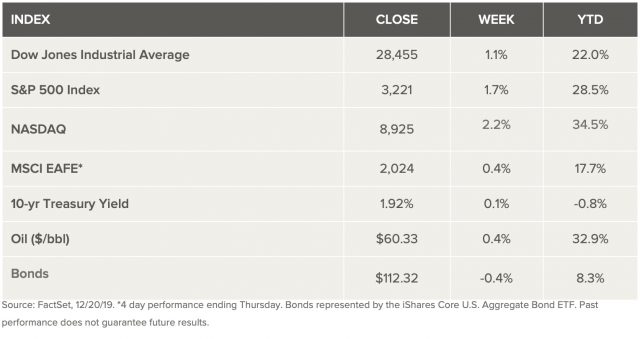
Heading into the Christmas-holiday shortened trading week, stocks are set to finish the year strong. The S&P 500 has now posted 31 all-time highs in 2019, driven by sizable gains in the technology sector, progress on Brexit, the U.S./China trade front, and continued strength in the U.S. jobs market. Despite an impeachment vote in the House of Representatives, the S&P 500 finished 1.7% up on the week, a reminder that the political drama isn’t the primary driver of market performance over time. Positive economic and corporate performance news has been the driving force behind this year’s sizable gains.

U.S. Economy

When it comes to the market, swings are a normal part of the investment landscape. But the pendulum has swung in particularly notable fashion over the past year. Investors digested a full plate of data and news last week, including an impeachment vote and the passing of USMCA (NAFTA 2.0) in the House, an updated reading of third-quarter U.S. GDP (2.1%) that included upwardly revised consumer-spending growth, and housing-market readings that showed a modest uptick in activity. And with all of that, the stock market moved higher again on the week, reaching yet another record high.

But it was just one year ago that conditions were seemingly on a polar-opposite path. The S&P 500 was down sharply, and headlines were filled with projections of impending economic doom. That was then (December 2018), and this is now.

Metals and Mining

The gold price was relatively flat on Friday (December 20) after US Treasury Secretary Steven Mnuchin said that the US and China would sign phase one of the trade pact at the beginning of the new year, which sent investors away from the yellow metal to riskier assets. As part of an alleged first phase deal, Washington has agreed to offer Beijing some tariff relief as well as a pause on a tranche of new tariffs. Mnuchin added that the pact will not be subject to any renegotiations. In addition to the announcement from Washington, China’s finance ministry revealed a new list of import tariff exemptions for a duration of one year — which will start next Thursday (December 26) — for six chemical and oil products from the US. Over the course of the year, gold has been largely supported by the trade war, which has helped it gain over 15 percent. The dispute between two of the world’s largest economies has caused turmoil in the markets and has had investors concerned over a global economic slowdown.

Gold was also weighed down this week by the better-than-expected US economic data, as that gave a boost to the greenback, setting it up to make gains for the first time in four weeks. Silver was up slightly on Friday, not falling under the same pressure that the yellow metal faced throughout the week. Despite a slightly shaky month, silver remains stronger in 2019, as it is 9.7 percent higher on a year-to-date basis. As of 10:02 a.m. EST on Friday, silver was changing hands at US$17.17 per ounce. Platinum was down on Friday, but still managed to stay above the US$900 per ounce level. Going forward, FocusEconomics believes that prices are likely to pick up slightly on the back of a fall in global supply. Despite this, weak automotive demand — the result of a shift away from diesel vehicles in the European Union — is seen capping the metal’s gains. Palladium continued its climb on Friday, staying above the US$1,900 per ounce level that it broke records with last week. The metal pushed past the US$1,900 level last Tuesday (December 10) following a power outage in South Africa that stopped production at several mines and exacerbated concerns over a supply shortage. Since the outage, the metal has continued to climbed and is headed for its fifth straight week of gains. Since the beginning of the year, the metal has risen over 40 percent, with its large gains being attributed to stricter environmental regulations around car emissions. As demand increases from the automotive sector, supply shortfalls are beginning to emerge, giving the spot price a boost on the market.

Energy and Oil

Oil didn’t move a lot this week, but it may have consolidated gains achieved earlier this month. The trade talks continue on a positive trajectory, and economic sentiment is slightly upbeat. The U.S. reported a drawdown in crude inventories, although there was a surprising jump in refined product stocks. “A sense of cautious bullishness is developing as we head into 2020,” Stephen Brennock, an analyst at PVM Oil Associates Ltd. in London, told Bloomberg. “Supply-side and demand-side factors are singing from the same supportive hymn sheet. Natural gas prices remain depressed. Natural gas prices could fall even further unless there is a serious cold snap in the U.S. this winter. Investors have staked out the most net-bearish position on gas futures in a decade. Natural gas spot prices rose at most locations this report week (Wednesday, December 11 to Wednesday, December 18). The Henry Hub spot price fell from $2.26 per million British thermal units (MMBtu) last Wednesday to $2.24/MMBtu yesterday.  At the New York Mercantile Exchange (Nymex), the price of the January 2020 contract increased 4¢, from $2.243/MMBtu last Wednesday to $2.286/MMBtu yesterday. The price of the 12-month strip averaging January 2020 through December 2020 futures contracts climbed 2¢/MMBtu to $2.294/MMBtu.

World Markets

European stocks rose after UK Prime Minister Boris Johnson’s emphatic general election victory and the U.S. and China agreed to an interim limited trade deal. The pan-European STOXX Europe 600 Index ended the week 1.55% higher, and the UK’s FTSE 100 Index climbed 3.11%. Germany’s exporter-heavy DAX index gained 0.27%. The UK pound gave up its postelection gains against the euro and the U.S. dollar after Johnson revived fears of a no-deal Brexit. Johnson signaled that he would amend the Brexit bill to prevent any extension of the transition period for a new trading relationship with the European Union beyond the end of 2020, the current deadline. A failure of the negotiations would mean the economic relationship would default to World Trade Organization terms, with the likelihood of tariffs on imports and exports. (Click here for a more detailed perspective on the implications of the Conservative election victory for Brexit.)

Chinese stocks rose for the third straight week, as a partial trade deal between the U.S. and China offered a temporary respite in trade tensions. For the week, the benchmark Shanghai Composite Index rose 1.23%, and the large-cap CSI 300 Index, which tracks blue chips listed on the Shanghai and Shenzhen exchanges, added 1.2%. The weekly gains came one week after the U.S. and China announced that they had reached an agreement on a “phase one” trade deal that would lower some U.S. tariffs levied during the dispute and suspend planned duties that were scheduled to kick in on December 15.

The Week Ahead

Economic data will be light this week, with building permits, continuing jobless claims, and the Chicago Fed National Activity Index a few of the measures being released.

Key Topics to Watch

  • Chicago Fed national index
  • New home sales
  • Durable goods orders
  • Core capex orders
  • Weekly jobless claims

Markets Index Wrap Up
The unpleasant surprise waiting for you when you retire? Taxes

Tax-deferred accounts are great, until they aren’t—when we have to pay taxes on our withdrawals.

Millions of Americans have tax-deferred accounts, pundits laud them, companies help fund them, institutions service them and markets help them grow. But when it comes time to empty them, often the only person to guide us is Uncle Sam, who’s patiently awaiting his cut.

Efficiently managing 30 years of retirement withdrawals from a 401(k), 403(b), IRA or other tax-deferred account is just as important as the 40 years of accumulation. While we could just follow the government’s required minimum distribution (RMD) rules beginning at age 70½, who says these rules are optimal? Granted, the normal playbook is to postpone paying taxes for as long as possible. Heck, “deferred” is the way these accounts are described.

Yet deferring may not be right for everyone. There are some widely discussed reasons to make earlier and larger withdrawals from tax-deferred accounts—to convert this money to a Roth IRA, to avoid future tax rate increases, to use the money while still young and healthy, and to reduce future RMDs by making withdrawals earlier in our 60s, when we might be in a lower tax bracket.

Married couples have an often-overlooked additional reason to consider extra early withdrawals: Their taxes will almost certainly increase after the first spouse dies. Think of this as the widow or widower’s tax. It’s is an issue I recently discovered when I was weighing how much to withdraw from the retirement accounts owned by my wife and me.

What’s the problem? First, the standard deduction for the surviving spouse will typically decline from $24,400, the 2019 level for those married filing jointly, to $12,200 for a single individual. In addition, the surviving spouse will lose the additional “over age 65” deduction of $1,300 for the deceased spouse.

Assuming the same income and a 22% marginal tax rate, the surviving spouse’s tax bill will increase $2,970 from lost deductions alone. On top of this, tax rates also increase. While the change to filing as a single individual increases tax rates by only 2 percentage points for a large portion of middle-income surviving spouses, tax rates can jump as much as eight to 11 percentage points at certain income levels, as shown in the table below for 2019.

Married couples with annual incomes around $40,000 to $80,000, or above $160,000, are likely to get hit with significantly higher tax rates upon the first spouse’s death. Today’s tax rates are unusually low. That means the tax penalty could be even higher, depending on the results of 2020s election. It could also be higher after 2025, when today’s low tax rates are slated to return to pre-2018’s higher levels.

How can married couples take advantage of today’s low tax rates? If their taxable income is around or only moderately above $39,500 in 2019, couples might consider additional withdrawals from tax-deferred accounts, perhaps up to a taxable income of $78,950. That’s the equivalent of $103,350 in total income, once you figure in the standard deduction. The married marginal tax rate remains a miserly 12% at these income levels. Paying taxes at this rate may allow the surviving spouse to avoid paying taxes at a much higher rate later on.

Likewise, if income is already above $160,000, couples might consider tax-deferred account withdrawals to achieve a taxable income of as much as $321,450, equal to $345,850 in total income, after factoring in the standard deduction. Even at this very high income, the marginal tax rate remains a relatively modest 24%.

Keep in mind that this additional taxable income may trigger higher taxes on your Social Security benefit or higher Medicare premiums, and perhaps both. Don’t plan to spend these extra withdrawals in the near future? The best strategy is probably to convert this money to a Roth IRA.

Congress approves major changes to how you save for retirement

The biggest legislative changes to America’s retirement system in 13 years are on their way.

On Thursday, the U.S. Senate approved a spending bill that includes the bipartisan Secure Act, which aims to increase the ranks of retirement savers and the amount they put away. The measure — which passed the House earlier this week — now will head to President Trump, who is expected to sign it into law.

“The Secure Act has been years in the making,” said Paul Richman, chief government and political affairs officer at the Insured Retirement Institute. “It’s filled with common-sense measures to strengthen retirement security for millions more American workers.”

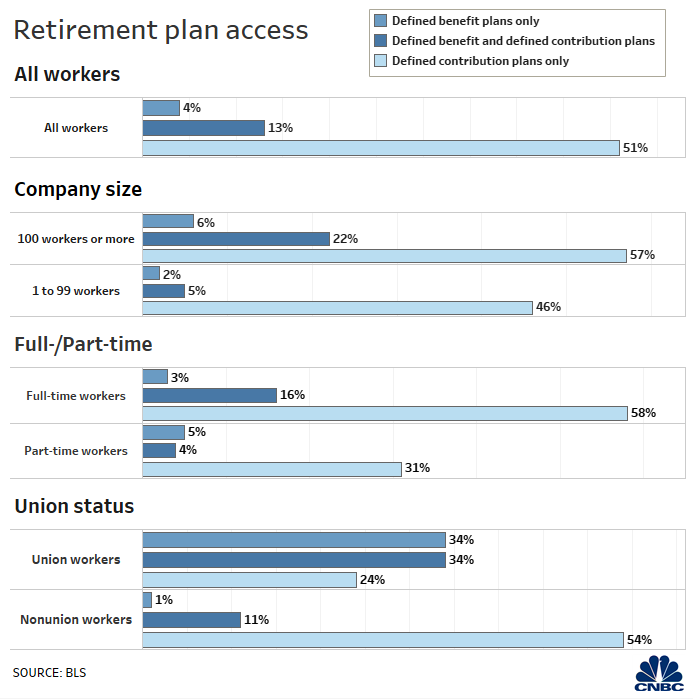
Changes include making it easier for small businesses to band together to offer 401(k) plans and offering tax credits to those firms that do; requiring businesses to let long-term, part-time workers become eligible for retirement benefits; and repealing the maximum age for making contributions to traditional individual retirement accounts (right now, that’s 70½).

It also would raise the age when required minimum distributions, or RMDs, from certain retirement accounts must start to 72, up from 70½.

Additionally, the measure aims to allow more annuities in 401(k) plans by eliminating companies’ fear of legal liability if the annuity provider fails or otherwise doesn’t deliver. While companies already can offer annuities in their 401(k) lineups, just 9% do, according to the Plan Sponsor Council of America.

Other changes include allowing money in 529 college savings plans to go toward student-loan debt (with a $10,000 limit) and letting workers with 401(k) plans withdraw up to $5,000 from their account, penalty-free, to cover the cost of having a baby or adoption.

The provisions generally are funded by modifying the rules governing inherited retirement accounts, a move expected to generate $15.7 billion over 10 years in additional tax revenue, according to an estimate from the Congressional Budget Office. Instead of being able to take required withdrawals over the course of their life as they can now, most non-spouse beneficiaries would need to withdraw the money within 10 years of the original account owner’s death.

“That’s obviously a negative for inherited traditional IRAs and for Roth IRAs that used to stretch over the beneficiary’s lifetime,” said certified financial planner Mike Hennessy, founder and CEO of Harbor Crest Wealth Advisors in Fort Lauderdale, Florida.

Meanwhile, the legislation comes as experts warn that many Americans are falling short with their retirement savings. For example, among pre-retirees ages 55 to 64, the median 401(k) account balance — half are above, half are below — is $61,700, according to Vanguard’s 2019 How America Saves Report. For those ages 45 to 54, it’s $40,200.

Additionally, roughly a third (38%) of U.S. adults say they have never had a retirement account, according to a recent Bankrate.com survey. It was most pronounced among Gen Xers (36%) and households with annual income below the $30,000 mark (58%).

You may be surprised by who carries the most credit card debt

Credit card debt is expensive and diverts cash that could be used to build an emergency fund or make contributions to a retirement account. And low minimum payments can trap you into decades of debt. Bankrate.com released a survey this past week about who is carrying the most credit card debt, and the findings were surprising.

Turns out, Americans with a net worth of more than $100,000 are more likely to have credit card debt than people who have a negative net worth. Taking a deep dive into the numbers, 58 percent of people with this level of net worth owe at least $2,500, and 39 percent are carrying at least $5,000, Bankrate.com found.

Forty-six percent of those who earn more than $80,000 per year have credit card debt. The lowest income bracket, people earning $40,000 or less, had the least amount of debt. By the way, the data does not include “transactors,” or consumers who pay off their balances every month.

“If you truly are building wealth, my thought was that you would not have credit card debt,” said Ted Rossman, an analyst for Bankrate.com who closely watches credit card trends.

It’s important to point out that a substantial portion of people’s net worth is often tied up in their homes. So, on paper, they can be worth a lot, but this does not mean they have cash liquidity.

The survey showed that the most common reason for accumulating credit card debt was to pay for day-to-day expenses, such as groceries, utility payments and child-care costs (28 percent). This was followed by retail purchases such as clothes and electronics (16 percent), car repairs (11 percent), medical debt (11 percent) and vacations (9 percent).

Here are other reasons people gave for accumulating debt:

● “A granddaughter’s wedding.”

● “Birthday and holiday gifts.”

● “Tattoo removal.”

● “Fast-food consumption.”

● “I used credit cards to fix up the rental properties I own.”

● “Tax bill.”

● “Mother’s funeral expenses.”

● “Bad decisions when younger.”

People with high incomes who are carrying credit card debt may be the victims of “lifestyle creep,” Rossman said. This is when people’s standard of living improves as their income increases so that luxuries become viewed as necessities.

“Let’s say you get promoted and earn a 10 percent raise but you expand your standard of living by the same amount. You’re no better off,” he said.

To be clear, Rossman isn’t suggesting living a miserly life.

“Life and money are meant to be enjoyed,” he said. “But you also need to be smart and live within your means and save for your future. If you have adequate emergency savings and your debt is under control, then absolutely treat yourself with a portion of your raise and bank the rest. But if you were living paycheck-to-paycheck before and lacked savings and had lots of credit card debt and weren’t saving for retirement, then you need to dedicate much more of your raise to those priorities.”

Easier access to credit is another factor that may explain why people with higher incomes are accumulating debt, Rossman said. “Just because somebody gives you a credit card or a line of credit doesn’t necessarily mean that that’s the best option for you,” he said.

Here’s why this survey matters.

The money you devote to paying off high-interest credit card debt could be better used building long-term wealth, said Corbin Blackwell, a financial planner with Betterment.

“Over the last 20 years, the U.S. stock market has returned about 8 percent per year on average, but eight of those years had returns well below 5 percent,” Blackwell said. “Ultimately, your dollars should go further by paying down high-interest debt. The only time where you could prioritize investing over paying off debt is if your debt has an interest rate below 5 percent.”

Even knowing how costly carrying credit card debt can be, it’s still, by far, the most common form of debt.

Forty-two percent of all U.S. adults have credit card debt, followed by car loans or auto leases (27 percent), mortgages (26 percent), student loans (16 percent) and personal loans (12 percent), according to Bankrate.com.

I’ve counseled many individuals and couples who cycle in and out of credit card debt for purchases that were not necessary.

I also know that life happens. You got by after a job loss or a medical crisis by using your credit card. But if you’re using your plastic to live above your means, that’s a money move that will only pull you under.

If you’re a business owner, grab this 20% tax break before the year ends

Entrepreneurs hoping to pocket some tax deductions for 2019 shouldn’t forget a new 20% break.

The qualified business income or QBI deduction made its debut in 2018, a feature of the Tax Cuts and Jobs Act.

The new write-off allows owners of “pass-through” entities, including S-corporations and partnerships, to deduct up to 20% of their qualified business income. Tax professionals first grappled with this new rule earlier this year, when the IRS rolled out further guidance.

The changes have come at such a rapid pace that even tax-planning software had a hard time keeping up.

“The issue with the QBI deduction came with calculating it,” said Michael D’Addio, a principal at Marcum LLP.

“The software companies had to keep up; the IRS had to issue guidance and regulations in a complex set of statutes, and the practitioners had to absorb the information coming out to properly advise clients and be certain of the results produced by the software,” he said.

“There were massive amounts of time to be invested by all parties concerned.”

About 15.6 million tax returns claimed the QBI deduction on their 2018 taxes, according to IRS filing data through July 25. That’s the most recent set of figures the agency has available.

That number is likely to be higher, since many entrepreneurs with more elaborate returns tend to go on extension and file their returns on Oct. 15.

Know your eligibility

Not everyone can partake of the deduction.

First, business owners in any industry are free to use it if they have taxable income that’s under $160,700, if single, or $321,400, if married and filing jointly in 2019. The IRS applies limitations over those thresholds.

In addition, taxpayers in a “specified service trade or business,” including doctors, lawyers and accountants, can’t claim the deduction at all if their taxable income exceeds $210,700, if single, or $421,400, if married.

If you’re not in a “specified service trade or business,” then the rules are a little different.

In that case, you get a reduced deduction if your taxable income exceeds the $160,700/$321,400 threshold but is still under the $210,700/$421,400 threshold.

If your business isn’t in a specified service trade or business, and your taxable income exceeds the $210,700/$421,400 threshold, then your deduction is generally capped as a percentage of W-2 wages paid to your employees.

Here’s another consideration: The QBI deduction is only around until the end of 2025, when it will expire unless Congress acts. Keep that in mind before you overhaul your business.

Rental properties

In September, the IRS issued guidance on the deduction and its applicability to owners of rental real estate.

Those rules include maintaining separate books and records for each rental enterprise, as well as performing and documenting at least 250 hours of rental services in a year if the enterprise has been around for less than four years.

Landlords who’ve had their rental business for longer than that must document at least 250 hours of rental services in three of the last five years.

Rental services include maintenance and repairs on the property and supervising people who work there.

Other tasks, including time spent purchasing property or traveling to and from your real estate, won’t count toward the hourly requirement.

Landlords will need to keep immaculate records to prove they’re following the rules.

“Save your documents and receipts; you need to support your hours,” said Troy Lewis, CPA, associate teaching professor at Brigham Young University.

Failure to meet those September guidelines doesn’t bar you from claiming the deduction, but the burden of proof is on you if you’re audited.

Before you take a break

If you’re hope to take  the deduction as 2019 winds down, just make sure you have your paperwork in order.

Document everything. Be sure to closely review the receipts and statements that pertain to your business. Prepare to turn these in to your accountant.

If you’re hoping to claim the deduction for a property you rent out, the IRS will want to know how much time you actually spent on maintenance, management and more.

Work with a pro. Do a gut check of your appetite for the deduction, and prepare for the possibility that you may have to make your case to the IRS.

“There are gray areas where it’s a matter of your tax risk tolerance,” said Jeffrey Levine, CPA and CEO of BluePrint Wealth Alliance. “Are you a fighter, or are you going to say, ‘I have bigger things to worry about’?

Avoid drastic moves. Last summer, the IRS put the kibosh on aggressive strategies accountants pitched to help entrepreneurs qualify for the break.

The qualified business income deduction is still a work in progress — and it’s only around until the end of 2025 — so slow down before doing anything too drastic.

“The well-advised client will view this as another data point to reevaluate their structure and business,” said Jonah Gruda, CPA and partner at Mazars USA. “But I always tell them that, while tax is an important aspect of business decisions, it’s only an aspect.”