Archives for December 2, 2019

Analysts Set Expectations for Novavax, Inc.’s FY2019 Earnings (NASDAQ:NVAX)

Novavax, Inc. (NASDAQ:NVAX) – B. Riley issued their FY2019 EPS estimates for shares of Novavax in a note issued to investors on Wednesday, November 27th. B. Riley analyst M. Mamtani expects that the biopharmaceutical company will post earnings of ($5.17) per share for the year. B. Riley has a “Buy” rating and a $12.00 price target on the stock. B. Riley also issued estimates for Novavax’s Q4 2019 earnings at ($0.60) EPS, Q1 2020 earnings at ($0.56) EPS, Q2 2020 earnings at ($0.55) EPS, Q3 2020 earnings at ($0.67) EPS, Q4 2020 earnings at ($0.68) EPS and FY2020 earnings at ($2.42) EPS.

Novavax (NASDAQ:NVAX) last announced its quarterly earnings results on Thursday, November 7th. The biopharmaceutical company reported ($0.74) earnings per share (EPS) for the quarter, beating the Thomson Reuters’ consensus estimate of ($0.98) by $0.24. The business had revenue of $2.51 million during the quarter, compared to analyst estimates of $4.40 million. During the same quarter last year, the company posted ($2.40) earnings per share.

Several other brokerages have also recently issued reports on NVAX. Oppenheimer decreased their price target on shares of Novavax from $25.00 to $13.00 and set an “outperform” rating for the company in a research report on Tuesday, September 10th. HC Wainwright upped their price target on shares of Novavax from $10.00 to $17.00 and gave the company a “buy” rating in a research report on Wednesday, August 14th. Citigroup decreased their price target on shares of Novavax from $19.00 to $15.00 and set a “buy” rating for the company in a research report on Tuesday, September 24th. Zacks Investment Research cut shares of Novavax from a “hold” rating to a “sell” rating in a research report on Friday, October 25th. Finally, LADENBURG THALM/SH SH restated a “buy” rating and issued a $27.50 price target on shares of Novavax in a research report on Friday, November 8th. Three investment analysts have rated the stock with a sell rating, four have issued a hold rating and six have given a buy rating to the stock. Novavax has a consensus rating of “Hold” and an average target price of $28.85.

Shares of NASDAQ NVAX opened at $4.85 on Monday. Novavax has a 52-week low of $3.54 and a 52-week high of $51.60. The firm has a 50 day moving average price of $4.32 and a two-hundred day moving average price of $5.24. The stock has a market cap of $104.71 million, a P/E ratio of -0.49 and a beta of 1.90.

In other news, SVP John A. Herrmann III sold 3,643 shares of the stock in a transaction on Tuesday, September 17th. The shares were sold at an average price of $7.07, for a total transaction of $25,756.01. The transaction was disclosed in a legal filing with the Securities & Exchange Commission, which is available through the SEC website. Also, insider Gregory M. Glenn sold 9,620 shares of the stock in a transaction on Friday, September 13th. The stock was sold at an average price of $6.18, for a total transaction of $59,451.60. Following the sale, the insider now owns 123 shares of the company’s stock, valued at $760.14. The disclosure for this sale can be found here. Over the last quarter, insiders have sold 22,770 shares of company stock valued at $132,123. 3.30% of the stock is currently owned by corporate insiders.

Several institutional investors and hedge funds have recently bought and sold shares of the company. State Street Corp increased its position in shares of Novavax by 3.4% during the third quarter. State Street Corp now owns 424,189 shares of the biopharmaceutical company’s stock worth $2,129,000 after buying an additional 14,066 shares during the period. Creative Planning increased its position in shares of Novavax by 16.5% during the third quarter. Creative Planning now owns 92,344 shares of the biopharmaceutical company’s stock worth $464,000 after buying an additional 13,101 shares during the period. Ontario Teachers Pension Plan Board acquired a new stake in shares of Novavax during the second quarter worth $510,000. A.R.T. Advisors LLC acquired a new stake in Novavax in the second quarter worth $435,000. Finally, GSA Capital Partners LLP acquired a new stake in Novavax in the second quarter worth $197,000. Institutional investors own 26.74% of the company’s stock.

About Novavax

Novavax, Inc, together with its subsidiary, Novavax AB, a late-stage biotechnology company, focuses on the discovery, development, and commercialization of vaccines to prevent serious infectious diseases. The company’s lead vaccine candidates include ResVax, a respiratory syncytial virus (RSV) fusion (F) protein recombinant nanoparticle vaccine with aluminum phosphate as an adjuvant that is in Phase III clinical trial to protect infants from RSV disease through maternal immunization; and NanoFlu, which is in Phase II clinical trial for treating seasonal influenza in older adults.


Analysts Cut Earnings Estimates for GasLog Ltd (NYSE:GLOG)

GasLog Ltd (NYSE:GLOG) – Equities researchers at Jefferies Financial Group reduced their FY2020 EPS estimates for shares of GasLog in a research report issued on Wednesday, November 6th, Zacks Investment Research reports. Jefferies Financial Group analyst R. Giveans now anticipates that the shipping company will post earnings per share of $1.23 for the year, down from their prior forecast of $1.42.

Other research analysts have also issued research reports about the stock. ValuEngine upgraded shares of GasLog from a “sell” rating to a “hold” rating in a research note on Wednesday, October 2nd. Zacks Investment Research lowered shares of GasLog from a “buy” rating to a “hold” rating in a research note on Tuesday, October 29th. Fearnley Fonds lowered shares of GasLog from a “buy” rating to a “hold” rating in a research note on Tuesday, November 19th. Finally, BTIG Research cut their price target on shares of GasLog to $16.00 and set a “buy” rating on the stock in a research note on Monday, November 11th. Four research analysts have rated the stock with a hold rating and three have given a buy rating to the company’s stock. GasLog currently has a consensus rating of “Hold” and an average target price of $17.25.

GasLog stock traded down $0.03 during mid-day trading on Friday, reaching $9.36. 396,584 shares of the company traded hands, compared to its average volume of 715,948. The company has a debt-to-equity ratio of 1.68, a current ratio of 0.80 and a quick ratio of 0.77. GasLog has a fifty-two week low of $8.68 and a fifty-two week high of $21.64. The company has a market capitalization of $759.29 million, a price-to-earnings ratio of 16.42 and a beta of 1.12. The firm’s fifty day moving average is $12.19 and its two-hundred day moving average is $13.27.

GasLog (NYSE:GLOG) last issued its quarterly earnings results on Wednesday, November 6th. The shipping company reported $0.01 earnings per share (EPS) for the quarter, missing the Zacks’ consensus estimate of $0.05 by ($0.04). GasLog had a negative net margin of 5.44% and a positive return on equity of 3.28%. The company had revenue of $165.59 million for the quarter, compared to analyst estimates of $164.49 million. During the same quarter in the previous year, the company posted $0.11 EPS. The company’s revenue for the quarter was up 4.5% compared to the same quarter last year.

The firm also recently disclosed a quarterly dividend, which was paid on Thursday, November 21st. Stockholders of record on Friday, November 15th were issued a $0.15 dividend. This represents a $0.60 annualized dividend and a dividend yield of 6.41%. The ex-dividend date was Thursday, November 14th. GasLog’s dividend payout ratio (DPR) is currently 105.26%.

Hedge funds have recently added to or reduced their stakes in the company. Macquarie Group Ltd. boosted its holdings in shares of GasLog by 3.9% in the 2nd quarter. Macquarie Group Ltd. now owns 91,137 shares of the shipping company’s stock valued at $1,312,000 after acquiring an additional 3,427 shares during the last quarter. BB&T Securities LLC boosted its holdings in shares of GasLog by 14.8% in the 3rd quarter. BB&T Securities LLC now owns 44,900 shares of the shipping company’s stock valued at $578,000 after acquiring an additional 5,800 shares during the last quarter. Strs Ohio boosted its holdings in shares of GasLog by 14.5% in the 2nd quarter. Strs Ohio now owns 48,900 shares of the shipping company’s stock valued at $704,000 after acquiring an additional 6,200 shares during the last quarter. Nuveen Asset Management LLC purchased a new stake in shares of GasLog in the 2nd quarter valued at $5,099,000. Finally, Northern Trust Corp boosted its holdings in shares of GasLog by 4.0% in the 2nd quarter. Northern Trust Corp now owns 524,718 shares of the shipping company’s stock valued at $7,555,000 after acquiring an additional 20,152 shares during the last quarter. 39.81% of the stock is currently owned by institutional investors and hedge funds.

About GasLog

GasLog Ltd. operates as an owner, operator, and manager of liquefied natural gas (LNG) carriers providing support to international energy companies. It provides maritime services for the transportation of LNG on a worldwide basis and vessel management services. As of March 5, 2019, its owned fleet consisted of 34 LNG carriers, including 25 ships on the water and 9 on order.

NATO summit expected to put Canada under pressure on multiple fronts

The U.S. wants allies to ban Huawei and boost military spending

It may be a world away from NATO, but the Chinese telecom titan Huawei — and the United States’ desire to keep it out of the security grid of western democracies — will be a major topic of conversation among allied leaders this week.  

Senior Trump administration officials telegraphed last week that it “is not in any of the allies’ interests” to allow the company into their 5G wireless networks.

That message was directed at Britain and Canada.

And it likely will not be lost on Prime Minister Justin Trudeau, who leaves Monday for the Dec. 3-4 NATO summit in London. His government has yet to decide whether to accept Huawei’s participation in the yet-to-be-established network.

The NATO summit likely will see Canada tested on multiple fronts — among them a renewed call by the White House for Ottawa to meet alliance’s benchmark for defence spending of two per cent of the gross domestic product.

A rapid response plan

There is also the “Four 30s” plan, a U.S-led initiative that aims to bolster NATO’s ability to reinforce Europe during a crisis with the deployment of 30 battalions of soldiers, 30 squadrons of aircraft and 30 warships within 30 days.

The plan is due to roll out next year and would require Canada to put more money into keeping existing forces at a higher state of readiness.

Some countries, notably France, are pushing back at the American agenda, telling Washington that the discussion among NATO leaders has to be about more than money.

Canada already has committed to increasing its defence spending but it will not meet NATO’s target of two per cent of the country’s gross domestic product. One defence expert said the “Four 30s” plan could back the Liberal government further into a corner.

“Will the government, if it makes promises in London, add more money to operations and maintenance? My suspicion is no, they won’t,” said Canada’s former top NATO military adviser, retired vice-admiral Bob Davidson.

“And they’re not going to grow the defence budget any more than they already have, particularly in a minority Parliament.”

A senior Canadian government official, speaking on background ahead of the summit, said Canada “will not be on the defensive” and intends to underline that it is not “a passive member of the alliance.”

Canada’s budget bind

Ever since relations with Russia were sent into the deep freeze by Moscow’s annexation of Crimea, Washington has been pushing allies to contribute more to defence budgets and to increase their ability to respond to a crisis.

The “Four 30s” plan means allies will be expected early next year to identify the forces they intend to keep at a higher state of readiness. The secretary general of NATO, Jens Stoltenberg, has said the plan is about boosting the preparedness of existing units, not setting up or deploying new forces.

Davidson said that’s going to cost money — and it will be instructive to listen to what the Liberal government says at the London summit and compare it to what it sets aside in the next budget to fund training, operations and maintenance.

“It would be possible for us to to make a verbal commitment at the summit that would say that we’re going to do our part without necessarily having to invest significantly more money, or do a whole lot more than we already are, which is what I think the government will do,” he said.

The Canadian navy and air force both maintain high-readiness ships and fighter aircraft for rapid deployment. The Canadian army keeps one battle group (which is slightly bigger than a battalion) trained and ready to deploy in case of an emergency.

The nuclear wild card

But Canadian defence planners have a problem: How can they reinforce Europe in an emergency when, in all likelihood, the sea lanes would be either closed or severely restricted because of Russian submarines?

Ivo Daalder, the former U.S. permanent representative to NATO, said the plan sends an important message of deterrence. The question, he said, is not whether the U.S. or Canada can mobilize the required forces.

“The question is whether they can meet them in 30 days,” he said.

The other, more apocalyptic consideration is whether those forces could be assembled before a conventional conflict with Russia goes nuclear.

“I am reminded that in back in the days of the Warsaw Pact, when they used to war-game Russian invasions of Europe, those war games always ended in nuclear war within a fairly short period — two to three weeks, maybe,” Daalder said.

Having said that, Daalder said the Russia of today is not the Soviet Union of yesterday and its conventional forces, while still formable, could be matched by NATO’s existing forces.

“There should be no reason why Europe, with the assistance of the United States and Canada, can’t defend European territory against a Russian conventional attack,” said Daadler, who now serves as president of the Chicago Council on Global Affairs.

The cornerstone of Cold War deterrence was the threat of nuclear war. Despite the passage of three decades, Daadler said the deterrent still works.

Davidson said both political and defence planners are no doubt asking themselves whether there’s a likely threat of Russian tanks rolling west across the border.

“Russia likes to play in their near horizon,” he said. “They’re working to maintain control and security of their border states. So, they’re going to exercise influence there.”

The annexation of Ukraine is one thing, he said, but to “take on Poland … why on earth would would [Russian President Vladimir] Putin want to do that today with a global economies the way they are? They need their oil markets.”

The Trump administration doesn’t necessarily see it that way. Recently-appointed U.S. National Security Adviser Robert O’Brien said America expects its allies, including Canada, to live up to their spending commitments, to pull their weight in the world and to fall in line on security threats such as Huawei.

World’s largest avalanche detection system to be put to the test

13 infrasound panels and 3 radar detectors are designed to notify avalanche experts of slides

What the Canadian government trumpets as the largest and most extensive avalanche detection network in the world is expected to be put to the test any day now — with the first big dump of snow.

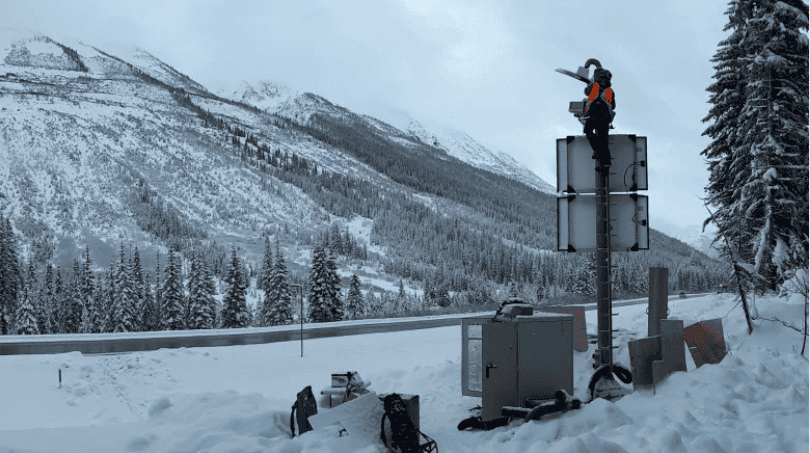
The $3-million system was installed this year in Rogers Pass, a high-mountain pass in Glacier National Park.

The system was designed by the Swiss and uses two technologies to detect avalanches, and notify avalanche experts: 13 infrasound panels which sense low-frequency sound, and three radar detectors.

“So with darkness or during storms it’s difficult to assess what activity is going on,” says Jeff Goodrich, senior avalanche officer with Parks Canada.

“With this new avalanche detection network we will get alerts to which avalanche paths are running.”

Jeff Goodrich, a Senior Avalanche Officer with parks Canada in front of one of 13 infrasound panels in the Rogers Pass. 

The detectors will pick up the slightest sound vibration given off by a powder cloud created when an avalanche hits.

“We’ll be getting texts on our cell phones to let us know avalanche activity is happening,” says Goodrich.

Rogers Pass and the Trans Canada Highway that cuts through it is the busiest rail and road corridor to the Pacific Coast.

It also closes frequently because of avalanches and avalanche control. There are 134 avalanche paths in just a 42 kilometre stretch of the highway over the pass, through Glacier National Park.

In the past, it often closed for days at a time. But Parks Canada spokesperson Shelley Bird says they’ve got that down to an average of about 60 hours a season. And they’re hoping this system cuts that down even more, because the early notification will let crews clear the snow faster.

“It’s an important part of not just connecting Canada from coast to coast, it’s an important part of the economy,” said Bird. 

Lieutenant Owen Thompson is part of the detachment from Manitoba who has arrived in B.C. for avalanche control. 

Canadian military involvement

The new detection system is just one of many measures to reduce avalanche risk in the pass. Another involves the Canadian military.

For almost six decades, military gun detachments have blasted Howitzer shells at the mountainsides in Rogers Pass to bring the snow down after big storms.

Two detachments from Manitoba have just arrived in the pass to begin the yearly bombardments.

“They tell me what direction to point my cannon in and we’ll get what they need done,” said Lieutenant Owen Thompson.

The Rogers Pass mission is the longest running in Canadian military history. And this year, the Howitzers will operate alongside high tech.

The Canadian military has been in Rogers Pass since 1962 blasting Howitzer shells at the mountainside. 

A $4.8M chandelier under Vancouver’s Granville Bridge draws divided response

Public art piece, paid for by developer, criticized for excess in a city grappling with a housing crisis

As Pierre Blais crossed the noisy construction site Wednesday on Vancouver’s Beach Avenue, dodging the forklifts and street sweepers, he nearly didn’t see the massive chandelier dangling above him.

It wasn’t until he paused and a construction worker pointed above, twirling her finger in a circular motion, that he stumbled upon the city’s newest public art installation.

“It’s gaudy,” said Blais, a 51-year-old small business owner, gazing at the chandelier’s 600 faux crystals. “If that was the demographic they’re aiming for, they nailed it.”

Blais, who has lived for five years in the neighbourhood, reflects the polarizing response to the installation since its grand unveiling this week.

In a city grappling with a housing and homelessness crisis, the chandelier has ignited criticisms of Versailles-like grandeur and excess, fuelled by its eye-popping $4.8-million price tag.

The piece, titled Spinning Chandelier, was designed by B.C. artist Rodney Graham, who based it on a 2005 film installation of a whirling chandelier.

The fixture spans 7.7 metres in height and 4.2 metres in length and is made of stainless steel, LED lamps and polyurethane faux crystals.

Every so often, the chandelier descends from the north end of the Granville Bridge, spins for about four minutes while flashing its lights, then retreats into the bridge’s underbelly.

“The price tag is way too high for what it is,” said Janice Rafael, a 58-year-old retired artist, who walks by the area daily. 

Rafael said she wishes part of that money had gone to adding artwork or amenities at May and Lorne Brown Park, a small, busy green space a block away.

The installation was commissioned and paid for by the luxury property developer Westbank as part of its Vancouver House project. The site’s centrepiece is a twisting, Jenga-like highrise, just north of the chandelier.

In a written statement, Westbank said there will always be critics when it comes to spending on public art.

“There is a pervasive attitude in our city that we must choose between contributing to social infrastructure or making other contributions, whether artistic or cultural, that are seen as less functional,” the developer wrote.

“Westbank does not view this as an ‘either or’ situation.”

It took more than three years to design and manufacture the nearly eight-metre-tall chandelier. 

Changing neighbourhood

Westbank was required to provide a public art piece for Vancouver House under the city’s bylaws.

It first pegged the cost at $1.2 million in its 2015 proposal to city council, but that number ballooned to $4.8 million as the project’s complexity came to light.

The city allowed Westbank to pool funds from three other developments to create one larger installation. Westbank covered the entire cost of the chandelier and is on the hook for any maintenance. 

As part of the city’s rezoning conditions, Westbank will contribute 106 new rental homes and more than $21 million in levies to the city.

Units in the Vancouver House, however, cater to the wealthy: A three-bedroom unit is listed at $6.9 million, while a two-bedroom penthouse is up for nearly $9 million.

The development has drawn a flurry of activity to a historically industrial area, where the homeless have often sought refuge under the bridge.

Observers stop to take photos of the chandelier. 

Eric Fredericksen, head of public art for the City of Vancouver, said the chandelier will bring more people to the “rough and functional” space. But he’s mindful of the criticism.

“For the artist, I think he was thinking more abstractly about the sculpture and the light possibilities in the chandelier. I’m not sure how much the social implications are in there,” Fredericksen said.

“But they are there now and I think they’ll be part of the reading of the piece, which is a spectacular object. I’m curious as to how that conversation will play out over time.”

For some, the chandelier is best viewed as a feat of design. Desmond Williams, a 59-year-old engineer, scrutinized the chandelier as crews tested out the chandelier.

“I don’t know if it’s the best public art that I would see for this area. I haven’t decided,” Williams said.

Just then, the chandelier began to spin, its crystals flaring out like wings. Williams’ face lit up.

“Already I’m liking it,” he said. “I think with light, it could be really cool.”

The chandelier will hang dormant for most of the day. 

B.C. forest industry facing uncertain future as mills close across province Social Sharing

Finance Ministry budget numbers show forest revenues are down 11 per cent so far this year

It seems barely a day goes by without an announcement about layoffs, temporary closures or permanent mill shut downs in British Columbia’s struggling forest industry.

As a result, thousands of workers, their families and many communities have been left facing uncertain futures.

The layoffs and shutdowns are causing widespread economic and social pain, says B.C. Liberal forestry critic John Rustad.

“It’s unfathomable to think of the carnage that’s already happened, let alone what will happen this winter,” he said in a recent interview. “It’s going to be a very bleak winter.”

Rustad said on a visit to Campbell River a car dealer told him he repossessed 10 vehicles from forestry workers who were out of work.

One laid-off worker asked him if he could keep his vehicle until Christmas and sold the dealer a load of firewood to make a payment, Rustad said.

On Vancouver Island, where Mosaic Forest Management announced an early winter shutdown of timber harvesting operations, 2,000 people are out of work indefinitely.

Among those affected are also about 175 workers at a mill owned by Tolko Industries in Kelowna where the plant will close permanently on Jan. 8. Canfor’s decision to permanently close its mill in Vavenby, north of Kamloops, resulted in the loss of 172 jobs in the community of about 700 people.

“Basically, I would say 80 per cent or more of the coastal forest sector is down,” Rustad said. “It’s not good. It’s really, really tough.”

Revenues down

Finance Ministry budget numbers show forest revenues are down 11 per cent so ar this year and projected harvest volumes of 46 million cubic metres are the lowest in years. The NDP government faced daily calls for action from the Liberals during the fall session of the legislature, which concluded Thursday.

“When will the premier and his government start paying attention and do something?” asked Liberal co-finance critic Shirley Bond, whose Prince George riding is facing about 50 impending layoffs at a mill.

Liberal rural development critic Donna Barnett wants the government to grant payment relief to Sigurdson Forest Products, which owes the province $4.6 million in stumpage fees. She said the company in Williams Lake is committed to paying the fees but needs a temporary stay on the payments to save up to 200 jobs.

“SFP is a viable company and wants to continue operations,” said president Brian Sigurdson in a letter to Finance Minister Carole James, Premier John Horgan and Forests Minister Doug Donaldson.

“We want to continue to support all of our employees and our local businesses and community.”

Donaldson said the request for relief is before the Ministry of Finance, but he added stumpage rates in the B.C. Interior dropped by 12 per cent in October and 24 per cent on the coast.

He also said political intervention into the stumpage system could make matters worse for B.C. companies because it could result in a trade challenge from forest producers in the United States. B.C. lumber exports to the U.S. already face tariffs of about 20 per cent.

Low timber prices and the large-scale destruction of Crown harvest zones during the pine beetle epidemic and two successive record wildfire seasons have hurt the industry, Donaldson said.

“We understand the impact the global downturn is having on the economies of the Interior and we’re determined to address it,” he said in the legislature.

He said the province has taken steps to drive more logs to domestic production and for use in value-added products.

A report by the council in September said the industry has been a cornerstone of the B.C. economy for more than 100 years and the well-being of 140 communities is closely linked to the health of the sector. 

Industry spokeswoman Susan Yurkovich said it can rebound but companies need assurances from the government about long-term availability of a timber supply at a reasonable cost. The industry itself must move to greener products and become more competitive on the global market, she added.

“I’ve spent 25 years in the resource sector and I’ve spent a lot of time in many of the communities that are hurting,” said Yurkovich, president of the Council of Forest Industries.

“The most important thing we can do for those communities in transition is to look at where are the future opportunities for the sector.”

A report by the council in September said the industry has been a cornerstone of the B.C. economy for more than 100 years and the well-being of 140 communities is closely linked to the health of the sector.

It said forestry supports about 140,000 jobs and generates about $4 billion in revenues annually for the province.