Archives for November 14, 2019

FedEx Corporation (FDX) Dips 3.1%

Among the S&P 500’s biggest fallers on Wednesday November 13 was FedEx Corporation (FDX). The stock experienced a 3.1% decline to $156.23 with 2.21 million shares changing hands.

FedEx Corporation started at an opening price of 160.00 and hit a high of $160.01 and a low of $156.15. Ultimately, the stock took a hit and finished the day at $4.99 per share. FedEx Corporation trades an average of n/a shares a day out of a total 260.91 million shares outstanding. The current moving averages are a 50-day SMA of $n/a and a 200-day SMA of $n/a. FedEx Corporation hit a high of $234.49 and a low of $137.78 over the last year.

FedEx pioneered overnight delivery in 1973 and remains the world’s largest express delivery firm. In fiscal 2019, FedEx derived about 54% of its $70 billion top line from its express division, 29% of sales from ground, and 11% from its freight less-than-truckload trucking segment. Remaining revenue comes from other services, including FedEx Office, which provides document production and shipping services. FedEx acquired Dutch parcel delivery firm TNT Express in 2016.

With its headquarters located in Memphis, TN, FedEx Corporation employs 239,000 people. After today’s trading, the company’s market cap has fallen to $40.76 billion, a P/S of n/a, a P/B of 2.24, and a P/FCF of n/a.

For all the attention paid to the Dow Jones Industrial Average (DJIA), it’s the S&P 500 that’s relied on by insiders and institutional investors. It represents the industry standard for American large-cap indices.

The Dow is made up of just 30 stocks to the S&P 500’s 500, and it uses an unreliable and outdated price-weighting system where the S&P 500 relies on market cap in weighting its returns. This is why its long-term returns is a much more reliable gauge for the performance of large- and mega-cap stocks over time.

Dow Inc. (DOW) Dips 2.72%

Among the S&P 500’s biggest fallers on Wednesday November 13 was Dow Inc. (DOW). The stock experienced a 2.72% decline to $53.66 with 3.42 million shares changing hands.

Dow Inc. started at an opening price of 54.19 and hit a high of $54.48 and a low of $53.46. Ultimately, the stock took a hit and finished the day at $1.5 per share. Dow Inc. trades an average of n/a shares a day out of a total 741.5 million shares outstanding. The current moving averages are a 50-day SMA of $n/a and a 200-day SMA of $n/a. Dow Inc. hit a high of $60.52 and a low of $40.44 over the last year.

Dow Inc is a diversified chemical manufacturing company. It combining science and technology to develop innovative solutions that are essential to human progress. Dow’s portfolio is comprised of six global business units, organized into three operating segments: Performance Materials and Coatings, Industrial Intermediates and Infrastructure and Packaging and Specialty Plastics.

With its headquarters located in Midland, MI, Dow Inc. employs 37,000 people. After today’s trading, the company’s market cap has fallen to $39.79 billion, a P/S of n/a, a P/B of 2.29, and a P/FCF of n/a.

For all the attention paid to the Dow Jones Industrial Average (DJIA), it’s the S&P 500 that’s relied on by insiders and institutional investors. It represents the industry standard for American large-cap indices.

The Dow is made up of just 30 stocks to the S&P 500’s 500, and it uses an unreliable and outdated price-weighting system where the S&P 500 relies on market cap in weighting its returns. This is why its long-term returns is a much more reliable gauge for the performance of large- and mega-cap stocks over time.
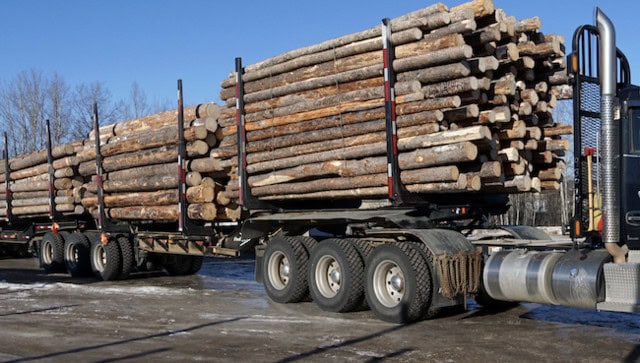
Calming forestry fears

Trade mission seeks to calm concerns about forestry downturn

Forests Minister Doug Donaldson says he’s in Asia trying to calm investor concerns about reduced supplies of British Columbia timber for major residential developments and tourism-resort projects in China and Japan.

Donaldson, in a teleconference from Tokyo, says he and 35 senior executives from B.C. forest companies and associations are on a five-day trade mission to Asia that concludes Friday.

He says the Chinese and Japanese are keenly aware of the toll pine beetle infestations and massive wildfires have taken on B.C.’s forests, but business leaders and forests ministry officials are reassuring potential customers the province has abundant supplies of timber.

The Opposition Liberals recently released a document detailing ongoing forest industry struggles, listing almost 60 examples where companies have implemented cost-cutting measures that range from harvest reductions to permanent mill closures.

The detention of top Huawei executive Meng Wanzhou in Canada prompted the minister to postpone his planned participation on a forestry trade mission to China last December.

Donaldson says this week’s trade talks in Japan and China focused only on business.

CAE profits take off

CAE Inc. reports second-quarter profit and revenue up

CAE Inc. says its second-quarter profit rose nearly 22 per cent from the same time last year as its civil aviation business led revenue growth.

The simulator and training company said it earned a profit attributable to shareholders of $73.8 million or 28 cents per share for the quarter, up from $60.7 million or 23 cents per share last year.

Revenue totalled $896.8 million, up from $743.8 million a year ago.

The growth came as revenue at CAE’s civil aviation business rose 35 per cent compared with a year ago to $529.9 million, while revenue at its defence and security business totalled $336.5 million, up five per cent from a year ago.

Health care revenue was $30.4 million, the same as a year ago.

Analysts on average had expected a profit of 25 cents per share and $849.9 million in revenue, according to financial markets data firm Refinitiv.

Loblaw reports $331M profit

Loblaw revenue up 2.3 per cent on $331-million profit

Loblaw Companies Ltd. reported a third-quarter profit of $331 million as revenue rose 2.3 per cent, helped by higher sales at its Shoppers Drug Mart stores.

The drug store and grocery retailer says the profit amounted to 90 cents per share for the 16-week period ended Oct. 5. That compared with a profit of $106 million or 28 cents per share in the same quarter last year.

Revenue totalled nearly $14.66 billion, up from nearly $14.32 billion a year ago.

Food retail same-store sales were up 0.1 per cent, however Loblaw says excluding the unfavourable impact of the timing of Thanksgiving food same-store sales were up 1.0 per cent. Drug store same-store sales were up 4.1 per cent.

On an adjusted basis, Loblaw reported a profit from continuing operations of $458 million or $1.25 per share. That compared with an adjusted profit from continuing operations of $466 million or $1.24 per share in the same quarter last year when the company had more shares outstanding.

Analysts on average had expected a profit of $1.24 share and $14.57 billion in revenue, according to financial markets data firm Refinitiv.

LNG site taking shape

1,000 workers on site preparing for Kitimat LNG terminal

One year ago, the partners behind LNG Canada formally sanctioned a $40 billion project in Kitimat.

Today, roughly 1,000 workers are on site – and that’s just to set the stage for the main construction phase, which isn’t expected to start for another couple of years.

“It’s definitely buzzing,” says Kitimat Mayor Phil Germuth. “The hotels are full, there’s another brand new hotel that’s being built. There’s a brand new 35-unit townhouse development being done.”

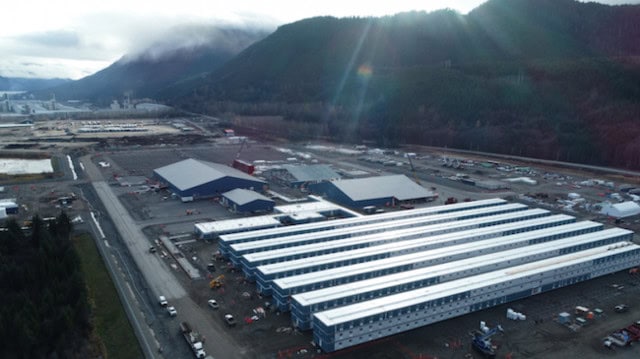
Located at the mouth of Douglas Channel, next to the recently upgraded Rio Tinto aluminum smelter, the LNG Canada site at 400 hectares is about the size of 550 soccer fields.

At the north end, the Cedar Valley Lodge, a self-contained work village that will house up to 4,500 workers, is starting to take shape, while at the south end, dredging barges are busy scooping up sediment – some of it contaminated from historical industrial activities – to deepen the channel for liquefied natural gas carriers. The dredging alone currently employs about 150 workers.

In between these two bookends is the main site, where a battalion of more than 70 pieces of earthworks machinery – dump trucks, graders, excavators – has already moved about one-third of the 2.8 million cubic metres of fill needed to prepare the site.

On site are 6,000 40-metre steel pilings, made in Turkey. They will be driven into the ground to support the LNG complex, which will include two LNG processing modules, known as trains.

In July 2021, LNG modules that will be built in Asia are expected to arrive. That is when most of the tradespeople – electricians, welders, pipefitters – will be mobilized to start putting it all together. Peak construction will be between 2022 and 2024.

“That’s when the skyline of the project changes every day, virtually,” said LNG Canada general manager Vince Kenny, who spent the last five years on an LNG project in Australia. “It’s quite an intense couple of years.”

From 2022 to 2024, up to 7,500 people will be employed on the project. The shifts will be staggered, with employees working two weeks on and one week off, so no more than 4,500 will be on site at any one time. Another 2,500 will be working on the associated $6.2 billion Coastal GasLink project.