Archives for October 13, 2019

Stocks to Watch: State Street Corporation (STT) Rises 3.29%

Among the biggest risers on the S&P 500 was State Street Corporation ($STT), popping some 3.29% to a price of $58.70 a share with some 2.18 million shares trading hands.

Starting the day trading at $58.25, State Street Corporation reached an intraday high of $59.49 and hit intraday lows of $58.06. Shares gained $1.87 apiece by day’s end. Over the last 90 days, the stock’s average daily volume has been n/a of its 372.58 million share total float. Today’s action puts the stock’s 50-day SMA at $n/a and 200-day SMA at $n/a with a 52-week range of $48.62 to $84.00.

State Street is a leading provider of financial services, including investment servicing, investment management, and investment research and trading. With over $31 trillion in assets under custody and administration and $2.5 trillion assets under management as of Dec. 31, 2018, State Street operates globally in more than 100 geographic markets and employs more than 40,000 worldwide.

State Street Corporation has its corporate headquarters located in Boston, MA and employs 39,483 people. Its market cap has now risen to $21.87 billion after today’s trading, its P/E ratio is now n/a, its P/S n/a, P/B 1.01, and P/FCF n/a.

Corned beef and pastrami products recalled due to Listeria contamination

The Canadian Food Inspection Agency says some corned beef and pastrami meats distributed in British Columbia, Alberta and Manitoba are being recalled due to Listeria.

The products made by Nossack Fine Meats Ltd. are called Butcher’s Pride Corned Beef and Pastrami. They were both sold with a best before marker of 2019NO27.

No reported illnesses
The CFIA says consumers should not eat the products and distributors such as retailers and food service establishments like hotels, restaurants, cafeterias, hospitals and nursing homes should not sell or use the recalled products.

Recalled products should be thrown out or returned to the location where they were purchased.

Food contaminated with Listeria monocytogenes may not look or smell spoiled, but can still make people sick.

Symptoms can include vomiting, nausea, persistent fever, muscle aches, severe headache and neck stiffness.

The CFIA says there have been no reported illnesses associated with the consumption of the recalled products.

Rescue efforts underway after rains from Typhoon Hagibis flood Japan

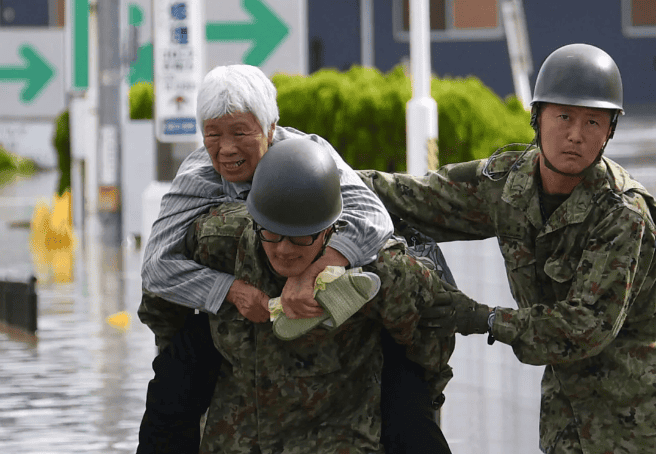
Helicopters plucked people from their flooded homes on Sunday as rescue efforts went into full force in wide areas of Japan after a powerful typhoon unleashed heavy rainfall on Tokyo and surrounding areas, leaving at least seven dead and 15 missing.

Public broadcaster NHK gave a higher toll than the government of 10 dead and 16 missing plus 128 injured as more details were coming in the from field, a day after Typhoon Hagibis made landfall south of Tokyo and moved northward.

“The major typhoon has caused immense damage far and wide in eastern Japan,” government spokesperson Yoshihide Suga told reporters, adding that 27,000 military troops and other rescue crews were deployed for the operation.

News footage showed a rescue helicopter hovering in a flooded area in Nagano prefecture where an embankment of the Chikuma River broke, and streams of water were continuing to spread over residential areas. The chopper plucked those stranded on the second floor of a home submerged in muddy waters.

Aerial footage showed tractors at work trying to control the flooding. Meanwhile, rows of Japan’s prized bullet trains, parked in a facility, were sitting in a pool of water.

A stretch of Fukushima, in the city of Date, was also flooded with only rooftops of residential homes visible in some areas. Parts of nearby Miyagi prefecture were also under water.

The Tama River, which runs by Tokyo, overflowed its banks.

Authorities warned of a risk of mudslides. Among the reported deaths were those whose homes were buried in landslides. Other fatalities included people who got swept away by raging rivers.

Suga said that damage to housing from the flooding was extensive but promised recovery was on its way. Some 376,000 homes were without electricity, and 14,000 homes lacked running water, he said.

Boats as well as helicopters were sent to the flooded areas, while rescue crew dug through dirt in other areas to try to get people out from homes buried by landslides.

Several train service in the Tokyo area resumed early morning, although others were undergoing safety checks and were expected to restart later Sunday.

Ruling party politician Fumio Kishida said the government will do its utmost in rescue operations, including making sure that those who moved to shelters were taken care of.

He acknowledged Japan’s power grids need to be strengthened so people in disaster areas can rely on timely information.

“So many risks remain, and it is a reality we must stay on guard,” Kishida said on an NHK TV news talk show. “We must do our utmost. In these times, a disaster can hit anytime.”

As the typhoon bore down on Saturday with heavy rains and strong winds, the usually crowded train stations and streets of Tokyo were deserted with people advised to stay indoors. But life was quickly returning to normal under crisp clear skies Sunday.

Evacuation centres had been set up in coastal towns with tens of thousands seeking shelter. Kyodo News service said evacuation warnings had been issued to more than 6 million people.

The typhoon disrupted a three-day weekend in Japan that includes Sports Day on Monday. Qualifying for a Formula One auto race in Suzuka was pushed from Saturday to Sunday.

The authorities had repeatedly warned Hagibis was on par with a typhoon that hit the Tokyo region in 1958. But the safety infrastructure that Japan’s modernization had brought was apparent. The typhoon six decades ago had left more than 1,200 people dead and half a million houses flooded.

Manitoba to declare state of emergency due to October snowstorm

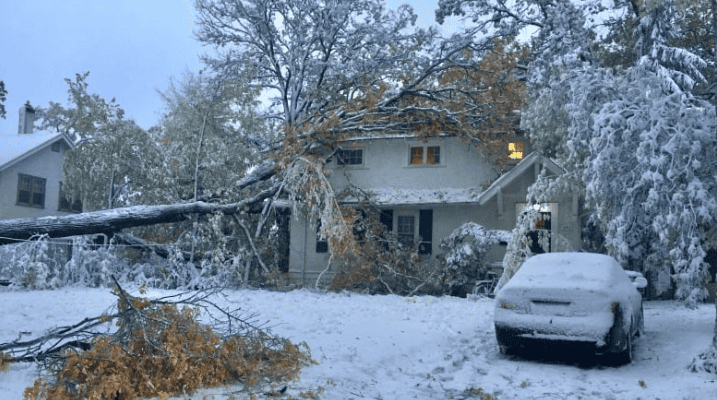
Premier Brian Pallister will declare a state of emergency after receiving a request from Manitoba Hydro, as a major snowstorm creates havoc across the southern portion of the province.

With about 50,000 Manitoba Hydro clients without electrical power as a result of the treacherous storm, Pallister gave the update on the provincial response to the storm on Saturday afternoon in an address at the Manitoba Legislature.

“I have spoken to Manitoba Hydro. They have officially made a request to declare a state of emergency which would give them additional powers to access resources, supplies, materials that they need at various descriptions in order to restore power as quickly as possible,” the premier said.

“We’ll be proceeding to grant that request… to bring about the ability of Manitoba Hydro to proceed more rapidly.”

The province’s co-ordinated emergency centre has escalated to Level 3 — a “heightened level of concern,” Pallister said.

“We have hydro towers that are leaning, we have wooden poles that have snapped, we have major work underway,” he said.

The last time Manitoba declared a state of emergency was in 2014 due to a surge in floodwaters.

Manitoba Hydro is still putting in writing the specifics of their request, Pallister said. The intention of the declaration is to give the crown corporation time to do their repairs.

On Wednesday, a Colorado low-weather system moved into Manitoba from the United States. It has wreaked havoc by downing power lines and tree limbs across the province, from the southwest corner into the Red River Valley and northwest toward Berens River and into Saskatchewan.

“We’ve had very heavy and freezing rain, heavy snow and strong winds,” Pallister said, adding that 50 to 70 millimetres of precipitation has draped trees filled with colourful leaves and already saturated soils.

An additional 20 to 25 millimetres is expected to fall in the south and central parts of province Saturday evening into Sunday.

Evacuations underway
Several rural Indigenous communities, such as Peguis First Nation, are preparing to evacuate due to outages.

Jason Small, a spokesperson for Canadian Red Cross, confirmed the national charity will begin assisting some First Nations on Sunday, depending on access and power restoration, as per an agreement with the federal government.

No details could be provided about who or how many people would be affected, he said. The Interlake Reserves Tribal Council Inc. has been working with the six communities in its region to make relocation plans in the interim, Small said.

Bruce Owen, a spokesperson for Manitoba Hydro, said the province’s electricity provider is unable to estimate how long it will take to restore power to all users given the volume of reports and difficulty in accessing areas due to wet grounds.

Crews have been busy tackling major jobs — like a downed transmission line in Portage la Prairie — that “can’t simply be fixed with a bucket truck,” Owen said in a plea to residents and potential travellers over the Thanksgiving long weekend.

“So if you don’t have to travel, if you don’t have to go anywhere, please stay put,” Owen said.

Portage la Prairie goes dark
Storm damage forced major temporary highway and road closures in southern Manitoba, including Highway 1 west of Winnipeg to the Saskatchewan border. Most roadways have since reopened, according to Manitoba 511’s online report.

The majority of Portage la Prairie — a city of about 13,000 residents located 83 kilometres east of Winnipeg along the Trans-Canada Highway — has been without power. Outages were affecting more than 5,800 people in the city as of 7:40 p.m. local time on Saturday.

“The entire city is without power. We have a lot of trees and lines that are down,” Mayor Irvine Ferris said.

Sixty people are staying in a shelter and about 300 people have been set up in hotels, which have all filled up, Ferris said.

Residents should expect to be without power for at least another 24 hours. Ferris warned them to be careful when using alternate sources of heating and follow manufacturers instructions to remain safe.

The city is also worried about the effect on drains and lift stations that carry wastewater to the water treatment plant, and is asking residents to avoid using water for showering, doing dishes and flushing the toilet to avoid sewer backups.

Ralph Groening, the reeve of the Rural Municipality of Morris, said many residents lost power on Thursday, which has since been restored. About half of Morris residents were without power for two days, he said.

“Our residents certainly had to survive a few days without power and that created a challenge,” Groening said.

Groening, who is also president of the Association of Manitoba Municipalities, said the most pressing concern now is rising waters after a record-setting wet September and additional precipitation pounded the Prairie region where the Red Rivers flows from south of the U.S. border to the Hudson Bay.

“We will certainly be preparing for and doing everything we can to anticipate the high water problems that possibly could be a challenge for us,” Groening said.

Flood risk increasing as water levels rise
In addition to huge swaths of power outages, rising waters levels also have the province on edge. Pallister said there are high water advisories in effect.

“Crews and equipment are staged in a number of high risk areas,” he said, including the Red River Valley, Interlake region, southeastern Manitoba and the Whiteshell area.

The city of Winnipeg has already closed the floodgates and activated the Red River floodway on Wednesday to prevent flooding in the capital region.

Pumping operations are already underway in Emerson, Morris, Dominion City and some other communities.

Several areas have experienced overland flooding and road washouts due to high levels of precipitation.

Two government departments — Manitoba Infrastructure and Sustainable Development — will continue to monitor the situation.

Trudeau wears bulletproof vest after security threat delays campaign rally Social Sharing

Tactical officers surrounded Liberal leader as he addressed Mississauga, Ont., crowd

Liberal Leader Justin Trudeau wore a bulletproof vest on stage amid heavy security at a campaign rally after a security threat, senior Liberal sources tell CBC News.

His appearance at a crowded rally of about 2,000 supporters in Mississauga, Ont., on Saturday evening was delayed by 90 minutes and featured a much heavier security detail around Trudeau once the Liberal leader took the stage.

Uniformed tactical officers wearing heavy backpacks surrounded the Liberal leader as he addressed the crowd. His wife, Sophie Grégoire Trudeau, was initially supposed to introduce him but did not appear on stage.

Trudeau delivered the speech without incident and shook hands with numerous supporters lining the stage and in the crowd as he left the venue.

When asked for more details, the Liberal Party said there would be no comment on Saturday night.

Heightened fears of violence
Saturday’s extra security measures came amid heightened fears of violence on the campaign. Last month, sources told CBC News the RCMP were compiling daily threat reports on online hate targeting federal political leaders during the election campaign, fearing it could spill over into real-world violence.

Government sources close to the file confirmed an increase in online posts condoning violence during the campaign.

Just two weeks ago, Trudeau’s security detail arrested a protester who approached the Liberal leader during the climate change strike march in Montreal.

In February, ahead of his testimony in front of the justice committee on the SNC-Lavalin affair, Michael Wernick, then-clerk of the Privy Council, warned of the dangers of rising hate on the campaign trail.

“I worry about the rising tides of incitements to violence when people use terms like ‘treason’ and ‘traitor’ in open discourse. Those are the words that lead to assassination,” Wernick told committee members.