
Archives for October 4, 2019

Palmer Luckey’s company is making drone-ramming drones

The controversial firm is already sending defensive UAVs to customers.

Oculus co-founder Palmer Luckey and his company Anduril Industries have drawn flak for their pursuit of controversial government and military contracts, and that uproar isn’t about to subside any time soon. Anduril has unveiled the Interceptor, a “counter-drone” built solely to take down other robotic fliers by ramming them at high speed. It requires human operators’ permission for takedowns, but can be cued through AI and automatically acquire targets using computer vision. The company is hoping this will protect military units and key infrastructure against hostile drones, whether they’re improvised bombers or purpose-built recon vehicles.

This isn’t just an idea in search of customers. Anduril started shipping “dozens” of Interceptors to the US and UK earlier in 2019, Bloomberg noted, with hundreds of further units in the pipeline. Its newest contract will bring Interceptors to conflict areas, although the company declined to say where and with whom.

For critics, this won’t help Anduril’s reputation. It’s already been accused of playing into the Trump administration’s controversial immigration policies by developing surveillance tech for the US-Mexico border — now, it’s releasing a weapon. However, the anti-drone project underscores the complexity of Anduril’s position. It’s neither a complete sinner nor a complete saint.

As it’s marketed, Interceptor is strictly a defensive tool. It’s theoretically saving lives rather than taking them. At the same time, its highly automated nature raises concerns about the rise of killer robots and the potential for abuse. It wouldn’t take much to have Interceptor attack targets on its own. Workers at companies like Google have already balked at working on military drones, yet Anduril is embracing them. The defense startup argues that it’s at least transparent about its intentions, though. Where firms like Google and Microsoft have been accused of staying quiet about military contracts and misleading workers, Anduril makes clear that weapons are part of its plans.


Apple patent application describes touchscreen keyboards you can feel

Whether this becomes an actual thing remains to be seen.

More than 10 years after the first iPhone, it’s safe to say most people are used to typing on on-screen keyboards. But that doesn’t they couldn’t be made better, and it looks like someone at Apple is thinking about ways to do just that. Patently Apple pointed out a patent application where the company describes a technology that could allow virtual keyboards to more easily mimic their traditional mechanical counterparts.

All the usual caveats with patents apply here: just because Apple has applied for a patent on this technology doesn’t mean we’ll see it make its way into one of the company’s future products. Moreover, it’s best to think of a specific patent application as one of the many directions a company can take a particular technology.

With that said, Apple envisions using a combination of haptic motors as well as electrostatic charges to create a keyboard that feels like the real thing. Each “key” would emit its own charge, and that charge would get stronger as you move your finger closer to the edge of the mechanism. What enables the keyboard to feel like a mechanical one is that your fingers would conduct the charges created by the keys. In this way, the keys could attract and repulse your fingers, as well as create the sensation of friction and texture. Together, these features of the keyboard would allow you to touch type on it, according to Apple.

The one factor that makes this patent more plausible than the ones we usually see is that the company is no stranger to removing hardware keys and buttons from its devices. Take the iPhone, for example. Even before Apple removed the home button altogether from the iPhone X, the company replaced the iPhone 7’s physical home button with a solid-state one. Still, we’re likely years away from more tactile feeling touchscreens and MacBooks without physical keyboards.

Update: This post has been updated to note Apple has applied for, but not yet received, a patent on this technology.

Boss’ new Katana guitar amps offer more tones than ever

The Katana MkIIs have twice as many amps simulations and let you use up to five effects at once.

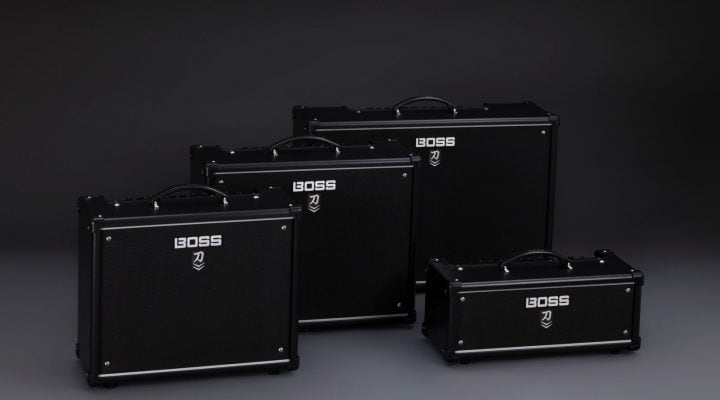
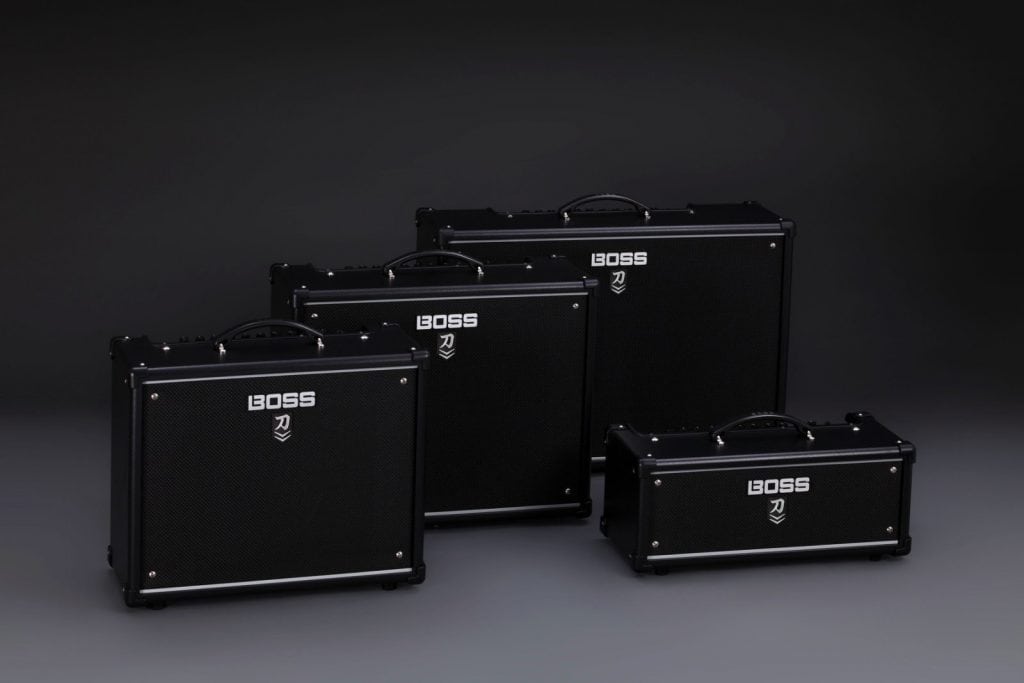
A few months back a reader asked us what the best connected guitar amp was for beginners. And there are a few solid options, including Yamaha’s THR line. But, one amp topped the rest: Boss’ Katana 50. And now Katana line is getting major refresh that makes it an even better bang for your buck than before. This most immediate change is the number of amp simulations available. The original Katanas had five, the Katana MkIIs add a variation of each, for a total of 10 amp models. You can also use more of the built in effects simultaneously now. Where as before you were limited to three, the MkII line lets you chain up to five together. And it’s still pulling from the same library of over 60 excellent Boss effects (after all, Boss is better known for its effects pedals than its amps).

Of course, the Katana keeps a lot of the other features that make is so easy to recommend. It still has switchable power for going from a full roar, to bed-room appropriate volumes (without changing the tone). And it still can connect to your computer over USB, where the Boss Tone Studio unlocks of host of other features, like mic or cabinet resonance simulation. Plus it can be used as an audio interface, so you can capture your jams straight to your favorite DAW.

While you can change up settings from your PC, Boss is pretty proud of the fact that there’s no menus or screens on the amp. All of the most important settings are there on the panel. Or, if you’re working with one of the 100 watt models, you can connect the GA-FC foot controller from Boss to turn effects on and off and change channels, without ever touching a knob. You can also connect an expression pedal to control onboard effects like wah — you’re not stuck in some awkward auto mode.

One new and interesting feature here is a direct in for the power amp. That means if you have a high-end multi-effects unit or amp modeler, you can bypass the builtin preamp. Though, I do need to point out that unlike a lot of other amps in this space, Boss decided to skip adding any sort of wireless connectivity. That means there’s not streaming audio over bluetooth to practice along with, and no hope for connecting to a mobile app.

The Katana MkII is available as a 50w combo with a single 12-inch speaker ($229), a 100w combo with one 12-inch speaker ($359), there’s a version of the 100w with two 12-inch speakers ($469) and a stand alone head unit ($349).

Intel wants to use AI to reconnect damaged spinal nerves

Its team-up could eventually restore movement for paralyzed people.

AI’s use in medicine could soon extend to one of the medical world’s toughest challenges: helping the paralyzed regain movement. Intel and Brown University have started work on a DARPA-backed Intelligent Spine Interface project that would use AI to restore movement and bladder control for those with serious spinal cord injuries. The two-year effort will have scientists capture motor and sensory signals from the spinal cord, while surgeons will implant electrodes on both ends of an injury to create an “intelligent bypass.” From there, neural networks running on Intel tools will (hopefully) learn how to communicate motor commands through the bypass and restore functions lost to severed nerves.

The initial interface will use external computing hardware to interpret spine signals. In the long term, the collaborators would like a wholly implanted system to make the connection.

This is something of a moonshot, and there’s no guarantee the project will end with a surefire solution for paralysis. It should still be useful even then, though. Assistant engineering professor David Borton stressed that the research should still “uncover new knowledge” about spinal cords and “accelerate innovation” toward treatment. If it’s not the remedy Intel and Brown seek, it should represent a big step in the right direction.

Stocks to Watch: W&T Offshore Inc. (WTI) Soars 5.05%

W&T Offshore Inc. (WTI) had a good day on the market for Thursday October 03 as shares jumped 5.05% to close at $4.16. About 2.28 million shares traded hands on 10,453 trades for the day, compared with an average daily volume of n/a shares out of a total float of 140.69 million. After opening the trading day at $3.91, shares of W&T Offshore Inc. stayed within a range of $4.16 to $3.89.

With today’s gains, W&T Offshore Inc. now has a market cap of $585.27 million. Shares of W&T Offshore Inc. have been trading within a range of $9.73 and $3.62 over the last year, and it had a 50-day SMA of $n/a and a 200-day SMA of $n/a.

W&T Offshore Inc is an oil and gas exploration and production company. The company’s exploration operations are focused in the Gulf of Mexico, where it drills for oil and gas. The company engages in both deepwater drilling and shallow-water shelf drilling. W&T Offshore extracts crude oil, natural gas, and natural gas liquids, which are then sold directly at the wellhead. Overall, crude oil accounts for the majority of the company’s revenue, with natural gas accounting for a much smaller portion.

W&T Offshore Inc. is based out of Houston, TX and has some 282 employees. Its CEO is Tracy W. Krohn.

W&T Offshore Inc. is also a component of the Russell 2000. The Russell 2000 is one of the leading indices tracking small-cap companies in the United States. It’s maintained by Russell Investments, an industry leader in creating and maintaining indices, and consists of the smallest 2000 stocks from the broader Russell 3000 index.

Russell’s indices differ from traditional indices like the Dow Jones Industrial Average (DJIA) or S&P 500, whose members are selected by committee, because they base membership entirely on an objective, rules based methodology. The 3,000 largest companies by market cap make up the Russell 3000, with the 2,000 smaller companies making up the Russell 2000. It’s a simple approach that gives a broad, unbiased look at the small-cap market as a whole.

Stocks to Watch: Community Health Systems Inc. (CYH) Soars 5.52%

Community Health Systems Inc. (CYH) had a good day on the market for Thursday October 03 as shares jumped 5.52% to close at $3.82. About 2.12 million shares traded hands on 9,252 trades for the day, compared with an average daily volume of n/a shares out of a total float of 118.05 million. After opening the trading day at $3.59, shares of Community Health Systems Inc. stayed within a range of $3.83 to $3.59.

With today’s gains, Community Health Systems Inc. now has a market cap of $450.96 million. Shares of Community Health Systems Inc. have been trading within a range of $5.35 and $1.79 over the last year, and it had a 50-day SMA of $n/a and a 200-day SMA of $n/a.

Community Health Systems is the largest publicly owned hospital operator in the United States. The company owns or leases over 100 general acute-care hospitals located in nonurban and urban markets. The company also owns four home health agencies and provides management and consulting services to independent hospitals.

Community Health Systems Inc. is based out of Franklin, TN and has some 87,000 employees. Its CEO is Wayne T. Smith.

Community Health Systems Inc. is also a component of the Russell 2000. The Russell 2000 is one of the leading indices tracking small-cap companies in the United States. It’s maintained by Russell Investments, an industry leader in creating and maintaining indices, and consists of the smallest 2000 stocks from the broader Russell 3000 index.

Russell’s indices differ from traditional indices like the Dow Jones Industrial Average (DJIA) or S&P 500, whose members are selected by committee, because they base membership entirely on an objective, rules based methodology. The 3,000 largest companies by market cap make up the Russell 3000, with the 2,000 smaller companies making up the Russell 2000. It’s a simple approach that gives a broad, unbiased look at the small-cap market as a whole.