
Archives for September 25, 2019

Boston Dynamics’ Atlas robot is now a gymnast

The bipedal robot handstands, rolls, jumps and spins.

The latest footage from Boston Dynamics is, unsurprisingly, both impressive and terrifying. Over the past few years we’ve seen Atlas navigate uneven terrain and even jump around a parkour course. This is on another level, though. The bipedal robot does a handstand, rolls around and even does a few jumping twists — all without losing its balance.

A new workflow helps Atlas pull off these smooth moves while also reducing development time and achieving a performance success rate of about 80 percent. “First, an optimization algorithm transforms high-level descriptions of each maneuver into dynamically-feasible reference motions,” says Boston Dynamics. “Then Atlas tracks the motions using a model predictive controller that smoothly blends from one maneuver to the next.” The exact purpose of an agile, bipedal robot is still a bit of a mystery, though; Atlas could end up becoming anything from a butler to a soldier. Why Google bought Boston Dynamics is yet another puzzle.

Boston Dynamics’ Spot is now available for those who want a robotic companion for commercial use. While individuals can’t purchase the doglike robot, enterprise customers can deploy a pack to help on construction, plant operations, and public safety jobs. Whether it’s as useful as a human worker or not, Spot is sure to impress corporate clients.


Add eye tracking to your HTC Vive headset for $149

The Droolon F1 supports the Cosmos, Focus Plus, Focus and CE.

VR companies have been hyping up eye tracking for years, yet even today, options are limited when it comes to VR headsets with integrated eye-tracking — namely the HTC Vive Pro Eye we first saw back at CES. Thankfully, a Chinese company dubbed 7invensun is soon offering a $149 upgrade kit that will let existing HTC headsets gain the same feature. Not bad considering the Vive Pro Eye costs $1,599. Pre-orders will commence in mid-November, followed by shipment in December.

Since our first encounter back in 2017, 7invensun received funding from HTC’s Vive X accelerator and eventually delivered its third-generation eye-tracking add-on, the Droolon F1. This is apparently more compact and easier to install than the earlier versions, and it runs off a USB cable that you plug into the headset — be it a Vive Cosmos, Vive Focus Plus, Vive Focus or the original Vive aka Vive CE. This kit tracks your eyes at 120Hz, though it can be customized to go up to 240Hz.

Most importantly, unlike 7invensun’s earlier trackers, the Droolon F1 is made specifically with HTC’s Vive Sense SDK in mind. This means apps that are already compatible with the Vive Pro Eye’s eye-tracking feature (powered by Tobii) should work with the Droolon F1 as well. Likewise, developers who want to take advantage of this new hardware should be able to easily add eye-tracking features to their apps using this SDK.

With eye tracking added, developers can choose to enable foveated rendering, which focuses GPU resources on the areas that you’re actually looking at, leaving the rest blurry — just like your own eyesight. In other words, you get a much sharper view in general, while the downgraded picture quality around it is barely noticeable.

In supported apps, users can also use their gaze to interact with menus and objects, which is useful in situations where controllers are not suitable for use. It’s also possible to map your eye expressions — be it blinking, squinting, winking or even rolling — to your avatar on VR social platforms.

Developers have the added benefit of tracking users’ eyesight in the virtual world. As we saw at the first Vive Pro Eye demo, an app called Ovation took advantage of this property for public-speaking training, whereas product showcase apps can generate a heat map to show which features got the most attention.

Interestingly, 7invensun’s latest eye tracker has one clear advantage over Tobii’s solution: Iris identification. This opens up a whole new door to instantaneous login and potentially payment processes in VR.

While it’s clear that 7invensun’s latest accessory is still targeting enterprise users, here’s hoping that this will encourage more developers and users to adopt eye tracking, and possibly discover new use cases as well. Only then will headset manufacturers include such technology as a standard feature moving forward.

Lyft unifies transportation options inside its app

Buses, rideshares and scooters all live in harmony.

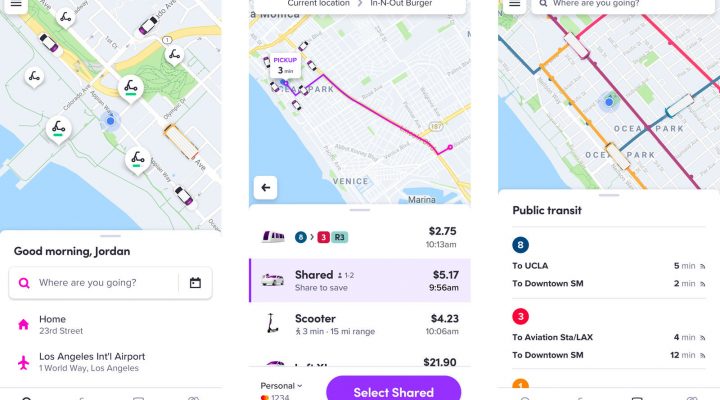
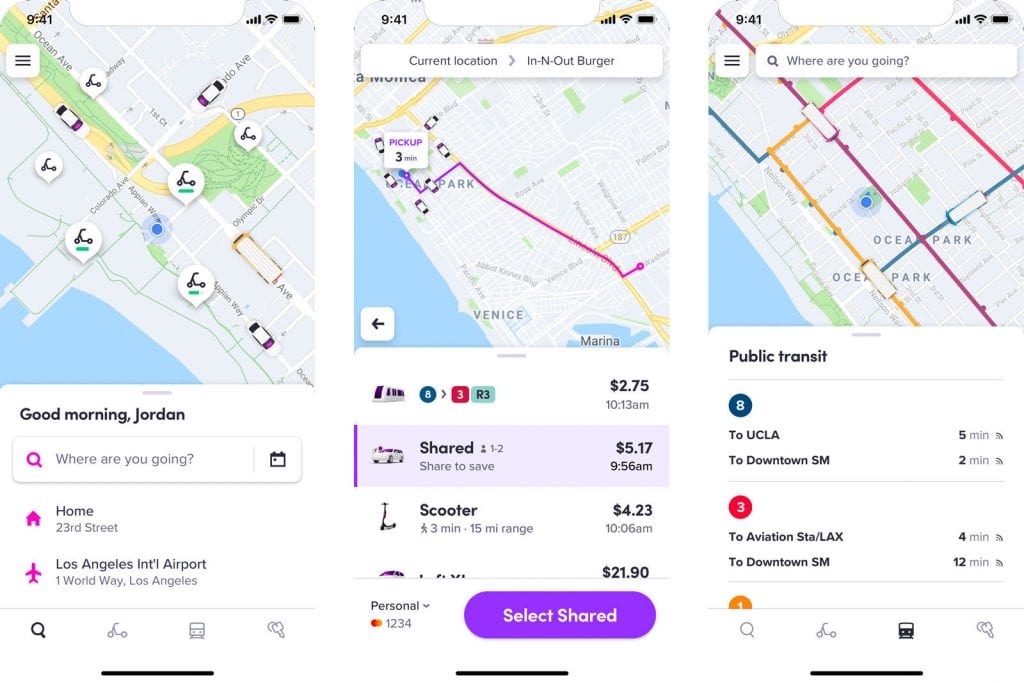
Lyft is countering Uber’s moves by making it easier to find every transportation option inside its app — including the ones that won’t give the company a dime. It’s rolling out updates that unify transportation searches, whether it’s bikes, scooters, rideshares, rentals or mass transit. The standard search now displays every choice within view rather than defaulting to ridesharing, and lets you compare options once you’ve set a destination. Tabs let you narrow the searches if you’re only interested in one option.

The changes should take effect over the “next few weeks.”

Lyft co-founder John Zimmer pitched this as a reflection of the company’s view that future cities will be “centered around people, not cars.” However, this is arguably more about boosting exposure to Lyft’s various services than anything else. You may be more likely to take a scooter if you realize that it’s not much slower than a car, or choose a bike if it’s right near the subway stop. Whatever Lyft loses to mass transit it might gain through more overall customers.

Canoo wants to sell the world’s first subscription-only EV

There’s room for seven people in the quirky, funky pod-like car.

You can get subscriptions for your music, TV and games, so why not for your vehicle as well? A company called Canoo wants to become the “Netflix of cars” by offering the world’s first subscription-only electric vehicle, and today it has revealed its futuristic van-like EV.

The Canoo vehicle looks like a space-age transport pod, offering a more roomy interior for passengers while maintaining the exterior footprint of a compact car. It has space for seven people and the rear seats are designed to be comfortable and stylish, more like a sofa than a traditional car seat. Other fun features include the ability for anyone in the car to control the navigation, music and heating from a smartphone or tablet.

The vehicle comes with advanced driver-assistance systems and driver monitoring, using a total of seven cameras, five radars and 12 ultrasonic sensors. These sensors can detect nearby objects and other cars using deep learning algorithms for better protection of the driver and passengers. Plus the battery has plenty of juice with a range of 250 miles and the ability to charge to 80 percent in under 30 minutes.

Subscription services for cars are becoming more commonplace, with Toyota, Audi, BMW and Mercedes-Benz getting in on the action, among others. However, there have been investigations from regulators after objections from dealers and not all the services have taken off, with Ford deciding to sell its subscription service earlier this month.

The Canoo EV subscription concept has lots to offer potential users, but it is incredibly difficult for new companies to bring a vehicle to production at scale. Canoo will now begin beta testing a fleet of vehicles before switching focus to production at the end of the year. The hope is to launch the service in 2021, beginning in Los Angeles.

How to Retire on $500,000

If you ask most financial advisers how to retire on a half-million dollars, they’ll likely say it can’t be done.

Many financial advisers point to the “4% rule” (also the “Bengen rule”) for tax-advantaged accounts such as 401(k)s and IRAs. The 4% rule says you can draw up to 4% of your nest egg’s value in your first year of retirement, then add inflation to the prior year’s total and withdraw that each subsequent year, for 30 years, without worrying your money will run out. William Bengen, who first proposed the rule in 1994, later updated that figure to 4.5%.

The median personal income in the U.S. is $33,706 per year, as of 2018 data. Not including Social Security, you’d need about $750,000 in your retirement account(s) to hit that number, if you followed this rule. Depending on where you live, as well as the lifestyle you want to maintain, you’d probably need to start with more. That’s why many advisers point even higher, stating figures between $1 million to $1.5 million as ideal retirement targets.

Brent Weiss, head of planning at Facet Wealth in Baltimore, reminds us there is no one-size-fits-all retirement solution. “In retirement, we face a unique set of risks and many are unknowns,” he says. “From inflation to healthcare costs to longevity, we need to have a plan for them today.” Among those issues is that not every family has as much saved as they need. That’s OK. If you’re wondering how to retire on less than what the traditional wisdom says you need, you have a few options.

These seven high-yield investments may allow you to retire well on a nest egg as small as $500,000. One other aspect of the 4% rule is that any dividends or bond interest you receive diminishes the amount you need to withdraw for your annual income. These seven investments should provide more across dividends and distributions* alone than the U.S. median personal income.

Larger Companies

A diversified retirement portfolio mixes stocks, bonds and other assets to ensure that, if one asset class crashes, the entire portfolio doesn’t collapse. While high dividends and fixed income will soften the blow somewhat, high-yield stocks and funds still carry some risk. Thus, it’s still best to diversify to add another layer of protection.

Let’s start with larger-company stocks.

The S&P 500 is a 500-company index that holds mostly large-cap stocks such as Apple (AAPL), JPMorgan Chase (JPM) and Exxon Mobil (XOM). It’s generally considered a good representation of the American economy, and it serves as a performance benchmark for thousands of actively managed and index funds.

While the S&P 500 is good for growth, it doesn’t deliver much in dividends. S&P 500 funds yield less than 2% at present. However, we can earn more by investing in a closed-end fund (CEF) that puts a twist on the index. You can learn more about CEFs here, but in short, they’re actively managed funds that can use certain mechanics, such as leveraging debt and trading options, in an attempt to generate outsize income and sharper price gains.

The Nuveen S&P 500 Buy-Write Income Fund (BXMX, $13.06) is a CEF that holds a majority (but not all) of the S&P 500’s components. However, what makes it different is that management also sells call options against its holdings. Traders use this “buy-write” options strategy to generate returns, which is how BXMX offers such a large distribution yield (currently 7.1%).

We also want to get exposure to the tech sector, which is loudly taking over the rest of the American economy. But because technology stocks often funnel most if not all of their cash into research and development, it’s not an income-friendly sector. The yield on the Technology Select Sector SPDR Fund (XLK), an index exchange-traded fund, is just 1.3%.

The BlackRock Science and Technology Trust (BST, $32.71), another closed-end fund with an actively managed tech portfolio, holds 100 mostly larger tech companies, including the likes of Microsoft (MSFT) and Amazon.com (AMZN). However, 30% of its portfolio is invested overseas, so it also holds firms such as Chinese internet giant Tencent Holdings (TCEHY).

Again, an options strategy helps BlackRock Science and Technology generate an outsize yield (5.5%) compared to its more straightforward competitors. But it’s not sacrificing much growth – BST, which came to life in late 2014, has outperformed the XLK 149%-109% on a total-return basis since the start of 2015.

Smaller Companies

Small-cap stocks and other investments centered on smaller companies might seem like counterintuitive additions to a retirement portfolio. But 1.) Americans are living much longer than they did decades ago, leading more financial advisers to emphasize growth later in life, even into retirement, and 2.) a few investments can still wring income out of smaller companies.

Royce Value Trust (RVT, $14.01) is a straightforward play on small-cap stocks. RVT is the first small-cap closed-end fund, investing in a wide selection of 423 companies currently. No stock accounts for more than 3% of the fund’s assets under management, and the vast majority represent mere fractions of a percent, which insulates the fund from single-stock implosions. Top holdings at the moment include aerospace and electronics company Heico (HEI), thermal imaging camera specialist FLIR Systems (FLIR), and Quaker Chemical (KWR), whose fluids and lubricants are primarily designed for the steel and metalworking industries.

RVT uses a small amount (4.4%) of leverage – taking out debt to invest more money in its holdings – which can help amplify its returns. The fund offers a high 7.7% distribution rate, but understand that much of that distribution is actually returned capital gains. Only a small portion of that is true dividend income, which makes sense given that smaller companies tend to offer little if no dividends.

Another way to invest in extremely small companies with high growth potential is TriplePoint Venture Growth (TPVG, $16.99), a Silicon Valley-based business development corporation (BDC). BDCs step in where many big banks won’t, providing financing to smaller companies – in fact, they were literally created by Congress, just like REITs, to do it. And like REITs, BDCs must pay out at least 90% of their taxable income as dividends.

TPVG employs numerous industry experts who have spent decades financing and fostering tech companies. It invests in the “growth stage” – essentially, the stage of capital needs that occurs right before companies go public. It has gotten in early on some truly impressive businesses, including Square (SQ), digital doorbell service Ring (now owned by Amazon) and YouTube (now owned by Google parent Alphabet). It also was an early investor in Facebook (FB).

TriplePoint Venture Growth has delivered a 103% total return since its 2014 IPO, which is roughly 2.5 times better than the small-cap Russell 2000’s return in the same time frame. Much of that is courtesy of its outsize 8.5% dividend yield.

Real Estate

Real estate investment trusts (REITs) trade on the public exchanges just like stocks, but they’re slightly different than the average company. For one, they’re required to pay out 90% of their taxable profits in the form of dividends, which is their tradeoff for enjoying generous tax exemptions. They’re also not perfectly correlated with stocks – real estate may actually perform well when most other stocks aren’t, and vice versa – so that’s a diversification benefit.

One option for REITs is another closed-end fund: the Cohen & Steers Quality Income Realty Fund (RQI, $15.73). This CEF boasts roughly 131 holdings in the real estate space. However, unlike many funds that hold just the REITs themselves, RQI also has a 14% weighting in their preferred stocks, as well as a small allocation to their corporate bonds – both of which further skew the fund toward providing higher income. Its common-stock holdings include the likes of telecom-infrastructure REIT American Tower (AMT), industrial play Prologis (PLD) and data center operator Equinix (EQIX).

RQI is one of the best funds of its kind. Its 6.1% distribution yield has contributed to an annualized 18.3% total return over the past decade – putting it in the top 1% among its competition. It’s been similarly dominant over the trailing five- and one-year periods.

Bonds

Investors are increasingly nudged into bonds as they near and eventually enter retirement. That’s because bonds tend to be less volatile than stocks, their returns aren’t uncorrelated with stocks and they provide a source of fixed income that retirees can depend on.

Pimco is one of the largest bond investors in the world, with more than $1.8 trillion in assets under management – most of it in debt products. Pimco Income Strategy II Fund (PFN, $10.28) is a prime example of its prowess.

PFN’s managers, Alfred Murata and Mohit Mittal, invest in a wide range of debt vehicles. The biggest chunk of its assets (27.3%) is in high-yield bonds (otherwise known as junk), with another 26.7% in mortgage-backed securities, nearly 12% in international developed-market sovereign debt, and other sprinklings of investment-grade bonds, U.S. government-related debt, municipal bonds and more.

This fund has doubled, and sometimes even tripled, the “Agg” bond benchmark over most significant time frames, and it typically sits around the top third of funds in its category. The lion’s share of that performance comes from its 9.3% distribution yield.

Municipal Bonds

Municipal bonds are a special subset of debt that deserves its own focus, because they’re not taxed like other debt. Bonds from entities such as states, cities and counties are, at a minimum, exempt from federal tax. And depending on where you live and where those bonds are issued, you might not even have to pay state and local taxes.

While their headline yields often are smaller than regular bonds with similar risk, the tax exemption may offset that difference and more. But if you do invest in municipal bonds, remember: Owning these types of bonds within a tax-deferred account such as an IRA negates that tax benefit.

Consider the MFS High Yield Municipal Trust (CMU, $4.64). One other interesting aspect of CEFs it that, because of how they’re constructed, they can sometimes trade at a premium to the net asset value (NAV) of their holdings – and sometimes at a discount. Right now, numerous muni-bond CEFs trade at small premiums to their NAV. However, CMU trades at a 5.5% discount, which means you’re essentially buying its assets for 94.5 cents on the dollar. Better still? That discount is actually wider than its 10-year average discount of 1.6%.

MFS uses a considerable amount of leverage to generate not only a 4.7% yield, but considerable outperformance over the Bloomberg Barclays Municipal Bond Index benchmark over most significant time periods.

Putting It All Together

If you were to divide your money evenly across all seven funds, your portfolio would yield 6.99% at current prices. Pour just $500,000 into these investments, and you would generate $34,950 annually – more than $1,200 per year better than the median American personal income.

And naturally, if you have even more money to invest, that nominal income figure will be even higher.

While this list does show you how to retire on a smaller lump sum, remember: these investments, like any other, carry their own risks. CEFs in particular can see more exaggerated price movement, compared to plain index or actively managed ETFs and mutual funds, because of the debt leverage they use. Leverage amplifies gains, sure, but also losses. Also, certain options strategies are great at generating income, but they can cap upside in truly rip-roaring markets. Lastly, everyone’s tax situation is going to be different, which means the amount you’ll need to invest may be different, too.

But these investments do deliver far more of their performance in regular distributions, which can be essential in planning out your finances in retirement. And as shown above, they have (and have demonstrated) the potential to outperform their benchmarks.

These FAFSA mistakes can negatively affect your financial aid

In just a week, it’ll be time to apply for college financial aid.

Oct. 1 marks the first day for students and their families to apply for grants and other aid for the 2020-21 school year through the Free Application for Federal Student Aid.

More than 18 million applicants filled out the FAFSA form during the 2017-2018 season, according to the U.S. Department of Education.

Students should submit the paperwork as accurately and as early as possible. “If you apply for aid later, you might miss that priority deadline,” said Mark Kantrowitz, publisher of SavingforCollege.com.

Avoid these three mistakes, each of which could lead to higher costs for higher education.

1. Not applying

One of the worst mistakes students and families can make is not applying via the FAFSA, said Todd Weaver, treasurer of the Higher Education Consultants Association.

Families erroneously believe that if they fall into a certain income bracket, they’re ineligible to receive aid, he said.

In reality, each family’s financial situation is judged on an individual basis.

“It really depends on so many parts,” he said. “I’d like to see parents and children apply no matter what.”

In one case, Weaver said he consulted with a family with annual income over $355,000. They were still eligible for aid because they had three children attending college at the same time.

During the 2017-2018 school year, the average amount of aid for each full-time equivalent student was $14,796, according to the College Board. Of that amount, grant aid accounted for $8,974.

High school graduates in 2017 missed out on $2.3 billion in federal grants because they didn’t fill out the FAFSA at all, according to an analysis by personal finance website NerdWallet.

2. Procrastinating on paperwork

If you’re searching for state financial aid, you’ll also need to file the FAFSA in a timely fashion.

That’s because state aid is finite. “There are over a dozen states where it’s on a first-come, first-served basis until it runs out,” said Kantrowitz — Alaska, Illinois, Indiana, Kentucky, Nevada, North Carolina, North Dakota, Oklahoma, Oregon, South Carolina, Tennessee, Utah, Vermont and Washington.

Those states have a fixed allocation of funding that’s available until it’s depleted, which means if you’re late on your FAFSA, you may have to settle for loans instead of grants, Kantrowitz said.

3. Making data errors

Avoid these common errors as you fill out the FAFSA:

  • Including retirement assets in calculations. Money you hold in a 401(k) or an individual retirement account aren’t considered assets on the FAFSA. Insurance policies, annuities and home equity are also excluded from consideration.
  • Confusing the parent and student sections. Parents may inadvertently put down their own information in the FAFSA section that’s designated for the student.
  • Using a nickname, rather than a legal name. Applicants are required to use their legal name, not their nickname.

Cut down on application mistakes by using the IRS data retrieval tool, which electronically populates your FAFSA with your federal tax return data.

Give yourself time to apply for an FSA ID — a user name and password that you’ll need to fill out the the form — as it can take up to three days to receive, said Lisa Bleich, founder and president of College Bound Mentor.

Above all, keep your cool.

Here are some other common mistakes to avoid: not completing the entire FAFSA form; not using the correct website; not filing the FAFSA form by the deadline; not using your FSA ID to start the FAFSA form; and not reporting all required information.

“Take a deep breath and know that people go through this every year,” said Weaver. “It’s not as challenging as people make it out to be.”