
Archives for September 23, 2019

How to raise a whiz kid investor

Plenty of parents start their kids off with a piggy bank to underscore the importance of savings. Very few teach their children how to invest.

“Investing is something a lot of parents struggle with,” said Roger Young, a senior financial planner at T. Rowe Price in Owings Mills, Maryland.

Parents who don’t have best habits themselves talk less about it with their kids and may pass on negative habits, he added.

Of course, kids can simply set money aside and watch it grow, thanks to the magic of compound interest.

However, “it’s hard to meet long-term goals without investing,” Young said. “Certainly, it starts with saving, saving comes first. But in terms of long-term success, investing has to be the next step.”

“The interest we can get from bank accounts is very low so investing is a way to make your money go further,” he said.

For example, a 10-year old who stashed $1,000 in a high-yield savings account earning 2% would have close to $3,000 by retirement age. Alternatively, if they earned 7% a year by investing that money over the same time period, that deposit would grow to more than $41,000 by age 65. (See another example in the chart below using an above-average interest rate of 10%.)
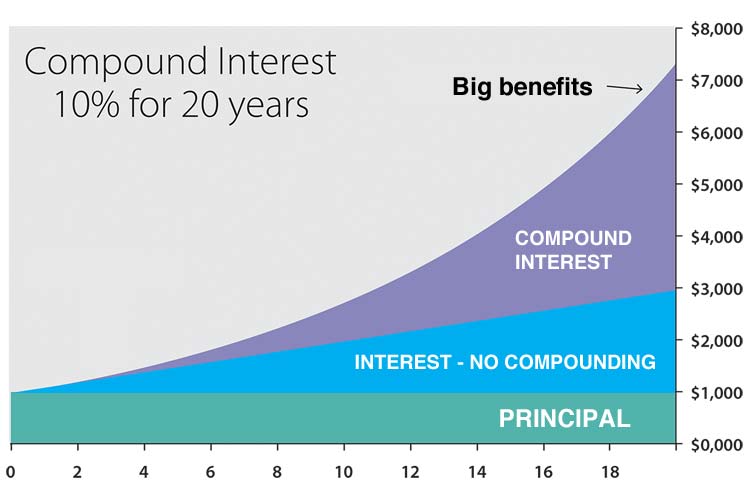
Once kids understand interest, they can take on investing and the stock market. They’ll have the ability to earn even more if they can grasp a few key concepts, Young said.

  1. Stocks vs. bonds: When you invest in a stock, you are a partial owner of the company. Alternatively, when you buy a bond, you are lending money.
  2. Risk vs reward: If you take on more risk, the rewards tend to be greater over time. However, the likelihood of losing money increases as well.
  3. Time horizon: Saving for something six months down the road is different than saving for something five years from now when it comes to investing. While stocks may sink from time to time, over the long run they go up.
  4. Diversification: Investing in a few companies reduces the risk compared to investing in a single stock.

Parents can snag their child’s attention with examples they may particularly care about, Young advised, such as Apple, Amazon, Netflix or Nike.

“Explain that these companies need money to make their products, so sometimes they sell stock to raise money,” said Liz Frazier Peck, a certified financial planner and the author of “Beyond Piggy Banks and Lemonade Stands: How to Teach Young Kids About Finance.”

“If your child buys stock in a company, it means they own a piece of that company,” she said. “If the company does well, they make money and vice versa.”

A Uniform Gift to Minors Act (UGMA) account or a Uniform Transfer to Minors Act (UTMA) account is a great way to get started.

These custodial accounts let adults to transfer assets to minors without setting up a special trust.

The UGMA allows for bank deposits, stocks, bonds, mutual funds and insurance policies. The UTMA allows for all of that plus real estate. In 2019, individuals can deposit up to $15,000 and couples up to $30,000 without incurring federal gift tax.

In these cases, the assets belong to the child upon reaching the age of maturity (typically 18 or 21 depending on the state you live in) and your child will be able to use the funds as cash, a scenario that may not work for everyone.

Americans Are Saving More, and That Isn’t Necessarily Good

From the 1980s through 2007, household saving followed a predictable pattern. It typically rose after a recession as people paid down debt and rebuilt balance sheets, then declined as they grew more optimistic—and spendthrift.

That hasn’t happened during the current expansion. The personal-saving rate, the portion of after-tax income that consumers don’t spend, rose from 3.7% in 2007, at the height of the housing bubble, to 6.5% in 2010, the year after the recession ended. But since then, rather than falling, it has drifted up, to an average 8.2% in the first seven months of 2019. That is higher than the average for any full year since 2012, when incomes spiked as companies pulled forward dividend and bonus payments to beat a tax increase.

“That is evidence to suggest that something structural has changed, and it’s made the saving rate kind of sticky at higher levels,” said Tiffany Wilding, a U.S. economist at Pacific Investment Management Co.

Saving, which is the slice of paychecks, dividends and other earnings that Americans sock away, was up 17% in 2018 from the previous year, according to recently revised figures from the Commerce Department, beating consumer spending’s 5.2% and business investment’s 7.8%.

“The timing is no coincidence,” says Paul Ashworth, chief North American economist at Capital Economics. “The tax cuts seem to have been saved.” He notes the saving rate jumped by a full percentage point in January 2018, the month after President Trump signed the Tax Cuts and Jobs Act into law.

Economists point to other factors as well, including greater caution among consumers scarred by the 2007-09 recession, aging baby boomers preparing for retirement and a widening gap between the rich (who save a lot) and the poor (who save little).

Higher saving can be positive when it represents prudential behavior, for example preparation for retirement. It can also act as a cushion against recession. Rainy-day funds enable consumers—who account for two-thirds of economic output—to continue spending despite a job loss, reduced hours or slashed bonuses.

But whether savings serve as a recession cushion depends in part on how they are distributed. Wealthier Americans are less likely than middle- and lower-income families to change their spending patterns after a windfall such as a tax cut or a setback such as a recession.

“If you’re a billionaire, and you find $100 on the street, you’re probably not going to rush off to Walmart to spend it,” says Ian Shepherdson, founder of Pantheon Macroeconomics. “But if you’ve got no money, and you find $100 on the street, you are going to rush off to spend it.”

While the latest saving data aren’t broken down by income, some economists say the recent rise is likely being driven by the wealthy. Mark Zandi, chief economist at Moody’s Analytics, estimates that the wealthiest 10% of Americans accounted for more than three-fourths of the increase in the saving rate since the tax cut.

That cut increased after-tax incomes of the upper one-fifth of households—those making at least $149,400 a year—by 2.9%, versus 1.6% for the middle fifth and 0.4% for the bottom fifth, according to the Tax Policy Center, a research group.

Joe Norflus, a retired investment banker in Essex Co., New Jersey, whose income consists mostly of dividends and interest, said he benefited from the law’s lower tax rates and saw his net worth rise. But the earnings boost was “fairly insignificant” relative to his overall net worth, so he used it to increase his savings.

“The tax cut didn’t impact in any way, shape, or form my spending habits,” Mr. Norflus said.

On the other hand, economists say lower taxes did appear to boost spending by lower- and middle-class families last year. One sign: Sales were up 11% at discount retailers tracked by Redbook Research, compared with 3.4% at department stores.

Regardless of the cause, if saving outstrips investment opportunities for a long time, some economists say, it can hold down interest rates, inflation and economic growth. Such “secular stagnation” may leave less room to cut interest rates, making it harder for the Federal Reserve to boost growth during downturns.

“Rather than being a virtue, saving becomes a vice,” said Gauti Eggertsson, an economist at Brown University.

Mr. Ashworth said the data for a long time didn’t back the argument that rising inequality would boost saving and weigh on growth. That case looks stronger now that revisions have raised the saving rate, he said.

Two world travelers who retired at 31 as millionaires say there’s a ‘dark side’ to early retirement. Here’s how they tackled the 3 biggest downsides.

Getting through a day of work can be challenging. But it can also be challenging not having to work.

Take it from Kristy Shen and Bryce Leung of Millennial Revolution. The two former computer engineers quit their jobs at 31 as millionaires to travel the world. In their book, ” Quit Like a Millionaire,” they said they needed to first overcome the three most common fears surrounding early retirement: running out of money, loss of community, and loss of identity.

“Fear is necessary for survival,” they wrote. “But the point of life isn’t to hide under your bed and never take any risks. The point of life is taking the leap but bringing a parachute — just in case.”

Here’s how they tackled the “dark side” of early retirement.

To avoid running out of money, they were strategic about their savings

The easiest way to run out of money during early retirement is to deplete your investment portfolio during the first five years by selling stock into a down market, according to Shen and Leung. To deal with this, they suggest using a cash cushion — a reserve fund of savings you can draw from to avoid a full portfolio withdrawal during the down years.

They also suggest having a yield shield, which is a combination of dividends and interest from exchange-traded funds (ETFs) — a collection of investments such as stocks and bonds — that can be delivered as cash without selling any assets.

Unexpected health care costs and inflation could also factor into running out of money, they said. But traveling has helped them sidestep inflation, since it’s a per-country effect. They also purchased expat insurance, which is less expensive than domestic insurance plans if you’re an American retiring abroad.

“Our experience, after being retired for three years and having gone through a market crash in year one, has taught us that the fear of running out of money is overblown,” they wrote. “Not only has our net worth grown by $300,000, our expenses continue to drop. We’re safer and richer than when we left.”

They made friends at conferences and meet-ups

Early retiree Tony went back to work a year and a half after retiring early, partly because he missed social interaction. In a podcast with fellow early retiree Brandon of The Mad Fientist, he said that aspiring early retirees need to prepare for how they’ll build human connection once they leave work.

Shen and Leung put it simply: When you’re working, colleagues are your social circle. And others may not understand your decision to retire, they said.

“The confident ones will be happy for you,” they wrote. “The unhappy ones will blame you for invalidating their own path.”

“The longer you’re retired, the more confident you become,” they continued. “And if you lose friends by choosing a different path, those friendships weren’t worth keeping in the first place.”

But you also gain a new community by joining the FIRE movement. It opens up opportunities to meet new people — something Shen and Leung said they barely had time to do when working. Since retiring early, they’ve made genuine friendships with people all over the world from FIRE-related conferences and meet-ups.

John from ESI Money also suggests joining a club or gym and volunteering to meet people and connect socially.

Early retirement allowed them to build a better identity

“For some people what they do is who they are,” John wrote. “Then when the job is over, they don’t know who they are any more.”

He said that to get through early retirement, people need to find new activities to replace the time and meaning they got from work. Those could be recreational (hobbies, traveling, etc.), volunteering (church, non-profits, etc.), or occupational (a part-time job to help them feel productive again), he said.

As Shen and Leung put it: “Lose one identity, build a better one.”

Being financially independent, they said, doesn’t have to be about quitting your job and traveling the world — it’s about choices.

“Becoming financially independent is about designing the life you want,” they wrote. “Once you’ve built a portfolio large enough that 4% of it covers your expenses each year, work is an option, not a mandate. If you want to fully retire like us and travel the world, do that. If you like your job, continue working with a more flexible schedule.”

They advise getting rich and then following your passion so you don’t have to worry about when or where your next payout is coming from. If your passions lead to failure, it will only hurt emotionally, not financially — if, that is, you have a portfolio to rely on that pays your expenses, they said.

They added: “There will always be worries when you go against the norm. But just like the perceived danger during a turbulent plane ride, they’re mostly in your head.”

Kiplinger’s Personal Finance: New tax form created just for seniors

A new Form 1040 tailored to taxpayers 65 and older is making its debut.

In mid-July, the IRS released a draft form of the 1040-SR, “U.S. Tax Return for Seniors.”

The form is designed to be easy for seniors to use and highlights retirement income streams and other tax benefits for older taxpayers. People 65 and older have the option of using the final version of the form to file their 2019 tax returns.

The 1040-SR is based on the regular 1040, and the IRS says it uses all the same schedules, instructions and attachments. Older taxpayers who use tax software to file are unlikely to even notice a change.

But taxpayers who still file by paper will see a new form modified for aging eyes. The font is bigger to make the text easier to read. The shading in boxes on the regular 1040 has been removed to improve the contrast and increase legibility.

The IRS presented an overview of the new form, which was created by the 2018 Bipartisan Budget Act, at the IRS Nationwide Tax Forum in National Harbor, Md., in early July.

The agency says it consulted AARP during the form’s development. “AARP supported the development of the simpler 1040-SR tax form since most seniors could not use the 1040-EZ due to their different sources of income,” said David Certner, AARP legislative counsel.

A key feature of the 1040-SR is the addition of a standard deduction chart, said Darren Hamilton, an official in the agency’s forms and publications division who presented information about the new form at the tax forum held in Maryland.

The form lists the standard deduction amounts that taxpayers age 65 and older qualify for, “so seniors don’t have to hunt for it,” Hamilton said.

The chart makes it simpler for seniors to take advantage of the higher standard deduction for which they are eligible. But seniors who still itemize deductions can also use the form.

The form has lines for specific retirement income streams, such as Social Security benefits and IRA distributions. But the IRS says you don’t have to be retired to use the form; older workers can use it, too.

Find the draft 1040-SR at IRS.gov/DraftForms. The form is subject to change until it is finalized later this year. Industry players, such as certified public accountants and enrolled tax agents, will get a chance to comment on it and suggest improvements.