
Archives for September 8, 2019

Stocks to Watch: Yext, Inc. (:YEXT)

Research brokerage firms on Wall Street are offering a consensus “Buy” rating on shares of Yext, Inc. (:YEXT).  Using the following ratings scale: 1.0 Strong Buy, 2.0 Buy, 3.0 Hold, 4.0 Sell and 5.0 Strong Sell, analysts have an average recommendation of 2.20 on the shares.  Based on a recent trade, the shares are hovering around $16.99 which, according to analysts, yield significant upside potential to the $25.00 consensus target price.

Coming up with a viable and solid stock investment plan might be on the minds of many individual investors. A solid plan might entail defining the overall objective and recognizing tangible restraints. Figuring out these details may help the investor focus on the most important aspects of investing in the stock market. Following strategies set forth by others may work, but they may also leave the investor in a quandary. What worked in the past for one person may not work in the future for another. Investors may need to craft the plan keeping in mind the long-term goals. Although some investors and traders focus on the short-term, many investors are more interested in making the grade over a number of years, and not a number of days or months. Plans may need to be set up so that they are flexible and have the ability to withstand unforeseen shifts and rapidly changing stock market scenarios. Flexibility may end up being the key to a successful plan down the road. Investors may also want to do regular check-ins on portfolio performance in order to keep tabs on how well the plan is working.

Traders may be using technical analysis to help spot ideal entry and exit points. One idea behind technical analysis is that historical price movement trends have the ability to repeat themselves. Technical analysis involves the use of chart patterns to examine market movements and to help define trends. Trends in the stock market are not always easy to spot. Many chartists will strive to determine whether the trend is up, down, or sideways. After defining a trend, the technical analyst may look to see what type of timeframe the trend encompasses. Some traders will look to identify whether the trend is major or long-term, short-term, or intermediate. Being able to decipher what the data is saying may assist the trader with finding potential entry and exit points on a particular trade. There are many different indicators that can be employed when undertaking technical analysis. Many traders will do numerous chart studies to find out which indicator or indicators tend to project the most relevant trading assistance. Learning how to spot these trends might help the trader develop specific charting skills that will hopefully lead to future market success.

RSI 

Yext, Inc. (:YEXT)’s shares may have a significant upside to the consensus target of 25.00, but how has it been performing relative to the market?  The stock’s price is 16.99 and their relative strength index (RSI) stands at 38.68.  RSI is a technical oscillator that shows price strength by comparing upward and downward movements.  It indicates oversold and overbought price levels for a stock.  

Investors are often dealing with the decision of whether to sell a stock that has been a solid performer or hold on to it for more profit. This can be almost as trying as deciding when to buy a certain stock. Once investors have latched on to a certain stock, they may find it hard to let go. On the flip side, investors may also have to deal with cutting ties with a losing stock. With both scenarios, it may be important for investors to try to keep emotion out of the decision making process. Investors may feel that giving up on a losing stock can be admitting that a mistake was made. No matter what the circumstance, not letting go of a losing stock may lead to poor portfolio performance in the long run. Constantly keeping a close watching on fundamental and technical data can provide important information needed to stay afloat in the equity markets.

Yext, Inc. (:YEXT) shares are moving 0.06% trading at $16.99 today.

As the next earnings season comes into focus, investors will be keeping watch on the performance of companies that they own. A company that continually exceeds earnings projections is most likely on the right track. On the other end of the spectrum, a company that frequently misses earnings projections might provide some insight to the fact that something isn’t right. Although it is important to keep track of earnings estimates and results, it shouldn’t be the only thing that the investor is looking at regarding the stock. Just because a company misses or beats expectations for one quarter may not mean anything super special. Tracking performance over a longer period of time can help paint the bigger picture of what is going on with the company. Sharp investors often have the ability to look deeper into the numbers to see the actual causes of an earnings hit or miss. Of course estimates are just that, estimates, and some analysts may be more accurate than others. 

Quebec company says it will sue New Brunswick over failed bid to seize dry dock

Premier Blaine Higgs rejects claims, saying Groupe Océan has no right to complain

Quebec’s Groupe Océan says it plans to sue the Higgs government over the province’s failed attempt to block it from moving its floating dry dock from New Brunswick to Quebec.

A Federal Court judge ruled Thursday that the province could not prevent the company from moving the dry dock from the shipyard in the village of Bas-Caraquet.

But the government’s initial injunction, which blocked the move for several days, caused the company to miss its window to make the move and may delay it by days, weeks or even months. 

“To be stopped like that and to have to wait for the next window of opportunity, it will cost us a lot of money, and for sure, we will assert our rights in regard to this cost,” said company spokesperson Philippe Filion. 

Higgs rejects allegation of ‘bad faith’

Filion said the province acted in bad faith when it went to Federal Court for an order blocking the move just days before the company’s long-planned date. 

The government knew for months that Groupe Océan could only move the dry dock at high tide, Filion said. He accused the province of halting the move during that window and then not making a strong case once the opening had passed.

“For us, this is bad faith,” he said Friday.

Premier Blaine Higgs rejected that, saying Groupe Océan had secured a sweetheart deal that gave it no right to complain.

“Given the lucrative nature of this contract that the province handed to them a few years ago, it’s kind of ironic they would take that position,” he said.

He said the ruling wasn’t a defeat for the province because it will also see Groupe Océan pay the province $260,000 in bail for the dry dock.

Premier Blaine Higgs says Groupe Océan secured a sweetheart deal that gave it no right to complain. 

And he said the company’s supposed window for launching the dry dock has shifted by several days in discussions with provincial officials. The government gave them permission before the court action to get ready to move the dry dock, he said.

“I think what the delay is going to turn out to be is the hurricane,” he said, meaning Hurricane Dorian, which is expected to affect New Brunswick on the weekend.

Groupe Océan is an anchor tenant at the New Brunswick Naval Centre, the government-owned shipyard in Bas-Caraquet. The province took over ownership under the previous Liberal government after the yard ran out of money.

Not enough local workers, company says

Groupe Océan says it always planned to build the dry dock at the shipyard to give local workers training and experience for future projects, and then move it to its other facilities in Quebec. 

The province accused the company of trying to move the dry dock before it was finished to complete electrical work on it there.

The company claimed that it could not find qualified workers to do the job in Bas-Caraquet, though both Higgs and a provincial trade union disputed that claim. The province took what Higgs called the “extreme measure” to seize the dry dock to force the company to do the work here.

But Filion said the province’s move was an attempt to blame Groupe Océan for the problems at the shipyard. Several other boat builders are tenants at the yard. 

Higgs said last month that taxpayers have invested $10 million in the dry dock. Filion said it has always been part of the company’s agreement in 2014 that the province would fund the construction and Groupe Océan would lease it over 20 years. 

The premier said that’s an overly generous deal that sees New Brunswick taxpayers subsidize infrastructure for a Groupe Océan facility in Quebec that will draw business away from Bas-Caraquet.

“This is a disgrace, the deal that was struck here,” he said.

Filion acknowledged Hurricane Dorian is a factor in when the dry dock can be launched, but he said unsettled fall weather will also create obstacles.

“We continue to work on different scenarios and we’re trying to figure out what the next window of opportunity will be to launch the floating dry dock,” he said.

The cost of the delay could run to six figures and includes the expense of keeping two tugboats and a barge on standby in Bas-Caraquet, he added. 

Pipeline work to continue

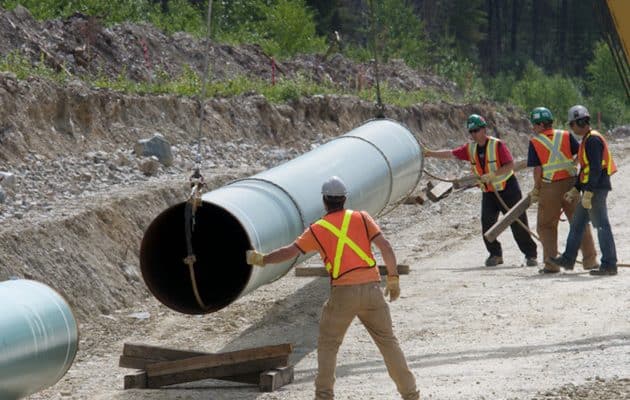
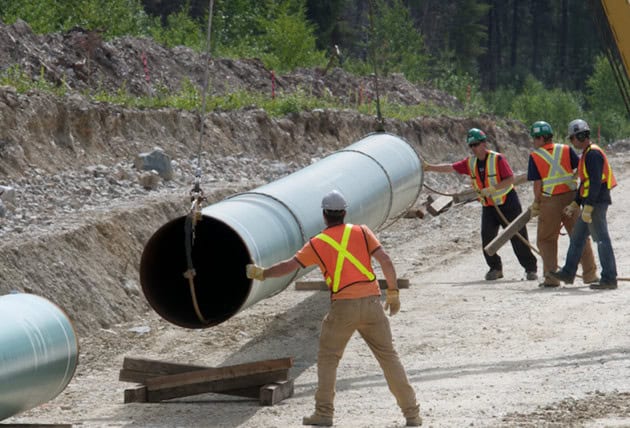
Trans Mountain Corp. is planning to continue its planned construction work on its pipeline expansion project this fall, despite a court ruling earlier this week that raised questions about whether the work will once again be halted.

On Aug. 4, the Federal Court of Appeal granted leave to appeal to First Nations challenging the federal government’s approval of the multi-billion pipeline twinning project.

“We have received the Federal Court of Appeal decision,” Trans Mountain said in an email. “Trans Mountain is confident in the certificates and approvals obtained to date and we look forward to building and operating this project in a manner that minimizes impacts to the environment and provides benefits to all Canadians.

“As these cases make their way through the courts, we will continue with all aspects of planning and construction. The applications are challenging the decisions made by the Canada Energy Regulator and the Federal Government, but do not in and of themselves negate the pre-existing approvals provided by those governmental authorities until and unless the court rules otherwise.”

Environmental groups and First Nations brought a dozen motions forward in a leave to appeal. The federal court rejected six, but allowed six – all by First Nations – to proceed.

In dismissing some of the applications, costs were awarded to Trans Mountain.

The court decision was unusual in that the court actually published a detailed written reason for granting the leave to appeal – something it doesn’t normally do – and also spelled out the limits, both in scope and time, of the appeal hearing.

The court ruled the appeal must focus solely on the question of whether later stage negotiations with First Nations were adequate. None of the arguments dealt with in previous court cases will be retried and no new arguments will be heard.

Much was made of the fact that the federal government offered no argument against the leave to appeal – something that the court itself suggested was unusual.

“The court’s standing practice is not to issue reasons in disposing of leave applications,” Justice David Stratas wrote.

“However this is an exceptional case as the respondents (the federal government), who have a direct interest in the project, took no position for or against the leave applications in all cases but one, thereby leaving the matter to the discretion of the Court.

“Taking no position on a motion is a common practice when dealing with procedural matters; it is not when issues of general importance are in play.”

The federal government’s lack of a response to the leave to appeal applications has been viewed by some as evidence the Trudeau government is only going through the motions and would be relieved if the project was killed by the courts.

Geoff Plant, a former B.C. attorney general currently a partner with GLGZ LLP law firm, said the federal government’s position – i.e. taking no position in the appeal application – is understandable.

He said the bar for granting a leave to appeal is low. Agreeing to hear an appeal by no means guarantees it will succeed.

“It’s perfectly understandable why a respondent to such an application might decide not to appear and argue whether leave should be granted, given how low the threshold is and, to be perfectly blunt, the unlikelihood that a single judge of the Federal Court of Appeal would have the fortitude to completely shut the door on any judicial scrutiny of the Cabinet’s decision.

“If I were advising Canada on this matter I would have said that there was no – and I mean zero – chance of successfully opposing every single one of the dozen applications.”

Last year, the same Federal Court of Appeal quashed an order in council that allowed the Trans Mountain expansion to proceed. The court found the National Energy Board (NEB) failed to properly consider the marine impacts of increased oil tanker traffic.

It also found the phase 3 consultations with First Nations inadequate. After addressing both those issues, the federal government once again gave the Trans Mountain expansion the green light in June.

First Nations and environmental groups then appealed the second order in council.

While granting First Nations the leave to appeal, Stratas also pointed out that proper consultation does not mean First Nations must be fully satisfied with the consultations.

“Dissatisfaction, disappointment or disagreement with the outcome reached after consultation is not enough to trigger a breach of the duty,” he writes.

“Under the duty to consult, First Nations and Indigenous peoples do not have a right to veto a project.”

U.S. trade deal with Japan may cost Canadian farmers a tariff edge

U.S. President Donald Trump is shown meeting with Japanese Prime Minister Shinzo Abe in May. After pulling out of the Trans-Pacific Partnership, the White House is now pushing for a bilateral trade deal with Japan.

American farm lobby ‘pressuring’ Trump to get agreement that will help boost exports into key Asian market

It was only last year when the ratification of a trade deal with Asia-Pacific nations was heralded as a big win for Canadian exporters.

One of the jewels of the pact — called the Comprehensive and Progressive Trans-Pacific Partnership (CPTPP) — was Japan, which agreed to slash tariffs on a variety of goods.

Canada’s pork and beef producers were projected to be among the big winners, gaining a potential edge over their American rivals in the pursuit of Japanese buyers.

Now it seems that tariff advantage could be short-lived.

U.S. and Japanese officials are busy hammering out the details of a new agreement that could see tariffs fall on  American agricultural exports, giving them a boost in one of the world’s most desirable markets.

The precise impact could take weeks or even months to unfold, but it may offer yet another test for Canadian meat producers already coping with the fallout of Chinese trade turbulence.

“We’re a bit premature as far as understanding what the specific deal will be,” said Rick Bergmann, chair of the Canadian Pork Council. “But it does create concern for us, as we export over 70 per cent of our product around the world to 88 different countries. Countries like Japan are very important for us.”

Various trade ministers pose for a photo after the signing ceremony of the Comprehensive and Progressive Agreement for Trans-Pacific Partnership (CPTPP) in 2018. 

The Japanese market was a big reason Canada’s agri-food exporters were excited when the CPTPP was ratified late last year. The deal quickly lifted some tariffs and began phasing others out.

Tariffs on Canadian fresh beef, for instance, have dropped to 26.6 per cent from 38.5 per cent; ultimately, they’ll fall to nine per cent. Since the deal kicked in, Canadian beef exports to Japan have soared.

Citing federal data, the Canadian Cattlemen’s Association said the volume of beef exports to Japan climbed to nearly 22,600 tonnes through the first half of the year — up more than 62 per cent over the same period last year.

I feel safe in saying it’s going to be our best year ever in Japan,” said John Masswohl, director of government and international relations for the Canadian Cattlemen’s Association. 

Canadian pork producers are among those watching to see how a U.S.-Japan trade deal will impact their industry. 

Trade with Japan, as well as the other nations included under the CPTPP, appears even more important in the wake of China’s decision to put restrictions on various Canadian exports, including pork and beef.

But Canada’s inroads in Asia aren’t the sort of thing that goes unnoticed south of the border, especially as President Donald Trump balked at joining its precursor, the Trans-Pacific Partnership (TPP).

The farming lobby has been “pressuring” Trump to get a deal with Japan, said political scientist Yves Tiberghien, co-director of the Centre of Japanese Research at the University of British Columbia.

The U.S. trade war with China, which has been tough on American farmers, only ratcheted up the urgency. 

In turn, Tiberghien said, the White House had been putting “enormous” pressure on Japanese Prime Minister Shinzo Abe.

Then at the recent G7 meeting in France, Trump and Abe announced they had an agreement in principle and would aim to sign a final deal in New York by the end of September.

Canada’s cattle sector saw its beef exports to Japan soar earlier this year after the CPTPP kicked in. 

The outcome of the talks isn’t certain and terms of the deal are said to still be under negotiation. Bloomberg News reported this week that trade officials are still discussing how much Japan is willing to open its agricultural market to U.S. imports.

Some experts anticipate that when a deal is finalized, Canadian and U.S. food producers will be on even terms in Japan.

“The short-term advantage that Canada had relative to the U.S. under [CPTPP] will likely go away — if and when that agreement is reached,” said Mike von Massow, a food economist at the University of Guelph.

If the deal happens, American producers will likely push hard to regain any market share they may have lost, said Carlo Dade, director of the trade and investment centre at the Canada West Foundation.

I think they may price aggressively,” Dade said. “That’s what I would do.”

But Dade said Japanese tariffs aren’t the whole ballgame when it comes to the CPTPP, which includes Canada and 10 other countries in the Asia-Pacific region, including Australia, Vietnam and Malaysia.

Carlo Dade, director of the trade and investment centre at the Canada West Foundation, expects the tariff advantages Canadian meat exports have enjoyed over the U.S. in Japan will end if the Americans strike their own deal. 

For example, American exporters may sell cheaper goods into Japan. But, Dade explained, the CPTPP contains rules that would restrict Japanese firms from using those goods to make something else by entering them into the supply-and-production chain. Canadian exports to Japan don’t face those restrictions.

“That advantage remains with us,” Dade said.

Indeed, von Massow said it’s significant the U.S. is seeking a bilateral deal with Japan rather than join the TPP.

“The other countries, Vietnam and others, we still have an advantageous position — and that’s where we really saw the biggest potential for growth. And I expect that’s where we’re prioritizing,” he said.

Still, Canada’s pork and beef sectors are watching for details as the U.S.-Japan talks unfold.

Masswohl sees a potential upside for the Canadian cattle sector if tariffs on U.S. beef fall: It would mean more money in the hands of Japanese buyers, he said, who will then have more money to spend.

“We also sell a lot of cattle into the U.S.,” Masswohl said.  “For U.S. exporters to be making more money in the Japanese market can only be good for them buying Canadian cattle.”

Hudson’s Bay to shutter last 2 Zellers stores in Toronto and Ottawa

Hudson’s Bay Co. says it will close the last two Zellers locations at the start of 2020.

The stores are expected to close in January and eligible employees will receive employment separation packages

The last two remaining locations of discount retailer Zellers will shutter its doors early next year, says Hudson’s Bay Co.

“Through the normal course of business we continually evaluate store performance and other factors, and may determine it necessary to close a store,” spokeswoman Tiffany Bourre wrote in an emailed statement.

The retailer expects to close the Toronto and Ottawa locations in January 2020.

Bourre declined to specify how many employees work at the stores, saying “we do not break out store employment numbers.”

Eligible employees will receive employment separation packages and the company will explore transfer opportunities where it is feasible, she said.

Waterloo County, Ont.-born Walter Philip Zeller started the company in 1928 with four stores in Ontario.

But an American firm bought him out and subsequently went bankrupt during the Great Depression. Zeller purchased back the Canadian properties, which had grown to 14 locations by then.

He reopened a dozen of the stores in Ontario, Quebec and New Brunswick as Zellers in 1932.

HBC became the sole owner of Zellers in 1978.

In 2011, the company reached a roughly $1.8-billion deal to sell the leases of 189 Zellers stores to Target and close the remainder — save for three locations — by March 2013.

Of the three locations, Montreal and Surrey closed in 2014. That same year, the Ottawa location re-opened, leaving it and Toronto store as the sole remaining Zellers stores.