
Archives for July 4, 2019

Stocks to Watch: Intact Financial Corporation (TSX:IFC) Up +1.49%

At close of market on Tuesday, Intact Financial Corporation (TSX:IFC) stock finished trading at +1.49%, bringing the stock price to $122.81 on the Toronto Stock Exchange. The stock price saw a low of $121.61 and a high of $123.37.

The company’s stock was traded 2,017 times with a total of 271,239 shares traded.

Intact Financial Corporation has a market cap of $17.09 billion, with 139.19 million shares in issue.

Intact Financial Corp is a property and casualty insurance company that provides written premiums in Canada. The company distributes insurance under the Intact Insurance brand through a network of brokers and a wholly owned subsidiary, BrokerLink, and directly to consumers through belairdirect. Most of the company’s direct premiums are written in the personal automotive space. Intact directly manages its investments through subsidiary Intact Investment Management. The vast majority of these invested assets are fixed-income securities. Its asset mix is designed to generate interest and dividend income.
Stocks to Watch: Bank of Montreal (TSX:BMO) Up +1.20%

At close of market on Tuesday, Bank of Montreal (TSX:BMO) stock finished trading at +1.20%, bringing the stock price to $99.92 on the Toronto Stock Exchange. The stock price saw a low of $99.36 and a high of $100.18.

The company’s stock was traded 7,436 times with a total of 1,481,842 shares traded.

Bank of Montreal has a market cap of $63.83 billion, with 638.83 million shares in issue.

Bank of Montreal is a diversified financial-services provider based in North America, operating four business segments: Canadian P&C banking, U.S. P&C banking, wealth management, and capital markets. The bank’s operations are primarily in Canada, with a material portion also within the U.S.

$762M trade surplus in May

Canada posted its first trade surplus since last summer in May as the auto sector helped boost exports to a record level and the economy continued to show signs of rebounding.

Statistics Canada said Wednesday a jump in exports helped the economy to a $762-million international merchandise trade surplus in May.

The surplus was the first since the economy eked out a $10-million surplus in July 2018.

Economists had expected a deficit of $1.5 billion for the month, according to Thomson Reuters Eikon.

“May’s international trade data joins a suite of other data releases confirming that the Canadian economy is recovering from the soft patch seen in late 2018 and early 2019,” TD Bank economist Omar Abdelrahman wrote in a report.

Abdelrahman said there was little to complain about in the trade report, though part of the surge should be discounted given the one-off transactions including the resumption of motor vehicle production following shutdowns and spikes in the volatile aircraft and boats and other transportation equipment categories.

“Still, a solid report is a solid report, with today’s data revealing an encouragingly broad-based May export picture,” he said.

The Canadian economy hit a weak patch late last year as oil prices plunged and the country posted its weakest back-to-back quarters of growth since 2015 at the end of 2018 and the start of this year.

However, recent data has suggested the weakness was temporary and the economy has been growing in strength.

The Bank of Canada, which is expected to make its next interest rate announcement next week and release its updated monetary policy report, has been expecting the pick up in growth.

The Canadian central bank’s position stands in contrast to that of the U.S. Federal Reserve which has suggested it is prepared to cut interest rates later this year.

Benjamin Reitzes, Canadian rates and macro strategist at BMO Capital Markets, said the Canadian economic data continues to outperform despite the increasingly dour global backdrop.

“There’s still plenty of data to go for Q2, but it looks as though the economy is rebounding strongly from the near-zero growth in Q4 and Q1,” Reitzes said.

“The question now is whether this strength persistent into June and Q3 when the global backdrop was much more challenging.”

FN pipeline bid imminent

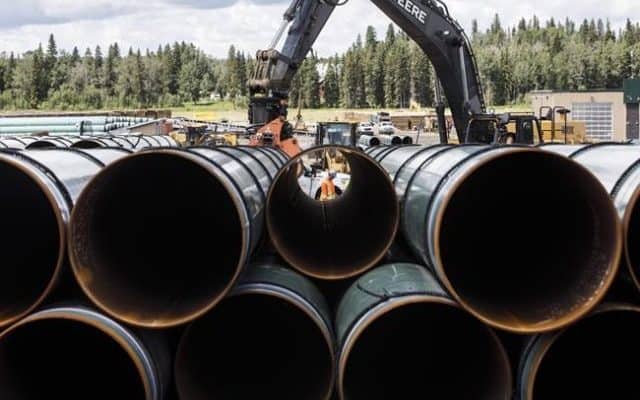
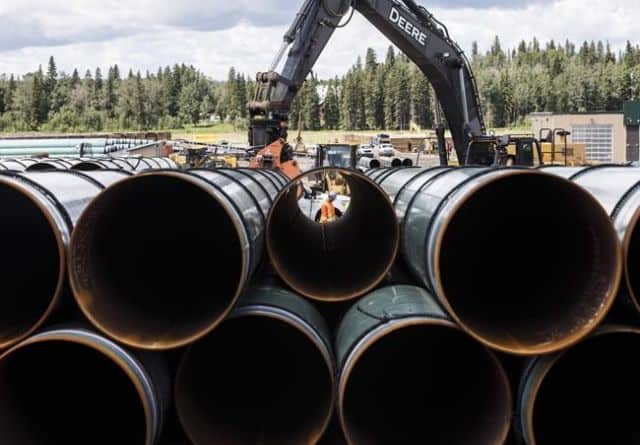
An Indigenous-led group says it will soon be ready to make a bid for majority ownership of the controversial Trans Mountain pipeline currently owned by the federal government.

The group, called Project Reconciliation, says it will be prepared as early as next week to talk with Ottawa about its proposal for a 51 per cent stake in the pipeline.

Project Reconciliation says the bid will be underwritten by contracts with pipeline customers and not rely on taxpayers. The group says almost 340 Indigenous communities across B.C., Alberta, and Saskatchewan could choose to share ownership of the pipeline, which is designed to ship crude oil from the oilsands to the West Coast.

“There’s real momentum towards Indigenous ownership,” said Delbert Wapass, founder and executive chair of Project Reconciliation in a statement.

“It’s exciting to see support is growing in governments and among Indigenous people. There is a pipeline to reconciliation and we should take it.”

Project Reconciliation says it plans to set aside 80 per cent of future proceeds from the pipeline into a type of sovereign wealth fund to ensure longer-term benefits for Indigenous communities in Western Canada.

A separate Indigenous-led group called the Iron Coalition is looking to secure ownership of the pipeline for First Nations and Metis communities in Alberta. The group says it would distribute proceeds to member communities based on ownership share and population.

The government says it is open to Indigenous ownership of the project and will host discussions in Vancouver, Victoria, Edmonton and Kamloops, B.C. later this month with Indigenous groups to further discussions on potential participation in the economic development of the project.

Ottawa reapproved the pipeline last month after its initial go-ahead was quashed by the Federal Court of Appeal over incomplete Indigenous consultations and a faulty environmental review. The government bought the pipeline for $4.5 billion last year in an effort to keep the expansion project alive.

The project has support from some Indigenous groups along the route, but faces intense opposition from others, especially on the coast.

In May, the Union of B.C. Indian Chiefs warned First Nations in an open letter that they should reconsider investing in the pipeline because it faces many hurdles, including Indigenous land claims, and it is unlikely to be as profitable as the government says.

Chief Leah George-Wilson of the Tsleil-Waututh First Nation said after the most recent approval that it will appeal Ottawa’s decision to the Federal Court of Appeal.

Gas profits under wraps

An impasse may be developing just days before hearings are set to begin at the British Columbia inquiry examining possible reasons for soaring gas prices in the province.

The B.C. Utilities Commission has been ordered to review the last four years of gas and diesel pricing in the province and wants suppliers to complete a questionnaire about various business aspects including profit margins.

Those suppliers range from Shell and Imperial to Suncor, Husky, Super Save and 7-11, but documents submitted to the commission show that only 7-11 has responded with details about how it sets the price per litre at the pumps.

It has requested the information not be released publicly and the utilities commission has complied, posting a redacted version of 7-11’s questionnaire response to its website.

The other suppliers offered almost identical reasons for withholding profit margin data, with Husky’s submission citing “commercially sensitive information” that is “not shared publicly or between refiners.”

The inquiry timetable calls for the release of the second phase of the utilities commission consultant report by next Wednesday, followed by up to four days of what is termed an “oral workshop,” where panel members can question industry representatives, including gas and diesel suppliers.

When it unveiled the process for the inquiry in May, the utilities commission said it would explore factors potentially affecting prices in B.C. since 2015, including competition and the amount of fuel in storage.

The inquiry is also expected to examine mechanisms that could be used to moderate price fluctuations and increases.

As the price of a litre of regular gasoline climbed above $1.70 in mid-May, Premier John Horgan ordered the probe, saying in a news release that gas and diesel price increases were “alarming, increasingly out of line with the rest of Canada, and people in B.C. deserve answers.”

The three-person inquiry panel must submit its final report by Aug. 30.

Merchandise exports rise

Statistics Canada says the country posted a $762-million international merchandise trade surplus in May as the auto sector helped boost exports to a record level.

Economists had expected a deficit of $1.5 billion for the month, according to Thomson Reuters Eikon.

The surplus came as exports rose 4.6 per cent to a record $53.1 billion in May.

Exports of motor vehicles and parts were up 12.4 per cent for the month as exports of passenger cars and light trucks jumped 17.8 per cent.

Meanwhile, total imports rose 1.0 per cent to $52.3 billion in May.

In volume terms, exports increased 4.0 per cent and imports were up 1.2 per cent.