
Archives for June 2, 2019

Stocks to Watch: Canadian Imperial Bank Of Commerce (TSX:CM) Down -1.04%

At close of market on Friday, Canadian Imperial Bank Of Commerce (TSX:CM) stock finished trading at -1.04%, bringing the stock price to $102.49 on the Toronto Stock Exchange. The stock price saw a low of $100.73 and a high of $102.49.

The company’s stock was traded 11,608 times with a total of 2,265,818 shares traded.

Canadian Imperial Bank Of Commerce has a market cap of $45.57 billion, with 444.66 million shares in issue.

Canadian Imperial Bank of Commerce is Canada’s fifth-largest bank, operating three business segments: retail and business banking, wealth management, and capital markets. It serves approximately 11 million personal banking and business customers, primarily in Canada.


What’s at stake in the Ford government’s battle with The Beer Store

Premier Doug Ford is taking steps to scrap a contract with The Beer Store, so that all Ontario grocery stores and convenience stores would be permitted to sell beer

Big brewers, grocery chains, convenience stores jostle over $3.6-billion retail market

Beer is big business in Ontario, and the battle over who gets to sell it is shaping up to be fierce.

Premier Doug Ford and his government are showing where they stand in this battle by announcing plans to scrap a contractual agreement that sets the rules for beer sales until 2025 

The move would lay the groundwork to allow every grocery store and convenience store in Ontario to sell beer. That pits the government directly against the Beer Store, the retail arm predominantly owned by three big brewers, Labatt, Molson and Sleeman. 

What’s at stake are big chunks of a retail industry worth $3.6 billion a year.  

The big supermarket chains want unfettered access to beer sales. They are keen to see the end of clauses in the beer agreement that bar them from using their own distribution networks or negotiating their own price deals with brewers. 

The convenience store sector sees getting a piece of the beer sales action as a crucial revenue opportunity. Lobbyists for the sector argue that many corner stores are barely getting by, and selling beer could be their saviour by bringing more customers in the door. 

Those wider beer sales would clearly eat into The Beer Store’s profits. The latest figures published by the LCBO show total revenues at The Beer Store and brewery outlets dropped 2.3 per cent in the year after the province allowed a limited number of supermarkets to sell beer. Throwing the beer retail market wide open would mean an even bigger bite.

The limited number of Ontario grocery stores that are allowed to sell beer are barred from selling 12 or 24-packs. 

The high stakes mean that all sides are engaged in a publicity battle to try to sway public opinion, with competing websites and ad campaigns.

One front in that battle is the question of price.

A report commissioned by the Retail Council of Canada (an industry group lobbying for wider beer sales) that suggests prices in Ontario are 8.3 per cent higher than in neighbouring Quebec (factoring out the tax differential.) 

Finance Minister Vic Fedeli used that precise figure this week as evidence in favour of expanding the number of stores selling beer. 

“If we wanted to have as many stores per capita as Quebec, we would have to open 10,000 new stores,” said Fedeli.

“In Quebec, beer is 8.3 per cent cheaper than here in Ontario. I think that helps you understand that there’s an opportunity for lower prices here.” 

The Beer Store is calling that figure inaccurate and the study that generated it torqued. 

The Retail Council’s report “looked at very limited pricing data for a single one-month period for only four brands in specific package formats,” write Debra Aron and Justin Lenzo, a pair of economists hired by the Beer Store to critique the report.

“Cherry-picking a few brands and a few pack formats can be used to engineer whatever result the authors … wanted to find, but it is bad science.”

Retail beer sales total some $3.6 billion in Ontario each year, and The Beer Store controls about two-thirds of that market. 

Aron and Lenzo’s pricing report (commissioned by The Beer Store) says factoring out taxes, beer is 13 per cent cheaper in Ontario than in Quebec. 

What would throwing open the market do to prices?

The Beer Store argues that its stranglehold on retailing keeps beer cheaper by reducing the costs of distribution, a key factor in the price you pay. 

The Ford government’s adviser on alcohol sales, former Alberta cabinet minister Ken Hughes, says that system merely saves the big brewers money. He’s urging the government to lift the limit on the number of retail stores.

Speaking to reporters Friday, Ford doubled down on that message.

 “There’s no place in the world that has a monopoly like the three international beer organizations or companies … that have artificially increased the cost of beer by over 10 per cent,” he said.

“They control the market. Everyone thinks [The Beer Store] was owned by the government store. It’s owned by the three big beer companies. And they push their product out there. How about all the little microbreweries? How about when the beer store is is closed on the holidays?” Ford said, adding the retailer’s reluctance to expand distribution to convenience stores “says everything.”

“It’s about time we start treating adults like adults,” he added.

Former TD Bank chief executive Ed Clark came to a different conclusion when he reported on the beer industry in 2014 and 2015, as an adviser for the then-Liberal government.

He reviewed beer sales data from other jurisdictions and concluded that as the number of stores grew “retail and distribution costs increased, consumer prices went up, and, in some cases, government tax revenues declined.” 

Whatever the impact will be, Fedeli is for the moment forging ahead with the plan for wider beer sales.

“Bringing choice and convenience is one of the key campaign promises that the premier made and we intend to fulfil our
promise,” he told a news conference Thursday. 

Thunderstorms in fire area

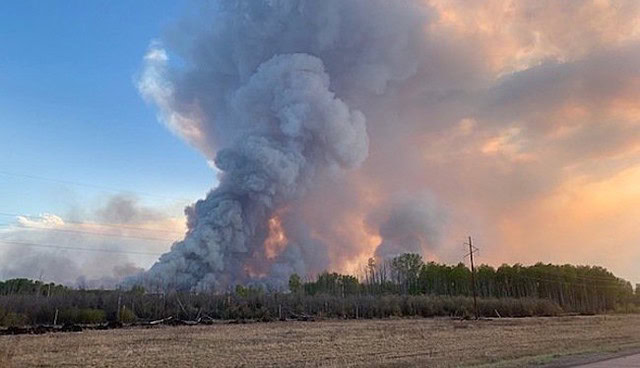
Crews battling Alberta wildfires that have forced thousands of people from their homes and put others on evacuation notice faced another challenge Saturday — thunderstorms.

While such storms bring the promise of rain, they also produce lightning, which can spark new fires and strong winds to fan the flames.

Wildfire information officer Leah Lovequist says a lightning strike on Saturday afternoon hit a tree south of a lookout tower not far from Swan Hills in the Slave Lake Forest Area, causing a small fire that crews were dealing with.

Slave Lake has been on evacuation notice for several days due to a large fire 33 kilometres to the northeast, and residents have been told to be ready to leave with only eight hours’ notice.

Environment Canada issued a severe thunderstorm warning for the town on Saturday, saying conditions were favourable for the development of dangerous thunderstorms that may be capable of producing strong wind gusts, damaging hail and heavy rain.

The forecast also called for possible thunderstorms in High Level, where residents have been out of their homes for over a week due to a wildfire that’s still out of control and is 280,000 hectares in size.

“The forecast today expects some precipitation, but with a chance of thunderstorms that will yield variable and gusty winds that can prove a challenge to ongoing operations,” an update from the Alberta government on the fire near High Level said Saturday.

“While precipitation can dampen fire activity and aid suppression efforts, any return of warm and dry weather can revive fire behaviour.”

Slave Lake, a town of 6,500, was partially destroyed by a wildfire in 2011.

On its Facebook page Saturday, the town posted phone numbers for mental health support lines for anyone who may be triggered by the wildfires. It noted flashbacks, changes in sleep patterns and increased use of alcohol or drugs may be signs people are having difficulty coping.

A number of communities — Chipewyan Lakes, the Hamlet of Wabasca and Bigstone Cree Nation — in the Slave Lake Forest Area have already been evacuated, as well as some communities in the High Level management area.

Federal Public Safety Minister Ralph Goodale said Friday that Ottawa has granted Alberta’s request for help from the Canadian Forces. The military will help airlift evacuees, transport supplies and provide medical assistance.

Smoke from the fires, meanwhile, continued to disrupt normal activities throughout much of Alberta on the weekend.

An air quality statement for Calgary was lifted on Saturday, but remained in effect for much of northern Alberta.

In Edmonton, a festival to promote tree-planting was cancelled on Saturday due to poor air quality.

Delay in policy update that could prevent SNC-Lavalin ban from federal business

OTTAWA — The federal government has blown its own timeline to unveil an update to Canada’s corporate-misconduct provisions, including changes that could help SNC-Lavalin avoid being barred from lucrative federal contracts.

An internal federal document obtained by The Canadian Press shows the Liberal government was planning to announce a long-studied revision to its so-called “integrity regime” in early February.

“The integrity regime’s updated ineligibility and suspension policy will be published in early February 2019, and will come into effect at the end of February 2019,” said information contained in a Feb. 4 email to an associate deputy minister. The email was released under access-to-information law.

Three months later, the government has yet to publish the integrity-regime update, nor has it responded to requests to explain the reason for the delay.

The integrity regime has been under scrutiny ever since SNC-Lavalin, the huge Montreal-based engineering and construction firm facing Canadian criminal charges over dealings in Libya, found itself at the centre of a political controversy in Ottawa.

On Feb. 7, three days after the email, the Globe and Mail newspaper reported that Prime Minister Justin Trudeau’s aides pressed former attorney general Jody Wilson-Raybould to intervene in the SNC-Lavalin case and help it avoid prosecution through a plea-bargain-type deal. Trudeau has denied his officials acted inappropriately.

This week, a Quebec judge ruled that there’s enough evidence against SNC-Lavalin to send the case to trial.

A conviction could result in a severe punishment for the company: a disqualification from federal business for 10 years. Since much of SNC-Lavalin’s work is in civil construction projects, that could be deeply damaging to its Canadian business.

However, SNC-Lavalin could still see a shorter suspension from federal contracts — or perhaps none at all — if the proposed update to the integrity regime comes into force.

SNC-Lavalin urged the Liberal government in 2017 to weaken federal penalties for corporate misconduct to the point a guilty company could completely avoid a ban on receiving public contracts.

A draft of the Liberal government’s new scheme released last fall shows the revised provisions will carry no minimum ineligibility period. Public Services Minister Carla Qualtrough, who is in charge of federal procurement, has said such a change would address concerns raised by companies about the “lack of flexibility” in the 10-year suspension terms.

Any adjustments to the regime that help SNC-Lavalin dodge a ban could be politically sensitive for the Liberals.

On Feb. 28, under questioning by a House of Commons committee, Qualtrough said the updated integrity regime would be finalized by late March or early April.

Asked about the timing of the update’s eventual release this past week, Qualtrough’s department still has not provided a date. It also has yet to give an explanation for the delays.

The integrity regime was designed to ensure the government only does business with ethical companies in Canada and abroad.

Federal officials held a public consultation on the integrity regime in 2017. A summary of the process, which included input from SNC-Lavalin, said most participants felt a disqualification period of a decade, or even five years, was too long.

Last fall, the proposal went through another round of public consultations with the aim of making additional tweaks before coming into force.

Another tool designed to deal with corporate wrongdoing has been under a microscope since the political affair involving SNC-Lavalin first made headlines.

The company has made unsuccessful attempts to preserve its ability to bid on federal contracts under that separate, plea bargain-type approach that would head off a criminal case.

But the federal director of public prosecutions ruled late in 2018 that its case was ill-suited for such a deal, which is known as a remediation agreement or a deferred-prosecution agreement.

It’s the legal avenue at the heart of the political controversy that surrounded the Liberals earlier this year.

The federal attorney general has the power to overrule the director’s rejection of a deferred-prosecution agreement and take on the case him- or herself. Wilson-Raybould declined to do so.

David Lametti, who replaced Wilson-Raybould as justice minister and attorney general, acknowledged Wednesday in response to reporters’ questions that a deferred-prosecution agreement with SNC-Lavalin remains a possibility. He declined to comment further, saying the case was before the courts.

Trudeau has argued a criminal trial could lead to the company’s moving to the United States and the loss of thousands of jobs, a sentiment supported by an internal SNC-Lavalin document obtained by The Canadian Press.

Sask. made ‘fundamental mistake’ treating STC as business, not service: researcher

The Saskatchewan Transportation Company was scrapped by the provincial government in its budget two years ago. The move would save the government millions over a five year period.

Private sector not stepping up in the absence of the STC, research indicates

The wheels on the bus just aren’t rolling in Saskatchewan. 

A researcher from the University of Regina has found the private sector has not stepped up to fill the transportation gap left in Saskatchewan two years after government shuttered the Saskatchewan Transportation Company. 

The provincial government closed the STC after it determined it would cost $85.5 million in subsidies to keep the wheels turning on STC over a five year period.

“The government expected the private players to come and step in all the routes that the STC previously supported,” said Chandrakant Rane, a grad student working on his executive masters of business administration at the U of R.  

“My finding was that most of the players are trying to make money in the busy corridor, between Moose Jaw, Regina and Saskatoon.” 

Speaking with numerous people affected by the STC shutdown, including users, municipal and rural representatives, former STC employees and entrepreneurs, Rane’s research found people are still suffering because of the closure.

He feels the government didn’t create an appropriate “ecosystem” to attract private transportation companies to address the need.  He estimates there are between five and six transportation companies operating in Saskatchewan and he had spoken to four, which he said are “small players” and are struggling.

He said the government should introduce incentives for transportation companies to come to Saskatchewan, like subsidies and changes to policy that would make them easier to operate. Rane feels the government’s “fundamental mistake” was looking at STC as a business as opposed to a public service.

A spokesperson for Joe Hargrave, minister responsible for the Crown Investments Corporation of Saskatchewan, said the minister’s office would look at the report.

Asked for comment on the project, Minister of Crown Investments Corporation Joe Hargrave’s office provided a statement saying it would be reviewing the research.

“In the meantime, our position hasn’t changed,” the statement said.

“The decision to shut down STC was a very difficult one for the Government of Saskatchewan. Continuing to operate STC was going to cost the government and taxpayers an estimated $85 million in subsidies over the next five years.”

The government said STC’s ridership had been “steadily declining,” falling by 77 per cent since 1980, 35 per cent since 2012 and 10 per cent during its last year of operation.

“A number of private sector companies currently offer transportation services across the province,” the statement said. “We remain hopeful the private sector will identify business opportunities to serve markets where there is demand.”

STC had a declining ridership but was still used by low income earners, people with disabilities and seniors, among other marginalized groups. 

Several groups of people were affected by the closure, including seniors, people with disabilities, chronically ill residents and low income earners in Saskatchewan. The closure also hurt the bottom line for some businesses who relied on the STC for freight. 

Rusty Cameron owns Rusty’s Wild Rice near Hudson Bay. He has seen sales cut roughly “in half” since the STC closed, as those ordering his product are not willing to pay the more expensive freight, which jumped from roughly $25 with STC to about $50 through the mail. 

“It’s basically doubling our freight,” said Cameron, who was headed out to work in the rice fields on Friday morning.

“The price of the rice is great. They love the price of the rice but the price of the freight, they just can’t handle. That’s what’s really hurt us.”

Cameron said he’d like to see the government reconsider reversing “what they’ve done,” but isn’t holding out hope, as assets involving STC were sold.

Ryan Meili, leader of the provicial opposition NDP, said in a news release released Friday that if the NDP were elected, his government would bring back the bus company. 

“We owe it to the people of Saskatchewan to restore this essential service,” the statement read.