Archives for May 27, 2019

Stocks to Watch: Eyes on Chegg, Inc. (CHGG), Zynga Inc. (ZNGA)

The price of Chegg, Inc. (NYSE:CHGG) went up by $0.69 now trading at $36.74. Their shares witnessed a 62.06% increase from the 52-week low price of $22.67 they recorded on 2018-10-29. Even though it is still -13.47% behind the $41.69 high touched on 2019-03-19. The last few days have been rough for the stock, as its price has decreased by -1.9% during the week. It has also performed poorly over the past three months, as it lost around -6.99% while it has so far climbed around 40.44% during the course of a year. The stock of CHGG recorded 29.28% uptrend from the beginning of this year till date. The 12-month potential price target for Chegg, Inc. is set at $42.3. This target means that the stock has an upside potential to increase by 15.13% from the current trading price.

74 institutions entered new Chegg, Inc. (NYSE:CHGG) positions, 153 added to their existing positions in these shares, 119 lowered their positions, and 24 exited their positions entirely.

Chegg, Inc. (CHGG) trade volume has decreased by -66.95% as around 756,950 shares were sold when compared with its 50-day average volume of traded shares which is 2,290,630. At the moment, CHGG is witnessing a downtrend, as it is trading -0.1% below its 20-day SMA, -2.76% below its 50-day SMA, and 13.04% below its 200-day SMA. The company runs an ROE of roughly -4.1%, with financial analysts predicting that their earnings per share growth will be around 25% per annum for the next five year. This will be compared to the 41% increase witnessed over the past five years.

The first technical resistance point for Chegg, Inc. (NYSE:CHGG) will likely come at $37.09, marking a 0.94% premium to the current level. The second resistance point is at $37.43, about 1.84% premium to its current market price. On the other hand, inability to breach the immediate hurdles can drag it down to $35.99, the lower end of the range. CHGG’s 14-day MACD is 0.12 and this positive figure indicates an upward trading trend. The company’s 14-day RSI (relative strength index) score is 48.4, which shows that its stock has been neutral. The 20-day historical volatility for the stock stands at 51.29 percent, which is high when compared to that of the 50-day’s 41.92 percent.

The shares of Zynga Inc. (NASDAQ:ZNGA) has decreased by -0.16%, and now trading at $6.06 on the Wall Street in the intra-day deal, with their shares traded now around 8,208,593. This is a decline of -8,190,907 shares over the average 16,399,500 shares that were traded daily over the last three months. The stock that is trading at $6.06 went higher by 82.53% from its 52-week low of $3.32 that it attained back on 2018-11-28. The stock recorded a 52-week high of $6.31 nearly 11 days ago on 2019-05-16.

ZNGA stock has performed well over the past 30 days, as it added 10.99% while its price climbed by 54.2% year-to-date (YTD). Looking at the last few days, it has been tough for the stock, as it tumbled -2.1% over the last week. The stock’s 12-month potential target price is now at $6.89. This means that the stock price might likely increase by 13.7% from its current trading price. 13 out of 18 Wall Street analysts which represents 72.22% rated the stock as a buy while the remaining 22.22% rated it as a hold, with 5.56% of analysts rating it as a sell.

Zynga Inc. (NASDAQ:ZNGA) has been utilizing an ROE that is roughly -7.3%, with stock analysts predicting that the company’s EPS for the next five years will go up by 30% per year, following the 18.9% raise that was witnessed during the past five years. The stock at the moment is on a uptrend, trading 1.56% above its 20-day SMA, 7.81% above its 50-day SMA, and 34.88% above its 200-day SMA. In percentage terms, the aggregate Zynga Inc. shares held by institutional investors is 75.5%. 64 institutions jumped in to acquire Zynga Inc. (ZNGA) fresh stake, 138 added to their current holdings in these shares, 124 lowered their positions, and 34 left no stake in the company.

The stock’s 9-day MACD is -0.03 and this negative figure indicates a downward trading trend. The company’s 9-day RSI score is 53.74, which shows that its stock has been neutral. The 20-day historical volatility for the shares stand at 21.81 percent, which is less when compared to that of the 50-day’s 26.96 percent. On the daily chart, we see that the stock could reach the first level of resistance at $6.14, sporting a 1.3% premium to the current level. The next resistance point is at $6.22, representing nearly 2.57% premium to the current market price of Zynga Inc. (ZNGA). On the other hand, failure to breach the immediate hurdles can drag it down to $5.94, the lower end of the range.
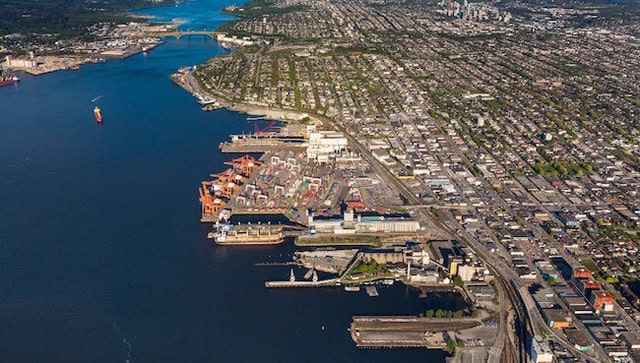
Longshoremen strike notice

Longshore workers have issued 72-hour strike notice that could see two Port of Vancouver container terminals behind picket lines by Monday.

Jeff Scott, chair of the B.C. Maritime Employers Association, says they’ve been informed that Global Container Terminals in Delta and Vancouver could be behind picket lines on Monday morning.

The dispute involves about 6,000 members of the International Longshore & Warehouse Union Canada, who voted 98.4 per cent in favour of supporting strike action earlier this month.

The union couldn’t be reached for comment.

Scott says both sides remain at the bargaining table with the help of federal mediation services in the hope of avoiding a labour dispute because they recognize the significant economic impact that it could cause.

He says the Port of Vancouver did an analysis on a possible labour disruption and found that the affect on cargo would be about $540 million a day.

The employers association represents more than 30 member companies at B.C. ports and Scott says a strike would affect as many as 34,000 workers.

The association acts on behalf of the terminal operators, shipping lines and its member companies.

Steel yourself, Canada: Tariff deal falls short of ‘a full lift’

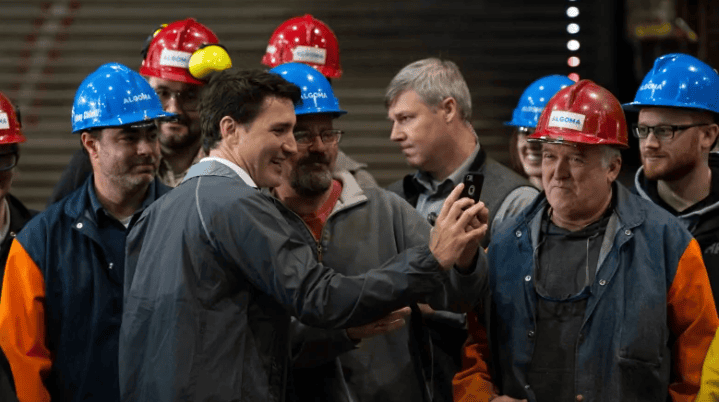
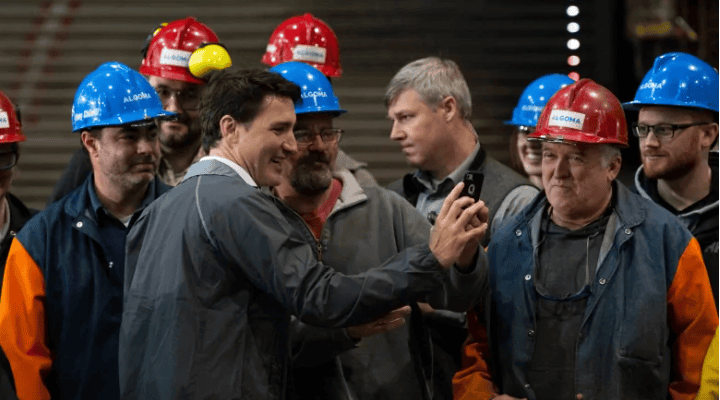
Prime Minister Justin Trudeau posed with steelworkers in Sault Ste. Marie Friday, the latest stop in his government’s victory-lap tour of steel and aluminum producers last week, celebrating the lifting of American tariffs.

Much-hailed agreement left openings for steel and aluminum tariffs to snap back

“Don’t bask in the glory of this one,” United Steelworkers president Leo Gerard told CBC’s The House podcast last week, casting a skeptical eye on the agreement to end steel and aluminum tariffs.

The deal points to where the Trump administration’s protectionism may be headed next — and it’s not really a return to a North American free trade zone for steel and aluminum products.

That didn’t stop Prime Minister Justin Trudeau and Foreign Affairs Minister Chrystia Freeland from touring Canada, striking celebratory poses with the grateful hard-hats-and-overalls crowd last week. Trudeau talked to aluminum workers in Sept-Iles, Que. and steelworkers in Sault Ste. Marie, Ont. Freeland met steelworkers in Regina before heading to meet more aluminum workers in Jonquiere, Que.

Their message at every stop: we had your backs. Patience and firm persistence paid off. Sault Ste. Marie MP Terry Sheenan even introduced Trudeau as their “man of steel.”

“Canada is able to make sure that we’re taking care of our people,” the prime minister said, sporting an Algoma Steel jacket. But, he acknowledged, there’s still more work to do.

If everyone at those events was being completely honest, they’d admit things aren’t returning to how they used to be. Workers must steel themselves for this: the U.S. hasn’t abandoned protectionism. Rather, it adjusted it when it became politically expedient to do so.

The White House needed allies in its escalating trade fight with China. This tariff deal cleared the way for a much-needed trade win on the relatively simpler North American front.

But a “full lift” of the tariffs didn’t really come without concessions, despite what Trudeau suggested May 17.

“There wasn’t a way to this without some sort of concession to the United States,” said former U.S. diplomat Sarah Goldfeder as the deal was announced. “This is a necessary evil.”

Here are a few still-unanswered questions about where things stand now:

What’s a ‘meaningful surge’?

The agreement is what trade watchers call a “snap back” deal. Yes, the tariffs were removed. But the U.S. reserved the right to slap them back on — specifically, “in the event that imports of aluminum or steel products surge meaningfully beyond historic volumes of trade over a period of time.”

Freeland has been asked to define a “surge” and couldn’t. There’s a conversation still underway with the U.S. to flesh out how this language should be interpreted.

Canada’s hope was that this part of the agreement would never be used.

Foreign Affairs Minister Chrystia Freeland celebrated the end of the tariffs at the Evraz steel mill in Regina Wednesday.

Catherine Cobden of the Canadian Steel Producers Association told CBC News this week she doesn’t have a clear definition for “surge” either, but she’s hoping for a way to engage with the Americans and nail it down.

Otherwise, what’s to stop the Americans from torquing any increase in Canadian imports into a industry-threatening “surge”? What time periods would be compared? How would these volumes be calculated?

Sometimes, data can be manipulated to show whatever you want the numbers to show. And if tariffs are re-applied, Canada could no longer retaliate with tariffs on politically sensitive commodities like orange juice or bourbon.

Are there really no quotas?

Both the Mexicans and the Canadians said they wouldn’t settle for a deal that fixed quotas on their exports. But, as Carleton University’s Meredith Lilly observed on Power & Politics last week, “there’s language in the agreement that suggests perhaps we have quota by another name.”

The agreement lays out how the U.S. “may” request consultations before imposing duties at the same rate as the previous tariffs, “with consideration of market share.” In other words, Americans don’t want Canada’s market share to grow.

Is this a quota in disguise?

The U.S.–Mexico agreement is less subtle, saying that in assessing whether there has been a surge, Washington will consider that the U.S. may require “225,000 tonnes of billet from Mexico” and new investment in Mexico may require “200,000 tonnes of cold-rolled steel.” Those are negotiated quotas, hiding in plain sight.

What kind of Canadian steel is still a target?

The new (but undefined — officials are working on it, Freeland’s spokesperson says) monitoring regime for Canadian and Mexican imports “may treat products made with steel that is melted and poured in North America separately from products that are not.”

Freeland’s office emphasizes that the wording here is “may,” not “will.”

Only a handful of facilities in Hamilton and Sault Ste. Marie, Ont., make steel from iron ore in integrated mills. Most of Canada’s producers are smaller facilities for electric-arc steelmaking, often from scrap.

Where does that scrap come from? Even if it’s not from offshore — industry representatives say that’s rarely profitable — can they prove the integrity of their supply chains?

If they lack the right paperwork, Canadian steel products could be stalled, or even rejected, at the U.S. border, as eagle eyes track any traces of Chinese steel. It creates uncertainty for exporters — a classic non-tariff barrier to trade.

“There’s a presumption that [Americans] would use any opportunity to restrict market access,” trade consultant Dan Ciuriak said. “Is this something we extracted from them at great pain, that they would claw back at the slightest excuse?”

Are more safeguards coming?

The United Steelworkers union, and Cobden’s CSPA, still want Canada to put up more tariff barriers to protect its market. Spokespeople like Gerard warn about “countries that cheat because they want dollars”; because the world still makes more steel than it needs, they fear foreign steel displaced from the U.S. could somehow flood into Canada.

But Canada’s safeguard process has already run its legal course. The Canadian International Trade Tribunal concluded surtaxes were only justified on two offshore products — heavy plate and stainless steel wire — for the next three years.

Prime Minister Justin Trudeau meets workers in the cafeteria on Tuesday, May 21, during a visit to the Alouette aluminum plant in Sept-Iles Que.

There’s a difference between unfairly dumped steel — which Canada investigates regularly, implementing dozens of different duties — and fairly priced foreign steel, which meets legitimate needs that domestic producers cannot or will not serve. Manufacturers and construction companies that import steel were relieved when the government followed the tribunal’s advice and the provisional surtaxes imposed on five other steel products ended last month.

A working group has until early June to consider other ways of supporting Canada’s industry.

Will this help the new NAFTA pass?

After saying initially that the end of the tariffs meant things were “full steam ahead” for ratifying the revised North American trade agreement, Freeland and Trudeau were using more cautious language last week.

Freeland would make no predictions about ratification timing during a CBC Radio interview Tuesday. Trudeau has talked about ratifying in co-ordination with Washington.

Democrats in the U.S. Congress have suggested several parts of the deal must change before they’d proceed with a vote, including strengthening intellectual property provisions for biologic drugs, a move that could increase pharmaceutical costs.

Vice-President Mike Pence is scheduled to visit Ottawa next Thursday to promote ratification of the revised NAFTA deal. The Trudeau government may long to conclude this saga as well.

But it’s risky to draft and pass an implementation bill to change Canadian laws based on an agreement that’s still fluid in Washington. What if they made Canadian drugs more expensive than they actually needed to be to get a deal? How would that play in an election campaign?

No mention of NAFTA legislation appeared on the House of Commons notice paper in time for a bill to be introduced on Monday, when the House returns for what is scheduled to be its final two- to four-week stretch before the summer.

Fiat Chrysler proposes merger with French carmaker Renault

Fiat said the combined business would be 50% owned by FCA shareholders and 50% owned by those of Renault.

French government owns 15% of Renault

Fiat Chrysler on Monday proposed a merger with French carmaker Renault aimed at saving billions of dollars for both companies as the industry pivots to electric and autonomous vehicles.

The merged company would be the world’s No. 3 automaker and be 50 per cent owned by FCA shareholders and 50 per cent by Renault shareholders, Fiat Chrysler Automobiles said in a statement Monday.

The companies have been in discussions for weeks.

Renault said it was “studying with interest” the terms of the proposed merger. It’s unclear what the merger would mean for Renault’s existing alliance with Japan’s Nissan and Mitsubishi.

“After careful review of the terms of FCA’s friendly proposal, the board of directors decided to study with interest the opportunity of such a business combination, comforting 
Groupe Renault’s manufacturing footprint and creating additional value for the Alliance,” Renault said in a statement.

The Fiat Chrysler statement said the merged company would produce 8.7 million vehicles annually and save €5 billion for the companies each year by sharing research, purchasing and other activities. It said the deal would involve no plant closures, but didn’t address potential job cuts.

The Renault-Nissan-Mitsubishi alliance has been troubled since the November arrest of its boss and biggest champion, Carlos Ghosn, on financial misconduct charges in Japan. Together, the three companies are the biggest maker of passenger cars in the world.

The French government, which owns 15 per cent of Renault, is cautious about the new FCA merger idea.

A French official said Sunday that the state will only agree to a merger if it makes sense for jobs and France’s national interests. The official told The Associated Press that Japanese authorities have also been informed, and that France would prefer a tie-up within the existing Renault-Nissan-Mitsubishi alliance. The official wasn’t authorized to be named.

Renault Chairman Jean-Dominique Senard replaced Carlos Ghosn, who is dealing with criminal charges in Japan.

Nissan Motor Co. Chief Executive Hiroto Saikawa wouldn’t comment directly on the idea of a Renault-FCA merger but said, “I am always open to exchanging constructive views on strengthening the alliance.” He was shown speaking to reporters on Japan’s Fuji TV news.

Collaboration between automakers has taken on importance in recent years as they seek to build their technological capabilities in pursuit of electrical vehicles, net connectivity and artificial intelligence for vehicles. Automakers are also under pressure from regulators, particularly in Europe and China, to come up with electric vehicles so they can meet tougher pollution limits.

During an earnings conference call earlier this month, FCA CEO Mike Manley told shareholders that he believed that there would be “significant opportunities” in terms of strategic partnerships or alliances in the next two or three years.

Manley also told analysts that Fiat was taking action to address weaknesses in Europe.

Please abstain: How industrial companies are grappling with legalized cannabis

Some companies are urging employees to abstain from cannabis, even though the substance is legal.

Imperfect testing among the problems businesses face with cannabis in the workplace

Seven months after the legalization of recreational cannabis, Garnet Amundson’s worries have not abated.

Amundson is chief executive of Calgary-based Essential Energy Services, with nearly 400 workers, including 350 in safety-sensitive roles in the oilpatch.

Topping his list of concerns is having employees who can pass any type of drug test on any given day and arrive at work without any impairment.

Not only does his company drug test employees in certain instances, but the staff may also be tested when they perform work at a facility owned by a different firm. In that case, Amundson said his workers have to meet the standards of the other company.

“Employees have to be completely clean at all times, so they can access these top customers and get on to their job sites,” he said.

It’s a situation underscoring the human resource and legal issues created by the legalization of cannabis for industries where any sign of impairment is closely monitored and safety is a priority.

The oilpatch, for example, has worked hard to get a handle on substance abuse for several years and the legalization of recreational cannabis presents another challenge for companies dealing with the often thorny issue of drug testing.

A heavy hauler mining truck dumps a load of bitumen ore at an oilsands facility in northern Alberta.

Testing for cannabis is not as advanced as using a breathalyzer to gauge someone’s impairment from alcohol. A urine test for cannabis, for instance, can detect THC, but can’t necessarily judge a person’s level of impairment.

“I think people maybe have been a bit misinformed believing that there is a completely accurate and reliable way to test for impairment with cannabis,” said Amundson.

No wonder the legalization of cannabis is proving to be a logistically challenging for Amundson and other employers across the country. 

Legal grey areas and a lack of definitive tests mean “complete abstinence from some of these substances is required,” Amundson said.

Impairment is a concern in many industries such as oil and gas, forestry, mining and transportation, where workers are at a high risk of injury.

Other companies in different sectors also continue to grapple with the legalization of cannabis and, in particular, how to respect a worker’s right to consume the substance while also ensuring no one is impaired on the job. 

“It’s a challenge for all employers in Canada, but especially small and medium-sized businesses that don’t have the financial or technical resources to manage this themselves,” said Tim Salter with the Drug and Alcohol Testing Association of Canada.

Some companies are telling workers to abstain from cannabis altogether.

The major active ingredient in cannabis, tetrahydrocannabinol (THC), can be found during urine testing up to 30 days after a worker uses cannabis, said Salter, but that only provides so much information.

“There’s really no way for employers to reasonably screen for impairment,” he said, “outside of doing a blood test which is not going to happen at the workplace.”

That’s where legal issues can occur. If there is an accident on a job site, a company is allowed to do post-incident drug testing. The urine sample may find traces of THC, but again, the test can’t judge the level of impairment. That’s why a company may not be able to say whether the worker was at fault because of cannabis or not, since there is no definitive proof that THC contributed to the accident.

“Employers are just forced into this corner of promoting abstinence,” said Salter. “It’s most definitely a mess because the governments really haven’t done a great job of preparing the industry for the legalization of cannabis.”

Eventually, Salter said the court system will have to decide on many of the issues cannabis presents for employers.

One workplace dispute was in front of the Newfoundland Supreme Court recently focusing on a construction labourer who was working on the Lower Churchill hydroelectric project in Labrador.

The man was prescribed cannabis to manage pain due to Crohn’s disease and osteoarthritis, since other medication wasn’t as effective. His company tried to accommodate his use of cannabis, but couldn’t. 

Ultimately, the construction company wouldn’t give the man any work because of the risk of impairment in the safety-sensitive job site. The province’s top court agreed, pointing to how accommodating the worker “would amount to undue hardship” for the company.

Each case is different, but the court ruling shows how companies could refuse work to those who use cannabis, medically or not, depending on the dose and the type of job.

Safety first

So far, the legalization of cannabis has not contributed to an increase in workplace accidents, according to Murray Elliott, the chief executive of Energy Safety Canada, although it’s too early for reliable statistics.

“There has been very little impact or change in impairment in the workplace,” said Elliott.

While testing techniques for cannabis are evolving, Elliott said the accuracy is good and there are general guidelines companies can follow to gauge what level of THC in someone’s body is a significant risk of impairment.

“There is not necessarily a direct link between the levels of cannabis that show up in testing and whether there is impairment or not. It’s really only a risk of impairment,” he said.

The legalization of cannabis has not contributed to an increase in workplace accidents, according to Murray Elliott with Energy Safety Canada.

In preparing for legalization, companies took a range of approaches, such as updating their existing drug and alcohol policies.

Sinopec Canada, an oil and gas producer, spent nine months before legalization to create a policy that would respect the rights of workers, legally protect the company, and also ensure a safe workplace.

Kara Bennik, a human resources advisor with the company, said they set out to be as informed as they could about the issue, consulting different departments to incorporate a range of views.

“We’re still evolving and growing our program,” said Bennik. “The reality is that future legislation is going to continue to come in.”

Considering the struggles of the oilpatch in recent years, the sector hasn’t hired too many workers, but when that happens, Amundson, with Essential Energy Services, worries there will be fewer qualified applicants than before because of the pre-employment drug test.

Already during some hiring, Amundson said the applicants are asked at the end of their interviews if they would pass a drug test.

“They look at us and say most of the time, ‘what do you mean?’ I don’t think a lot of the time we get an unequivocal ‘Absolutely!'”

Often, he said they ask if they can come back in a few weeks.