Archives for May 15, 2019

Stocks to Watch: Seven Generations Energy Ltd. class A common shares (TSX:VII) Down -2.57%

At close of market on Monday, Seven Generations Energy Ltd. class A common shares (TSX:VII) stock finished trading at -2.57%, bringing the stock price to $8.72 on the Toronto Stock Exchange. The stock price saw a low of $8.66 and a high of $8.96.

The company’s stock was traded 6,030 times with a total of 1,352,274 shares traded.

Seven Generations Energy Ltd. class A common shares has a market cap of $3.08 billion, with 353.03 million shares in issue.

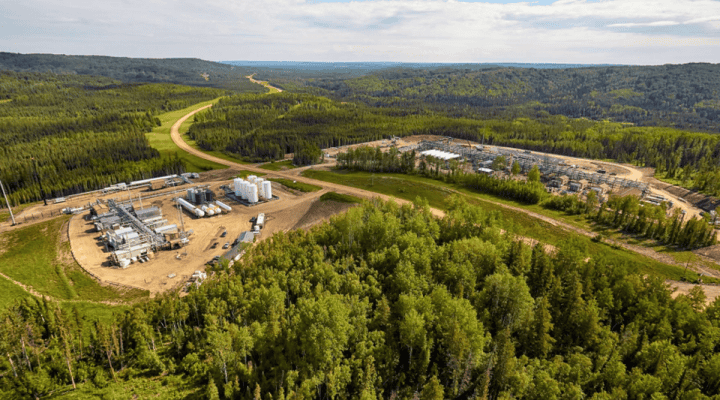
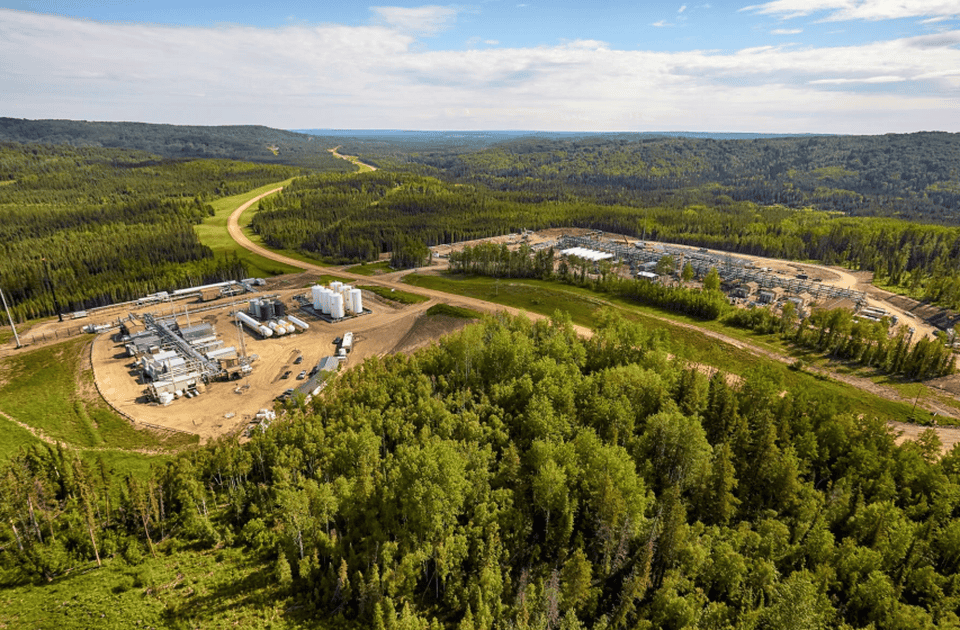
Seven Generations Energy Ltd is an independent energy company focused on the acquisition, development, and optimization of high-quality, tight rock, natural gas resource plays. The company employs long-reach and horizontal drilling to produce resources of natural gas, condensate, and natural gas liquids. In addition to drilling operations, Seven Generations owns several gathering lines and processing facilities. The company depends on a skilled technical and business team to identify, capture, develop, and catalyze production from resource plays.


Stocks to Watch: Lexinfintech Holdings LTD. (LX) and Regulus Therapeutics Inc. (RGLS) on the Marquee

The price of LexinFintech Holdings Ltd. (NASDAQ:LX) went up by $0.64 now trading at $13.09. Their shares witnessed a 102.01% increase from the 52-week low price of $6.48 they recorded on 2018-12-11. Even though it is still -40.11% behind the $18.34 high touched on 2018-05-18. The last few days have been rough for the stock, as its price has decreased by -2.46% during the week. It has also performed better over the past three months, as it added around 30.9% while it has so far retreated around -21.94% during the course of a year. The stock of LX recorded 80.55% uptrend from the beginning of this year till date. The 12-month potential price target for LexinFintech Holdings Ltd. is set at $16.28. This target means that the stock has an upside potential to increase by 24.37% from the current trading price.

17 institutions entered new LexinFintech Holdings Ltd. (NASDAQ:LX) positions, 30 added to their existing positions in these shares, 25 lowered their positions, and 14 exited their positions entirely.

LexinFintech Holdings Ltd. (LX) trade volume has decreased by -38.01% as around 867,015 shares were sold when compared with its 50-day average volume of traded shares which is 1,398,558. At the moment, LX is witnessing a downtrend, as it is trading -2.16% below its 20-day SMA, 5.75% above its 50-day SMA, and 23.6% above its 200-day SMA. The company runs an ROE of roughly 70%, with financial analysts predicting that their earnings per share growth will be around 4.87% per annum for the next five year. This will be compared to the 0% decrease witnessed over the past five years.

The first technical resistance point for LexinFintech Holdings Ltd. (NASDAQ:LX) will likely come at $13.31, marking a 1.65% premium to the current level. The second resistance point is at $13.53, about 3.25% premium to its current market price. On the other hand, inability to breach the immediate hurdles can drag it down to $12.33, the lower end of the range. LX’s 14-day MACD is -0.4 and this negative figure indicates a downward trading trend. The company’s 14-day RSI (relative strength index) score is 50.67, which shows that its stock has been neutral. The 20-day historical volatility for the stock stands at 64.25 percent, which is low when compared to that of the 50-day’s 65.77 percent.

The shares of Regulus Therapeutics Inc. (NASDAQ:RGLS) has increased by 3.57%, and now trading at $1.45 on the Wall Street in the intra-day deal, with their shares traded now around 651,039. This is a rise of 471,637 shares over the average 179,402 shares that were traded daily over the last three months. The stock that is trading at $1.45 went higher by 81.25% from its 52-week low of $0.8 that it attained back on 2018-12-24. The stock recorded a 52-week high of $9.48 nearly 343 days ago on 2018-06-06.

RGLS stock has performed well over the past 30 days, as it added 31.82% while its price climbed by 55.81% year-to-date (YTD). Looking at the last few days, it has been good for the stock, as it rose 20.83% over the last week. The stock’s 12-month potential target price is now at $1.33. This means that the stock price might likely increase by -8.28% from its current trading price. 0 out of 4 Wall Street analysts which represents 0% rated the stock as a buy while the remaining 100% rated it as a hold, with 0% of analysts rating it as a sell.

Regulus Therapeutics Inc. (NASDAQ:RGLS) has been utilizing an ROE that is roughly -671.1%, with stock analysts predicting that the company’s EPS for the next five years will go up by 39.6% per year, following the 0.8% raise that was witnessed during the past five years. The stock at the moment is on a uptrend, trading 24.56% above its 20-day SMA, 27.66% above its 50-day SMA, and -13.38% below its 200-day SMA. In percentage terms, the aggregate Regulus Therapeutics Inc. shares held by institutional investors is 25.4%. 9 institutions jumped in to acquire Regulus Therapeutics Inc. (RGLS) fresh stake, 14 added to their current holdings in these shares, 17 lowered their positions, and 8 left no stake in the company.

The stock’s 9-day MACD is 0.14 and this positive figure indicates an upward trading trend. The company’s 9-day RSI score is 76.39, which shows that its stock has been overbought. The 20-day historical volatility for the shares stand at 81.63 percent, which is less when compared to that of the 50-day’s 92.52 percent. On the daily chart, we see that the stock could reach the first level of resistance at $1.57, sporting a 7.64% premium to the current level. The next resistance point is at $1.7, representing nearly 14.71% premium to the current market price of Regulus Therapeutics Inc. (RGLS). On the other hand, failure to breach the immediate hurdles can drag it down to $1.3, the lower end of the range.

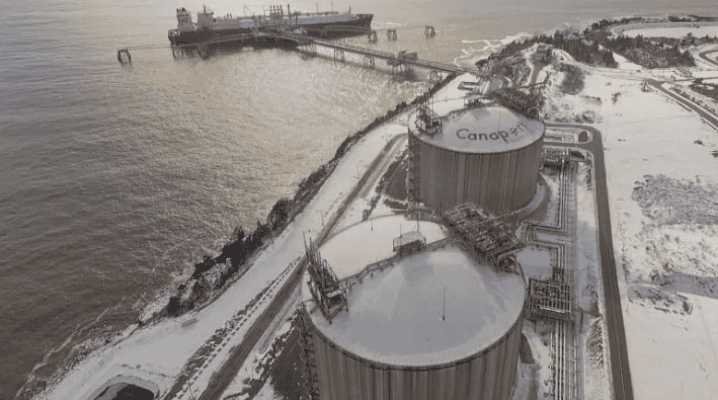
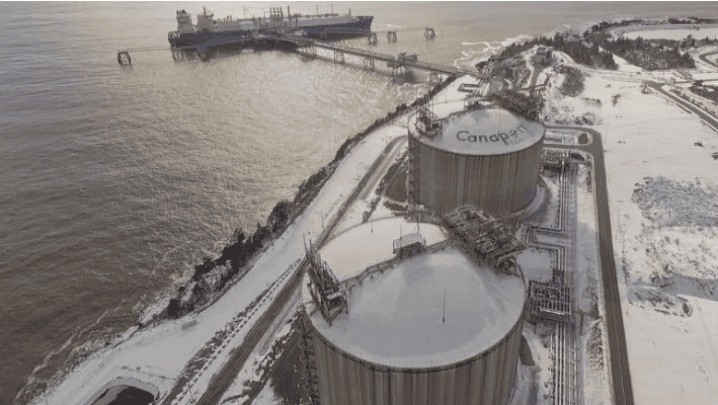
Canaport LNG gets little new business from end of Nova Scotia gas

Canaport LNG’s Saint John import facility has been operating at a fraction of its capacity since opening in 2008.

Supplying New England remains company’s ‘goal and commitment’

The general manager of Canaport LNG says the end of natural gas production off Nova Scotia has done little to boost production at his Saint John import facility.

“We were hoping to see more business, to tell you the truth,” said Javiar Azagra. “We thought it was going to be more opportunities for us to bring more gas but actually it didn’t happen.”

After almost two decades, gas supplies have run out at the Nova Scotia gas fields at Cape Sable Island and Deep Panuke.

Production was stopped completely Jan. 1.

Corridor only producer left

That left Corridor Resources the only natural gas producer in the Maritimes, but according to consultant Todd MacDonald of Energy Atlantica, Corridor can supply less than one half of one per cent of the total natural gas demand in the region. 

The remainder is being met largely through suppliers in the U.S. and even Alberta, said MacDonald, with gas arriving here through the Maritimes and Northeast pipeline via Maine.

He expects prices in the region to remain relatively stable thanks to long-term contracts for transportation costs.

“If you think about your natural gas, it has two components, the actual cost of the molecule and then the cost to transport that molecule,” said MacDonald.

“And now the cost to transport that molecule has been fixed at a fixed price for the next 15 or 20 years. And that represents upwards of 75 percent of your total cost.”

Existing long-term contracts made by natural gas customers may be part of the reason Canaport LNG could pick up little new business when offshore Nova Scotia gas vanished from the marketplace.

The company imports gas in liquid form to reduce volume. It is then returned to gas form and marketed via pipeline through Repsol S.A. which, said Azagra, is willing to buy the product from other sources according to price. 

Repsol is also a parent company to Canaport LNG.

Azagra said 2019 turned out to be an average winter, with the company pushing gas into the U.S. “spot” market to meet peak demand during cold snaps.

“It’s always very depending on how hard is the winter,” he said. “At Canaport we fulfil the demand of the market of New England. That’s our goal and commitment.”

Competition increases

 And there was some stiff competition for that peak winter business over the past several months.

After a two-year break, a ship-based LNG regasification plant was back in operation this winter 20 kilometres off the Boston coast.

Its absence in 2018 helped give Canaport LNG a boost from bringing in just four ships in 2016 to seven ships last year. 

Each vessel, said Azagra, carries about 150,000 cubic metres of LNG, which converts to about 87 million cubic metres of natural gas.

Azagra expects little improvement in the volume of business over the next year or two.

He said carbon pricing and the tightening of environmental regulations surrounding marine fuels could send customers in search of cleaner fuels such as natural gas further down the road. 

Markets suffer deep losses

North American markets partially rallied from the deep hit they endured to start the week amid the escalating U.S.-China trade war.

The S&P/TSX composite index closed up 91.12 points to 16,284.53.

In New York, the Dow Jones industrial average was up 207.06 points at 25,532.05. The S&P 500 index was up 22.54 points at 2,834.41, while the Nasdaq composite was up 87.47 points at 7,734.49.

The Canadian dollar traded at an average of 74.24 cents US compared with an average of 74.33 cents US on Monday.

The June crude contract was up 74 cents at US$61.78 per barrel and the June natural gas contract was up 3.8 cents at US$2.66 per mmBTU.

The June gold contract was down US$5.50 at US$1,296.30 an ounce and the July copper contract was up 0.6 of a cent at US$2.72 a pound.

Tilray revenue soars

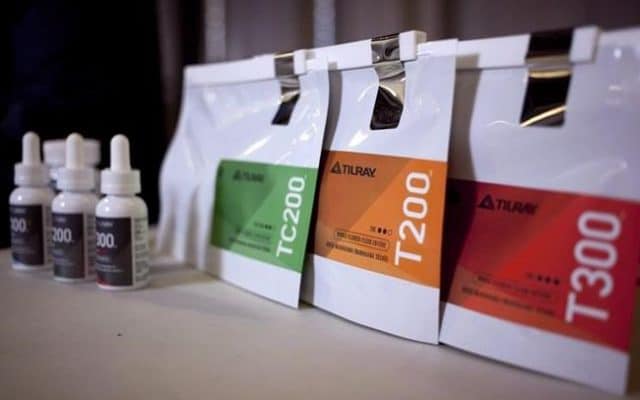
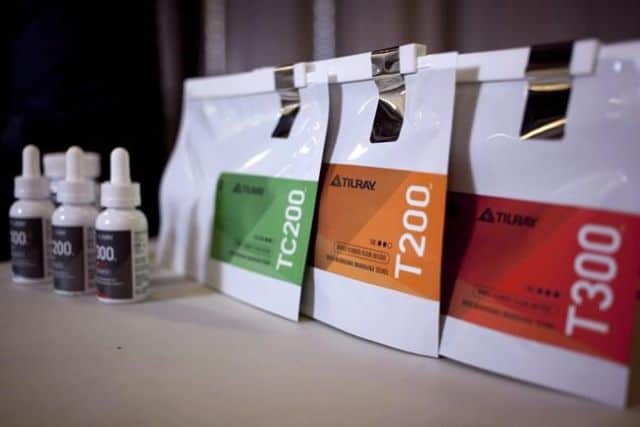
Tilray Inc. expects Canada’s cannabis supply could become balanced within the next two years, while the cannabis producer ramps up its production and manufacturing footprint in the country.

CEO Brendan Kennedy said Tuesday that the company now believes Canada will reach a supply balance in the next 18 to 24 months. In mid-March, Kennedy had estimated the country would be in oversupply over the next 18 months.

The change comes as the industry continues to struggle at ramping up production in the current regulatory environment, he said during a conference call with investors after the company released its first-quarter results.

Tilray said it’s seeing increasingly high demand in the domestic market and reiterated the company’s announcement last week to invest US$32.6 million to increase its Canadian and manufacturing footprint by roughly 18,860 square metres across its three facilities in Leamington and London, Ont., and Nanaimo.

The company is proud of its most recent quarterly results despite these continued domestic supply constraints, he said.

“We are pleased with our first quarter results which include the first full quarter of adult use market sales,” said Kennedy.

Canada legalized recreational cannabis for adult use on Oct. 17.

The Nanaimo-based company, which keeps its books in U.S. dollars, saw its revenue grow 195.1 per cent to US$23 million for the first quarter ended March 31, compared with $7.8 million in the same quarter the previous year.

Tilray says that growth came from cannabis legalization last year in Canada, as well as additional sales from its acquisition of Manitoba Harvest that closed during the quarter and strong growth in medical markets abroad.

The average net selling price per gram decreased to $5.60 from $5.94 in the same quarter the previous year.

The company’s net loss was $30.3 million or 32 cents per share, compared with $5.2 million or seven cents per share for the first quarter of the previous year.

Canola growers caught in middle as Canada-China relations sour

Jack Froese, a farmer and board member of the Manitoba Canola Growers, says this year Canadian farmers are planting 1.5 million fewer acres than they did in 2018 as a result of the dispute with China.

Chinese crop boycott means hard times for Canada’s massive canola industry

Toban Dyck picked the right crops this year — by accident.

Instead of seeding canola, the Winkler, Man., farmer is seeding wheat and soybeans. The pick was purely coincidental — he didn’t know when he bought his seed in the fall that a dispute with China would mean big problems for Canadian canola producers.

“Often these kinds of trade disruptions can last for years. I hope it’s not the case,” Dyck says.

China is the biggest buyer of Canadian canola, purchasing nearly 40 per cent of the crop grown here.

Now the country has effectively blocked that trade. The move is likely a response to Canada’s arrest of Huawei executive Meng Wanzhou. Her extradition process to the U.S. could take years, which has farmers worrying the canola blockade could last just as long.

Canola oil on a store shelf in Beijing. China usually buys about 40 per cent of Canada’s canola crop.

“China’s a big giant player,” Dyck says, adding “China is a giant wild card.”

Canola is one of the biggest agricultural products in Canada, and if the spat with China lingers, the impact on the economy could be huge:

  • Canada is the No. 1 producer and exporter of canola in the world.
  • Canadian farmers grew 23 million acres of canola last year.
  • The crop contributes more than $26 billion a year to the economy, according to Statistics Canada.

Then there are the jobs: the crop is responsible for employing 249,000 Canadians and $12.5 billion in wages, according to the Canadian Agri-Food Trade Alliance.

Already, the impact of the Chinese canola embargo is being felt here. This year farmers are planting 1.5 million fewer acres than they did in 2018, according to Jack Froese, a farmer and board member of the Manitoba Canola Growers.

That’s the equivalent to almost the entire land area of PEI being changed to another crop.

Farmers unload canola on a farm near Beiseker, Alta. The canola industry employs 249,000 Canadians, according to the Canadian Agri-Food Trade Alliance.

If this dispute drags past the fall, Froese says he expects there will be even less canola seeded next year.

“We’ll certainly be putting a lot less canola in, that’s for sure,” he says, noting that the price of canola has gone down $2 per bushel since last fall.

“At average yields, it’s break-even at best.”

U.S. tariffs

There’s also the added factor of trade tensions between China and the U.S. that could soon cause even more pain for Canada’s agricultural sector.

China largely stopped buying U.S. soybeans last year over a trade dispute, which has contributed to a depression of many crop markets, says Froese. As prices have dropped, the weak Canadian dollar has been an unexpected silver lining for farmers here, making Canadian produce more attractive to international buyers.

“Well, we in Canada are somewhat fortunate,” Froese says. “We’ve had the Canadian dollar at 75 cents and it’s kind of saved us. But the guys in the U.S. are eating into equity and have been for probably a year or two.”

Canola is a mega-crop that contributes more than $26 billion a year to the Canadian economy, according to Statistics Canada.

But the U.S. and China are trying to negotiate a new trade deal that would cut the tariffs the nations have placed on each others’ goods, and that could negatively affect Canada, according to Sylvain Charlebois, food distribution and policy professor at Dalhousie University.

“Tariffs may drop between the two countries, which could make some commodities — American economy commodities — more attractive to China. Which means they could actually implement more embargoes against Canada, and I can see [products such as] lobster being affected,” he says.

Besides seafood, Charlebois says other markets could become targets too, such as Canadian beef sales to China.

Taking a hit

In the meantime, even though Dyck isn’t planting canola this year, it doesn’t mean China’s shift away from buying it isn’t affecting him. He’s still holding some of his canola harvest from last year.

Normally this would have been a smart move financially. If producers can hold their crop beyond harvest-time, the price they can fetch for it usually goes up as supply diminishes.

This year, however, holding onto part of the harvest is working against them.

Canola farmer Sterling Hilton walks by his farm’s grain bins that store his canola crop near Strathmore, Alta., on April 12. Many farmers try to store some of the canola beyond harvest time to get a better price for it, but this year prices have fallen along with the demand from China.

Dyck says he has already taken a financial hit on the canola he was trying to save. “I could have secured contract for June-to-August pick-up of this canola for $13.25 per bushel.”

But now that China has backed off Canadian canola, he says the selling price is about $11.50.

It would not be unusual for farmers to have 100,000 bushels of grain in their bins, meaning the drop represents a $200,000 hit to a small business’ bottom line.