Archives for May 9, 2019

Elektron turned its Digitone groove box into a proper synth

Turns out, all they had to do was slap a keyboard on it.

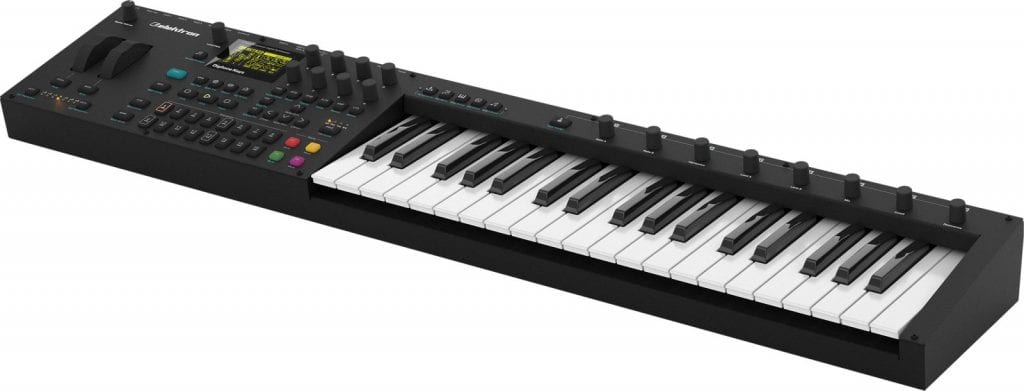
If you’re into synths and grooveboxes at all, chances are you’re familiar with Elektron’s Digitone. It’s part of it’s mid-range “Digi” line of instruments, and it’s loaded with all sorts of gorgeous FM sounds. It’s not quite as cold as the classic FM synths of yore like the DX7, but it’s still capable complex digital tones, metallic chimes and retro pads. The Digitone Keys is basically the same instrument, but with a keyboard attached.

See, probably the biggest issue with the Digitone was that it begged to be played expressively, in a way that just punching in patterns on its non-pressure sensitive buttons just couldn’t achieve. That meant you’d need to hook up a MIDI controller. Not necessarily a huge deal, but sometimes you just want a completely self-contained synth, and the Digitone Keys is that.

Under the hood is the same 8-voice FM synth, with a multi-mode filter, base width filter and overdrive channel for each voice. There’s also two assignable LFO per voice. In short, there’s tons of ways to sculpt your sound. You also still get Elekton’s famed 64-step sequencer with trig conditions and microtimings. Plus you can completely change the sound on a per-step basis. That means, even though there’s only four synth tracks in the sequencer (plus four MIDI), you can basically have as many patches as you want on a single pattern… so long as you don’t expect them to all play notes simultaneously.

The big news here though, is the addition of a three-octave, 37-key keyboard. Even better those keys aren’t just velocity sensitive, but they have aftertouch for an additional layer of expressiveness. There’s also a pair of assignable pitch and modulation wheels. And, of course, there’s full Overbridge support for integrating the Digitone Keys into your DAW seamlessly.

At $1,299 the Digitone Keys isn’t cheap, but it’s not insanely overpriced either. We already know it’s capable of making some really incredible music. It’s just a question of whether that keyboard feels as good in person as it sounds on paper. If so, the premium over the desktop Digitone ($789) doesn’t seem that absurd.


Intel will ramp up 10nm CPU production in June, 7nm in 2021

The first 10nm parts are for thin-and-light-laptops.

Intel is nearly ready to ship 10-nanometer processors in large volumes — no, for real this time. After years of delays, the semiconductor giant has announced that its 10nm mobile Ice Lake processors will start shipping in June. It’s not certain just when you’ll see the first laptops based on the new parts, but Intel is boasting that a future Core i7 quad-core chip will tout twice the graphics performance over its 8th-gen counterpart, twice the video transcoding speed and up to three times the AI brawn. You still aren’t likely to be doing heavy duty number-crunching with it, but that’s still an improvement over years of modest upgrades to Intel’s long-in-the-tooth 14nm technology.

You can expect “multiple” 10nm chips throughout 2019 and 2020, including a general-purpose GPU, server-side processors and specialized parts like the AI-oriented Nervana.

You’ll have to wait a while for the leap to 7nm. The first product based on the smaller and denser technology, an Xe-based general-purpose GPU, isn’t due until 2021. At least you can expect reasonable gains from it. Intel is expecting a roughly 20 percent boost in performance per watt, and the extreme ultraviolet lithography needed to make it should be useful for “multiple” generations of smaller processes.

In many ways, Intel is opening the floodgates. Intel’s struggle to manufacture 10nm chips has held the company back, giving rivals like AMD (not to mention companies using ARM-based chips) a chance to catch up and sometimes outrun its hardware. While their processes aren’t always comparable (AMD’s 7nm won’t be as meaningful as Intel’s), that’s not a good look for a company that once prided itself on consistently offering the fastest CPUs. Intel can finally start offering sizeable generation-to-generation improvements without having to tack on more cores, and everyday users might have better reasons to upgrade their PC after years of skipping incremental Intel revisions.

Stocks to Watch: SNC-Lavalin Group Inc. (TSX:SNC) Down -3.23%

At close of market on Tuesday, SNC-Lavalin Group Inc. (TSX:SNC) stock finished trading at -3.23%, bringing the stock price to $27.83 on the Toronto Stock Exchange. The stock price saw a low of $27.51 and a high of $28.83.

The company’s stock was traded 7,590 times with a total of 1,243,285 shares traded.

SNC-Lavalin Group Inc. has a market cap of $4.89 billion, with 175.55 million shares in issue.

Montreal-based SNC-Lavalin is a professional service and project management company, as well as an infrastructure owner. From offices in over 50 countries, SNC provides engineering and construction services, financing and asset management, consulting, procurement, and operations and maintenance management, plus sustaining capital services. It services the following industries: Oil and gas, mining and metallurgy, infrastructure, clean power, nuclear, and EDPM (engineering design and project management). SNC generated 2018 sales and E&C-related adjusted EBIT of CAD 10 billion and CAD 338 million, respectively.

Stocks to Watch: Kinross Gold Corporation (TSX:K) Down -1.46%

At close of market on Tuesday, Kinross Gold Corporation (TSX:K) stock finished trading at -1.46%, bringing the stock price to $4.06 on the Toronto Stock Exchange. The stock price saw a low of $4.06 and a high of $4.18.

The company’s stock was traded 3,747 times with a total of 3,216,235 shares traded.

Kinross Gold Corporation has a market cap of $5.08 billion, with 1.25 billion shares in issue.

Kinross Gold is a Canada-based senior gold producer, producing roughly 2.5 million gold equivalent ounces in 2018. The company had 25.5 million ounces of proven and probable gold reserves and 53.9 million ounces of silver reserves at the end of 2018. It operates mines and focuses its greenfield and brownfield exploration in the Americas, West Africa, and Russia. The company has historically used acquisitions to fuel expansion into new regions and production growth.

Stocks to Watch: Silvercorp Metals Inc. (TSX:SVM) Up +3.08%

At close of market on Tuesday, Silvercorp Metals Inc. (TSX:SVM) stock finished trading at +3.08%, bringing the stock price to $3.01 on the Toronto Stock Exchange. The stock price saw a low of $2.89 and a high of $3.04.

The company’s stock was traded 663 times with a total of 124,046 shares traded.

Silvercorp Metals Inc. has a market cap of $510.74 million, with 169.68 million shares in issue.

Silvercorp Metals Inc is a mineral mining company. It acquires, explores, develops, and mines precious and base metal mineral properties at its producing mines and exploration and development projects in China. Its segments are Mining and Administrative. Its projects include Ying Mine, HPG Mine, TLP Mine, LM Mine in the Ying Mining District, BYP Gold- Lead-Zinc Mine and the Gaocheng project.

Stocks to Watch: Calfrac Well Services Ltd. (TSX:CFW) Up +1.08%

At close of market on Tuesday, Calfrac Well Services Ltd. (TSX:CFW) stock finished trading at +1.08%, bringing the stock price to $2.80 on the Toronto Stock Exchange. The stock price saw a low of $2.70 and a high of $2.81.

The company’s stock was traded 887 times with a total of 257,086 shares traded.

Calfrac Well Services Ltd. has a market cap of $404.84 million, with 144.59 million shares in issue.

Calfrac Well Services Ltd provides specialized oilfield services, including hydraulic fracturing, coiled tubing, cementing and other well completion services to the oil and natural gas industries in Canada, the United States, Russia, Mexico and Argentina. The company Canadian segment is focused on the provision of fracturing and coiled tubing services to a group of oil and natural gas exploration and production companies. The company United States segment provides fracturing services to oil companies operating in the Bakken oil shale play in North Dakota. The company Russian segment provides fracturing and coiled tubing services in Western Siberia. The Latin America segment provides pressure pumping services from its operating bases in Argentina.