Archives for May 3, 2019

TSX down, U.S. stocks fall

Falling commodity prices weighed on the energy and materials sectors on the Toronto Stock Exchange as Canada’s main stock index fell in late-morning trading.

The S&P/TSX composite index was down 87.21 points at 16,415.54.

In New York, the Dow Jones industrial average was down 132.28 points at 26,297.86. The S&P 500 index was down 9.69 points at 2,914.04, while the Nasdaq composite was down 14.71 points at 8,034.93.

The Canadian dollar traded for 74.27 cents US compared with an average of 74.54 cents US on Wednesday.

The June crude contract was down US$2.29 at US$61.31 per barrel and the June natural gas contract was down 4.7 cents at US$2.57 per mmBTU.

The June gold contract was down US$13.90 at US$1,270.30 an ounce and the July copper contract was down 2.05 cents at US$2.78 a pound.
Oil politics hurts business

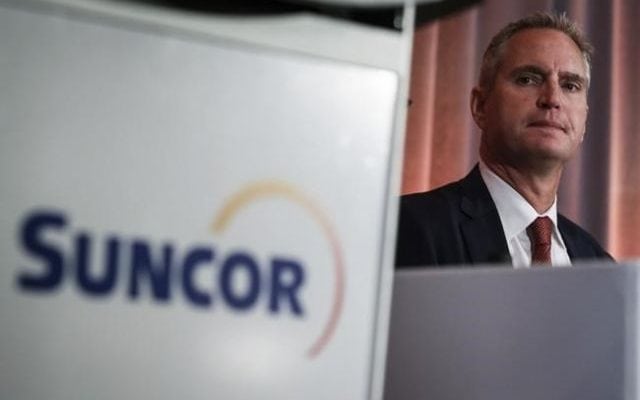
Suncor president and CEO Mark Little prepares to address the company’s annual meeting in Calgary, Thursday, May 2, 2019.

The new CEO of Suncor Energy Inc. says he doesn’t want the Alberta government to carry through on its threat to cut off shipments of oil and refined products to B.C. if its western neighbour continues to interfere with pipeline growth.

Following the company’s annual meeting in Calgary on Thursday, Mark Little said any such action resulting from the proclamation of Bill 12 by the new United Conservative government this week would create a barrier between Suncor’s refinery assets in the Edmonton area and its customers in British Columbia.

He said Suncor is using the Trans Mountain pipeline to the West Coast now to bring gasoline and diesel to the B.C. market and it supports pipeline expansion so that it can grow that market.

“We’re hoping that through the government’s negotiations this can get sorted out, because the last thing we want to do is have an impediment in serving our customers,” he said.

He added he views the Alberta bill as “a fairly significant intervention into a market to try to resolve a dispute.”

Earlier in the day, Little told analysts on a conference call that Suncor remains opposed to another Alberta market intervention, its oil production curtailments, in spite of their “slightly positive” impact on first-quarter financial results.

The results show the value of Suncor’s integrated business model and extensive pipeline contracts at a time of turmoil in the industry, he said.

“In the fourth quarter of 2018, there were low benchmark prices with wide heavy and light crude oil differentials. Whereas, in the first quarter of 2019, there were higher benchmark prices and narrow differentials,” Little said.

“Both quarters, we were able to generate significant funds from operations.”

Little officially took over as chief executive from Steve Williams at the annual meeting in downtown Calgary. Williams was given a standing ovation by shareholders after a speech about the company’s accomplishments during his seven years as CEO.

Alberta’s decision to impose quotas on its biggest oil producers was designed to free up pipeline space and draw down crude storage after price discounts on western Canadian oil spiked last autumn.

The move is supported by oilsands producers like Cenovus Energy Inc., whose CEO pointed out last week the resulting higher prices have helped boost royalties to Alberta’s treasury.

But it’s opposed by rivals such as Imperial Oil Ltd. and Husky Energy Inc. who note that crude-by-rail exports plunged to 131,000 barrels per day in February from an all-time high of 354,000 bpd in December — which means oil export capacity was actually reduced.

Both points are accurate, said Little, but he added the confusion means Suncor and others are reluctant to spend money on new projects.

The UCP government has supported curtailments brought in by the NDP and favours gradually reducing the cuts over the coming year.

Suncor said its quota strategy involved maximizing highly profitable upgraded synthetic crude oil volumes, while throttling back lower-margin mined raw bitumen, a move that has temporarily increased its operating costs per barrel.

The company said average realized bitumen prices jumped to $62.92 per barrel at Fort Hills in the first quarter, up from $30.57 in the fourth quarter of 2018, as oil price discounts eased.

Its shares were down 1.4 per cent by 2:30 local time on the Toronto Stock Exchange on Thursday despite good marks given by financial analysts on its results released late Wednesday.

The Calgary-based oilsands producer and refining giant reported net income for the first three months of the year that beat analyst expectations thanks to higher oil prices, record downstream results, growing oilsands production and a $264-million after-tax insurance gain on its assets in Libya.

Net earnings were $1.47 billion or 93 cents per share in the quarter, up from $789 million or 48 cents in the same period of 2018.

Its operating profit came to $1.2 billion, compared with $985 million in the first quarter of 2018.

It had total oilsands production of 657,000 barrels per day in the first quarter, compared with 572,000 bpd a year earlier, thanks to gains at the expanded Fort Hills oilsands mine and higher contributions from the Syncrude mine and upgrader, in which it has a 58.7 per cent stake.

The company says refining and marketing delivered record operating earnings of $1 billion, up from $789 million in the first quarter of 2018.

Suncor said production from its East Coast offshore Hebron project increased to 18,300 bpd (net to Suncor) and is continuing to grow following the completion of a fifth production well in the first quarter.

It said first oil was achieved ahead of schedule in the quarter at the Oda project offshore Norway, in which it has a 30 per cent stake.

Oregon LNG faces delay

A Calgary company proposing to build a US$10-billion LNG export facility in Oregon says the project timeline is being delayed by about a year.

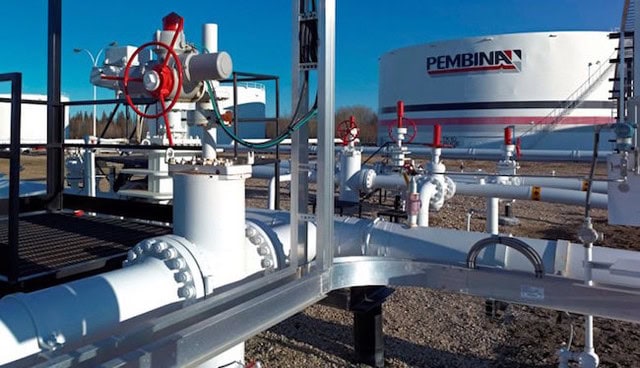
Pembina Pipeline Corp. says it has decided to minimize project spending at about $50 million this year as it tries to vault remaining regulatory and permitting hurdles for the Jordan Cove liquefied natural gas project at Coos Bay, Ore., and a related 370-kilometre pipeline.

The reduced level of work is expected to result in construction delays such that first gas exports are now expected one year later than the targeted date in 2024.

Pembina, which inherited the project when it purchased Veresen Inc. in 2017, said it received a draft environmental impact statement from the U.S. Federal Energy Regulatory Commission in March that provided a framework for approval of the Jordan Cove project as proposed with “reasonable” conditions.

However, a final FERC decision is not expected until next January and critical Oregon state permits aren’t expected until near the end of this year.

A previous smaller version of the project was denied by FERC in 2016 due to landowner objections and what it said was a failure to demonstrate demand for its product.

Pembina says it still intends to bring in partners for the pipeline and liquefaction facility to reduce its ownership to between 40 and 60 per cent.

It said it has non-binding off-take agreements with customers in excess of the planned design capacity of 7.5 million tonnes per year but will pause executing binding deals until early 2020.

Rogers Media buys Vancouver podcast production company Pacific Content

“Podcasting is a big part of the future of audio,” a spokesperson from Rogers said in a statement announcing the acquisition.

Pacific Content currently employs 22 people and is based in Vancouver

Rogers Media is adding to its podcasting business through the acquisition of Pacific Content, an independent production and marketing company formed five years ago by a number of former employees of the CBC.

Pacific Content, which currently employs 22 people based in Vancouver, works with companies and advertisers to attract audiences using audio storytelling techniques.

One of its more recent clients is Facebook, which commissioned Pacific Content to create the “3.5 Degrees” podcast about business leaders and entrepreneurs.

Facebook’s series was released Jan. 13 through the Apple, Google, Stitcher and Spotify podcast platforms.

Rogers didn’t disclose how much it’s paying for Pacific Content but did say it will complement the Frequency Podcast Network that it launched last year.

“They wanted to make a show for a business audience,” Pacific Content co-founder Steve Pratt said in an interview.

“One of the episodes has (somebody with) a very small, local hamburger business getting to meet the CEO of McDonald’s and finding they have a lot in common, and can learn from each other about how their businesses work.”

This type of commissioned content aims to build a sponsor’s brand by attracting an audience, Pratt said.

“It has to be a really, really great show that truly is original and not a piece of marketing,” he added.

“We bring a lot of expertise in terms of trying to translate brand strategy into audio shows that are great listens.”

‘A big part of the future of audio’

Rogers didn’t disclose how much it’s paying for Pacific Content but did say it will complement the Frequency Podcast Network that it launched last year.

“Podcasting is a big part of the future of audio. We quickly identified its immense potential and are being aggressive in this space,” Julie Adam, Rogers Radio senior vice-president, said in a statement.

Pratt said almost all of Pacific Content’s employees will remain, although one co-founder will leave to open a restaurant.

Asked about Pacific Content’s pay scales, Pratt said wouldn’t disclose amounts but said they were “better than average.”

“Our team is the most important thing we have in the whole company and our culture is a huge part of the reason that the company works. And we want to make sure that everybody is feeling very well compensated for the work they do.”

However, he said, Rogers will also help Pacific Content with its strong sales organization.

“Right now, most of our clients are in the States, so being able to work with Rogers to make this happen for Canadian brands is something we’re really excited about.”

Rogers Communications Inc. owns one of Canada’s largest media businesses, which includes 56 radio stations, 29 local TV stations, the Sportsnet specialty TV channels and the Toronto Blue Jays major league baseball team.