
Archives for April 29, 2019

Stocks to Watch: Eyes on Infosys Limited (INFY), Quorum Health Corporation (QHC)

The price of Infosys Limited (NYSE:INFY) went up by $0.13 now trading at $10.65. Their shares witnessed a 24.27% increase from the 52-week low price of $8.57 they recorded on 2018-05-08. Even though it is still -6.85% behind the $11.38 high touched on 2019-04-08. The last few days have been good for the stock, as its price has grew by 2.5% during the week. It has also performed better over the past three months, as it added around 0.95% while it has so far climbed around 24.44% during the course of a year. The stock of INFY recorded 12.48% uptrend from the beginning of this year till date. The 12-month potential price target for Infosys Limited is set at $10.74. This target means that the stock has an upside potential to increase by 0.85% from the current trading price.

51 institutions entered new Infosys Limited (NYSE:INFY) positions, 181 added to their existing positions in these shares, 181 lowered their positions, and 35 exited their positions entirely.

Infosys Limited (INFY) trade volume has decreased by -43.31% as around 5,084,674 shares were sold when compared with its 50-day average volume of traded shares which is 8,968,474. At the moment, INFY is witnessing a downtrend, as it is trading -1.64% below its 20-day SMA, -1.03% below its 50-day SMA, and 5.11% below its 200-day SMA. The company runs an ROE of roughly 24.1%, with financial analysts predicting that their earnings per share growth will be around 8% per annum for the next five year. This will be compared to the 147.2% increase witnessed over the past five years.

The first technical resistance point for Infosys Limited (NYSE:INFY) will likely come at $10.7, marking a 0.47% premium to the current level. The second resistance point is at $10.75, about 0.93% premium to its current market price. On the other hand, inability to breach the immediate hurdles can drag it down to $10.51, the lower end of the range. INFY’s 14-day MACD is -0.1 and this negative figure indicates a downward trading trend. The company’s 14-day RSI (relative strength index) score is 47.42, which shows that its stock has been neutral. The 20-day historical volatility for the stock stands at 20.88 percent, which is high when compared to that of the 50-day’s 18.22 percent.

The shares of Quorum Health Corporation (NYSE:QHC) has increased by 6.1%, and now trading at $1.74 on the Wall Street in the intra-day deal, with their shares traded now around 574,600. This is a decline of -108,116 shares over the average 682,716 shares that were traded daily over the last three months. The stock that is trading at $1.74 went higher by 83.16% from its 52-week low of $0.95 that it attained back on 2019-04-09. The stock recorded a 52-week high of $7.95 nearly 354 days ago on 2018-05-10.

QHC stock has performed well over the past 30 days, as it added 16% while its price plunged by -39.79% year-to-date (YTD). Looking at the last few days, it has been good for the stock, as it rose 65.71% over the last week. The stock’s 12-month potential target price is now at $4.5. This means that the stock price might likely increase by 158.62% from its current trading price. 0 out of 2 Wall Street analysts which represents 0% rated the stock as a buy while the remaining 100% rated it as a hold, with 0% of analysts rating it as a sell.

Quorum Health Corporation (NYSE:QHC) has been utilizing an ROE that is roughly 430.1%, with stock analysts predicting that the company’s EPS for the next five years will go down by 0% per year, following the -52.4% drop that was witnessed during the past five years. The stock at the moment is on a uptrend, trading 45.42% above its 20-day SMA, -6.2% below its 50-day SMA, and -51.31% below its 200-day SMA. In percentage terms, the aggregate Quorum Health Corporation shares held by institutional investors is 97.7%. 10 institutions jumped in to acquire Quorum Health Corporation (QHC) fresh stake, 39 added to their current holdings in these shares, 56 lowered their positions, and 16 left no stake in the company.

The stock’s 9-day MACD is 0.35 and this positive figure indicates an upward trading trend. The company’s 9-day RSI score is 75.96, which shows that its stock has been overbought. The 20-day historical volatility for the shares stand at 125.98 percent, which is more when compared to that of the 50-day’s 103.93 percent. On the daily chart, we see that the stock could reach the first level of resistance at $1.82, sporting a 4.4% premium to the current level. The next resistance point is at $1.9, representing nearly 8.42% premium to the current market price of Quorum Health Corporation (QHC). On the other hand, failure to breach the immediate hurdles can drag it down to $1.48, the lower end of the range.

Stocks to Watch: Eyes on Gray Television, Inc. (GTN), New Oriental Education & Technology Group Inc. (EDU)

The price of Gray Television, Inc. (NYSE:GTN) went down by $-0.1 now trading at $22.56. Their shares witnessed a 110.84% increase from the 52-week low price of $10.7 they recorded on 2018-06-05. Even though it is still -12.19% behind the $25.31 high touched on 2019-04-11. The last few days have been rough for the stock, as its price has decreased by -3.55% during the week. It has also performed better over the past three months, as it added around 36.89% while it has so far climbed around 85.68% during the course of a year. The stock of GTN recorded 53.05% uptrend from the beginning of this year till date. The 12-month potential price target for Gray Television, Inc. is set at $26.17. This target means that the stock has an upside potential to increase by 16% from the current trading price.

64 institutions entered new Gray Television, Inc. (NYSE:GTN) positions, 121 added to their existing positions in these shares, 88 lowered their positions, and 17 exited their positions entirely.

Gray Television, Inc. (GTN) trade volume has decreased by -48.46% as around 597,990 shares were sold when compared with its 50-day average volume of traded shares which is 1,160,278. At the moment, GTN is witnessing a downtrend, as it is trading -1.82% below its 20-day SMA, 4.09% above its 50-day SMA, and 25.38% above its 200-day SMA. The company runs an ROE of roughly 19.6%, with financial analysts predicting that their earnings per share growth will be around 10% per annum for the next five year. This will be compared to the 49.7% increase witnessed over the past five years.

The first technical resistance point for Gray Television, Inc. (NYSE:GTN) will likely come at $22.87, marking a 1.36% premium to the current level. The second resistance point is at $23.18, about 2.67% premium to its current market price. On the other hand, inability to breach the immediate hurdles can drag it down to $21.94, the lower end of the range. GTN’s 14-day MACD is -0.83 and this negative figure indicates a downward trading trend. The company’s 14-day RSI (relative strength index) score is 48.89, which shows that its stock has been neutral. The 20-day historical volatility for the stock stands at 31.05 percent, which is low when compared to that of the 50-day’s 45.06 percent.
The shares of New Oriental Education & Technology Group Inc. (NYSE:EDU) has increased by 2.48%, and now trading at $94.54 on the Wall Street in the intra-day deal, with their shares traded now around 2,069,612. This is a rise of 667,610 shares over the average 1,402,002 shares that were traded daily over the last three months. The stock that is trading at $94.54 went higher by 87.95% from its 52-week low of $50.3 that it attained back on 2018-12-24. The stock recorded a 52-week high of $108.24 nearly 321 days ago on 2018-06-12.

EDU stock has performed well over the past 30 days, as it added 11.46% while its price climbed by 72.49% year-to-date (YTD). Looking at the last few days, it has been good for the stock, as it rose 5.06% over the last week. The stock’s 12-month potential target price is now at $101.7. This means that the stock price might likely increase by 7.57% from its current trading price. 28 out of 30 Wall Street analysts which represents 93.33% rated the stock as a buy while the remaining 6.67% rated it as a hold, with 0% of analysts rating it as a sell.

New Oriental Education & Technology Group Inc. (NYSE:EDU) has been utilizing an ROE that is roughly 0%, with stock analysts predicting that the company’s EPS for the next five years will go up by 24.24% per year, following the 16.8% raise that was witnessed during the past five years. The stock at the moment is on a uptrend, trading 5.19% above its 20-day SMA, 12.31% above its 50-day SMA, and 29.37% above its 200-day SMA. In percentage terms, the aggregate New Oriental Education & Technology Group Inc. shares held by institutional investors is 84.4%. 54 institutions jumped in to acquire New Oriental Education & Technology Group Inc. (EDU) fresh stake, 161 added to their current holdings in these shares, 157 lowered their positions, and 64 left no stake in the company.

The stock’s 9-day MACD is 1.3 and this positive figure indicates an upward trading trend. The company’s 9-day RSI score is 70.9, which shows that its stock has been overbought. The 20-day historical volatility for the shares stand at 23.5 percent, which is less when compared to that of the 50-day’s 29.06 percent. On the daily chart, we see that the stock could reach the first level of resistance at $96.02, sporting a 1.54% premium to the current level. The next resistance point is at $97.49, representing nearly 3.03% premium to the current market price of New Oriental Education & Technology Group Inc. (EDU). On the other hand, failure to breach the immediate hurdles can drag it down to $91.43, the lower end of the range.
Canada’s oil imports from Saudi Arabia on the rise since 2014, trade figures show

Canadian oil imports from Saudi Arabia were worth $3.5 billion last year, up more than $1 billion from 2017.

Total volume of Canadian imports from kingdom has increased by 66 per cent over past 5 years

Canada’s oil imports from Saudi Arabia have been rising steadily for the past five years, according to Statistics Canada trade data reviewed by CBC News, and a festering diplomatic spat with the kingdom appears not to have had any significant impact on Canada’s appetite for Riyadh’s crude.

The total volume of Canadian imports from Saudi Arabia has increased by 66 per cent since 2014, with imports rising every year during that period. 

Last year, Canadian companies spent $3.54 billion importing 6.4 million cubic metres of Saudi oil, up from 5.9 million cubic metres worth $2.5 billion in 2017, before the dispute started in August 2018.

In January 2019, for example, oil imports from the kingdom were 606,000 cubic metres, up from 559,000 cubic metres a year earlier. And although monthly imports gyrate significantly — a normal trend in the oil business, according to analysts — the long-term trend is unmistakable.   

“Over five years, imports from Saudi have increased,” said David Hughes, a former research manager with the Geological Survey of Canada and president of Global Sustainability Research, a consultancy in Calgary. In January 2019, Saudi oil accounted for roughly 10 per cent of Canadian consumption, up from about eight per cent in 2017, he said. 

Saudi Arabia is the second-largest source of foreign oil for Canada, after the U.S.

‘Not a diplomatic question’

Observers are divided on what rising imports from Saudi Arabia should mean for Canadian policy. 

Human rights groups say Canada should not be propping up the Saudi regime by purchasing its oil, following the recent executions of 37 people, the killing of journalist Jamal Khashoggi, a bloody war in neighbouring Yemen and a host of other abuses. 

When the diplomatic dispute between Canada and Saudi Arabia started last August, Saudi Energy Minister Khalid al-Falih said oil exports from the kingdom would not be impacted.

Energy industry officials say rising imports strengthen the case for building pipelines from Alberta to Eastern Canada, where most Saudi Arabian imports are currently sold. 

Environmental groups say more pipelines won’t actually cut dependency on Saudi Arabia as Western Canadian oil can’t be easily processed in eastern refineries, and investing in green energy is the best way to reduce dependency on autocratic, oil-rich states.

Other analysts say the imports aren’t related to politics at all, and are based simply on privately owned Canadian refiners wanting the right kind of oil at the cheapest price.

“Oil is the most freely traded commodity in the world,” said Jim Krane, an energy expert at Rice University’s Baker Institute for Public Policy in Texas. “For a Canadian refiner, it’s an economic or a chemical question, not a diplomatic question.… They aren’t buying it based on the relationship between Ottawa and Riyadh or human rights violations in Saudi Arabia.” 

Deteriorating rights situation

Saudi Arabia’s embassy in Ottawa did not respond to requests for comment.

While the war of words between Canada and Saudi Arabia has died down since last summer, the dispute continues. Canada has not apologized for calling for the immediate release of detained women’s rights activists, as Saudi Arabia has demanded. 

Ottawa hasn’t had an ambassador in the kingdom since Dennis Horak was expelled last year and the Saudis have not rescinded their pledge to stop buying Canadian grains or reinstated flights to Toronto. 

“Saudi Arabia’s human rights record … has, in many deeply troubling ways, deteriorated considerably in recent years,” said Alex Neve, secretary general of Amnesty International Canada.

“It is incumbent upon the Canadian government to ensure that business relationships do not cause or contribute to human rights violations in any country, including Saudi Arabia.”

Petroleum accounts for about 70 per cent of Saudi export earnings and half of its gross domestic product, according to the Organization of Petroleum Exporting Countries (OPEC), meaning oil exports are the lifeblood of the kingdom’s economy and its system of absolute monarchy.  

‘Additional pipeline capacity’

A spokesperson for the Canadian Association of Petroleum Producers (CAPP) said increased imports from Saudi Arabia buttress the call for more pipelines to increase market access for Western Canadian crude. 

“Right now, our pipeline network is fairly extensive but it doesn’t extend to the East Coast,” said Mark Pinney, CAPP’s manager of markets and transportation. “There are some refineries Canadian producers are not easily able to reach…. Additional pipeline capacity is the answer to a lot of things.” 

In 1980, Canadian Prime Minister Pierre Trudeau met Saudi Arabian Oil Minister Sheik Yamani, left, at a desert camp in Madein Saleh, Saudi Arabia.

While oil imports from Saudi Arabia and the U.S. have increased, total Canadian imports have been falling since 2016, he said. 

Imports are down overall because of the reversal of Enbridge’s Line 9 pipeline, allowing more crude from Alberta’s oilsands to be easily moved to refineries in Ontario and Quebec, said Pinney. 

He said the industry is “frustrated” over slow progress in building new pipelines that would allow domestic producers to compete to supply Eastern Canadian markets, potentially displacing future imports.

Between 2015 and the end of 2018, he said, total Canadian imports fell by 13 per cent.

Canada is the fourth-largest producer and fourth-largest exporter of oil in the world, according to the National Research Council, and 99 per cent of Canadian oil exports go to the U.S. It’s not uncommon for countries to be both exporters and importers of crude, analysts said. 

Energy transition

Most Saudi oil exports to Canada go to refineries in Eastern Canada, specifically the Irving refinery in Saint John, and facilities in Quebec, said David Hughes, the consultant.

That refinery is specifically geared to handling light oil from the Middle East, rather than the heavy crude from the oilsands, said Hughes. Reconfiguring it to process Alberta oil would cost around $1 billion, he estimates. 

Irving did not respond to interview requests.  

Much of the Saudi oil imported into Canada goes to the Irving oil refinery in Saint John. (Andrew Vaughan/The Canadian Press)

It’s unclear if the company would want to spend that money, even if Canada’s pipeline network was extended to the Atlantic provinces, as the now-cancelled $15-billion Energy East Pipeline aimed.  

“Irving Oil in Saint John [where the formerly proposed Energy East pipeline would go] have been clear that they would not sign binding contracts to take the oilsands oil,” said Tim Gray, executive director of the Toronto-based campaign group Environmental Defence. 

Most of the Albertan production proposed for the pipeline would have been exported, he added, urging Canadian companies to speed up the switch to renewable energy. 

“Oil imports can and will be offset by successful efforts to electrify our economy,” Gray said. “This means that electric cars, home heat pumps and industrial processes using clean electricity can cause a rapid decrease in the need for foreign oil.”

Talking trade without Trump

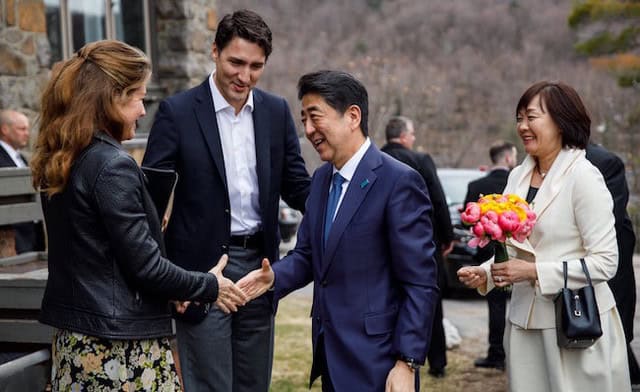
Japanese Prime Minister Shinzo Abe’s whirlwind visit to Ottawa this weekend offers the Liberal government a rare chance to trumpet a strong international alliance in the face of unyielding strain with its two top trading partners.

Canada finds itself between a rock and a hard place with the United States and China: the Trump administration is holding firm on punitive metal tariffs while the People’s Republic’s ongoing imprisonment of two Canadian men following the arrest of Huawei’s chief financial officer in Vancouver has thwarted the Trudeau government’s Asian trade ambitions.

Abe was greeted by Prime Minister Justin Trudeau on Parliament Hill on Sunday, and the two will celebrate their successful launch late last year of the rebooted Trans-Pacific Partnership — the 11-country Pacific Rim trade alliance that was rescued after President Donald Trump withdrew the U.S. from it in January 2017, nearly killing it.

The two countries are also charter members of another international club that doesn’t include the U.S.: the Alliance for Multilateralism, a French-German initiative aimed at supporting the post-Second World War architecture — the United Nations, NATO, the World Trade Organization, and other groups — to which Trump has taken a wrecking ball.

Abe is to host the G20 summit in June and will join Trudeau at the G7 leaders’ gathering in France in late August, and while Trump’s seat at those two multilateral tables is guaranteed, continuing U.S. participation is no longer a given with its mercurial president.

International Trade Minister Jim Carr, who met Abe in Japan in January and will accompany Trudeau on Sunday, said the summit is about reinforcing strong Japanese-Canadian ties that have only flourished more since the new TPP.

“The Americans chose for their own reasons not to be part of that group,” Carr said in an interview Saturday.

“Our interest is to take advantage of the ratification of this agreement in our countries, to deepen the trading relationship, which we are already doing,” he said, citing increased exports of Canadian beef, pork and heavy machinery to Japan.

Abe arrived in Ottawa on Saturday, hours after playing a round of golf with Trump at his Virginia course on a visit that demonstrated personal bonhomie but bore no fruit towards advancing a U.S.-Japan trade deal to replace the TPP that Trump abandoned.

Japan, like Canada, is also suffering under Trump’s punitive tariffs on steel and aluminum imports, and is facing the threat of more tariffs on its automobiles. Trudeau and his cabinet have branded the Trump tariffs illegal and insulting.

Carr said the Abe-Trudeau bond is also strong and that it will help “set the stage” for this summer’s round of multilateral summitry — foreign trips that will be Trudeau’s last before Parliament breaks in June ahead of the October election.

“We are agreed that the rules-based multilateral trading order is in the interest of all of those nations who have benefited from post-war freer trading relationships among countries. We believe that rules-based trading systems create growth and create jobs,” said Carr.

Carr will join Abe and Trudeau for a luncheon with business leaders before departing Ottawa.

WestJet suspends routes

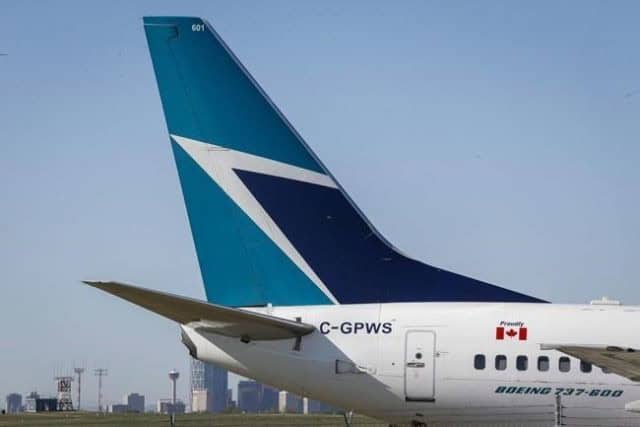
WestJet Airlines Ltd. has announced cancellations and schedule changes on some of its routes as the airline deals with the continued grounding of Boeing 737 Max aircraft.

Flights between Halifax and Paris have been suspended from June 3 through Aug. 2, and WestJet says guests will be rebooked either through Calgary, non-stop on its Boeing Dreamliner jets to Paris, or with one of its partner airlines through Toronto, Montreal or New York.

Flights between Edmonton and Ottawa, and Edmonton and Montreal, have also been suspended for most of June, and WestJet says guests will be rebooked through either Calgary or Toronto on WestJet-operated flights.

Service between Toronto and Kelowna, B.C., and Vancouver and Regina will also be suspended for much of June.

Transport Canada banned the 737 Max from Canadian airspace as part of an international response to the fatal March 10 crash of an Ethiopian Airlines plane.

WestJet says in a news release that it has adjusted flight times on some routes or substituted larger aircraft with fewer flights, but that it needed to suspend a small number of routes where no alternative aircraft were available.

“Although the Max comprised over 1,000 monthly departures in our June schedules, by adjusting our aircraft lease returns and the planned installations of our premium seats, we have been able to cover more than 700 of the flight routes where the Max was originally scheduled, with other aircraft,” Chief Operating Officer Jeff Martin said Sunday in a post on the company’s website.

“I thank our WestJet teams for their dedication as they continue to work hard to get our guests to their destinations.”

Martin said WestJet remains committed to the routes and will resume flights when it can.

Transport Minister Marc Garneau closed Canadian skies to the Max 8 on March 13 over safety concerns arising from the flight path of Ethiopian Airlines Flight 302 that bore startling parallels to a fatal Lion Air crash off the coast of Indonesia on Oct. 29, killing a combined 346 people.

WestJet had 13 Max 8s in operation when the planes were pulled from service, but has said it has no plans to cancel orders for 37 more Max jetliners.

Air Canada — where 24 Max 8s make up about 10 per cent of its main 243-plane fleet — said last week that the company has “protected 96 per cent of planned flying” through measures that include consolidating flights on larger planes and extending leases on aircraft planned to exit the fleet.

Toyota Canada to announce production changes for Ontario plant

Toyota Canada plans a “significant production announcement” at its Cambridge, Ont., plant on Monday.

Monday’s announcement will ‘further re-affirm Toyota’s commitment to manufacturing in Canada’

Toyota Canada is expected to announce production of one or more new models for its Cambridge, Ont., plant on Monday.

The North Plant in the city, 100 kilometres west of Toronto, currently builds the RAV4 crossover, one of North America’s best-selling crossover vehicles.

On Friday, Toyota said it planned a “significant production announcement” on April 29 that “will serve to further re-affirm Toyota’s commitment to manufacturing in Canada.”

Bloomberg is reporting Toyota is considering production of the upmarketLexus NX crossover and the Lexus RX sport utility vehicle in Ontario.

A Toyota Canada spokesperson denied two new models were involved, but declined to be more specific about the announcement.  

Last year Toyota invested $1.4 billion in its plants in Cambridge and also in Woodstock, switching them over to what it calls its New Global Architecture, the platform that underpins many of Toyota’s future products.

That means they have the flexibility to change production models.

The Japanese automaker recently cast doubt on how long these plants would make the Rav4 after it announced it would produce the gas-electric model in Georgetown, Kentucky.

The announcement of new models would be welcome news for the Ontario auto industry, where passenger vehicle production is shrinking.

GM is winding down its operations in Oshawa and expects to close by the end of the year as part of a global restructuring plan. About 2,500 people will lose their jobs.

And Fiat Chrysler announced it will cut the third shift at its Windsor plant in September, threatening another 1,500 jobs.