
Archives for April 26, 2019

iFixit pulls its Galaxy Fold teardown at Samsung’s request

The deconstructed device came from a ‘trusted partner.’

The Galaxy Fold won’t make its planned launch date as Samsung looks into problems experienced by several reviewers with test units. In the meantime, the folks at iFixit did what they do best and pulled one apart, but on Thursday explained their choice to “withdraw” the teardown. While iFixit usually gets a device specifically for the purpose of pulling it apart, this one was apparently provided by a third party. Samsung then asked that “trusted partner” to have the teardown removed and iFixit — while insisting it didn’t have to — acquiesced to keep the peace.

iFixit called the device it undid “alarmingly fragile,” but also noted in today’s post that “Our team appreciated the chance to look inside this ambitious device. All new products face challenges—this one perhaps more than most.”

We still don’t know exactly what Samsung might tweak before the Galaxy Fold is rescheduled for a proper retail launch, but it’s possibly that the company doesn’t want to expose problems, or any secrets before the thing is actually on sale. Either way, the teardown is out there now, and preserved in the Internet Archive if someone really wants to what a Fold test unit has inside and, perhaps more importantly, what it might lack in protection that would allow debris inside.


AT&T’s fake 5GE icon is available in the Android Open Source Project

Whether you like it or not, we’ll start seeing the icon on more phones.

AT&T is still in hot water over its 5GE logo, but that’s not slowing the company down. This week, the not-really-5G icon showed up in the Android Open Source Project (AOSP). Meaning, whether you like it or not, 5GE could start showing up on Android smartphones using AT&T. According to XDA Developers, the AOSP code suggest that phones will only need to use 4G LTE with Carrier Aggregation to prompt the icon, so as critics have said, there’s no guarantee that the logo will be anything more than a visual change.

AT&T introduced the 5GE (5G Evolution) in January on Samsung’s Galaxy S8 Active and LG’s V30. But as true 5G networks are still being tested, 5GE really indicates 4G LTE-Advanced — a mix of 4G LTE plus technologies like 4×4 MIMO antennas, 256 QAM and carrier aggregation. AT&T’s competitors were quick to mock and dispute the icon. And a study by OpenSignal claimed the so-called 5GE network tested slower than enhanced 4G on Verizon and T-Mobile, though AT&T said the methodology was flawed.

The problem, critics charge, is that the label is misleading and will only confuse people, especially when actual 5G coverage is available. As Verizon previously wrote, “The potential to over-hype and under-deliver on the 5G promise is a temptation that the wireless industry must resist.” But this isn’t all that different from when AT&T started using the 4G label while everyone else was still on 3G. Now that the 5GE icon is available in AOSP, there’s a good chance that, as AT&T promised, we’ll begin seeing a lot more of it.

Imogen Heap’s musical gloves are finally available to everyone

Pre-orders for the Mi.Mu Gloves are open now.

Imogen Heap hums the opening bars to Breathe In before pinching her fingers, instructing a sequencer to begin playing it on a loop. She opens her palms wide and makes a fist, as if holding a drumstick, and begins thumping the song’s beat. Piece by piece, Heap constructs the song until she is ready to begin singing, without ever touching an instrument.

Mi.Mu smart gloves, which she dreamt up in 2010, made this possible. Eight years of R&D later, and the gloves are ready for everyone to buy. “I always longed for more expressive control of the tech in the studio and on stage,” said the Grammy winner, back in 2012.

Inspired by MIT’s Elly Jessop, and Max Matthews before that, Heap’s gloves enable electronic musicians to step out from behind their banks of gear to actually perform to their audience.

The first pair of Mi.Mu gloves were created by Heap alongside researchers at the University of the West of England in Bristol. The idea was to use them as part of a live show for Earth Day, with an initial setup that included gloves, a backpack and bolero to house all the tech. Refinements to the system shrunk the technology to just the gloves, which Heap has used in shows ever since. And Heap has been a prominent ambassador for her new concept, showing them off at various music, technology and arts conferences.

Around 30 pairs of these prototype / first-generation gloves were made and were essentially hacked together. Because they were mostly intended as little more than custom prototypes for touring musicians, the initial models cost £5,000 (around $6,400). But they quickly found an audience. Arianna Grande used a pair during her 2015 tour.

“The first models were hand-sewn by Rachel,” said Dr. Tom Mitchell, who created the gloves with Heap. Rachel is Rachel Freire, a fashion and costume designer, making each pair in between jobs on movies like Avengers: Age of Ultron and Alien: Covenant. “It would take me about two days, solid, just to stitch the gloves,” said Freire, who also designed the gloves.

Much has changed between then and now, and while Freire still hand-makes the gloves, the process is a little faster. At an intimate launch in North London, UK, the company showed off a new edition of Mi.Mu, demonstrated through performances by Chagall van den Berg and Lula Mehbratu. Heap herself was absent, journeying to Toronto to perform at a Blockchain conference.

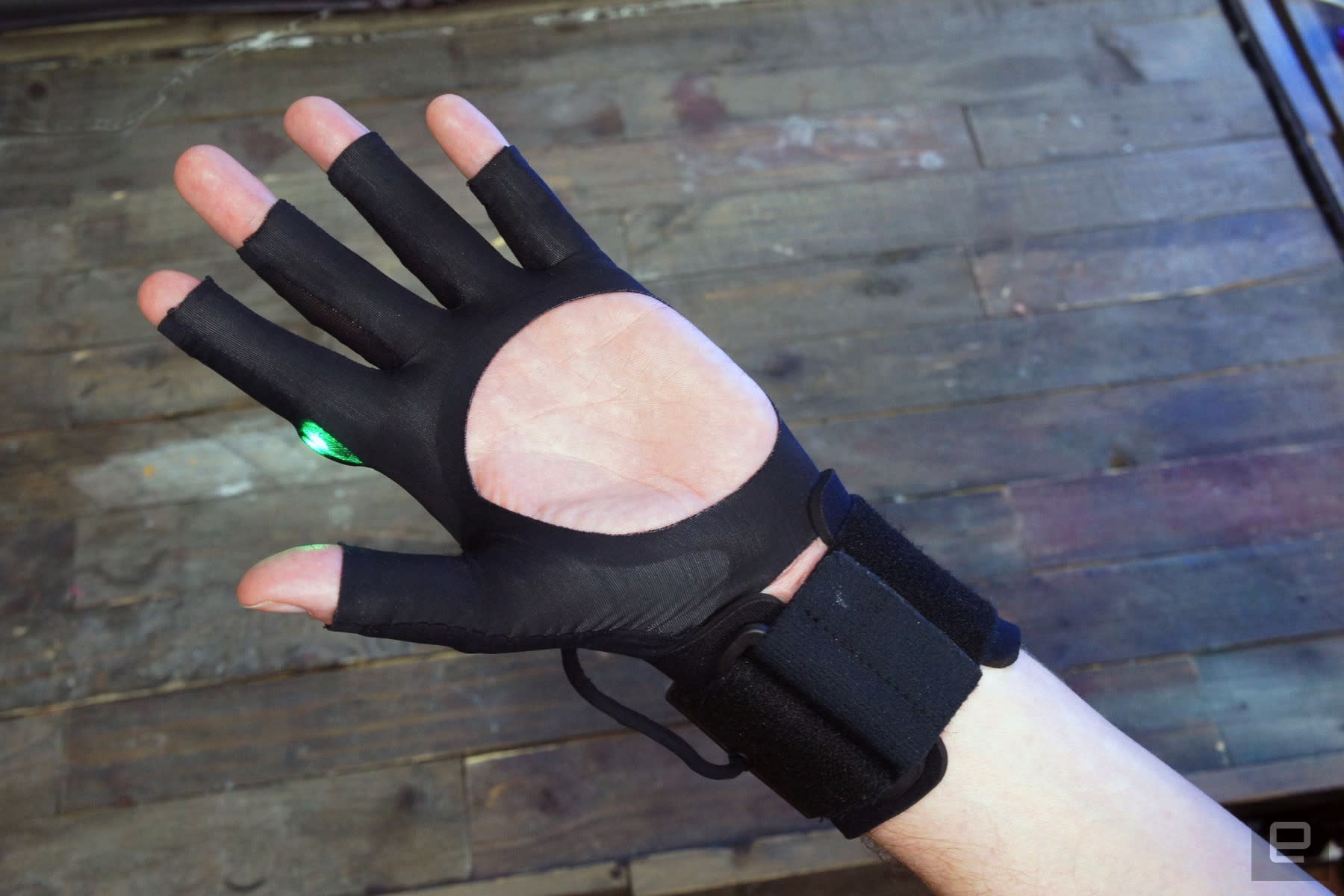
Mi.Mu Gloves

Mitchell and his team have made a number of refinements to the gloves as Mi.Mu has evolved into a genuine consumer product.

For one, the flex sensors have been redesigned for better accuracy, so it can pick up subtle pinch gestures with the fingers. That offers a greater variety of controls and enables performers to move in a more natural way. A redesigned IMU (inertial measurement unit) helps ensure the gloves always know where they are in three-dimensional space. The prior models often needed to be told which way the performer was facing to avoid errors creeping in.

Another big problem was latency, with a noticeable delay between a command and an action with the first version. This time around, the gloves use 802.11n WiFi, which has ensured that when someone does an action, the system instantly obeys the command.

Finally, the new gloves have removable batteries, chunky cells that, the company promises, will run for six hours on a charge. Artists will be able to swap in a fresh battery between a sound check and a live show, ridding them of panic over power. These batteries were originally designed for vapes, but suit Mi.Mu’s purposes perfectly.

Mi.Mu Gloves

With an eye on durability and sustainability, Friere looked for materials that were both recyclable and hard-wearing. She eventually settled on Yulex, a natural, environmentally friendly alternative to Neoprene popularised by sportswear-company Patagonia. The material, along with some tactical gluing, helps strengthen the gloves, since they have both an open palm and no fingertips.

This time around, the gloves are glued in layers rather than sewn, helping them look sleeker and feel more comfortable. It’s a practice created by Nick Turner’s Sew Systems and is more commonly found in high-end lingerie and sportswear. It’s indicative of the very broad, multidisciplinary team that Heap and Mitchell assembled to create this new type of product.

“We want people to be able to express themselves,” said Mi.Mu’s chief, Adam Stark, on the future direction of the company. The hope is that, eventually, the Mi.Mu gloves will fall in cost to be the price of an electric guitar, but it’ll take some time to get there. In the meantime, the gloves have found many uses that its creators didn’t conceive of, including use by disabled musicians. Kris Halpin has cerebral palsy, so struggles to play the guitar and piano — but has no problem using the gloves.

I tried the new Mi.Mu gloves very briefly, but the differences between them and the first version were staggering. The latency and fuzziness of the gestures seem to be all gone, replaced with a seamless setup that makes the virtual feel very real. Drumming on a virtual kit, you can pretty much pretend that you’re Phil Selway, with line after line of drums in front of you.

Both Mitchell and Freire describe the initial editions of the Mi.Mu as “bespoke tailoring” thanks to the painstaking process of assembly. That, combined with the £5,000 price and very long lead time meant that the gloves weren’t — until this point — ever actually on sale. “People would email in, asking how they could become part of this ‘exclusive club,'” said Adam Stark. With the price cut in half to £2,500 (around $3,220) and mass production on the way, the days of the exclusive club are gone.

The new Mi.Mu gloves are available to pre-order today, with deliveries expected to commence on July 1st.

Amazon may be working on a high-fidelity music streaming service

It could arrive this year for around $15 per month.

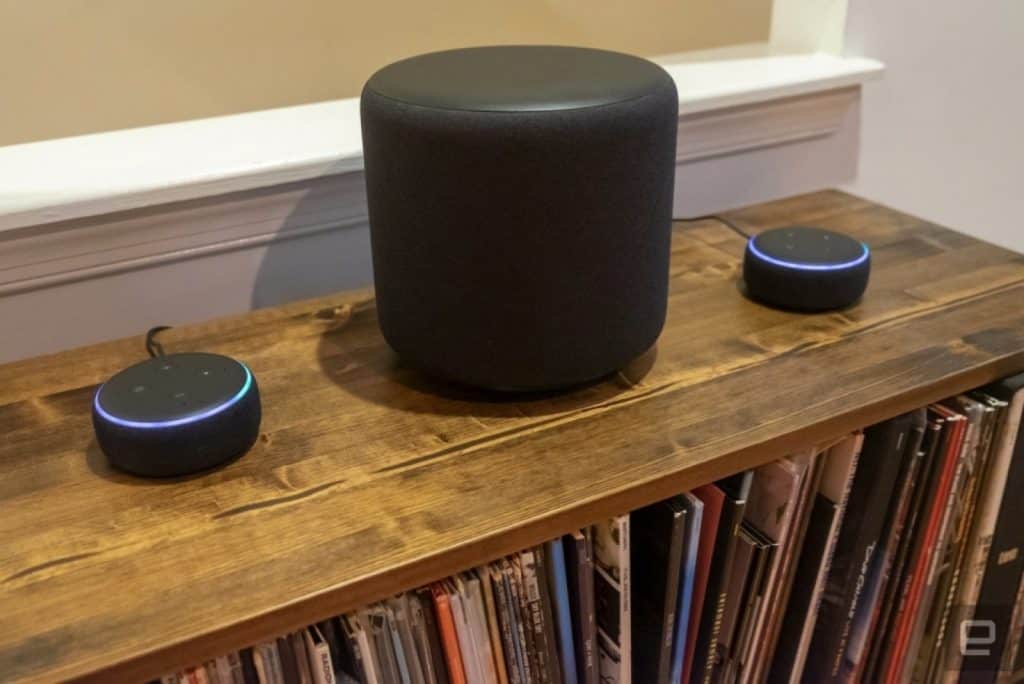
Amazon could be preparing to set itself apart from rivals like Spotify and Apple in the music space, as it’s said to be working on a high-fidelity streaming platform. It might arrive later this year for around $15/month. Amazon Music Unlimited starts at $4/month, while Amazon added a free, ad-supported music service to Alexa devices last week.

The rumored upcoming platform will reportedly offer “better than CD quality” music. So far, at least one major record company has signed up to license its recordings, according to Music Business Worldwide, while Amazon is supposedly in talks with other significant rights holders. If the platform comes to light, it could help Amazon differentiate itself further from Spotify and Apple Music, neither of which have high-fidelity options.

At the $15/month price level, the platform would undercut the likes of Tidal and Deezer, both of which offer high-fidelity tiers for $20/month. Amazon could eat into both of their user numbers significantly if it bundles its subscription with its other services, or, for instance, offers Prime members a discount.

However, a higher bit rate means more data, and many users will need to be conscious of how much their data allowance music streaming is gobbling up. As such, they might be happy to stick with the current offerings on the market.

Stocks to Watch: Colgate-Palmolive Company (CL) and Nightstar Therapeutics PLC (NITE) on the Marquee

The price of Colgate-Palmolive Company (NYSE:CL) went down by $-0.17 now trading at $68.69. Their shares witnessed a 19.65% increase from the 52-week low price of $57.41 they recorded on 2018-10-29. Even though it is still -1.99% behind the $70.06 high touched on 2019-04-22. The last few days have been good for the stock, as its price has grew by 0.01% during the week. It has also performed better over the past three months, as it added around 10.43% while it has so far climbed around 3.09% during the course of a year. The stock of CL recorded 15.41% uptrend from the beginning of this year till date. The 12-month potential price target for Colgate-Palmolive Company is set at $64.98. This target means that the stock has an upside potential to increase by -5.4% from the current trading price.

139 institutions entered new Colgate-Palmolive Company (NYSE:CL) positions, 545 added to their existing positions in these shares, 716 lowered their positions, and 81 exited their positions entirely.

Colgate-Palmolive Company (CL) trade volume has decreased by -6.51% as around 3,096,244 shares were sold when compared with its 50-day average volume of traded shares which is 3,311,792. At the moment, CL is witnessing a uptrend, as it is trading 0.48% above its 20-day SMA, 2.51% above its 50-day SMA, and 5.83% above its 200-day SMA. The company runs an ROE of roughly -736.2%, with financial analysts predicting that their earnings per share growth will be around 3.35% per annum for the next five year. This will be compared to the 3.6% increase witnessed over the past five years.

The first technical resistance point for Colgate-Palmolive Company (NYSE:CL) will likely come at $69.09, marking a 0.58% premium to the current level. The second resistance point is at $69.5, about 1.17% premium to its current market price. On the other hand, inability to breach the immediate hurdles can drag it down to $67.64, the lower end of the range. CL’s 14-day MACD is 0.21 and this positive figure indicates an upward trading trend. The company’s 14-day RSI (relative strength index) score is 57.89, which shows that its stock has been neutral. The 20-day historical volatility for the stock stands at 9.78 percent, which is low when compared to that of the 50-day’s 10.72 percent.

The shares of Nightstar Therapeutics plc (NASDAQ:NITE) has increased by 0.23%, and now trading at $25.6 on the Wall Street in the intra-day deal, with their shares traded now around 586,830. This is a rise of 47,044 shares over the average 539,786 shares that were traded daily over the last three months. The stock that is trading at $25.6 went higher by 166.94% from its 52-week low of $9.59 that it attained back on 2018-10-30. The stock recorded a 52-week high of $29.55 nearly 218 days ago on 2018-09-20.

NITE stock has performed well over the past 30 days, as it added 1.27% while its price climbed by 122.22% year-to-date (YTD). Looking at the last few days, it has been good for the stock, as it rose 0.39% over the last week. The stock’s 12-month potential target price is now at $26.06. This means that the stock price might likely increase by 1.8% from its current trading price. 1 out of 9 Wall Street analysts which represents 11.11% rated the stock as a buy while the remaining 88.89% rated it as a hold, with 0% of analysts rating it as a sell.

Nightstar Therapeutics plc (NASDAQ:NITE) has been utilizing an ROE that is roughly -29.9%, with stock analysts predicting that the company’s EPS for the next five years will go down by 0% per year, following the 0% drop that was witnessed during the past five years. The stock at the moment is on a uptrend, trading 0.75% above its 20-day SMA, 13% above its 50-day SMA, and 43.65% above its 200-day SMA. In percentage terms, the aggregate Nightstar Therapeutics plc shares held by institutional investors is 43.8%. 9 institutions jumped in to acquire Nightstar Therapeutics plc (NITE) fresh stake, 14 added to their current holdings in these shares, 27 lowered their positions, and 14 left no stake in the company.

The stock’s 9-day MACD is 0.04 and this positive figure indicates an upward trading trend. The company’s 9-day RSI score is 82.53, which shows that its stock has been overbought. The 20-day historical volatility for the shares stand at 2.22 percent, which is less when compared to that of the 50-day’s 119.83 percent. On the daily chart, we see that the stock could reach the first level of resistance at $25.71, sporting a 0.43% premium to the current level. The next resistance point is at $25.83, representing nearly 0.89% premium to the current market price of Nightstar Therapeutics plc (NITE). On the other hand, failure to breach the immediate hurdles can drag it down to $25.39, the lower end of the range.

Stocks to Watch: Gibson Energy Inc. (TSX:GEI) Down -4.15%

At close of market on Thursday, Gibson Energy Inc. (TSX:GEI) stock finished trading at -4.15%, bringing the stock price to $22.39 on the Toronto Stock Exchange. The stock price saw a low of $22.39 and a high of $22.97.

The company’s stock was traded 3,450 times with a total of 823,220 shares traded.

Gibson Energy Inc. has a market cap of $3.24 billion, with 144.58 million shares in issue.

Gibson Energy Inc is a midstream energy infrastructure and logistics services to customers across North America. The business activities of the group are carried out through Infrastructure, Logistics and Wholesale segments. The company derives majority of revenue through Wholesale, which involves the purchasing, selling, storing and optimization of hydrocarbon products, including crude oil, natural gas liquids, road asphalt, roofing flux, frac oils, light and heavy straight run distillates, combined vacuum gas oil, and an oil-based mud product.