
Archives for April 25, 2019

Vancouver’s rental prices are falling, listings analysis suggests

Housing experts say they are hoping to see less signs like these as more rental accommodation comes on stream, although the increase in the vacancy rate is only expected to see a modest 0.3 per cent increase by 2020.

Median price of 1-bedroom unit down 3.8% compared to 2018, according to analysis of Craigslist prices

Vancouver’s sky-high rental prices appear to have stopped increasing. Data from one analyst even suggests the price of units have dropped.

Blogger and data scientist Louie Dinh compared the prices of more than 5,700 Craigslist rental listings in March of this year with those in 2018.

He found the median price of one-bedroom units fell 3.8 per cent and two-bedrooms by 3.5 per cent, which in the three years he’s tracked Vancouver’s rental prices, he says, is “unusual.”

“You typically expect prices to go up just a little bit each year because of inflation and tenant turnover,” he said.

Dinh says when you factor in the cost of inflation, which is typically around two per cent, the drop is closer to five per cent, making it even more significant.

To him, it’s an indication the overall market is slowing. 

“Holistically, I guess it feels like things are starting to move in the right direction.”

Not a trend, yet

Dinh says he’s seen a continuous sharp upwards climb in rents since 2016.

But the downturn started September of 2018, he says, when he found the median price of a one-bedroom unit inch lower from $1,950. It is now $1,900.

However, he won’t call the slowdown a trend yet.

Neither will UBC business and real estate professor Tom Davidoff.

He agrees that rents were previously going up but says the data is still mixed as to whether rents are actually decreasing.

“What I can say with some confidence is between 2016 and 2018 rents rose sharply,” said Davidoff. “There is less evidence of rising rents since then.”

He points out the surge in new rental housing that is slowly being completed could eventually lead to more supply than demand for once.

But, it’s still not enough for him to make a prediction yet as to whether rents will decline.

Vacancy rate to rise

Eric Bond, an analyst with the Canada Mortgage and Housing Corporation, is forecasting those new units will help lift Vancouver’s historically low vacancy rate.

He says he expects the rate to rise from 1 to 1.1 per cent later this year.

By 2020, he believes it will increase to 1.3 per cent.

It will mean tenants will have more choices, but he notes prices may still remain high because new units will be replacing cheaper, older ones.

“Regardless, the market is expected to still remain tight,” said Bond.

“But it does represent a slight easing of the market compared with what we’ve seen over the past five years.”


Bank of Canada holds interest rate steady, hints low rates could stick around

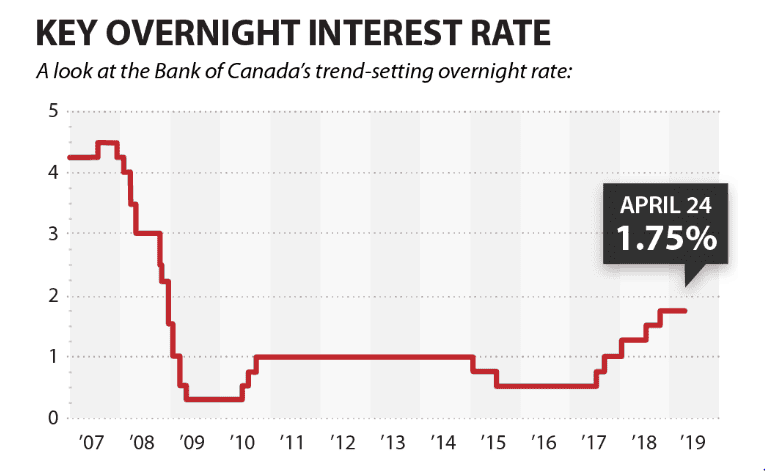
Stephen Poloz, governor of the Bank of Canada, has decided to keep the central bank’s core interest rate steady at 1.75 per cent.

Bank meets every 6 weeks to decide on interest rates

The Bank of Canada kept its benchmark interest rate at 1.75 per cent on Wednesday.

Economists who monitor the bank weren’t expecting any change to the rate, which the central bank meets to decide on every six weeks.

The bank tends to cut its rate when it wants to stimulate the economy, and hikes it when it wants to slow down an overheated one.

“Growth during the first half of 2019 is now expected to be slower than was anticipated in January,” which is why the bank is keeping its rate low, to help stimulate the economy, it said.

In January, the bank was expecting Canada’s economy to grow by 1.7 per cent this year. On Wednesday, it downgraded that lukewarm forecast to a chillier 1.2 per cent.

Bank of Canada governor Stephen Poloz did add, however, that the bank expects the latter half of the year to be better than the first.

“Right now, we believe that this setting of interest rates will give us the outlook that … growth picks up in the second quarter, and picks up for real in the third quarter for the second half of the year,” he said.

Nonetheless, an economy that’s on track to grow by less than the current inflation rate is a recipe for low rates, which is why “an accommodative policy interest rate continues to be warranted,” the bank said.

The central bank’s rate impacts Canadians by influencing the rates that retail banks give to savers and borrowers on products like mortgages and savings accounts.

“Anyone with a variable rate mortgage should be pleased with this announcement because it diminishes the timing and likelihood of any increase to the prime rate,” said James Laird, co-founder of Ratehub Inc. and president of mortgage brokerage CanWise Financial.

“This announcement also provides some pressure relief to those considering entering the housing market, as they should expect fixed rates to remain stable through the spring and summer homebuying season,” Laird added.

The latest figures from the Canadian Real Estate Association suggest average prices for homes are now falling across the country, on an annual basis, after years of outsized gains.

The bleak outlook caused the value of the Canadian dollar to drop to a three-month low of just under 74 cents US, before recovering somewhat on Poloz’s comments.

“The bank’s pivot away from its hiking bias was sharper than expected today, leaving the Canadian dollar trading weaker and yields lower on the day,” CIBC economist Royce Mendes said.

Trading in investments known as overnight index swaps imply there’s now zero chance of a rate hike this year. Traders think there’s about a 10 per cent chance of a cut as early as next month, and by September those odds jump to more than one in three.

Economist Stephen Brown with Capital Economics said “although the bank’s tone might therefore become more positive at the next couple of meetings if the data come in better than officials expect, we still think the bank’s next move will be to cut interest rates, in the second half of the year.”

Andrew Kelvin, senior rates strategist at TD Bank, said he also thinks the bank is done with rate hikes. “This just sounds like a central bank that is coming to grips with the fact that 1.75 per cent will be the top of this policy cycle,” he said.

Microsoft’s cloud growth pleases Wall Street

In this March 21, 2019, file photo a robot called “Pepper” is positioned near an entrance to a Microsoft Store location, in Boston. Microsoft Corp. reported strong 3rd quarter earnings Wednesday.

Push to get automakers, retailers and others onto its cloud platform powered strong 3rd quarter earnings

Microsoft’s ongoing push to get automakers, retailers and other businesses onto its cloud computing platform helped power the company’s third-quarter earnings ahead of Wall Street expectations Wednesday.

The software maker posted fiscal third-quarter earnings of $8.8 billion US, up 19 per cent from the same period last year. The Redmond, Washington-based company said it had profit of $1.14 per share, beating the $1 per share anticipated by analysts.

Microsoft also topped forecasts with $30.6 billion in reported revenue, a year-over-year increase of 14 per cent. Eleven analysts surveyed by Zacks had expected $29.8 billion.

Amid a decline in its legacy Windows software business, much of Microsoft’s growth in recent years has come from selling its cloud services to other businesses and governments.

Microsoft Chief Financial Officer Amy Hood said in a statement Wednesday that revenue from the company’s “commercial cloud” segment grew 41 per cent year-over-year to $9.6 billion.

ExxonMobil announced in February a deal to tap into Microsoft’s cloud platform and artificial intelligence to capitalize on the shale oil boom in Texas and New Mexico.

Vying for military contract and gamer dollars

Microsoft is battling Amazon for a multi-billion dollar contract to supply the U.S. military with cloud computing services. The Pentagon could award the contract as early as this summer. Microsoft has already won a smaller $480 million contract to build HoloLens augmented reality headsets for soldiers.

In the gaming sector, Microsoft said Wednesday that revenue from its Xbox division grew 5 per cent, with 12 per cent growth in software and services offsetting a decline in hardware sales. The company is preparing to launch its first diskless console next month as it braces for increasing competition from new forms of gaming, such as a Google’s console-free game streaming service due out later this year.

Microsoft shares have risen 23 per cent since the beginning of the year, while the Standard & Poor’s 500 index has risen 17 per cent. In the final minutes of trading on Wednesday, shares hit $125.07, an increase of 34 per cent in the last 12 months.

Microsoft said Wednesday it returned $7.4 billion in the quarter to shareholders in the form of share repurchases and dividends.

Canfor cuts production

Canfor Corp. has announced another temporary cutback in production due to low lumber prices and the high cost of wood supplies.

The company says that starting April 29 it will reduce production output by approximately 100 million board feet spread across its B.C. mills.

In January, Canfor announced temporary cutbacks at three sawmills because of similar concerns, cutting out about 40 million board feet.

The company announced further curtailments last fall as lumber prices declined while wood fibre costs rose.

The B.C. forestry industry has struggled with a loss of supply because of forest fires and insect infestations, while U.S. lumber prices have fallen back from record highs reached last summer.

Canfor has 13 sawmills in Canada, with total annual capacity of approximately 3.8 billion board feet.