
Archives for April 24, 2019

Stocks to Watch: Wake-up call for GrubHub Inc. (GRUB), Enlink Midstream, LLC (ENLC)

The price of Grubhub Inc. (NYSE:GRUB) went up by $2.02 now trading at $67.96. Their shares witnessed a 7.34% increase from the 52-week low price of $63.31 they recorded on 2019-04-18. Even though it is still -119.76% behind the $149.35 high touched on 2018-09-14. The last few days have been good for the stock, as its price has grew by 4.03% during the week. It has also performed poorly over the past three months, as it lost around -8.85% while it has so far retreated around -33.16% during the course of a year. The stock of GRUB recorded -11.52% downtrend from the beginning of this year till date. The 12-month potential price target for Grubhub Inc. is set at $101.24. This target means that the stock has an upside potential to increase by 48.97% from the current trading price.

71 institutions entered new Grubhub Inc. (NYSE:GRUB) positions, 180 added to their existing positions in these shares, 245 lowered their positions, and 135 exited their positions entirely.

Grubhub Inc. (GRUB) trade volume has increased by 11.34% as around 2,629,493 shares were sold when compared with its 50-day average volume of traded shares which is 2,361,676. At the moment, GRUB is witnessing a downtrend, as it is trading -0.48% below its 20-day SMA, -8.26% below its 50-day SMA, and -30.57% below its 200-day SMA. The company runs an ROE of roughly 5.8%, with financial analysts predicting that their earnings per share growth will be around 24.74% per annum for the next five year. This will be compared to the 63.7% increase witnessed over the past five years.

The first technical resistance point for Grubhub Inc. (NYSE:GRUB) will likely come at $69.61, marking a 2.37% premium to the current level. The second resistance point is at $71.25, about 4.62% premium to its current market price. On the other hand, inability to breach the immediate hurdles can drag it down to $64.41, the lower end of the range. GRUB’s 14-day MACD is -2.22 and this negative figure indicates a downward trading trend. The company’s 14-day RSI (relative strength index) score is 45.67, which shows that its stock has been neutral. The 20-day historical volatility for the stock stands at 34.23 percent, which is low when compared to that of the 50-day’s 45.75 percent.

The shares of EnLink Midstream, LLC (NYSE:ENLC) has decreased by -1.44%, and now trading at $12.36 on the Wall Street in the intra-day deal, with their shares traded now around 2,861,351. This is a rise of 282,465 shares over the average 2,578,886 shares that were traded daily over the last three months. The stock that is trading at $12.36 went higher by 38.88% from its 52-week low of $8.9 that it attained back on 2018-12-26. The stock recorded a 52-week high of $18.4 nearly 324 days ago on 2018-06-04.

ENLC stock has performed well over the past 30 days, as it added 2.74% while its price climbed by 30.24% year-to-date (YTD). Looking at the last few days, it has been tough for the stock, as it tumbled -1.28% over the last week. The stock’s 12-month potential target price is now at $14.3. This means that the stock price might likely increase by 15.7% from its current trading price. 6 out of 15 Wall Street analysts which represents 40% rated the stock as a buy while the remaining 53.33% rated it as a hold, with 6.67% of analysts rating it as a sell.

EnLink Midstream, LLC (NYSE:ENLC) has been utilizing an ROE that is roughly -0.7%, with stock analysts predicting that the company’s EPS for the next five years will go up by 70.1% per year, following the -16% drop that was witnessed during the past five years. The stock at the moment is on a downtrend, trading -1.13% below its 20-day SMA, 4.54% above its 50-day SMA, and -8.66% below its 200-day SMA. In percentage terms, the aggregate EnLink Midstream, LLC shares held by institutional investors is 61.2%. 40 institutions jumped in to acquire EnLink Midstream, LLC (ENLC) fresh stake, 108 added to their current holdings in these shares, 126 lowered their positions, and 47 left no stake in the company.

The stock’s 9-day MACD is -0.08 and this negative figure indicates a downward trading trend. The company’s 9-day RSI score is 49.1, which shows that its stock has been neutral. The 20-day historical volatility for the shares stand at 26.12 percent, which is more when compared to that of the 50-day’s 23.43 percent. On the daily chart, we see that the stock could reach the first level of resistance at $12.61, sporting a 1.98% premium to the current level. The next resistance point is at $12.86, representing nearly 3.89% premium to the current market price of EnLink Midstream, LLC (ENLC). On the other hand, failure to breach the immediate hurdles can drag it down to $12.11, the lower end of the range.
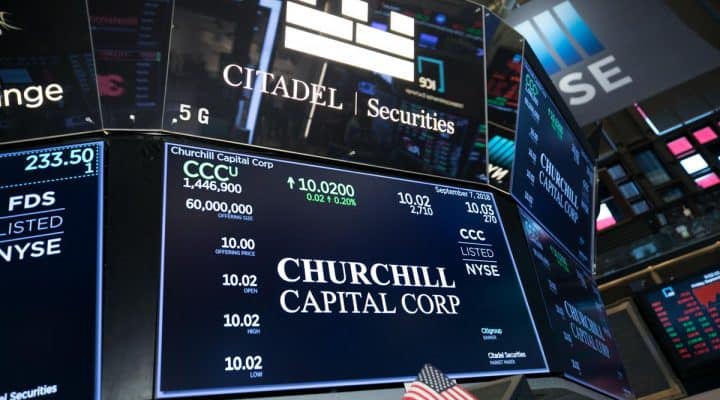

Stocks to Watch: Churchill Capital Corp (CCC) and Formula One Group (FWONK) in the spotlight

The price of Churchill Capital Corp (NYSE:CCC) went up by $0.01 now trading at $13.94. The last few days have been good for the stock, as its price has grew by 1.75% during the week. It has also performed better over the past three months, as it added around 33.52% while it has so far retreated around 0% during the course of a year. The stock of CCC recorded 45.97% uptrend from the beginning of this year till date. The 12-month potential price target for Churchill Capital Corp is set at $16.5. This target means that the stock has an upside potential to increase by 18.36% from the current trading price.

27 institutions entered new Churchill Capital Corp (NYSE:CCC) positions, 27 added to their existing positions in these shares, 0 lowered their positions, and 0 exited their positions entirely.

Churchill Capital Corp (CCC) trade volume has decreased by -42.98% as around 421,034 shares were sold when compared with its 50-day average volume of traded shares which is 738,430. At the moment, CCC is witnessing a uptrend, as it is trading 2.88% above its 20-day SMA, 13.06% above its 50-day SMA, and 27.44% above its 200-day SMA. The company runs an ROE of roughly 0%, with financial analysts predicting that their earnings per share growth will be around 7% per annum for the next five year. This will be compared to the -10% decrease witnessed over the past five years.

The first technical resistance point for Churchill Capital Corp (NYSE:CCC) will likely come at $14.02, marking a 0.57% premium to the current level. The second resistance point is at $14.09, about 1.06% premium to its current market price. On the other hand, inability to breach the immediate hurdles can drag it down to $13.79, the lower end of the range. CCC’s 14-day MACD is 0.25 and this positive figure indicates an upward trading trend. The company’s 14-day RSI (relative strength index) score is 78.71, which shows that its stock has been overbought. The 20-day historical volatility for the stock stands at 17.41 percent, which is low when compared to that of the 50-day’s 22.2 percent.

The shares of Formula One Group (NASDAQ:FWONK) has increased by 1.17%, and now trading at $37.94 on the Wall Street in the intra-day deal, with their shares traded now around 510,485. This is a decline of -528,849 shares over the average 1,039,334 shares that were traded daily over the last three months. The stock that is trading at $37.94 went higher by 37.91% from its 52-week low of $27.51 that it attained back on 2018-12-24. The stock recorded a 52-week high of $39.35 nearly 289 days ago on 2018-07-09.

FWONK stock has performed well over the past 30 days, as it added 11.13% while its price climbed by 23.58% year-to-date (YTD). Looking at the last few days, it has been good for the stock, as it rose 0.21% over the last week. The stock’s 12-month potential target price is now at $42. This means that the stock price might likely increase by 10.7% from its current trading price. 5 out of 7 Wall Street analysts which represents 71.43% rated the stock as a buy while the remaining 28.57% rated it as a hold, with 0% of analysts rating it as a sell.

Formula One Group (NASDAQ:FWONK) has been utilizing an ROE that is roughly 0%, with stock analysts predicting that the company’s EPS for the next five years will go down by 0% per year, following the 0% drop that was witnessed during the past five years. The stock at the moment is on a uptrend, trading 4.31% above its 20-day SMA, 10.73% above its 50-day SMA, and 11.9% above its 200-day SMA. In percentage terms, the aggregate Formula One Group shares held by institutional investors is 0%. 42 institutions jumped in to acquire Formula One Group (FWONK) fresh stake, 149 added to their current holdings in these shares, 151 lowered their positions, and 52 left no stake in the company.

The stock’s 9-day MACD is 0.08 and this positive figure indicates an upward trading trend. The company’s 9-day RSI score is 69.74, which shows that its stock has been overbought. The 20-day historical volatility for the shares stand at 14.64 percent, which is less when compared to that of the 50-day’s 30.96 percent. On the daily chart, we see that the stock could reach the first level of resistance at $38.32, sporting a 0.99% premium to the current level. The next resistance point is at $38.7, representing nearly 1.96% premium to the current market price of Formula One Group (FWONK). On the other hand, failure to breach the immediate hurdles can drag it down to $37.1, the lower end of the range.

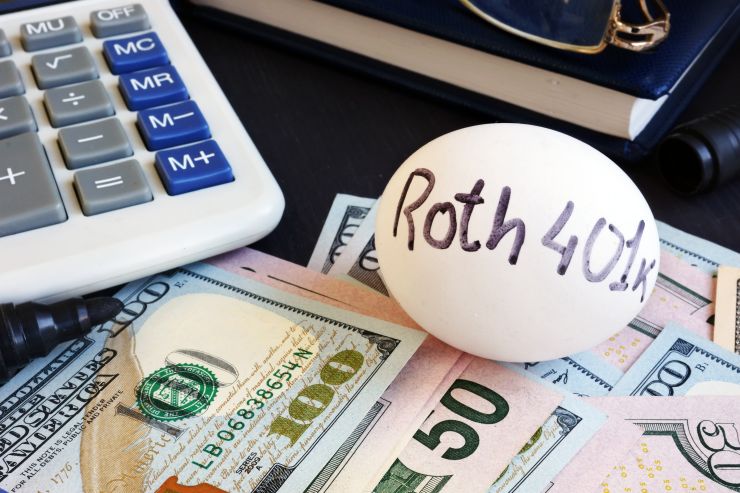
A Roth 401(k) offers tax advantages. Here’s how it works

Investors hear a lot about the importance of diversifying their retirement portfolio.

Having the right mix of small and large caps, U.S., international, bond and alternative investments is critical to your long-term success.

But what about tax diversification? This can be just as important as what kinds of stocks, bonds and mutual funds you own.

Most Americans have the bulk of their retirement savings in a 401(k) plan or similar employer-sponsored retirement account, and that’s great.

Contributions to a 401(k) plan can reduce your taxable income today. But eventually, when you take distributions from the account, you’re going to owe ordinary income taxes.

More and more employers are offering another option for your retirement savings: a Roth 401(k).

A tax-free tomorrow

When you contribute to a Roth 401(k), the contribution won’t lower your taxable income today. But when you eventually take the money out, similar to a Roth IRA, it’s completely and utterly tax-free.

A Roth 401(k) allows you to save significantly more than a Roth IRA.

You can only contribute $6,000 to a Roth IRA for the tax year 2019. If you’re age 50 or older, you can save an additional catch-up contribution of $1,000.

The 401(k) plan world is more liberal with what you can save: up to $19,000 a year to a 401(k) in 2019, and Roth 401(k) plans share that limit. If you are over age 50, you can save an additional $6,000.

How much money you earn also makes a difference.

Roth IRAs have an income cap. You can’t contribute to a Roth IRA in 2019 if you earn more than $203,000. If you earn that much, say goodbye to this kind of tax-free investing.

Unless, of course, you have a Roth 401(k).

There is no one perfect investment or retirement savings vehicle. Every investor has their own unique circumstances that have to be considered.

The biggest drawback to a Roth 401(k) is how contributions might impact your tax liabilities today.

Let’s say you earn $100,000 a year. If you save $19,000 to a traditional 401(k), your taxable income would be only $81,000. But if you make the same $19,000 contribution to a Roth 401(k), you’ll still have taxable income of $100,000.

That could take dollars out of your current spending bucket. However, for many investors, the positives outweigh the negatives.

There are no tax consequences when you take money out of a Roth 401(k) when you’re 59½ and you have met the five-year rule. If you need $20,000, take out the $20,000, and no taxes are due. If you take a similar distribution from a traditional 401(k) plan, the money you withdraw is subject to ordinary income tax.

Then there are the required minimum distributions. Roth 401(k) account owners have to take the RMD at age 70½. That’s not the case for Roth IRA owners. For that reason, it’s suggested that Roth 401(k) account owners roll their Roth 401(k) to a Roth IRA account before they turn 70½.

Whatever kind of 401(k) your employer offers, take advantage. Both the traditional and the Roth give you the opportunity to save painlessly through automatic payroll deductions, and both give you matching funds (assuming your employer offers them). Just know matching funds to a Roth 401(k) go to a traditional 401(k) account since those employer matching dollars and the earnings on them are taxable when they are distributed.

The Roth 401(k) plan is not an all-or-nothing kind of deal.

To that point, I have been splitting my contributions 50/50 since the Roth 401(k) was first available. It allows me to take advantage of the tax-free growth without giving up all the tax advantages of pre-tax savings.More than just taxes

If you’re hesitant because you don’t want to lose the tax benefit of a traditional 401(k) contribution, consider this: Your savings strategies should be about more than short-term tax reduction.

People typically look at this decision as one of paying taxes now or paying taxes later. However, it is more complicated than that for most people. What it really comes down to is a look at cash flow today versus cash flow in retirement.

Taxpayers need to separate contributions from earnings. The standard 401(k) provides a current tax break, which means the actual savings cost less. The Roth 401(k) is an after-tax contribution so it reduces your current cash flow by the taxes you have to pay on these dollars.

The thing that many people forget is that the earnings are the most important part of this analysis. If the earnings are taxable as they are in a traditional 401(k), that can be a really high cost when distributions are taken over time, years in the future, with tax rates we can’t predict today.

If you opt for the Roth 401(k), the earnings are never taxed. Not ever.

This is the best news and the biggest impact of Roth 401(k) plans. It is critical to really think about this: You may have earnings over 20 or 30 years and you will never pay taxes on these dollars.

That’s where the tax diversification comes in. Have a little bit of both kinds of accounts and you’ll have more planning possibilities when you need to withdraw money to support your retirement lifestyle.

The more options, the better.

If your employer doesn’t offer a Roth 401(k) yet, it’s time to call your benefits department to make the request. It’s not costly or complicated for the employer because they’re only amending an existing plan. And offering tax-free money to employees for retirement? That’s priceless.

American millennials have less money than other generations did at their age — but studies show an alarming amount of them have delusional ideas about their wealth

Some American millennials are pretty positive about their financial situations.

More than 50% of them think they’ll be millionaires one day, according to a 2018 TD Ameritrade survey, and more than a quarter of that group believes they’ll reach that milestone by age 40.

Other studies similarly revealed millennials’ optimistic mindset: The investment-research platform YCharts found more than half of those ages 22 to 37 thought they’d become millionaires by age 45, according to Catey Hill of MarketWatch; LendEDU found that more than half of millennials think they’ll be wealthier than their parents; and 37% of millennials said in an INSIDER and Morning Consult survey they think they’re better off financially than they thought they’d be 10 years ago.

But reality paints a different picture than the one millennials are envisioning.

Millennials are less wealthy than previous generations were at their age at any point between 1989 and 2007, according to The Economist, which cited a recent paper by the Brookings Institution. Median household wealth was roughly 25% lower for those ages 20 to 35 in 2016 than it was for the same age group in 2007.

Meanwhile, a report by the Federal Reserve published in November found that millennials have much less money than Gen Xers and baby boomers had at their age: “Millennials are less well off than members of earlier generations when they were young, with lower earnings, fewer assets, and less wealth,” the study said.

Millennials born in the 1980s are at the greatest risk of becoming a “lost generation” for wealth accumulation, according to a 2018 report by the Federal Reserve Bank of St. Louis. As of 2016, people born in this decade had wealth levels 34% below where they would most likely have been if the financial crisis hadn’t occurred, the report found.

Millennials are financially behind because of external economic circumstances

Because older millennials entered the workforce during the Great Recession, they’ve been scrambling to catch up ever since and have been the slowest cohort to recover from it.

They often weren’t able to save or accumulate the amount of wealth they anticipated — especially if they didn’t move to markets where job prospects were better or wages were enough to allow for savings, Jason Dorsey, a consultant, a researcher of millennials, and the president of the Center for Generational Kinetics, previously told Business Insider.

“Older millennials are often realizing they’re going to have to play catch-up with their finances if they want to ever be able to retire, but some of them have already decided that they likely will not ever be able to afford to retire,” he said. According to the INSIDER and Morning Consult survey, about 9% of millennials expect to never retire.

There’s also the student loan debt problem. The national total student debt is over $1.5 trillion and the average student loan debt per graduating student in 2018 who took out loans is $29,800, according to Student Loan Hero.

Along with rising costs for rent, homes, childcare, and healthcare, the increasing cost of college has made it difficult for millennials to keep up with the cost of living, let alone save, despite a 67% rise in wages since 1970, according to research by Student Loan Hero.

Consequently, more than half of millennials are relying on money from their parents to get by, according to the Country Financial Security Index. And while most millennials have savings accounts, according to the INSIDER and Morning Consult survey, more than half of them have less than $5,000 saved.

But while millennials got a slow start to building wealth, they are making an effort to catch up, which might explain their optimism.

“We are overall positive on how millennials will fare financially due to baby boomers retiring, potential inheritance, and the very low unemployment rate creating near-term job opportunities,” Dorsey previously told Business Insider.

Not a millionaire? Pay for expert financial advice the same way you pay for Netflix

Want to get your financial house in order? There’s a monthly subscription service for that.

The same payment model that you use to cover Netflix and Spotify each month has arrived to the world of financial advice.

Charles Schwab recently announced it would start charging investors in its Schwab Intelligent Portfolios Premium service a one-time $300 fee for financial planning and a $30 monthly subscription.

Participating clients have access to a certified financial planner who can give them ongoing advice. Investors can then view and update their plan online as their goals shift.

The new subscription fee replaces an advisory fee of 0.28%, which was charged against the assets clients invest in the program. Clients need to have at least $25,000 to invest in order to participate.

“Having a set premium model with an ongoing subscription is the right solution for a given client,” said Cynthia Loh, vice president of digital advice and innovation at Schwab.

“These are clients who are looking for advice, particularly in pivotal moments in their lives, including getting married or having a baby,” Loh said. “They want to speak with an expert on how to better plan for their future.”

Individual financial advisors are also offering subscription-fee planning — and you can get it without a huge nest egg.

“It works really well for younger people who don’t have assets or who are looking to manage money on their own, and they want financial planning guidance along with that,” said Eric Roberge, a CFP and founder of Beyond Your Hammock in Boston.

Attention to fees

Traditionally, financial advisors have charged investors about 1% of the assets they manage in order to pay for their services.

“If you have an assets-under-management fee model and your investments do well, your revenues go way up,” said Vanessa Oligino, director, business performance solutions at TD Ameritrade Institutional.

However, as the cost of investing has gone down — for instance, Fidelity launched its zero-fee funds last year — investors want advisors to justify their fees and provide more value than just their investment prowess.

“Advisors have to be much more articulate and deliberate in saying ‘Here are the financial planning services,’” said Dennis Gallant, senior analyst at Aite Group.

“There’s fee compression, the commoditization of asset management to some degree, boomers retiring and millennials moving up — all of this accelerates the solution toward advice,” he said.

That guidance includes budgeting, understanding employee benefits and investing in your 401(k), as well as advice amid major life changes, including marriage, having a baby and paying for college.

Monthly retainers

The amount you pay for a subscription-based relationship with an advisor could vary.

For instance, financial advisors who are part of XY Planning Network don’t require clients to have a minimum level of assets in order to work with them. They may charge a start-up fee, along with a monthly retainer fee.

“Most people at the wirehouses don’t want to help someone who is 25 years old, has $30,000 in a 401(k) and $1,000 in the bank,” said Rockie Zeigler, a CFP and founder of RP Zeigler Investment Services in Peoria, Illinois.

He charges his subscription-fee clients $500 upfront, plus a $150 monthly fee.

For that cost, clients get four to six personal conversations annually, ongoing communication with the firm, a twice-yearly review of their 401(k) plan and more.

The level of interaction you’ll get will also vary based on your circumstances and the advisor’s service offering.

“Some advisors are very hands-on and meet monthly each year because they’re doing cash-flow coaching and it takes that intensity to learn how to build those savings habits,” said Roberge.

He charges an upfront cost of $2,000, and a monthly retainer of $200 for the first year of service.

In that time, Roberge builds a plan for the client, implements it over the year, and meets with the client about six times.

“In between, you have access to me if there’s something urgent and that can’t wait,” he said.

Finding the right pro

It’ll take some footwork to find the best advisor for you, but here’s where to begin.

• Vet your professional: Dig up your advisor’s details on the Securities and Exchange Commission’s website, as well as the Financial Industry Regulatory Authority’s BrokerCheck page. These sites provide details on disciplinary actions, state licensing and years of experience.

• Ask if your advisor is a fiduciary: Confirm in writing that your financial advisor is acting in your best interest and puts your needs before his or her own.

• Find out how they’re paid: Whether you’re selecting an advisor under the AUM model or the subscription-fee model, ask about how much you’re paying and how often will you pay your professional.

• Know what you’re getting: Whether it’s a set number of meetings, infinite access via phone or email, or a written financial plan with quarterly goals, understand the service you’ll get – and get it in writing.

To Save More, Think Like an Optimist

A new study suggests that the power of positive thinking could also have a positive effect on your bank balance.

The Motley Fool reports:

A whopping 90% of optimists say they’ve saved up for a major purchase, compared to just 70% of pessimists. And 61% of optimists have started an emergency fund, while only 43% of pessimists have done the same. Optimists are also more likely to find ways to save even when money is tight, with 75% saying they’ve gotten creative when it comes to saving money, compared to 60% of pessimists who have done so.

This data comes from a recent study by Frost Bank and positive psychology researcher Michelle Gielan that indicates optimists are seven times more likely than pessimists to have “greater financial health.”

Why should this be the case? Well, optimists might be more likely to believe that they can make positive choices about their future—and this includes the choice to save for that future.

Or, as Frost Bank puts it:

Optimists aren’t perfect. They still experience financial stress (81 days a year on average), and most have only a rough financial plan (54 percent) over a detailed one (35 percent). They find simply making progress toward financial goals matters – 58 percent feel optimistic about their personal finances because they are making progress towards financial goals.

If you are more of the pessimistic type, it is possible to train your brain into thinking more positively—or at least trick it into temporary optimism. It all comes down to the way you choose to perceive the world (or the way you tell yourself you’re going to perceive the world). Do you look for dark clouds or silver linings? Do you think the worst of others, or assume the best?

Optimists, as Frost Bank reports, are more likely to view negative events or financial setbacks as learning opportunities—and then use what they’ve learned as a way to recommit to their financial goals.

What about you? Do you consider yourself an optimist, or a pessimist? Has your outlook on life affected your financial habits, and have you ever changed your outlook on life by changing your financial habits—or vice versa?