
Archives for March 31, 2019

Trump issues new permit for stalled Keystone XL pipeline

U.S. President Donald Trump is seen at his Mar-a-Lago estate in Palm Beach, Fla., on Friday.

Order intended to speed up building of crude oil line from Western Canada to U.S. Gulf Coast

Moving defiantly to kick-start the long-stalled Keystone XL oil pipeline, U.S. President Donald Trump on Friday issued a new presidential permit for the project — two years after he first approved it and more than a decade after it was first proposed.

Trump said the permit issued Friday replaces one granted in March 2017. The order is intended speed up development of the controversial pipeline, which would ship crude oil from western Canada to the U.S. Gulf Coast.

A federal judge blocked the project in November, saying the Trump administration had not fully considered potential oil spills and other impacts. U.S. District Judge Brian Morris ordered a new environmental review.

A White House spokesperson said the new permit issued by Trump “dispels any uncertainty” about the project.

“Specifically, this permit reinforces, as should have been clear all along, that the presidential permit is indeed an exercise of presidential authority that is not subject to judicial review under the Administrative Procedure Act,” the spokesperson said.

But a lawyer for environmentalists who sued to stop the project called Trump’s action illegal. The lawyer, Stephan Volker, vowed to seek a court order blocking project developer TransCanada from moving forward with construction.

“By his action today in purporting to authorize construction” of the pipeline despite court rulings blocking it, “President Trump has launched a direct assault on our system of governance,” Volker said Friday in an email.

Calgary-based TransCanada said in a statement that Trump’s order ‘clarifies the national importance of Keystone XL.’

Trump’s attempt to “overturn our system of checks and balances is nothing less than an attack on our Constitution. It must be defeated,” Volker said.

Calgary-based TransCanada said in a statement that Trump’s order “clarifies the national importance of Keystone XL and aims to bring more than 10 years of environmental review to closure.”

Trump “has been clear that he wants to create jobs and advance U.S. energy security, and the Keystone XL pipeline does both of those things,” said Russ Girling, TransCanada’s president and CEO.

Keystone XL will create thousands of jobs and deliver crude oil to U.S. refineries “in the safest, most efficient and environmentally sound way,” the company said. An appeal filed by the company is pending.

The U.S. Chamber of Commerce hailed Trump’s action, saying in a statement that “it shouldn’t take longer to approve a project than to build it.”

Keystone XL will boost U.S. economic and energy security interests, said Christopher Guith, acting president of the chamber’s Global Energy Institute. “Review after review has found it can be built and operated in an environmentally responsible way. It’s time to move forward,” Guith said.

‘Bad idea from Day 1’ 

Anthony Swift, director of the Canada project for the Natural Resources Defense Council, an environmental group, said the pipeline “was a bad idea from Day 1 and it remains a terrible idea. If built, it would threaten our land, our drinking water, and our communities from Montana and Nebraska to the Gulf Coast. And it would drive dangerous climate change.”

Trump “is once again showing his disdain for the rule of law,” Swift said, adding that the last time Trump “tried to ram this permit through he lost in court” and is likely to do so again.

The Keystone XL, first proposed in 2008 under President George W. Bush, would begin in Alberta and go to Nebraska, where it would join with an existing pipeline to shuttle more than 800,000 barrels a day of crude to terminals on the Gulf Coast.

The pipeline, first proposed in 2008, would begin in Alberta and go to Nebraska, where it would join with an existing pipeline to shuttle more than 800,000 barrels a day of crude to terminals on the Gulf Coast.

After years of delay, President Barack Obama rejected the project in 2015. Trump reversed that decision soon after taking office in 2017, saying the $8 billion US project would boost American energy and create jobs. A presidential permit is needed because the project crosses a U.S. border.

After environmental groups sued, Morris said the administration had not fully considered potential oil spills and other impacts and that further reviews were needed.

TransCanada disputes that, saying Keystone XL has been studied more than any other pipeline in history. “The environmental reviews are clear: the project can be built and operated in an environmentally sustainable and responsible way,” Girling said.
N.L. port would create jobs and open up the Arctic: CEO

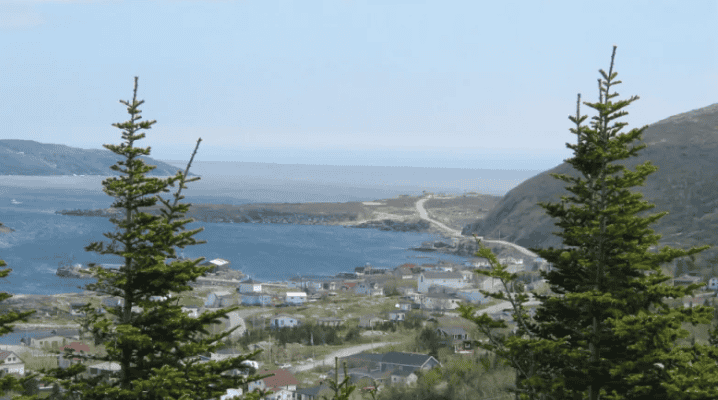
The proposed port project would be located at Crémaillère Harbour, just a few kilometres away from St. Anthony.

Great Northern Port partners with MUN to research how project would benefit the area and open up the Arctic

A company with plans to build a commercial port facility on the Northern Peninsula is moving closer to its goal.

The proposed project to develop a full-service marine port at Crémaillère Harbour, less than five kilometres from St. Anthony, would bring needed jobs and activity into a remote part of Newfoundland as shipping through the Arctic gets closer to reality, said Dan Villeneuve, president and CEO of Great Northern Port.

“The idea of the project as a whole was the fact that the Arctic is opening up,” Villeneuve said. As that continues, the Northern Peninsula could be an important gateway to the Northwest Passage, he said.

Great Northern Port is currently preparing to a resubmission of its environmental preview report, taking in account comments received from the provincial government in February, Villeneuve told CBC Newfoundland Morning on Tuesday.

And this week the company partnered with Memorial University to study the potential economic impact of a commercial port facility at the Northern Peninsula harbour, as reported by VOCM on Monday.

An opening Arctic

In the works since 2016, the Crémaillère Harbour Marine Port project, if developed, would make St. Anthony a key location for travel and shipping to and from the Arctic, Villeneuve said.

Right now, goods travelling by ship from China go through Rotterdam, the largest port in Europe, a journey of 11,000 nautical miles, Villeneuve said. 

Right now, container ships like this one travel thousands of nautical miles from China through Rotterdam, Europe’s largest port. The opening of the Arctic could shorten that journey considerably.

“As the Arctic opens up … it’s realistic to think in the very near future that there’ll be approximately 5,300 nautical miles shaved from that,” he said.

That future might not be far off — just this summer, for example, Mersk had its first container ships going through the eastern Arctic, he said.

“It’s coming, and as we all know, Newfoundland is a great location.”

The port would include an industrial cluster, Arctic marine and air operations, and a centre for ice research among other facilities and services, VOCM reported. The joint research project with MUN will be led by economist Wade Locke.

Diverse port

The selection of that particular area near St. Anthony for the project was decided in part because of its physical attributes, Villeneuve said.

It’s coming, and as we all know, Newfoundland is a great location.

– Dan Villeneuve

“We depended on an ice study to give us a location,” he said. 

“Crémaillère Harbour was the location that was selected by science.”

The port would be diversified to ensure several income streams, he said. The size of the harbour, allowing for multiple uses, was also a factor, Villeneuve said.

“The harbour itself is actually a little larger than the St. John’s harbour,” he said. 

“So it’s not a small project. It is a big project.”

Community support

The “dynamic community of St. Anthony” was another draw, he said, as were the supportive small communities on the peninsula. Villeneuve said he hopes the harbour leads to a business cluster in that area, with a manufacturing hub and different harbour services available.

Over the last couple of years, people with Great Northern Port and the project have met with members of the communities that would be near the harbour project.

Dan Villeneuve, president and CEO of Great Northern Port, says he hopes the proposed port project would lead to the development of related businesses in and around St. Anthony, on the Northern Peninsula.

“We’ve had incredible support in the communities itself, and we think that there’s a great opportunity with the port development in that area,” he said.

The project, still in its development stage, has been completely privately funded at this point, Villeneuve said. 

Great Northern Port heard back from the province on its environmental preview report in February, and Villeneuve said  the company has since met with several government departments to review the comments — a process that is not unusual for a proposed project of this size, he said.

The Department of Municipal Affairs and Environment declined a request for an interview with minister Graham Letto, but provided a statement that said Letto requested additional information on wildlife and fisheries in the project area, the placement of particular port facilities, plans for the development of a women’s employment plan, the need for road upgrades and expected traffic in the area, and whether the proposed project mirrors what is currently or potentially offered at existing ports.

The company is currently preparing a resubmission of the report comments, which they expect to bring back to the provincial government in early April. The public will have 35 days to submit comments once Great Northern Port has submitted its revisions, the department said, and the minister’s decision will come within 10 days of the close of the public comment period.

How the Ottawa-Gatineau bridge closures will affect your commute

The busy Alexandra Bridge boardwalk is due for some rehabilitation work and will close from the summer of 2021 until the end of 2022. Its foot and pedal traffic makes up 33 per cent of the daily average across all five bridges.

This June will see the most impact, with 3 of 5 bridges affected

The federal government and National Capital Commission (NCC) are rolling out four years of staggered construction across three of the five bridges connecting Ottawa and Gatineau.

The first project starts March 30 and the last isn’t expected to end until December 2022.

What it means this year

First of all, the two busiest bridges over the Ottawa River, which carry about 55 per cent of average daily vehicular traffic, are basically being left alone:

The Macdonald-Cartier Bridge connecting King Edward Avenue in Ottawa to Highway 5 in Gatineau is getting some rather routine inspection work in June, costing it a Gatineau-bound lane outside of rush hour.

The Champlain Bridge between Island Park Drive and chemin d’Aylmer isn’t having anything done.

This June will have a lot of impact on the Alexandra, Chaudière and Portage bridges, particularly if you’re going to Quebec:

  • Drivers will lose one of the two Gatineau-bound lanes on the Portage Bridge linking Wellington Street to boulevard Maisonneuve from the end of March to June, allowing the NCC to raise and separate the existing bike lane. Another of these lanes will occasionally close outside rush hours.
  • From June to August, the Chaudière Bridge near the Canadian War Museum is closed to most vehicles as part of the Zibi construction project. Buses can still use it on a “limited detour” through the Zibi site, and cyclists and pedestrians will have a sidewalk available.
  • Starting in June, the Alexandra Bridge between the National Gallery of Canada and Canadian Museum of History is down to one reversible traffic lane and the pedestrian boardwalk. Traffic will flow toward Ottawa at all times except from 3 to 7 p.m., when it will change to allow only Gatineau-bound traffic.

2020

This summer will see just one construction project at a time.

The Alexandra Bridge is back to two traffic lanes in June.

In July, the ​Chaudière Bridge is down to a single reversible lane over the Union Bridge — the green-tinged portion in the middle that turns 100 this year.

It will likely follow a similar pattern as the Alexandra Bridge’s reversible plan.

The Union Bridge in the middle of the Chaudière Crossing. It will be 101 years old by the time this major project starts in 2020.

2021

Two of the five bridges are affected by construction work this summer, similar to the late summer of 2019.

The Alexandra Bridge loses its boardwalk to rehabilitation work in June, so it’s back to a single lane of reversible traffic and sending pedestrians to the reworked grated lane on the east side of the bridge.

And the Chaudière Bridge work that began the previous year ​is expected to end in October.

2022

The Alexandra Bridge boardwalk steel replacement will last until December.

Judge restores Obama-era drilling ban in Arctic and Atlantic

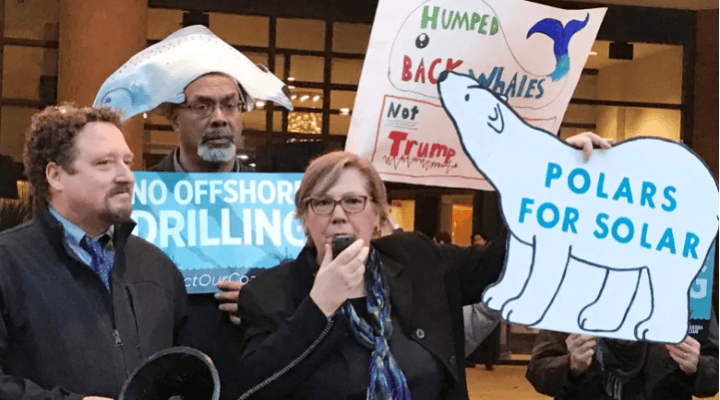
In this Feb. 15, 2018 file photo, Judith Enck, centre, former regional administrator for the Environmental Protection Agency addresses those gathered at a protest against President Trump’s plan to expand offshore drilling for oil and gas. A U.S. judge in Alaska says Trump exceeded his authority when he reversed a ban on offshore drilling in vast parts of the Arctic Ocean and dozens of canyons in the Atlantic Ocean.

‘The president cannot just trample on the Constitution to do the bidding of his cronies,’ says lawyer

President Donald Trump exceeded his authority when he reversed bans on offshore drilling in vast parts of the Arctic Ocean and dozens of canyons in the Atlantic Ocean, a U.S. judge said in a ruling that restored the Obama-era restrictions.

Judge Sharon Gleason in a decision late Friday threw out Trump’s executive order that overturned the bans that comprised a key part of Obama’s environmental legacy. 

Presidents have the power under a federal law to remove certain lands from development but cannot revoke those removals, Gleason said.

“The wording of President Obama’s 2015 and 2016 withdrawals indicates that he intended them to extend indefinitely, and therefore be revocable only by an act of Congress,” said Gleason, who was nominated to the bench by Obama.

A message left Saturday for the Department of Justice was not immediately returned. 

The American Petroleum Institute, a defendant in the case, disagreed with the ruling.

“In addition to bringing supplies of affordable energy to consumers for decades to come, developing our abundant offshore resources can provide billions in government revenue, create thousands of jobs and will also strengthen our national security,” it said in a statement.

Eric Grafe, an attorney with Earthjustice, welcomed the ruling, saying it “shows that the president cannot just trample on the Constitution to do the bidding of his cronies in the fossil fuel industry at the expense of our oceans, wildlife and climate.”

Earthjustice represented numerous environmental groups that sued the Trump administration over the April 2017 executive order reversing the drilling bans. At issue in the case was the Outer Continental Shelf Lands Act.

Acting Assistant U.S. Attorney General Jeffrey Wood said during a hearing before Gleason in November that environmental groups were misinterpreting the intent of the law written in 1953. He said it is meant to be flexible and sensible and not intended to bind one president with decisions made by another when determining offshore stewardship as needs and realities change over time.

In 2015, Obama halted exploration in coastal areas of the Beaufort and Chukchi seas and the Hanna Shoal, an important area for walrus. In late 2016, he withdrew most other potential Arctic Ocean lease areas — about 98 per cent of the Arctic outer continental shelf.

The bans were intended to protect polar bears, walruses, ice seals and Alaska Native villages that depend on the animals.

In the Atlantic, Obama banned exploration in 15,377 square kilometres of underwater canyon complexes, citing their importance for marine mammals, deep-water corals, valuable fish populations and migratory whales.