

Archives for March 27, 2019

Canadian mortgage rates are falling as bond yields slide lower

A woman fills out a form as part of a mortgage application. The cost of borrowing to purchase a home is declining in both the United States and Canada right now.

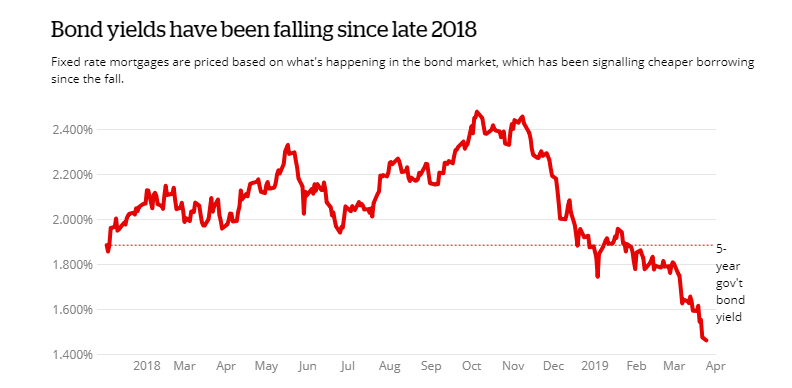
Yield on 5-year government debt has dipped below 1.5%, lowest since 2017

What’s bad news for some is good news for others, and Canadian mortgage-holders are the unexpected beneficiaries of some of the gloom that’s hovering over Canada’s economy.

Fixed mortgage rates have been falling precipitously in recent weeks, as the cost of financing those loans has gotten cheaper. Banks and other lenders get the money that they loan out in mortgages by borrowing it themselves on the bond market, and the yields on five-year bonds have been falling since late 2018.

A five-year Government of Canada bond was yielding just 1.45 per cent on Monday. That’s the first time the figure has been below 1.5 per cent since the summer of 2017.

Last week, the yield curve on long-term lending versus short-term inverted, a rare event that has an uncanny knack for predicting recessions.
“There’s all kinds of technical forces, and it is not necessarily the case that tomorrow we’ll have a recession,” CIBC economist Benjamin Tal said in an interview. 

“However, the yield curve slowing down is a clear signal … we have to listen to. We have a conflict between the stock market, which is more optimistic, and the bond market which is more pessimistic.”

Put simply, bond yields are heading lower largely because investors think the prospects for the economy are looking dim, so they expect interest rates to start moving lower.

Lower bond yields are generally “not a good sign from an economic standpoint,” says Janine White, vice-president of rate comparison website, Ratesupermarket.ca, “but it’s great for mortgage borrowers.”

That’s because cheaper financing costs are allowing the banks to cut their mortgage rates to try to entice borrowers. CBC News reported in January that Royal Bank cut its five-year posted rate to 3.74 per cent, a move that rivals were expected to match.

Royal Bank has since cut that rate two more times, first by 10 basis points on March 1 and then by another 15 basis points on March 13. The bank’s five-year fixed rate is now at 3.49 per cent, and other lenders are indeed following suit.

TD Bank currently has a special five-year fixed rate of 3.49 per cent. Smaller lenders are even lower. Dominion Lending Centres is offering 3.29 per cent locked in for five years, while HSBC Canada has a special five year of 3.24 per cent at the moment. 

Variable rates moving lower too

About three quarters of Canadian homeowners opt for the security of a fixed rate loans, Tal says, but the trend toward lower rates is happening in variable rate loans, too — albeit for different reasons.

Unlike fixed rate mortgages which take their cues from the bond market, variable rate mortgages tend to move in conjunction with whatever the Bank of Canada is doing.

One of the biggest shifts that occurred in our quarterly March forecast was the removal of any further interest rate hikes from our outlook.

– TD Bank chief economist Beata Caranci , in a note

And investors are betting that the central bank will soon be moving its rate down, not up. Investors in financial instruments known as overnight index swaps are pricing in zero chance of a hike this year, but about a one-in-five chance of a cut by July, and up to a 44 per cent chance by September.

White says the variable-rate mortgage market is simply pricing in some of the negative economic indicators of late, including lower inflation and an anemic GDP number that showed Canada’s economy actually shrank to close out 2018.

“There’s an increased probability they will actually cut to try to fuel economic growth,” White said, of her expectations for Canada’s central bank.

And economists are predicting the same thing.

“One of the biggest shifts that occurred in our quarterly March forecast was the removal of any further interest rate hikes from our outlook,” TD Bank’s chief economist Beata Caranci said in a note on Monday. “We hit the stop button.”

Variable rates have not just stopped going up, they’ve shifted into reverse and gone down in some cases. Rates below three per cent are now common, both at the big banks and at alternative lenders.

The spring is always a key time in the mortgage markets. That’s because the lion’s share of home purchases happen in those months, so lenders try to compete as much as possible on rates to take as big a bite as they can of that business.

Given that, the sudden trend towards cheaper lending could well stick around for a bit, White says. 

“Are we still going to be headed for interest rate increases in the next couple of years? Yes,” she says. “[But] for the rest of 2019 the prediction is that the variable rate is going to be stable and maybe has a chance of coming down.”

SNC’s reputation takes hit

The front lawn of the headquarters of SNC Lavalin.

SNC-Lavalin Group Inc. is leaving the door open to a lawsuit against Chile’s state-owned copper mining company, which has terminated its contract with the construction giant.

A spokesman for SNC-Lavalin tells The Canadian Press that the company is looking at all options to determine whether to take legal action.

The Montreal-based engineering firm has said it was “appalled and surprised” that state miner Codelco ended the US$260-million contract due to alleged quality issues and delays in subcontractor payments and project execution.

The contract, awarded in November 2016, included engineering, supply and construction of two new acid plants for a smelter at the Chuquicamata mine in northern Chile.

SNC-Lavalin is now demobilizing the job site and preparing dispute-resolution actions to recover some of the roughly $350 million in losses, which the company blames on Codelco and subcontractors.

Analyst Yuri Lynk of Canaccord Genuity says investors should not expect any recovery in 2019 and that such a big project cancellation will hurt SNC’s reputation in the mining industry.

Stocks get boost as oil rises

Canada’s main stock index pushed higher in late-morning trading as oil prices moved up and the energy sector headed higher.

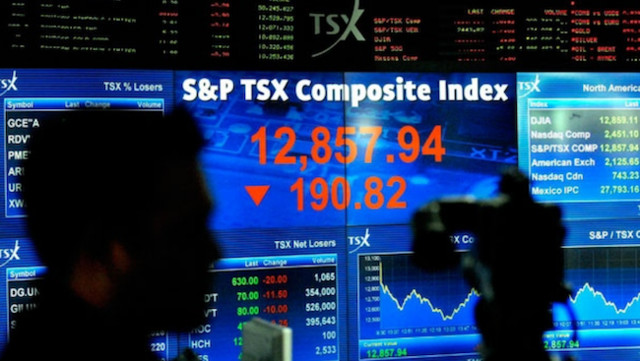
The S&P/TSX composite index was up 85.82 points at 16,151.68.

In New York, the Dow Jones industrial average was up 258.69 points at 25,775.52. The S&P 500 index was up 28.35 points at 2,826.71, while the Nasdaq composite was up 84.36 points at 7,721.90.

The Canadian dollar traded for 74.72 cents US compared with an average of 74.52 cents US on Monday.

The May crude contract was up US$1.30 at US$60.12 per barrel and the May natural gas contract was down 1.4 cents at US$2.76 per mmBTU.

The April gold contract was down US$7.30 at US$1,315.30 an ounce and the May copper contract was up one tenth of a cent at US$2.86 a pound.

China’s crackdown on Canadian canola expands as 2nd company, Viterra, has licence revoked

A high-speed bullet train travels past a canola field in Haian, China, this month. Canada is a major exporter of the grain to China, but customs officials have halted the flow of the crop, alleging dangerous impurities.

China alleges Canadian canola has harmful pests in it, escalating trade and diplomatic tensions

A second Canadian company has had its licence to sell canola to China revoked as a crackdown continues on one of the most Canadian crops in the world.

The latest move involves Regina-based Viterra Inc. The company, formed out of the merger of the former farming collective Saskatchewan Wheat Pool, is a major handler of canola.

Canadian company Richardson International was hit by a similar ban earlier this month when the Chinese government declared it had found dangerous pests such as fungus in the company’s canola, so it halted all shipments.

Last week, the Canola Council of Canada announced orders from China had mysteriously dried up across a number of canola sellers.

China’s ban of Viterra is effective immediately.

Based in Regina, Viterra is one of the largest grain handlers in Canada.

In justifying the move, Chinese customs officials said the ports of Dalian and Nanning had detected the same pests in Viterra’s canola.

“We can confirm that China has expanded its ban on Canadian canola imports to include shipments from Viterra,” a spokesperson for the company told CBC News.

“We are working closely with the federal government and the Canola Council of Canada to gather more information on the situation.

“All of our export products are tested to ensure they meet specific import standards. We take quality concerns seriously and support a sound, science-based approach in the testing of our exports. Market access issues such as this one hurt our industry and Canadian farmers. We are hopeful for a quick resolution to this matter.”

Speaking to reporters in Winnipeg on Tuesday, Prime Minister Justin Trudeau said the federal government is taking the situation “very seriously.” 

“We know that canola produced here in Canada is top quality and the oversight, inspection and science that surrounds what we do here is top notch and world class, and that is certainly something that we are going to continue to impress upon … our Chinese interlocutors on this issue.”

The unexpected canola conflagration comes against the backdrop of a roiling diplomatic dispute between the two countries, seemingly sparked by the arrest of Huawei executive Meng Wanzhou in Vancouver last year, at the request of American authorities.

Canada exports more canola than anyone else, and China is a major customer. (Scott Galley/CBC)

China has strongly objected to Meng’s arrest, and ratcheted up pressure on Canada to undo that move. The country has detained two Canadian businessmen alleging espionage, and now seems to be picking a fight over canola — a crop literally named after Canada.

Canola is a type of rapeseed that has a distinctive yellow flower and was invented by Canadian researchers in the 1970s. The seeds can be crushed into an edible oil, and discarded husks also make for an excellent animal feed.

Canada exports more canola than anyone else in the world. Last year, about 40 per cent of its seed exports went to China, worth roughly $2.7 billion.