
Archives for February 18, 2019

Stocks to Watch: Analysts Set Expectations for Stanley Black & Decker, Inc.’s Q2 2019 Earnings (SWK)

Stanley Black & Decker, Inc. (NYSE:SWK) – KeyCorp issued their Q2 2019 earnings per share (EPS) estimates for shares of Stanley Black & Decker in a note issued to investors on Tuesday, January 22nd, Zacks Investment Research reports. KeyCorp analyst K. Zener expects that the industrial products company will post earnings per share of $2.49 for the quarter. KeyCorp currently has a “Buy” rating and a $170.00 target price on the stock. KeyCorp also issued estimates for Stanley Black & Decker’s Q3 2019 earnings at $2.52 EPS, Q4 2019 earnings at $2.39 EPS, FY2019 earnings at $8.55 EPS and FY2020 earnings at $9.58 EPS.

Stanley Black & Decker (NYSE:SWK) last released its quarterly earnings data on Tuesday, January 22nd. The industrial products company reported $2.11 earnings per share for the quarter, beating analysts’ consensus estimates of $2.10 by $0.01. The company had revenue of $3.63 billion for the quarter, compared to the consensus estimate of $3.62 billion. Stanley Black & Decker had a return on equity of 16.29% and a net margin of 4.62%. The company’s quarterly revenue was up 4.9% on a year-over-year basis. During the same period in the previous year, the business earned $2.18 earnings per share.

A number of other equities research analysts also recently weighed in on SWK. Gabelli raised Stanley Black & Decker from a “hold” rating to a “buy” rating and set a $155.00 price objective on the stock in a report on Monday, October 22nd. Credit Suisse Group set a $135.00 target price on Stanley Black & Decker and gave the stock a “buy” rating in a report on Friday, October 26th. Barclays reduced their target price on Stanley Black & Decker from $166.00 to $152.00 and set an “overweight” rating on the stock in a report on Friday, October 26th. Wells Fargo & Co reduced their target price on Stanley Black & Decker from $162.00 to $150.00 and set an “outperform” rating on the stock in a report on Friday, October 26th. Finally, Nomura reduced their target price on Stanley Black & Decker from $188.00 to $169.00 and set a “buy” rating on the stock in a report on Friday, October 26th. Four equities research analysts have rated the stock with a hold rating and fourteen have given a buy rating to the company. Stanley Black & Decker presently has an average rating of “Buy” and an average price target of $156.53.

NYSE SWK traded up $3.31 during trading on Thursday, reaching $136.39. 998,461 shares of the company traded hands, compared to its average volume of 1,715,614. The company has a current ratio of 1.16, a quick ratio of 0.56 and a debt-to-equity ratio of 0.48. The company has a market capitalization of $20.60 billion, a price-to-earnings ratio of 16.73, a PEG ratio of 1.65 and a beta of 1.24. Stanley Black & Decker has a 1-year low of $106.41 and a 1-year high of $164.94.

The firm also recently announced a quarterly dividend, which will be paid on Tuesday, March 19th. Shareholders of record on Tuesday, March 5th will be given a dividend of $0.66 per share. This represents a $2.64 annualized dividend and a dividend yield of 1.94%. The ex-dividend date is Monday, March 4th. Stanley Black & Decker’s payout ratio is 32.39%.

In other Stanley Black & Decker news, SVP Jaime A. Ramirez sold 600 shares of the company’s stock in a transaction on Thursday, January 24th. The shares were sold at an average price of $118.69, for a total transaction of $71,214.00. Following the completion of the sale, the senior vice president now owns 35,048 shares in the company, valued at approximately $4,159,847.12. The sale was disclosed in a filing with the Securities & Exchange Commission, which is accessible through this hyperlink. Insiders own 0.69% of the company’s stock.

Several institutional investors and hedge funds have recently added to or reduced their stakes in the stock. FMR LLC boosted its holdings in shares of Stanley Black & Decker by 294.1% in the 2nd quarter. FMR LLC now owns 265,563 shares of the industrial products company’s stock worth $35,270,000 after acquiring an additional 198,170 shares in the last quarter. Schroder Investment Management Group boosted its holdings in shares of Stanley Black & Decker by 51.4% in the 2nd quarter. Schroder Investment Management Group now owns 36,626 shares of the industrial products company’s stock worth $4,919,000 after acquiring an additional 12,430 shares in the last quarter. Advisors Asset Management Inc. boosted its holdings in shares of Stanley Black & Decker by 20.6% in the 2nd quarter. Advisors Asset Management Inc. now owns 23,716 shares of the industrial products company’s stock worth $3,150,000 after acquiring an additional 4,051 shares in the last quarter. Old Port Advisors acquired a new position in shares of Stanley Black & Decker in the 2nd quarter worth approximately $268,000. Finally, Fulton Bank N.A. boosted its holdings in shares of Stanley Black & Decker by 9.1% in the 3rd quarter. Fulton Bank N.A. now owns 5,032 shares of the industrial products company’s stock worth $737,000 after acquiring an additional 418 shares in the last quarter. Institutional investors and hedge funds own 86.86% of the company’s stock.

Stanley Black & Decker Company Profile

Stanley Black & Decker, Inc provides tools and storage, engineered fastening and infrastructure, and security solutions worldwide. The company’s Tools & Storage segment offers professional products, including corded and cordless electric power tools and equipment, drills, impact wrenches and drivers, grinders, saws, routers, and sanders, as well as pneumatic tools and fasteners, including nail guns, nails, staplers and staples, and concrete and masonry anchors; and consumer products, such as lawn and garden products comprising hedge and string trimmers, lawn mowers, and edgers and related accessories, as well as home products, such as hand-held vacuums, paint tools, and cleaning appliances.


Stocks to Watch: Analysts Raise Earnings Estimates for Enterprise Financial Services Corp (EFSC)

Enterprise Financial Services Corp (NASDAQ:EFSC) – Investment analysts at DA Davidson lifted their Q1 2019 earnings per share estimates for shares of Enterprise Financial Services in a research report issued on Wednesday, January 23rd, Zacks Investment Research reports. DA Davidson analyst J. Rulis now expects that the bank will earn $0.97 per share for the quarter, up from their previous estimate of $0.93.

Several other equities analysts have also recently weighed in on the stock. Zacks Investment Research upgraded shares of Enterprise Financial Services from a “sell” rating to a “hold” rating in a research note on Monday, December 17th. BidaskClub raised shares of Enterprise Financial Services from a “sell” rating to a “hold” rating in a report on Tuesday, November 13th. ValuEngine downgraded Enterprise Financial Services from a “hold” rating to a “sell” rating in a research report on Wednesday, October 24th. Finally, FIG Partners upgraded Enterprise Financial Services from a “market perform” rating to an “outperform” rating in a research report on Monday, October 29th. Two investment analysts have rated the stock with a sell rating, one has issued a hold rating and four have given a buy rating to the stock. The stock presently has a consensus rating of “Hold” and an average target price of $55.25.

Shares of NASDAQ:EFSC traded up $0.90 during midday trading on Thursday, reaching $45.74. The company’s stock had a trading volume of 50,331 shares, compared to its average volume of 112,819. The company has a debt-to-equity ratio of 1.16, a current ratio of 1.05 and a quick ratio of 1.05. The company has a market capitalization of $1.06 billion, a PE ratio of 12.67, a P/E/G ratio of 1.26 and a beta of 1.14. Enterprise Financial Services has a 12-month low of $36.09 and a 12-month high of $58.15.

Several large investors have recently added to or reduced their stakes in the company. Legal & General Group Plc lifted its position in shares of Enterprise Financial Services by 23.9% during the fourth quarter. Legal & General Group Plc now owns 4,481 shares of the bank’s stock worth $169,000 after purchasing an additional 864 shares during the last quarter. Smith Moore & CO. raised its holdings in shares of Enterprise Financial Services by 12.9% in the fourth quarter. Smith Moore & CO. now owns 11,052 shares of the bank’s stock valued at $416,000 after acquiring an additional 1,259 shares in the last quarter. Segall Bryant & Hamill LLC raised its holdings in shares of Enterprise Financial Services by 26.0% in the fourth quarter. Segall Bryant & Hamill LLC now owns 198,970 shares of the bank’s stock valued at $7,487,000 after acquiring an additional 41,055 shares in the last quarter. Metropolitan Life Insurance Co. NY raised its holdings in shares of Enterprise Financial Services by 364.0% in the fourth quarter. Metropolitan Life Insurance Co. NY now owns 7,392 shares of the bank’s stock valued at $278,000 after acquiring an additional 5,799 shares in the last quarter. Finally, Squarepoint Ops LLC raised its holdings in shares of Enterprise Financial Services by 20.7% in the fourth quarter. Squarepoint Ops LLC now owns 5,840 shares of the bank’s stock valued at $220,000 after acquiring an additional 1,002 shares in the last quarter. Institutional investors and hedge funds own 77.85% of the company’s stock.

In other news, President Scott Richard Goodman sold 1,000 shares of Enterprise Financial Services stock in a transaction on Friday, December 21st. The stock was sold at an average price of $38.05, for a total transaction of $38,050.00. Following the completion of the sale, the president now directly owns 46,438 shares in the company, valued at $1,766,965.90. The transaction was disclosed in a filing with the SEC, which can be accessed through the SEC website. 2.60% of the stock is currently owned by company insiders.

The firm also recently announced a quarterly dividend, which will be paid on Friday, March 29th. Stockholders of record on Friday, March 15th will be given a dividend of $0.14 per share. This represents a $0.56 annualized dividend and a dividend yield of 1.22%. This is an increase from Enterprise Financial Services’s previous quarterly dividend of $0.13. The ex-dividend date is Thursday, March 14th. Enterprise Financial Services’s dividend payout ratio (DPR) is 14.40%.

About Enterprise Financial Services

Enterprise Financial Services Corp operates as the holding company for Enterprise Bank & Trust that offers banking and wealth management services to individuals and corporate customers. The company offers demand deposits, interest-bearing transaction accounts, money market accounts, and savings deposits, as well as certificates of deposit.

Canada’s NAFTA fears began before Trump became president

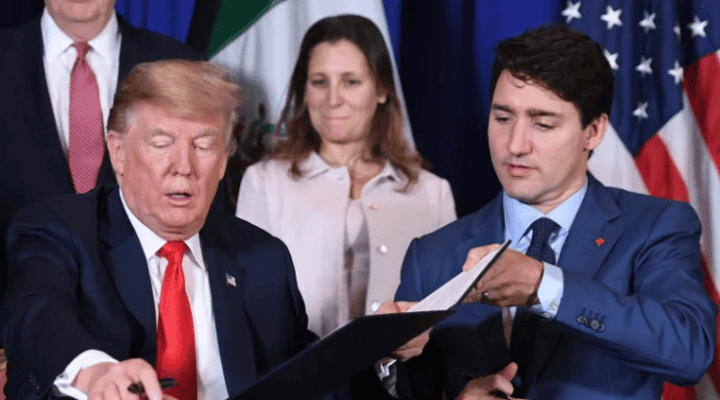
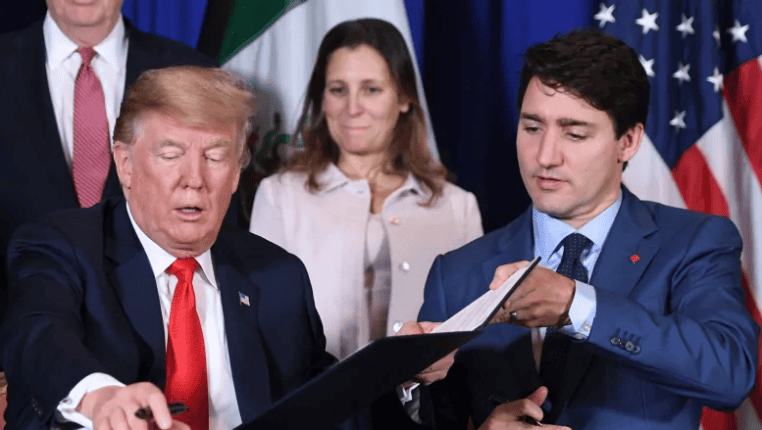
U.S. President Donald Trump and Canadian Prime Minister Justin Trudeau sign their copies of the new CUSMA deal after months of tense negotiations.

Internal documents show government was considering ‘Plan B’ options as early as August 2016

No matter who won the 2016 U.S. presidential election, Canada was bracing for NAFTA to go down in flames.

Internal documents, obtained by CBC News under access-to-information law, show the government started plotting out various “Plan B” options as early as August 2016 — months before Donald Trump was elected president.

Trump has been particularly hostile in trade relations between the two countries, but earlier notes prepared for the ministers of International Trade, Foreign Affairs and International Development warned that a Hillary Clinton presidency could have been a hardship too. 

“There has been significant criticism of NAFTA by a number of candidates,” one memo from 2016 cautioned. 

It pointed to Clinton’s repeated statements that the trade deal needed to be renegotiated, but particularly highlighted then-candidate Trump’s “far stronger and far more frequent” negativity on NAFTA. 

The documents — marked secret — go over “potential scenarios and implications,” if the deal was annihilated by a U.S. administration, though the precise details of the Plan B’swere removed from the document for confidentiality reasons.

Then in August 2017, Trump decided it was time to take a new look at trade in North America. His trade czar Robert Lighthizer said the administration had had enough with the deal. 

“We feel that NAFTA has fundamentally failed many, many Americans and needs major improvement.”

More than a year of slow, tense and sometimes hostile negotiations ensued, culminating in a new Canada-United States-Mexico Agreement (CUSMA) in the early hours of October.

In public, the government’s talking points didn’t change as the negotiators laboured on: Canada was committed to the talks and “will not walk away” from the table, Foreign Affairs Chrystia Freeland said.

Behind the scenes, however, communications titled “Plan B: NAFTA and CUSFTA withdrawal” were floating around government inboxes. 

Multiple Plan B’s

At least two scenarios were considered.

If the NAFTA deal was ripped up, the rules under the CUSFTA (Canada-United States Free Trade Agreement), the previous trade agreement signed in 1987,would have been reinstated. If the U.S. pulled out of that agreement too, Canada was researching the mechanics of the World Trade Organization standards that would have kicked in.

If both those agreements had been scrapped, Canada would have traded under “Most Favoured Nation” status with the U.S. within WTO rules.

Canada was preparing for wide-ranging fallout if all previous free trade agreements were abandoned. Memos bouncing between departments forewarned of the implications for the lumber, machinery, and oil industries and postulated how the investment climate would shift.

One particular piece of correspondence — called “WWJD” — explains how much authority Trump actually had to blow up NAFTA, and goes into the expected U.S., Mexican and Canadian reactions if Trump were to pull the plug. All of those details about reaction were redacted from the files CBC News obtained. 

The government wasn’t just preparing for the potential death of NAFTA. In November 2016, it also was alerted by the department about the potential for crushing tariffs. 

The severity of the situation if tariffs were slapped on Canadian products was laid out, product by product. 

Canola, beef, pork, cars, oil and gas, plastic, steel and lumber were all included in a memo that warned if existing free trade agreements were cancelled, almost 65 per cent of Canadian exports to the U.S. would be hit with tariffs — $224.4 billion worth of goods.

Pressure far from over

Throughout the unpredictability, the internal messaging remained optimistic, at least on paper. 

“Regardless of the current uncertainty, it remains important to continue advocacy efforts on the importance of NAFTA and the Canada-U.S. trading relationship, on both sides of the border,” one briefing concludes. 

Months of high-stakes negotiations taking place in cities across all three countries — including a period of time where Canada was threatened with the possibility of being left out of a deal — culminated in an agreement in principle.

On Nov. 30, that deal was signed on the sidelines of the G20 summit in Argentina.

But the pressure is far from over. 

Tariffs imposed on Canadian steel and aluminum remain, even though Prime Minister Justin Trudeau and Foreign Affairs Minister Freeland had hoped a new deal would nudge Trump to lift them. 

Even this week, Freeland was still using international gatherings to remind the U.S. of Canada’s abhorrence of the tariffs.

The CUSMA trade deal isn’t yet ratified, facing roadblocks in the Democrat-led U.S. Congress that threaten to delay the approval process. 

In Munich, Germany, Freeland spoke with U.S. Speaker Nancy Pelosi about the national security tariffs and the ratification process for the new NAFTA. 

U.S. Senator Chuck Grassley also said after meeting with Freeland last weekhe believes Canada and Mexico won’t consider ratifying the agreement unless the tariffs are lifted.

The U.S. government shutdown delayed critical reports explaining details of the deal to Congress, which is expected to stall things further.

When asked about Grassley’s comments and Canada’s side of the process, Freeland said the governing Liberals are actively working on ratification and that conversations are ongoing in committees, cabinet and the Senate. 

“Canada is definitely focused on our domestic ratification process,” she said. “We feel we have it well in hand.”

B.C. woman resurrects petition to make vaccinations mandatory in schools

A health official administers a measles vaccination at Maple Ridge Secondary School on Sept. 7, 2018. The woman behind an online petition to make vaccinations mandatory is frustrated because she says the Vancouver measles outbreak was preventable.

‘When your personal choice puts others at risk, it’s no longer about you,’ says Maple Ridge mother

A Maple Ridge, B.C., mother has resurrected a petition to make vaccinations mandatory at public schools amid a measles outbreak in Vancouver where eight cases were reported at one school.

By mid-afternoon Sunday, Katie Clunn’s petition had more than 23,000 signatures, up from 8,000 on Friday.

“When your personal choice puts others at risk, it’s no longer about you, it’s about the impact it’s having on the public,” said Clunn, the mother of two children who is pregnant with her third.

“If you don’t want to vaccinate … home school.”

Clunn originally launched the petition three years ago to gather signatures from the Maple Ridge school district, but now she is is gathering names across the province.

The petition calls on the province to amend its policy on public school enrolment to make it mandatory for parents to vaccinate their children before they can enrol their kids. There would be exceptions for medical reasons.

The measles vaccine is mandatory in Manitoba, Ontario and New Brunswick, but in B.C. the vaccine remains voluntary.

Monika Naus, medical director of communicable diseases and immunization at the B.C. Centre for Disease Control said a mandatory vaccination policy has merit. 

“We’ve achieved pretty good uptake with the voluntary process,” said Naus.

“It [mandatory vaccination] is always a consideration, depending on the trends that are happening, and sometimes those policy nudges can be very helpful,” she said.

Katie Clunn, who has two children and another on the way worries about another measles outbreak because the new baby can’t be vaccinated until 2020.

Clunn says people should have the right to choose whether to vaccinate, but that choice shouldn’t affect others — especially those whose immune systems are compromised.

The spike in the number of petition signatures may be attributed to the recent outbreak of measles in Vancouver.

Health officials reported eight cases of the disease on Friday — all from École Jules-Verne, a French-language high school in South Vancouver.

Another case of measles unrelated to the current outbreak was reported in Vancouver last week.

“It seems to be a yearly occurrence now, not just a random thing that happens every couple of years. Its so preventable, we could end this,” said Clunn.

“Disease control depends on herd immunity so come on people – vaccinate your kids!!!” wrote one person who signed the petition.

According to Vancouver Coastal Health, anyone who has ever had the infection does not need to be immunized. 

If you were born before 1994, or grew up outside of B.C., you may have received only one dose of the vaccine and require a second dose.

If you were born before 1970, you are likely to be immune to measles. However, if you aren’t sure if you ever had the infection, a measles, mumps and rubella (MMR) vaccine is safe and recommended.

Up to 10 cm of snow coming to Toronto, Environment Canada says

Up to 10 centimetres of snow expected in Toronto between Sunday night and Monday morning, Environment Canada says.

Snowfall amounts are generally expected to be in the 5 to 10 cm range

Widespread snow associated with a passing low pressure system is expected to move into the GTA early this evening and end later Monday morning, Environment Canada says.

The Federal weather agency issued a special weather statement Sunday afternoon in which it said snowfall amounts are generally expected to be in the 5 to 10 centimetres range.

“Travel may be hazardous at times today,” it says, “and especially tonight into Monday morning.”

For areas stretching from near Oakville towards Hamilton and Grimsby, there is a possibility that amounts may approach 15 cm, Environment Canada says.

In addition to the snow, gusty northeasterly winds will generate local blowing snow especially closer to Lake Ontario.

In the forecast for tonight calls for periods of snow beginning early this evening with a low of -8 C. Wind chill -10 C in the evening and -15 C overnight.

On Monday there will be periods of snow ending in the morning then clearing. Temperatures will peak at a high of -5 C and the wind chill will be near -15 C.

B.C. Finance Minister says budget will battle poverty, climate change

B.C. Finance Minister Carole James delivers the NPD’s first full budget on Feb. 20, 2018.

B.C. Finance Minister says budget will battle poverty, climate change

British Columbia’s finance minister says the budget she tables Tuesday undertakes development of social, environmental and economic initiatives as other provinces across Canada implement cuts to programs and shifts to the right.

Carole James says her budget builds on the minority New Democrat government’s goals of making life more affordable, improving services and ensuring a sustainable economy.

“I see them as hand in hand,” said James in an interview. “The investments we make in people and the investments we make in environment are investments in a sustainable, strong economy.”

Prof. David Black said he expects the social and economic agenda laid out in James’s budget to contrast sharply with the right-leaning policies in some other provinces.

B.C. spends as other provinces cut

Manitoba and Ontario have Conservative governments. The Coalition Avenir Quebec government, is essentially conservative, and the Saskatchewan party is right-leaning. Jason Kenney’s United Conservative Party in Alberta, meanwhile, is considered the front-runner in this year’s Alberta election, said Black, a political communications expert at Royal Roads University in the Victoria area.

“If the Alberta NDP lose in the spring election that leaves six out of 10 provinces with right-of-centre control,” he said. “It puts a powerful spotlight on B.C. as a place of social democratic governance.”

Black said while many province’s fight the federal carbon tax and cut education and child care, B.C. is spending billions on affordable housing, promising 22,000 child-care places and hiring teachers.

James’s budget is expected to include new funding for the government’s poverty reduction strategy and its Clean BC plan to fight climate change.

‘Radical pragmatism’

Black said the B.C. New Democrats led by Premier John Horgan are on a social building agenda that he labelled “radical pragmatism.”

Rather focusing attention on one issue — the environment, economy, education — the New Democrats are touching numerous social concerns that are building large-scale changes, he said.

“It is a much more humble, circumspect, careful, but nonetheless ambitious program of change,” said Black. “It’s not legislation by thunderbolt. It’s a kind of radical pragmatism.”

James said B.C.’s growing economy allows the government to pursue social, environmental and economic initiatives.

“Certainly all of our economic indicators are very positive,” James said, citing record low jobless rates and solid growth projections. “We’re in a strong economic position. It certainly is my plan to go forward with a balanced budget.”

Poverty and environment priorities

She said she expected the government’s poverty reduction and climate change strategies to be priorities in the budget.

The government passed legislation last year to cut B.C.’s overall poverty rate by 25 per cent and the child poverty rate by 50 per cent over the first five years of the plan.

The government’s Clean BC climate plan, introduced last December, is slated to cut greenhouse gas emissions by 40 per cent by 2030, 60 per cent by 2040 and 80 per cent by 2050. By 2040, all new cars and trucks sold in B.C. will be zero emission and new buildings will be 80 per cent more efficient than now.

“The poverty strategy will be a priority in this upcoming budget along with Clean BC,” said James. “Both of those will certainly have a priority when it comes to budget 2019.”

She said the dollar amounts designated to the poverty and environment plans will be revealed in the budget.

“The comprehensive poverty strategy will look across ministries, across government and at what kind of investments and supports we need to put in place to help people get ahead,” James said.

Iglika Ivanova, senior economist at the Canadian Centre for Policy Alternatives, said the poverty strategy needs to address homelessness, income, transit and child care.

“I’m a numbers person,” she said. “Until I see the numbers in the budget and see exactly how much is allocated to each priority, I don’t want to make too much out of promises and rhetoric. I want to see action in a number of different areas. The strategy needs to be comprehensive to be successful.”

The government said in its throne speech on Tuesday that making life more affordable will be the hallmark of its initiatives in the coming months. It promised to tackle cellphone costs, ticket scalpers, money laundering loopholes and poverty.