Archives for February 17, 2019

Sechelt sinkholes could lead to years of expensive legal struggles

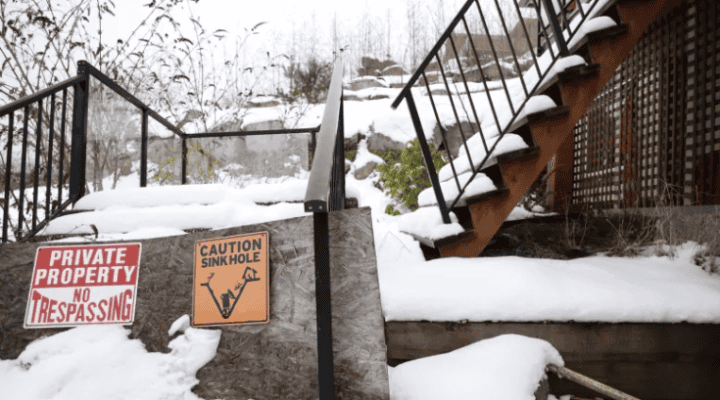
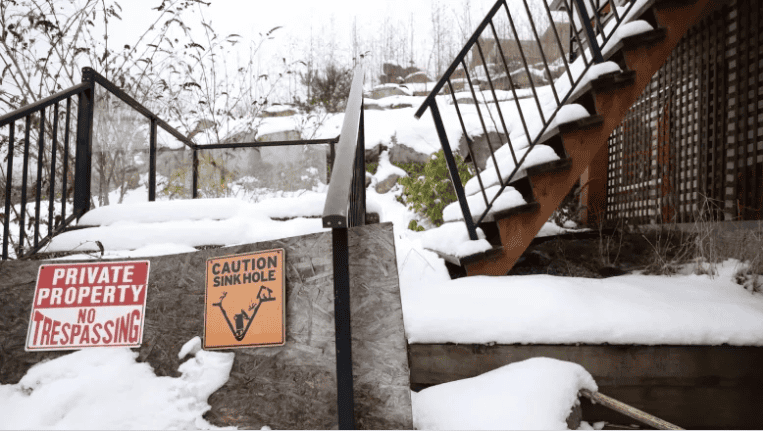
The front steps on a home in the Seawatch neighbourhood break apart, due to sinkhole activity.

Lawyer Jay Straith describes it as a ‘sue everybody in sight situation’

Emotions are still running high and tears continue to flow, as residents forced to evacuate their million-dollar ocean-view homes in Sechelt, B.C., try to figure out where they’re going to stay, and where to store their belongings.

A series of sinkholes in the Seawatch neighbourhood led the District of Sechelt to order the evacuation on Friday and declare a local state of emergency.

Some owners of the 14 affected houses are still paying mortgages. At least one couple bought their home with cash. With no clear avenue to getting the area remediated, the homes and properties risk becoming worthless. 

14 homes are affected by the evacuation order in the Seawatch neighbourhood in Sechelt.

“The 14 houses that have been evacuated, they’re suffering a large economic loss as far as the property is concerned, and they may be economically ruined,” said Jay Straith, a lawyer who litigated a high-profile North Vancouver landslide case dating back to 2005.

It’s possible legal recourse is the only hope the residents have, but it’s a long expensive journey to find justice in the courts for a case like this.

“It’s going to take — a good guess is — three to five years of litigation to get this thing sorted out,” said Straith, adding that legal fees will likely run in the hundreds of thousands of dollars.

Straith said the list of people to sue is long, and anyone who gets caught up in the case would be expected to sue someone else.

“Oh yeah, it’s one of these things we call a ‘sue everyone in sight’ situation,” he said.

Legal sights could be set on any previous owners, the developer, the engineers who provided professional reports, real estate agents involved in sales, the local government, and so on.

Rod and Donna Goy stand in their nearly empty Seawatch home with their dog Zoey. the Goys moved into the house on April 1 — Aprils Fools’ day — 2013.

The homeowners have been busy the last few days trying to clear out their houses, and haven’t had much time to think about legal avenues.

Some residents have told CBC News they would collectively explore the issue. They have Vancouver lawyer John Laxton reviewing their case.

“We didn’t overlook any of the due diligence required to move into a property like this. We did everything a prospective homeowner could possibly do to make sure that this place was safe— and we were lied to,” said Rod Goy, a displaced Seawatch resident.

Goy’s next door neighbour, Joanna Moradian, a real estate agent, fears losing everything.

“We bought it in good faith. We didn’t know the situation in the subdivision, so we put everything into this home,” said Moradian.

Joanna Moradian holds an armload of belongs as volunteers in the background work to clear everything out of the house before Friday’s evacuation order.

According to Straith, cases like this often come down to what was disclosed to buyers and when. If an omission was made when making a deal, that could be an avenue for legal action.

Many of the displaced residents have been sharply critical of the District of Sechelt’s role in issuing the development permits in the first place. 

“They can always, if they choose, take whatever actions they feel they need to do,” said Sechelt mayor Darnelda Siegers. “As a municipality, we are pursuing a number of avenues — more get added every day.”

Siegers said the sinkhole situation has given her municipality pause.

She said staff will be doing more due diligence, when it comes to other development projects in the future.

For Straith, a change in legislation at the provincial level could go a long ways to avoiding situations like this in the future. He wants to see issues like geotechnical red flags added to property title, so sellers don’t have to disclose — it’s just there.

“This shouldn’t be happening in British Columbia,” he said.

Downtown Edmonton intersection back to normal following water main break

Some ice on the sidewalks and median but otherwise traffic back to normal at 109th Street and 104th Avenue in Edmonton

The intersection reopened to traffic at about 8:40 a.m. Saturday

There are clumps of ice on the sidewalks and median but otherwise, things were back to normal Saturday morning at a busy downtown intersection where a water main burst Friday night.

According to an Epcor spokesperson, the break in the area of 109th Street and 104th Avenue was isolated at about 4 a.m. Saturday. The water main broke at about 9:20 p.m. on Friday, causing torrents of water to gush into the intersection.

Crews will be continuing to work on repairs today, but the roads have been cleared and the intersection reopened to traffic at about 8:40 a.m., a city spokesperson told CBC News.

Transit in the area is also back to normal operations.

Epcor’s Krista Grovestine said the cause hasn’t been determined but it is likely due to the cold weather and shifting water mains. Water main breaks are common during the winter.

A water main break on 109th Street caused flooding Friday evening in downtown Edmonton.

Last summer, there was a major water main break a few blocks away, at Jasper Avenue and 109th Street. The break flooded the intersection but also caused a power outage affecting nearly 500 customers. 

Trump’s pick for ambassador to UN Heather Nauert withdraws from consideration

U.S. State Department spokesperson Heather Nauert speaks during a briefing in Washington in November 2017.

‘The past 2 months have been gruelling for my family,’ says ex-Fox News journalist

Heather Nauert, U.S. President Donald Trump’s pick to be the next American ambassador to the United Nations, has withdrawn from consideration, the State Department said.

Nauert, a State Department spokesperson, said in a statement that “the past two months have been gruelling for my family and therefore it is in the best interest of my family that I withdraw my name from consideration.”

Her impending nomination had been considered a tough sell in the Senate, where she would have faced tough questions about her relative lack of foreign policy experience, according to congressional aides.

A potential issue involving a nanny that she and her husband had employed may also have been a factor in her decision to withdraw, according to one aide. That issue, which was first reported by Bloomberg on Saturday, centred on a foreign nanny who was legally in the U.S. but did not have legal status to work, according to the aide, who was not authorized to discuss the matter publicly and spoke on condition of anonymity.

The aide said some involved in the vetting process saw Nauert’s inexperience and questions about her ability to represent the U.S. at the UN as a larger issue.

Nauert’s impending nomination had been considered a tough sell in the Senate, where she would have faced tough questions about her relative lack of foreign policy experience, according to congressional aides.

Trump’s initial UN ambassador, Nikki Haley, served for nearly all of the administration’s first two years. She announced her resignation in October with plans to step down by year’s end.

That December, Trump said he would nominate Nauert, called her “very talented, very smart, very quick” and said he thought she would be “respected by all.” In the wake of November elections that strengthened Republican control of the Senate, her confirmation appeared likely if not easy. Yet Trump never put Nauert’s name forward with the Senate and no confirmation hearing was scheduled.

The State Department said in its statement that Trump would announce a nominee for the UN position “soon.”

Made jump to State Department from Fox News

Nauert was a Fox News Channel reporter when she joined the State Department as spokesperson almost two years ago during Rex Tillerson’s tenure as secretary of state. She rose to the upper echelons of the department’s hierarchy after Trump fired Tillerson in March 2018 and Mike Pompeo replaced him.

In the department’s statement, Pompeo said he respected Nauert’s decision on the UN job and that she performed her duties as a senior member of his team “with unequalled excellence.”

Secretary of State Mike Pompeo, right, said he respected Nauert’s decision on the UN job and that she performed her duties as a senior member of his team ‘with unequalled excellence.’

“Serving in the Administration for the past two years has been one of the highest honours of my life and I will always be grateful to the president, the secretary, and my colleagues at the State Department for their support,” Nauert said in the statement provided by the department.

Before coming to the State Department, Nauert was a breaking news anchor on Fox & Friends. With a master’s degree from Columbia University’s Graduate School of Journalism, she had moved to Fox from ABC News, where she was a general assignment reporter.

Nauert, who did not have a good relationship with Tillerson and had considered leaving the department, was appointed acting undersecretary of state for public diplomacy and public affairs after his departure. The appointment ended in October.

‘You can smell crude in the air’: Train carrying oil derails near western Manitoba village

About 37 crude oil cars have derailed near a village in western Manitoba. Crews were working to clean up the scene Saturday afternoon.

About 37 crude oil cars have derailed and oil is leaking near St. Lazare, Man.

CN Rail is working to clean up an oil leak after nearly 40 train cars carrying crude oil derailed near a village in western Manitoba early Saturday morning.

CN crews are responding to the derailment, which occurred at 3:30 a.m. Saturday morning near St. Lazare, about 300 kilometres northwest of Winnipeg near the Manitoba-Saskatchewan border, a spokesperson from the railway said. 

“You can smell crude in the air. That’s really concerning,” said rancher Jayme Corr. The derailment happened on his property, about 10 kilometres south of St. Lazare, in the rural municipality of Ellice-Archie.

“There’s oil leaking, and where they’re sitting is [near] a water lagoon,” he said.

The derailment happened around 3:30 a.m. Saturday. As of Saturday afternoon, crews were still on scene.

The derailment happened around 3:30 a.m. Saturday. As of Saturday afternoon, crews were still on scene. (Riley Laychuk/CBC )

Emergency personnel woke Corr up around 5 a.m. Saturday to alert him to the derailment, which happened just under two kilometres from his home.

No injuries or fires reported

Initial reports are that approximately 37 crude oil cars have derailed and that there is a partial leak of crude oil, Jonathan Abecassis, a media relations director for CN, wrote in an email to CBC.

“A perimeter has been set up around the area to facilitate site access. There are no reports of injuries or fires,” he wrote.

“CN crews will be conducting a full site assessment to determine how much product has spilled and exactly how many cars are involved. First responders are on location.”

CN’s environmental team has started cleaning up the area.

Corr said his cattle have since been moved away from the area, but he’s concerned that his main water source for the summertime will now be contaminated.

The train derailed about 10 kilometres south of St. Lazare, in the rural municipality of Ellice-Archie.

The train derailed about 10 kilometres south of St. Lazare, in the rural municipality of Ellice-Archie. (Riley Laychuk/CBC)

The rancher says he thinks a derailment like Saturday’s has been a long time coming.

“It seems to be the trains go faster, they’re longer, heavier, and the maintenance is getting less and less,” Corr said.

The Transportation Safety Board of Canada has sent investigators to the site of the derailment. 

‘It’s discouraging’

Jean-Paul Chartier, a rural municipality of Ellice-Archie councillor, said staff from the local fire department are on the scene of the derailment, assisting CN crews.

“They’re trying to do their best to get everything contained, and trying to get the traffic going, and trying to clear whatever debris there is,” Chartier said.

Trains frequently run through St. Lazare, and Chartier said he’s thankful the crash didn’t occur closer to the community. In areas of the village, there are houses just hundreds of metres from the tracks, and 30 to 40 trains can travel past each day, he said.

“Every time they come through, you think of the tragedy that happened in Quebec,” he said, referring to the Lac-Mégantic, Que., rail disaster, which killed 47 people after a freight train loaded with fuel exploded.

“It’s discouraging. Like you look at it everyday and you say ‘hopefully it’s not today and hopefully it doesn’t ever happen.’ But you’ve always got it in the back of your mind.”

LG’s first 5G phone will likely be the V50 ThinQ for Sprint

You’ll likely see it on February 24th.

LG and Sprint haven’t been shy about their plans to launch a 5G smartphone in 2019. Now, though, you might be looking at the device in question. Well-known scoop provider Evan Blass has obtained an image of the V50 ThinQ, a Sprint-bound flagship with some very conspicuous 5G branding. The picture doesn’t include many details outside of a notched display and an abundance of cameras, but it hints at a February 24th reveal date that lines up with LG’s South Korean announcement promising a 5G phone introduction that day, just ahead of Mobile World Congress.

That same release provided a few of the V50’s early details. It would use Qualcomm’s latest Snapdragon 855 chip, to no one’s surprise, but it would also make accommodations for early 5G hardware. You’d get a vapor chamber cooling system that’s 2.7 times larger than the heatpipe in the V40 as well as a 20 percent larger 4,000mAh battery. You should also have added longevity through software optimizations, LG said.

There are still quite a few unanswered questions, such as how the V50 will compare to the G8. For many, though, availability is the main concern. Sprint only promised LG’s 5G handset sometime in the first half of 2019, leaving the chance that you’ll wait months to get a V50. And when early 5G phones will be relatively expensive, there are concerns you’ll pay a stiff premium to be an early adopter. Phones like this could be more of a peek at the future than a realistic purchase.

UK will track thousands of criminals with GPS tags

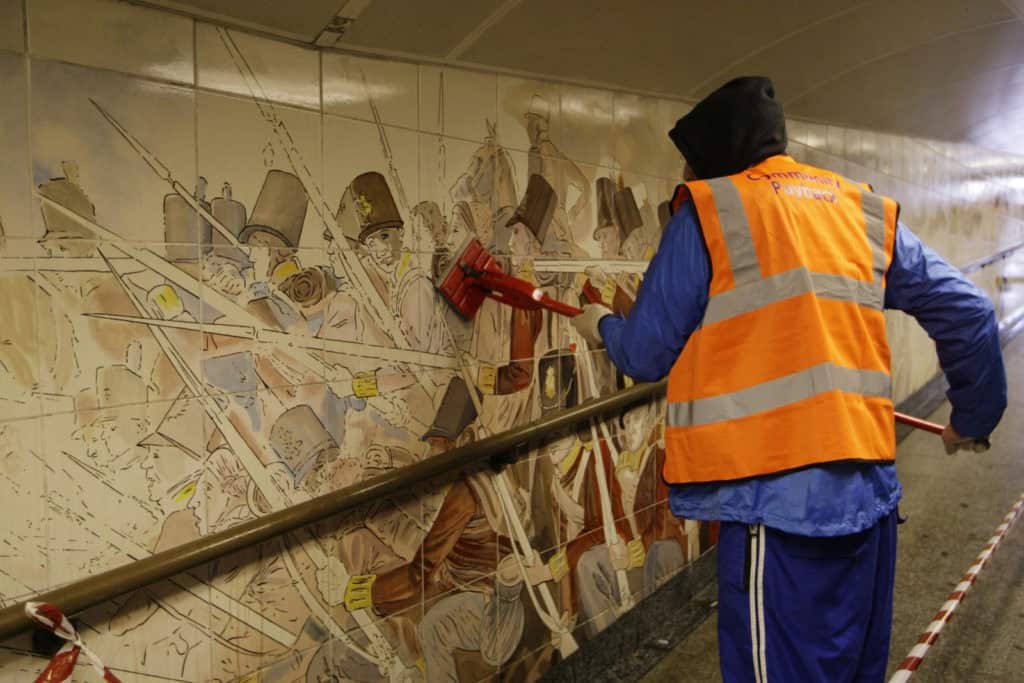
An offender, convicted of minor offences, cleans a wall in a subway at Hyde Park Corner in London in preparation for the royal wedding as a community payback scheme run by Westminster Council and the London Probation Trust, Tuesday, April 5, 2011. Prince William and Kate Middleton are to marry at Westminster Abbey in London on April 29, 2011. (AP Photo/Sang Tan)

They could reduce prison time, but there are ethics questions.

It’s not a novel idea to make criminals wear GPS bracelets, but they could soon be relatively commonplace in the UK. The country’s government plans to use them for around-the-clock monitoring of criminals across England and Wales by the summer, with a handful of regions already putting them to use. They’ll be used to both track behavior when out of prison (say, to ensure offenders attend rehab) and enforce geographic limits like restraining orders.

The government estimated that roughly 4,000 people will receive GPS tags each year, but no more than 1,000 people will wear tags at any given time.

As with earlier uses, there are ethical advantages and drawbacks. This could avoid or reduce prison sentences for minor offenses, and more effectively monitor serious criminals when allowed to reenter society. The current electronic tags can indicate if a wearer is present at a given building, but it’s not much use outside of those narrow conditions. However, it still amounts to 24/7 location tracking for people who, in some cases, committed only non-violent crimes. While convicts aren’t about to earn much sympathy, there’s little doubt that they’re losing a lot of privacy.