
Archives for February 4, 2019

Weekly Market Preview: Six Stocks To Watch For the Coming Week (GOOG, GILD, SNAP, DIS, GM, TWTR)

Momentum has returned to the stock market, thanks to (among other things) strong earnings reports from the likes of Apple (AAPL), Facebook (FB) and General Electric (GE), which helped the S&P 500 index to log its best January performance in thirty-two years with a gain of 8%. I won’t say “I told you so,” but I had an inkling this would happen.

The positive earnings results from a handful of S&P 500 companies have seemingly helped investors forget about tariff-related rhetoric and any impact the government shutdown has had on the economy. U.S. stocks on Friday were also aided by solid jobs report data for January. The U.S. economy created 304,000 new jobs in January, well above the consensus estimate of 172,000. This affirmed what we’ve known for some time: It’s going to take a lot more than political posturing to get this train off track.

All told, equities closed the week on a strong note, lead by the tech-heavy Nasdaq Composite Index, which closed out the week 1.4% higher. The Dow Jones Industrial Average, meanwhile, added more gains Friday, extending its streak for a sixth week, marking its longest weekly winning stretch in almost two years. More positive earnings should continue to fuel the momentum in equities. Here are the stocks to keep an eye on.

Alphabet (GOOG , GOOGL) – Reports after the close, Monday, Feb. 4

Wall Street expects Alphabet to earn $10.86 per share on revenue of $38.98 billion. This compares to the year-ago quarter when earnings came to $9.70 per share on revenue of $32.32 billion.

What to watch: Past concerns about the company’s profit margins have been corrected amid stronger Traffic Acquisition Costs in the advertising business as well as other operational improvements. But among the company’s expanding services portfolio, Wall Street will take an interest in Google’s Cloud performance compared to leaders Amazon (AMZN) and Microsoft (MSFT). Elsewhere, the company’s improving search features and strategic partnerships are expected to drive top-line growth. The question is, to what extent can these metrics offset concerns about possible stricter government intervention in an effort to strengthen the security and privacy of consumers’ data?

Gilead Sciences (GILD) – Reports after the close, Monday, Feb. 4

Wall Street expects Gilead to earn $1.71 per share on revenue of $5.49 billion. This compares to the year-ago quarter when earnings came to $1.78 per share on revenue of $5.95 billion.

What to watch: With Gilead shares rising some 11% over the past thirty days, a solid beat on both the top and bottom lines would be just what the doctor ordered to keep the momentum going. Increased competition from the likes of Merck (MRK) and AbbVie (ABBV) have pressured Gilead’s HCV revenues, resulting in declining sales in several key products such as Harvoni and Sovaldi, which are used to cure liver diseases. On Monday investors will want the management to outline its strategy to better compete in the hepatitis C market and issue guidance that suggests the recent stock increase can be sustained.

Snap (SNAP) – Reports after the close, Tuesday, Feb. 5

Wall Street expects Snap to report a per-share loss of 8 cents on revenue of $375.82 million. This compares to the year-ago quarter when the loss came to 13 cents per share on revenue of $285.69 million.

What to watch: Is the worst finally over for Snap? Eric Ross, chief investment strategist at Cascend Securities, believes it has. In a research note Friday, Ross upgraded the stock from Sell to Hold, saying Snap’s fumbled app redesign for Android “have snapped back to positive.” On the report, Snap shares climbed as high as 7%, but couldn’t hold on the gains. The stock ended Friday 3.44% higher and is now up 25% year to date. On Tuesday analysts will nonetheless focus on the company’s user engagement metrics, while monitoring how the company guides for the next quarter and full year.

Disney (DIS) – Reports after the close, Tuesday, Feb. 5

Wall Street expects Disney to earn $1.55 per share on revenue of $15.18 billion. This compares to the year-ago quarter when earnings came to $1.89 per share on revenue of $15.35 billion.

What to watch: The good news for Disney is that, unlike previous quarters, analysts won’t be so focused on the numbers. And that’s partly because expectations are so low. The quarterly estimates above calls for year-over-year declines on both revenue and EPS. Still, on Tuesday the media and entertainment behemoth will need to convince the Street that its growth ambitions to compete with Netflix (NFLX) as a full over-the-top streaming platform is on track. Then there’s the topic of Twenty-First Century Fox (FOX , FOXA), which Disney has acquired and has yet to close. And, of course, we can’t discuss Disney without mentioning its sports network ESPN, which generates the lion share of profits, but also the bulk of its expenses.

General Motors (GM) – Reports after the close, Wednesday, Feb. 6

Wall Street expects GM to earn $1.22 per share on revenue of $36.48 billion. This compares to the year-ago quarter when earnings came to $1.65 per share on revenue of $37.72 billion.

What to watch: Although there are tons of reasons to be bearish the stock, including its recently-announced 2.7% decline in sales for Chevrolet, Cadillac and Buick brands, the company has delivered a positive earnings surprise in three out of the past four quarters. The prospects for the next two years, however, aren’t bright. Neither revenue or earrings is expected to grow during that span. It’s for this reason the company has begun to layoff workers in an effort to remain profitable. The reductions come as GM undergoes a massive restructuring announced by CEO Mary Barra in November. Wednesday’s earnings call may shed some light on how this restructuring will unfold.

Twitter (TWTR) – Reports before the open, Thursday, Feb, 7

Wall Street expects Twitter to earn 25 cents per share on revenue of $869.5 million. This compares to the year-ago quarter when earnings came to 19 cents per share on revenue of $731.56 million.

What to watch: There’s no question that, after a tumultuous couple of years, Twitter has finally gotten things going in the right direction. But with that comes higher expectations. As such, the focus on Thursday is going to be on the numbers, which — due to the tougher year-over-year comparisons — will reveal just how much room for improvement the company has left. Namely, can it continue to achieve increased advertiser demand? What will 2019 guidance look like? And will the company’s commentary surrounding strategy and execution serve as a catalyst to get investors excited about said guidance?


3 Stocks to Watch in February

These three companies have only two things in common: They’ve proven great long-term investments, and they report earnings this month. Here’s what to watch for.

With the calendar flipped to February, we have moved solidly into the heart of earnings season. And while quarterly earnings updates don’t generally change the story very much for most companies, it does give investors an opportunity to learn a little bit more about how business is going, as well as how a company is being affected by industry and general economic trends. 

Furthermore, for companies in transition, each quarterly update is an opportunity to get a more complete picture of the company’s efforts to move in a new direction, right the ship, or otherwise improve the business. 

And there are three stocks relatively high on my radar to watch this month. The first one, Chipotle Mexican Grill (NYSE:CMG), certainly qualifies as a company in the midst of a turnaround. The second is renewable-energy producer Brookfield Renewable Partners (NYSE:BEP), which isn’t in a turnaround but is in the process of rotating out some of its less-productive assets and redeploying the proceeds into higher-return assets. Third is Chart Industries (NASDAQ:GTLS), a manufacturer that has spent much of the past few years restructuring its business and dealing with turnover in the executive suite.

For investors looking to maximize their long-term profits, these three companies offer compelling opportunities. Keep reading to learn what I’m looking to learn about them this month.

Can Chipotle reverse its traffic trend?

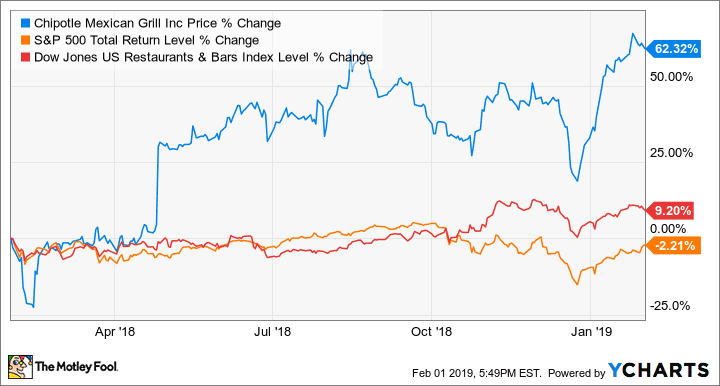
Based on the stock’s chart over the past year, it’s easy to assume Chipotle has finally turned things around:

The burrito-selling giant’s earnings support the idea that it had a strong turnaround year — at least through the first three reported quarters. Third-quarter sales were up 8.6%, an acceleration from the 8.1% combined growth through the first nine months, while earnings per share were up 12% on improved margins and higher sales. Adjusting for some non-recurring items, earnings would have grown almost 40%.

A big part of the company’s success in 2018 has been the recovery of its same-store sales — also called comps — which measures sales at restaurants that have been open at least 13 months. Comps surged 4.4% in the third quarter, lifting year-to-date comps above 3%.

That’s fantastic. With one minor issue: Chipotle’s recent comps growth has been entirely driven by higher prices and increased add-on item sales, not more orders. Management said comparable transactions actually declined 1.1% in the third quarter. To put it another way, the numbers indicate Chipotle isn’t attracting new customers.

But there’s a ray of sunshine, too. After falling more than 2% in the first half of the year, transaction comps have steadily improved each of the past few quarters, and my expectation is that we should see a reversal of this trend soon — hopefully as soon as in the fourth quarter, which Chipotle will report on Feb. 6.

Flipping the switch back to growth

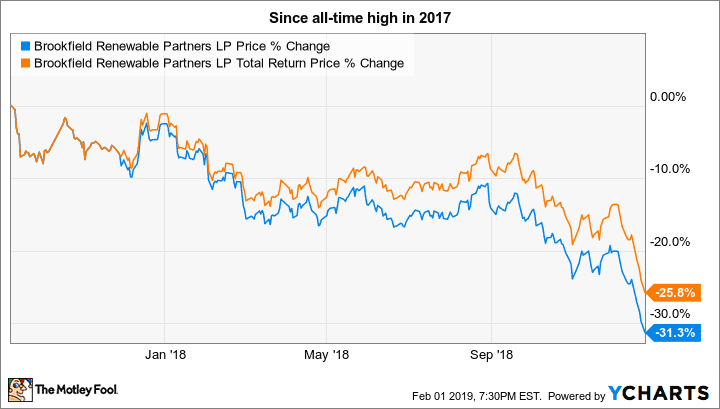
Renewable-energy producer Brookfield Renewable Partners has a wonderful long-term track record of delivering double-digit returns most years. But investors didn’t enjoy that success in 2018; to the contrary, the 26% decline in its unit price was the worst by far it’s done in a decade, and was only the third negative year over that period. Even when factoring in its generous dividend, investors still lost 21% in 2018.

And while it isn’t the case of a business that’s struggling, Brookfield Renewable has undergone some changes over the past year or so that did keep it from delivering the kind of cash flows growth investors had become accustomed to. As a matter of fact, funds from operations (FFO) fell 10% in the second quarter, and its hydroelectric business, which makes up about three-fourths of FFO generation, has generated about 10% less FFO in 2018 than the year before because of reduced rainfall.

At the same time, it’s in the midst of a pretty large “capital recycling” effort, having sold off — or in the process of selling — $850 million in lower-return assets, with plans to opportunistically reinvest that capital into renewable assets with higher returns and better growth profiles. The catch is, those opportunities sometimes take a while to come along, and Brookfield Renewable’s cash flows can take a temporary hit. This is part of what has spooked investors over the past year.

The good news is its solar and wind investments more than made up the weaker hydro results in the third quarter, and my expectation is that investors will see more of the same when the company reports fourth-quarter results on Feb. 8. With shares still down 19% from the all-time high in late 2017 and the dividend yield of 6.7% well above the long-term average of around 5.5%, it still represents an incredible value.

New management, same results

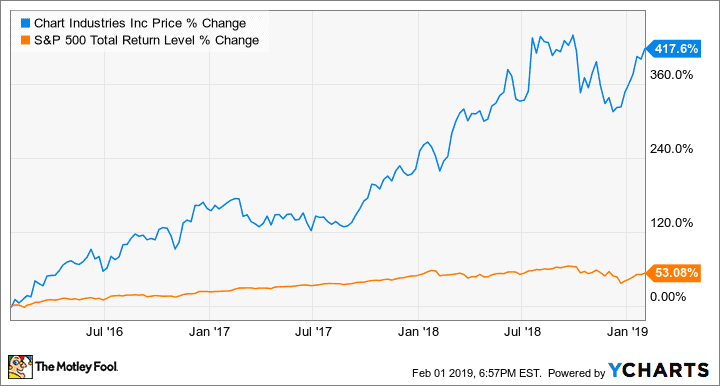
Cryogenic gas processing equipment maker Chart Industries has had one heck of a run over the past few years. Since bottoming out in mid-January 2016, its shares have been anything but ice-cold:

This big surge has mainly been due to a well-executed plan to lower costs, better leverage Chart’s core capabilities, and identify and acquire businesses that make it more competitive. In short, management has done quite a good job of doing what it intended.

What’s most incredible is that Chart has done it under three different CEOs, at least three different CFOs, multiple COOs, and a revolving door of lower-level executives. To put it plainly, it’s hard enough to restructure a business when leadership remains intact; most companies that go through that kind of executive change are complete disasters.

I think the key is that Chart’s board has done an admirable job of making sure each person assuming the CEO role was looking to continue execution of the existing strategy, not change direction, and much of the change in its executive ranks was started by the relocation of its headquarters from Ohio to Georgia, and the retirement of its longtime CEO in 2017. Furthermore, each of its new CEOs since then was an internal promotion, not an outsider, and I think that’s made a difference in the continuity of Chart’s execution.

When Chart reports on Feb. 14, investors will get an update on both the state of its current business and its progress toward closing a deal which will greatly increase its footprint in Europe. As global investments in LNG continue to ramp up, Chart’s new lean, focused business is prepared for even bigger profits in the future.

Reusable packaging coming

Canadian efforts to reduce single-use plastic will get a boost this year when a major retailer is slated to launch a test of reusable packaging in the most populated part of the country.

The chain’s identity is expected to be unveiled this spring with online operations starting by year-end, says the founder of recycler TerraCycle’s Loop.

“I say this as a Canadian, I’m super excited about getting Loop to Canada. I think it will resonate really well with the public there,” says Tom Szaky, who grew up in Toronto.

Residents within a 200- to 300-hundred kilometre radius of Canada’s largest city will be able to purchase hundreds of products in reusable packaging made by some of the world’s leading brands, including Proctor & Gamble, Unilever and Nestle.

Goods ranging from Haagen-Dazs ice cream to shampoo, toothbrushes and laundry detergent packaged in especially designed reusable containers will be ordered online from the retailer’s e-commerce site and delivered along with other store purchases. In-store purchases are expected to follow about six months later.

Cold-pressed juice startup Greenhouse Juice Co. will also participate in the project, demonstrating that it’s not just suitable for “big behemoths,” he said.

The system is akin to the old milkman delivery service that was ubiquitous in the 1950s and 1960s.

“Loop is very much a reboot of an old idea but done in a very modern setting,” said Szaky.

A deposit will be charged for the container which will be refunded when the unwashed vessel is returned at the next delivery or at the store.

The recycling effort is being launched as corporations — including large retailers, airlines and fast-food chains — have joined a global bandwagon aimed at reducing single-use plastics. The material has attracted negative attention from images of a floating garbage island in the Pacific Ocean and tangled ocean wildlife.

Retailers including Ikea, Walmart, KFC, A&W, Starbucks and Subway have promised to eliminate plastic straws and are looking for plastic alternatives for lids and cutlery. Air Canada says it will replace millions of plastic stir sticks with wood on all flights starting this summer. Tim Hortons’ parent company says it will unveil efforts to tackle the issue in the coming months, begin testing a new strawless lid this year and increase the amount of recycled content in packaging.

Retailers, suppliers, consumer goods companies and governments are taking action after research has disclosed the size of the challenge, says Kathleen McLaughlin, chief sustainability officer at Walmart Inc.

The world’s largest retailer has promised in Canada to further reduce check-out plastic bags, replace plastic straws with paper and eliminate “hard-to-recycle” PVC, expanded polystyrene and unnecessary plastic packaging in all its own private brand products.

Look ahead at week in biz

Five things to watch for in the Canadian business world in the coming week:

Let’s talk stress

The Office of the Superintendent of Financial Institutions’ assistant superintendent Carolyn Rogers will speak to The Economic Club of Canada on Tuesday about the regulator’s mortgage stress test. Stress tests were introduced in 2018 to cool real estate markets such as Toronto and Vancouver, and have limited the ability of some to qualify for mortgages.

BoC speech

Bank of Canada deputy governor Timothy Lane will speak before the Peterson Institute of International Economics on Wednesday. The topic of his speech will be “The Canadian Approach to Foreign Reserve Management.”

BCE earnings

BCE Inc. will release fourth-quarter results, hold a conference call and provide its 2019 estimates on Thursday. BCE subsidiary Bell Canada began asking its customers in December for permission to track everything they do with their home and mobile devices in return for advertising and promotions that are more “tailored” to their needs and preferences.

Housing starts

Canada Mortgage Housing Corp. releases housing starts for January on Friday. The national housing agency reported that seasonally adjusted annual rate of housing starts in Canada was 213,419 units in December, down from 224,349 in November but higher than analysts expectations of 205,000.

Unemployment update

Statistics Canada will release its labour force survey for January on Friday. The survey for December revealed that the unemployment rate stayed at its 43-year low of 5.6 per cent last month as the economy closed out 2018 with the addition of 9,300 net new jobs.

Trudeau speaks with allies

Venezuelan opposition leader Juan Guaido, who has declared himself the interim president of Venezuela, greets supporters as he arrives at a nationwide demonstration demanding the resignation of President Nicolas Maduro, in Caracas, Venezuela, Saturday, Feb. 2, 2019.

Prime Minister Justin Trudeau’s office says he has spoken with the man Canada and many of its allies consider the legitimate leader of Venezuela.

Trudeau’s office says he spoke with Juan Guaido about the need for countries to send a clear message about what the PMO calls “the illegitimacy of the Maduro regime.”

A statement from the PMO says the two also discussed the need to respect Venezuela’s constitution and to have free and fair presidential elections.

The call comes a day before Canada and its allies in the so-called Lima Group are set to meet in Ottawa.

The gathering of more than a dozen of Canada’s Western Hemisphere allies is meant to find new ways to support the Venezuelan opposition and ease the refugee crisis in neighbouring Brazil and Colombia

The agenda was still being finalized on Friday, in part because of the speed at which the Venezuelan crisis is unfolding.

Canada has already contributed $2.2 million for the humanitarian crisis in Venezuela that has forced three million people from their homes.

Trudeau’s office says he told Guaido that Monday’s meeting will look at any ways countries can “can further support the people of Venezuela, including through immediate humanitarian assistance.

“The prime minister commended Juan Guaido for his courage and leadership in helping to return democracy to Venezuela and offered Canada’s continued support,” the statement says.

Ontario fines Costco $7M

Ontario’s government has fined Costco more than $7 million after finding that the company accepted illegal kickbacks at 29 pharmacies in warehouses across the province.

The Ontario Ministry of Health announced Friday that it would be penalizing CWC Pharmacies (Ontario) Ltd. after it found that the company received illegal advertising payments before August 2015.

The government says the company approached the ministry for confirmation on the legality of the payments, which Costco voluntarily stopped receiving until the completion of the ministry’s review.

The inspection revealed that Cosctco received $7.25 million for advertising services that the ministry says violate its terms for accepting rebates.

According to a statement from Costco, the payments were from generic drug manufacturers to reduce dispensing fees and drug mark-ups, and it has agreed to pay the penalty fee.

The statement says that while the company believed that the payments were legal at the time, it co-operated fully with the ministry’s investigation and it acknowledges that the payments did not abide by Ontario’s rebate laws.

According to the ministry, the Ontario government prohibits the operator of a pharmacy from accepting rebates from a drug manufacturer that has a product listed on the province’s drug database.

CWC Ontario is a “wholly owned subsidiary” of Costco Wholesale Canada Ltd., according to the Costco Pharmacy website.