Archives for January 18, 2019

How to find out if your email was one of 773 million exposed in data breach

Your email account may be among the hundreds of millions that were exposed in a massive data breach.

Security experts say it could be the largest data breach ever with 773 million email addresses and 21 million passwords, according to Fortune.

The breach appears to come from several different sources. The data was posted to a hacking forum, and was discovered by a cybersecurity researcher.

To find out if your email has been hacked visit haveibeenpwned.com.

Google just spent $40 million for Fossil’s secret smartwatch tech

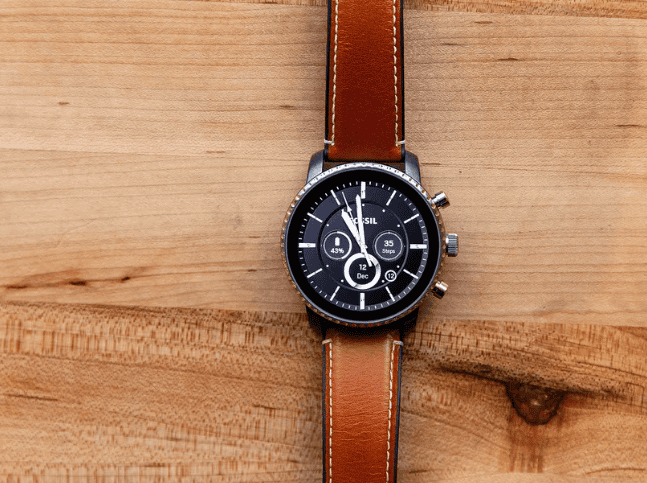
Google and watchmaker Fossil Group today announced an agreement for the search giant to acquire some of Fossil’s smartwatch technology and members of the research and development division responsible for creating it. The deal is worth roughly $40 million, and under the current terms Fossil will transfer a “portion” of its R&D team, the portion directly responsible for the intellectual property being sold, over to Google. As a result, Google will now have a dedicated team with hardware experience working internally on its WearOS software platform and potentially on new smartwatch designs as well.

“Wearables, built for wellness, simplicity, personalization and helpfulness, have the opportunity to improve lives by bringing users the information and insights they need quickly, at a glance,” Stacey Burr, the president of product management for Google’s WearOS platform, said in a statement. “The addition of Fossil Group’s technology and team to Google demonstrates our commitment to the wearables industry by enabling a diverse portfolio of smartwatches and supporting the ever-evolving needs of the vitality-seeking, on-the-go consumer.”

According to Wareable, the technology is a “new product innovation that’s not yet hit the market,” Greg McKelvey, Fossil’s executive vice president of chief strategy and digital officer, told the publication. It’s unclear what exactly that innovation is, or why exactly Google is so eager to buy it, although $40 million is a drop in the bucket for Google when it comes to acquisition costs. What we do know is that it’s somehow based on tech Fossil got its hands on when it acquired wearable maker Misfit for $260 million back in 2015.

Burr’s official statement seems to make clear that Fossil was working on some type of health and wellness-focused technology, and Fossil has been Google’s most consistent and long-term hardware partner on WearOS, since back when it was named Android Wear and Google was looking for watchmakers to help it rival Apple in the wearable space.

Burr did tell Wareable that Google saw the technology and thought it “could be brought out in a more expansive way if Google had that technology, and was not only able to continue to use it with Fossil but bring it to other partners in the ecosystem,” she said. Burr goes on to say that Fossil will bring the technology to market in the form of a product and it will expand “across our full breadth of brands over time,” before expanding “across the industry over time to benefit all.”

Putting aside the cryptic product innovation talk, Fossil has specialized in what are known as hybrid smartwatches: devices that do some minor smart features like step-tracking and notifications, but otherwise look and feel like your standard, semi-expensive wristwatch. The company makes smartwatches with touchscreens that resemble other WearOS devices and the Apple Watch, but its strong suit has always been the hybrid watch, given Fossil’s design and manufacturing experience in the traditional accessories market. The issue there, however, is that Fossil, while making some of the nicest-looking smartwatches, has been slow to adopt technologies like GPS and heart-rate tracking that have existed on other wearables for years. So in this case, Fossil may have cracked something having to do with hybrid watches, but we just don’t know yet.

For Google, this could be a big chance for it to turn WearOS around and truly try to compete with the Apple Watch. Whether the Fossil technology pushes Google to finally develop and release an official Pixel Watch with its own internal design, or it simply helps the company better refine its software, this acquisition proves that WearOS still has some fight left in it.

Google Play malware used phones’ motion sensors to conceal itself

Malicious apps hosted in the Google Play market are trying a clever trick to avoid detection—they monitor the motion-sensor input of an infected device before installing a powerful banking trojan to make sure it doesn’t load on emulators researchers use to detect attacks.

The thinking behind the monitoring is that sensors in real end-user devices will record motion as people use them. By contrast, emulators used by security researchers—and possibly Google employees screening apps submitted to Play—are less likely to use sensors. Two Google Play apps recently caught dropping the Anubis banking malware on infected devices would activate the payload only when motion was detected first. Otherwise, the trojan would remain dormant.

Security firm Trend Micro found the motion-activated dropper in two apps—BatterySaverMobi, which had about 5,000 downloads, and Currency Converter, which had an unknown number of downloads. Google removed them once it learned they were malicious.

The motion detection wasn’t the only clever feature of the malicious apps. Once one of the apps installed Anubis on a device, the dropper used requests and responses over Twitter and Telegram to locate the required command and control server.

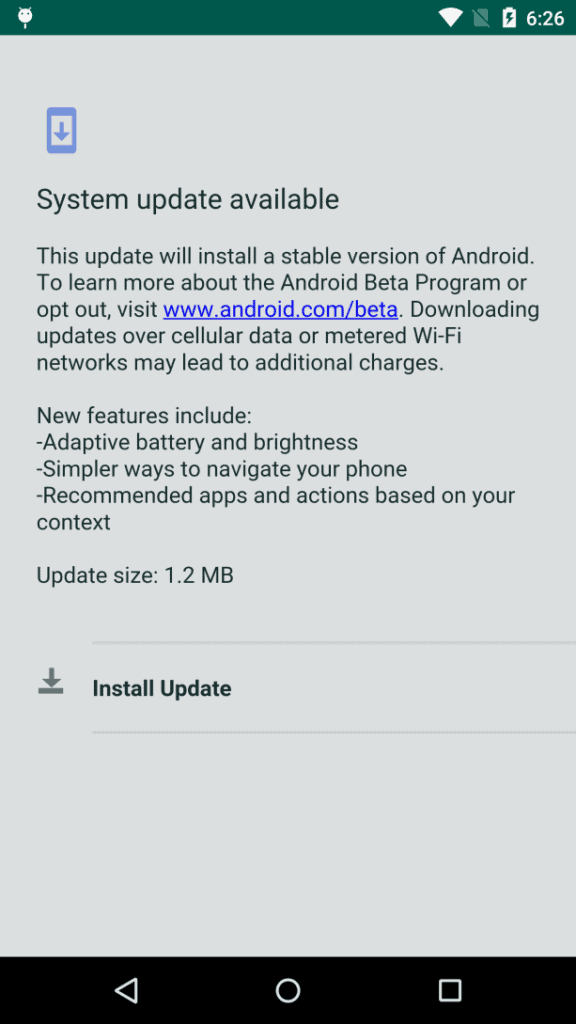
“Then, it registers with the C&C server and checks for commands with an HTTP POST request,” Trend Micro researcher Kevin Sun wrote. “If the server responds to the app with an APK command and attaches the download URL, then the Anubis payload will be dropped in the background.” The dropper then tried to trick users into installing the app using the fake system update shown below:

Once Anubis was installed, it used a built-in keylogger that can steal users’ account credentials. The malware can also obtain credentials by taking screenshots of the infected users’ screen. Sun continued:

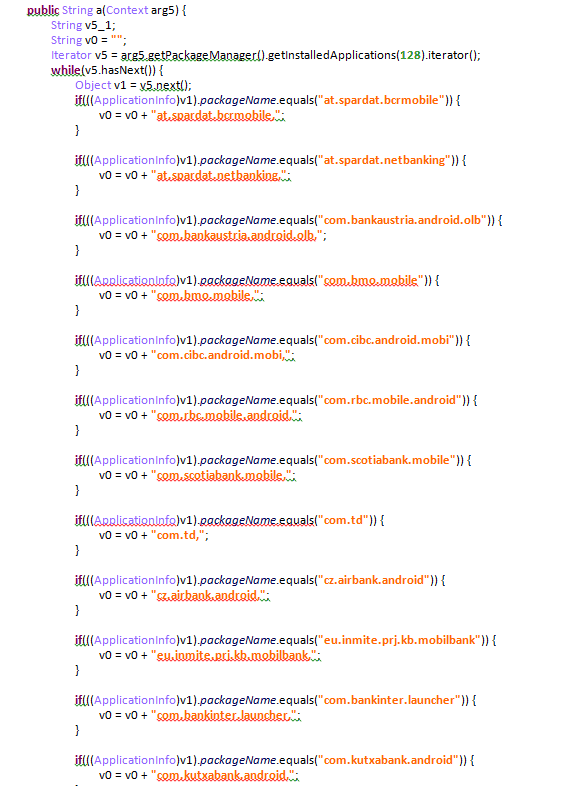
Our data shows that the latest version of Anubis has been distributed to 93 different countries and targets the users of 377 variations of financial apps to farm account details. We can also see that, if Anubis successfully runs, an attacker would gain access to contact lists as well as location. It would also have the ability to record audio, send SMS messages, make calls, and alter external storage. Anubis can use these permissions to send spam messages to contacts, call numbers from the device, and other malicious activities. Previous research from security company Quick Heal Technologies shows that versions of Anubis even function as a ransomware.

The researcher provided the following screenshot showing some of the financial apps Anubis targets:

There are two takeaways from the report. The first is that the quality of malicious Android apps is improving. The second is that Android users should continue to think carefully before downloading and installing apps on their devices. The purported benefit of both of these now-removed apps was minimal. People are better off sticking to a small number of apps from well-recognized developers.

Twitter Oopsie: Bug Made Some Android Users’ Private Tweets Public

Twitter shared some unsettling news for Android users today.

For more than four years, a bug affecting Twitter’s Android app made some users’ private tweets public. Twitter says the bug was triggered when users turned on the “Protect your Tweets” setting and made seemingly unrelated changes to their accounts, like updating their email addresses.

The “Protect your Tweets” setting makes your account private, blocking anyone who does not follow you from seeing your tweets and requiring any new followers to receive your explicit approval.

Twitter didn’t provide any additional examples of account changes that could have inadvertently disabled the privacy feature. The company says it fixed the bug days ago, on January 14, but that it has affected users since November 3, 2014.

In a blog post on the news, Twitter explained that it had already reached out to users who were affected by the bug, but it warned that it “can’t confirm every account that may have been impacted.” Twitter says it has turned the privacy setting back on for users who had the feature disabled.

Reached by Gizmodo, a Twitter spokesperson reiterated that it does “not have a complete list of impacted accounts,” and said that it “provided a broad notice so that anyone potentially affected by this can ensure their privacy settings reflect their preferences.”

“We recognize and appreciate the trust you place in us, and are committed to earning that trust every day,” Twitter said in its post. “We’re very sorry this happened and we’re conducting a full review to help prevent this from happening again.”

Stocks rise after report says US considering easing China tariffs during negotiations

Stocks rose on Thursday on the back of a report that said the U.S. could ease tariffs on Chinese goods during their trade negotiations with China.

That idea was floated by Treasury Secretary Steven Mnuchin, according to a Wall Street Journal report, which cited people close to the matter. The report, however, added that Mnuchin faced pushback from U.S. Trade Representative Robert Lighthizer, who thinks any concession could be seen as a sign of weakness.

The report sent stocks to their highs of the day, with the Dow Jones Industrial Average rising more than 250 points. The S&P 500 and Nasdaq Composite both rose about 1 percent following the report.

However, the major indexes came off their highs after a Treasury Department spokesperson working with the trade team told CNBC: “Neither Secretary Mnuchin nor Ambassador Lighthizer have made any recommendations to anyone with respect to tariffs or other parts of the negotiation with China. This is an ongoing process with the Chinese that is nowhere near completion.”

A senior administration official who participated in a trade meeting with the president on Wednesday later told CNBC that there is “no discussion of lifting tariffs now.” The official also said President Donald Trump “has no interest in making decisions now, it would put him in a weaker position.”

The Dow closed up 163 points, lifting itself out of correction territory. The S&P 500 ended the day up 0.76 percent while the Nasdaq climbed 0.7 percent.

“The good news is the reaction shows how much of a headwind the trade situation is on the market right now. It’s like a coiled spring ready to react to a whiff of good news. The bad news is it needs to be more official and less floated,” said Art Hogan, chief market strategist at National Securities.

Caterpillar shares spiked 2.2 percent, while Boeing jumped 2 percent. Caterpillar and Boeing shares are seen as bellwethers for global trade given their exposure to overseas markets. Apple also rose 0.6 percent.

Back in December, China and the U.S. agreed to stop slapping tariffs on each other’s goods for 90 days while they tried to strike a deal on trade. Recent data has shown signs of weakness in China’s economy.

Stocks had traded slightly higher earlier in the day as investors awaited Netflix’s quarterly results. Netflix is scheduled to report after the close Thursday. The stock has been on a tear so far this year, rising more than 31 percent. Netflix’s earnings will arrive after the streaming giant announced it would raise monthly subscription prices by 13 to 18 percent, a move that was cheered by Wall Street earlier this week. Dow member American Express is also set to report after the close.

“Some of the information we have gotten are surprisingly negative to me,” said Kim Forrest, senior equity analyst at Fort Pitt Capital. “It’s a mixed sort of earnings season so far.”

“Today’s information is super important, not just for Netflix, because these are our most discretionary dollars,” Forrest said. “How is that being spent? Is it being spent the same way it was last year? I think that will tell us something about how healthy the consumer is and how healthy the economy is.”

Morgan Stanley reported earnings and revenue that fell short of Wall Street estimates. The company’s results were dragged down by poor performances in its trading and wealth management businesses. Morgan Stanley shares fell 4 percent. Citigroup, J.P. Morgan Chase and Wells Fargo also reported quarterly earnings this week.

Thursday’s moves came after the major indexes posted solid gains in the previous session, lifted by the sharp gains in Goldman Sachs and Bank of America. For the week, the major indexes are all up more than 1 percent.

“Upside should now prove limited for global indices, with S&P likely to start to weaken and pullback and any strength would face strong overhead resistance between 2630-40,” said Mark Newton, managing member at Newton Advisors, in a note.

“Indices have moved between 10-15% in the last 15 trading days since Christmas Eve, and have finally reached the 50% retracement levels (or fractionally below) from the decline from September/October,” he added. “Structurally this area remains difficult as several lows were made at this area and now offer resistance on this rally.”

3 Stocks to Buy Ahead of the Next Market Crash

For some, the recent stock market volatility is a sign of a crash to come. While pulling your money out of the market is obviously one move you could make, so is investing in businesses that not only survive a downturn but thrive in one.

Three Motley Fool contributors see American States Water (NYSE:AWR), Cronos Group (NASDAQ:CRON), and Lockheed Martin (NYSE:LMT) as companies that are uniquely positioned to handle whatever the future throws at them, particularly if it is the next market crash.

Not your typical utility

Neha Chamaria (American States Water): If you’re worried about a coming market crash, you can’t go wrong adding a utility to your portfolio now. But wait, the utility stock I’m recommending today isn’t like any other: It is among the handful of utilities to have become a Dividend King and has more than tripled total returns in the past decade. That’s American States Water for you.

There are two things I particularly like about American States Water. First is its unbeatable dividend track record: The company has increased dividends for 64 straight years now. That makes it a highly bankable dividend stock even during market crashes.

Second is its growth potential. You see, while American States Water gets the bulk of revenue from providing regulated water services to the public, it also boasts 50-year contracts with the U.S. government to serve water needs of 11 military bases. This segment not only gives the company a unique edge over competitors but also adds a growth option to its portfolio.

American States Water aims to grow dividends by a more than 6% compound annual rate over the next five years, and the stock currently yields 1.6%. Even if the market tumbles and the economy slows down, being assured of a dividend hike this year and beyond from a stock that’s more than tripled investors’ money in the past decade isn’t something you’d want to pass up.

A counterintuitive defensive stock

George Budwell (Cronos Group): What’s that you say? Buy shares in a commercially unproven marijuana company with a sky-high valuation ahead of a possible market crash? That’s right. While Canada’s Cronos Group certainly doesn’t check any of the boxes of a traditional defensive stock, this mid-cap cannabis company should actually perform quite well moving forward — regardless of the overlying market conditions.

Cronos’ investing thesis has two key pillars. First off, the legal marijuana market is projected to expand at a compound annual growth rate of 34.6% for the next six years, according to a report by Grand View Research. And this astonishing growth estimate doesn’t even include secondary cannabis markets like hemp oils — an ancillary market that’s set to explode higher following the passage of the 2018 Farm Bill in the United States. In short, Cronos, as a top cannabis company, should benefit enormously from this rising tide.

Secondly, Cronos’ partnership with American tobacco titan Altria (NYSE:MO) instantly transformed the company into a top dog in this emerging space. The company now has one of the best balance sheets in the industry, a partner with the expertise to develop strong brand recognition in a field with literally thousands of nascent brands coming online, and a potential first-mover advantage when it comes to the high-value American cannabis market.

The bottom line here is that Cronos has a solid plan in place to deliver outstanding returns for investors in the years to come. That’s why this marijuana stock arguably stands out as a top — albeit unorthodox — defensive play right now.

Bombs away!

Rich Duprey (Lockheed Martin): Lockheed Martin is the single largest defense contractor for the federal government; it generates virtually all of its revenue from Defense Dept. expenditures. Yet while it has a diverse range of aircraft and advanced technologies for the Army, Navy, Air Force, and Marines, most of its business stems from the F-35 fighter jet program, which represented 27% of Lockheed’s revenue in the most recent quarter. It also receives contracts to supply U.S. allies.

Defense spending is not seen decreasing anytime soon, and even though President Trump has asked cabinet heads to submit proposals for cutting their budgets by 5%, he asked former Defense Secretary James Mattis to prepare a $750 billion budget for 2020, nearly a 5% increase from 2019’s $716 billion budget.

Lockheed Martin also pays a generous $8.80 annual dividend that currently yields 3.3%. It just increased the payout 10% last September. The defense contractor is expected to earn $19.64 a share next year, and analysts see it growing earnings more than 45% over the next five years. If the market crashes, Lockheed Martin is one stock you’ll want defending your portfolio.