Archives for January 16, 2019

Rail problems in Vancouver

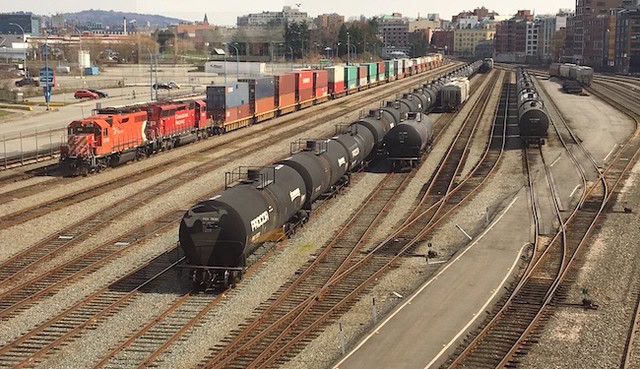
The Canadian Transportation Agency will investigate possible problems with freight train service issues in the Vancouver area including whether rail companies are fulfilling their obligations.

The agency said in a news release Monday that it’s the first time it is using its new authority to launch such an investigation, which will also determine whether there was discriminatory treatment of certain commodities.

Agency chairman Scott Streiner said it will hold public hearings, allowing parties to submit evidence and offer suggestions on how things could be improved.

The agency said hearings will be held at the end of January and give railway companies and shipper groups an opportunity to provide evidence.

The Forests Products Association of Canada said in a release that it welcomes the investigation, adding that rail delays last year cost the forest sector over $500 million.

Keith Creel, president and CEO of Canadian Pacific Railway, said in a statement he “takes great exception” to being included in the investigation.

“We have not been made aware of any formal complaints to the CTA relating to our service in Vancouver, nor has the CTA been in touch with us prior to launching this investigation,” he says.

“The fact is that CP has achieved record-setting performance in Vancouver thanks to our talented team of railroaders who work day and night to make it one of the best performing terminals in North America.”

The company says it broke a previous record for carloads of Western Canadian grain and grain products shipped to the Port of Vancouver in a single month in November. CP Rail says it has worked with CN in Vancouver to help ease congestion in Vancouver.

“Are we perfect 100 per cent of the time? No,” said Creel. “When we are not performing to the requisite level of service, I will be the first to step up and acknowledge it. The flip side of that coin is: when we are subject to unsubstantiated action, I will be the first to step up and defend the men and women who make this operation run.”

Canadian National Railway said it will co-operate fully and that the investigation should take into account the full supply chain and dozens of players involved late last year.

“CN acted swiftly and efficiently to serve its customers during this period and played its role in moving record volumes through Vancouver’s complex and multi-commodity supply chain,” the statement said. “During this period, CN moved 10 per cent more freight through Vancouver than last year.”


BP scales back exploration

The Seadrill West Aquarius drilling platform is shown in this undated handout photo. BP Canada is scaling back its oil and gas exploration plans off the coast of Nova Scotia, giving up half the offshore area included in its exploration licence.

BP Canada is scaling back its oil and gas exploration plans off Nova Scotia, giving up half the offshore area included in its exploration licence.

The Canada-Nova Scotia Offshore Petroleum Board says the energy giant is surrendering 50 per cent of the area included in its licence — a consolidation of four offshore parcels roughly 300 kilometres southeast of Halifax.

The move comes after BP failed to drill four wells within the first phase of its exploration licence, required for the second phase to be approved.

The board says the company will pay a $1-million deposit to extend the first phase of its exploration licence, which ended Monday, by one year.

It says if BP decides to drill a well during the extension period, the energy firm will need to apply for authorization.

However, the board says if BP does not drill a well during that period, the company would forfeit the deposit and either surrender the remaining area under its exploration licence, or be required to make a $2-million deposit for another one-year extension.

Indigenous owned pipeline?

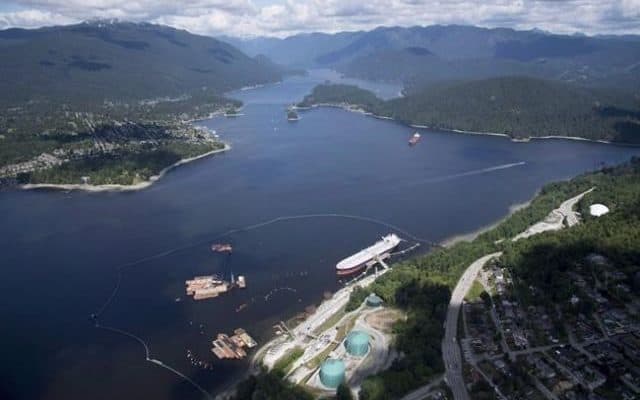
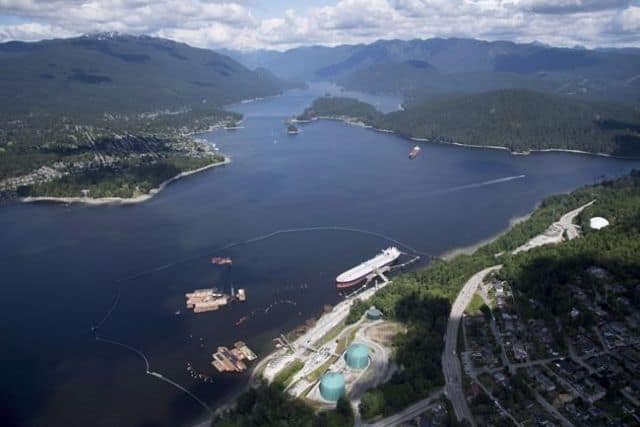
Aerial view of Kinder Morgan’s Trans Mountain marine terminal, in Burnaby.

First Nations that produce oil and gas in Canada will hear presentations Wednesday at the Indigenous Energy Summit on how they might take ownership of major energy projects, including the Trans Mountain pipeline.

Steven Saddleback of the Indian Resource Council says a session will feature presentations on financing models that could be followed to allow ownership of major projects including the oil pipeline from Edmonton to Burnaby.

When the federal government bought Trans Mountain and its controversial expansion project from Kinder Morgan Canada Ltd. last year for $4.5 billion, it signalled that it did not intend to hold it for the long term and that potential buyers included Indigenous groups.

Saddleback says other potential “long-term viable opportunities” to be discussed at the summit on the Tsuut’ina Nation outside Calgary include Canadian National Railway Co.’s proposal to make pellets from oilsands bitumen — dubbed “CanaPux” — for easier transportation to customers in Asia.

The Indian Resource Council, which has about 130 members, is to hold its annual general meeting on Thursday.

IRC member Bernard Shepherd, a councillor for Saskatchewan’s Whitebear First Nation, says Trans Mountain could be a good long-term investment and financing would not necessarily be an insurmountable obstacle.

“Some of the other activities going on around the pipeline offer short-term jobs but I think actually investing in it, owning it, I think that’s where there’s a long-term revenue stream,” he said.

He said he doesn’t think Indigenous ownership would necessarily help ensure the pipeline expansion is built, given the opposition from some environmental and Indigenous groups.

Canadians weighed down by lines of credit they don’t understand


A survey suggests 35 per cent of Canadians have a home equity line of credit and 19 per cent said they’d borrowed more than they intended.

3 million Canadians have home equity lines of credit, but half of us don’t know how they work

Over the past 15 years, home equity lines of credit have emerged as the driver of mounting non-mortgage debt in Canada — yet many Canadians don’t understand what they’ve signed up for and are not moving to pay them off, a new survey suggests.

The more than three million Canadians holding a HELOC owed an average amount of $65,000, the study released Tuesday by the Financial Consumer Agency of Canada (FCAC) found.  About one quarter of HELOC holders had a balance of more than $150,000.

Yet 25 per cent of respondents said they only made the interest payments month to month.

Ipsos conducted the online survey of 4,800 Canadians, most of them homeowners, from June 5-28, 2018, on behalf FCAC, a federal agency that promotes financial education.

HELOCs are revolving credit products secured against the equity in a home. Banks can lend up to 65 per cent of the value of a home. Such lines of credit have been easy to get and banks offer them as a default credit option to anyone with home equity.

Of the homeowners surveyed, 54 per cent had a mortgage and 35 per cent had a HELOC.

Cheap source of credit

“You can’t deny the fact that for the consumer it is a cheap source of credit. However, you have to use it well,” said Michael Toope, communications strategist for FCAC.

The problem is that people borrow more than they intended and end up struggling with the debt, he said.

The survey suggested there is a lack of understanding among consumers of how these lines of credit work.

Only half of respondents knew basic facts about the terms of HELOCs, such as:

  • Banks can raise the rate of a HELOC at any time.
  • The bank can demand the balance of a HELOC at any time.
  • There are fees to transfer a HELOC to another institution.
  • The bank can raise or lower the credit limit on a HELOC.

Interest rates began climbing in 2017 and 2018 and are likely to rise further this year. That affects the interest cost of these loans and the overall cost of paying them off. Your HELOC is more expensive than a mortgage as the interest rate is higher.

“Each bank sets its own prime rate based on the Bank of Canada rate and HELOCs are usually set at prime plus a premium, but the bank can change that premium at their discretion,” Toope said.

For some, HELOCs are risky

Almost two-thirds of respondents said they used their HELOC only or mostly as intended, as a revolving line of credit.

Yet for some, HELOCs are a risky product that eats away at their ability to build wealth, Toope said.

The equity they build in their home as they pay off a mortgage is a way for Canadians to build wealth over time, but that won’t happen if they have a debt secured by the house.

“In the end, you’re losing the long-term value of the mortgage you have in your home,” Toope said.

In a 2017 report, FCAC found home equity lines of credit may be putting some Canadians at risk of over-borrowing.

That report found most consumers do not repay their HELOC in full until they sell their home.

About 19 per cent of respondents to the new survey said they’d borrowed more than they intended.

How much do I owe?

And 18 per cent said they did not know the full balance on their HELOC.

Among those who paid only the interest on the debt, the majority were young Canadians, aged 25 to 34. That’s not unusual, as people at that stage of life tend to have lower incomes and may be burdened with student debt as well as a mortgage, but it still indicates a lack of understanding, Toope said.

About half of respondents said they used their HELOC for a renovation, but another 22 per cent consolidated other debt.

The survey found 62 per cent of those who paid only the interest expected to repay their HELOC in full within five years, a plan Toope called a “mathematical impossibility.”

Half of Canadians borrowed against their HELOCs for renovations, but another 22 per cent dipped into it for debt consolidation, with vehicle purchases and daily expenses also common uses, according to the survey.

“People should know what they are going to use it for and how to pay it down, so it doesn’t become an eternal revolving debt,” Toope said.