
Archives for January 5, 2019

Proof carding doesn’t work

Justice Michael Tulloch speaks at a public meeting on police street checks otherwise known as carding in Toronto on Wednesday, Feb. 28, 2018.

An Ontario judge who issued a report on the police practice of street checks, widely known as carding, is set to discuss his findings today.

Justice Michael Tulloch issued a report earlier this week saying carding has little to no value as a law enforcement tool and should be significantly limited in the province.

The report does allow that police may have legitimate grounds to conduct street checks in certain circumstances, but notes those are very specific and the practice as a whole should be sharply curtailed.

Tulloch is set to speak about his conclusions and recommendations in a news conference in Toronto at 11 a.m.

He was appointed by Ontario’s previous Liberal government to assess the effectiveness of new regulations meant to limit the impact of street checks on racialized groups.

Tulloch was asked to turn his attention to carding months after the previous government took steps to eliminate what it described as systemic racism in law enforcement.

Street checks began to come under intense scrutiny several years ago amid data showing officers were disproportionately stopping black and other racialized people.

The province introduced rules more than two years ago stating that police must inform people that they don’t have to provide identifying information during street checks, and that refusing to co-operate or walking away cannot then be used as reasons to compel information.

The change aimed to end arbitrary stops, especially those based on race. But critics have said the new rules don’t go far enough and have called for carding to be abolished altogether.

Race is prohibited as forming any part of a police officer’s reason for attempting to collect someone’s identifying information.

Police had long argued that street checks have value as an investigative tool, a notion Tulloch challenged in his report.
Railways ‘well-poised’

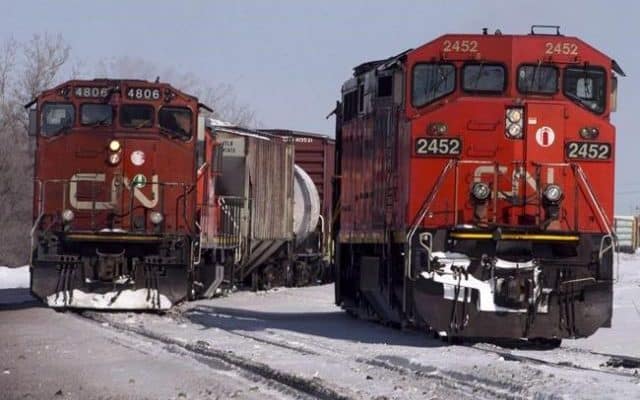
Canada’s two major railways are well-positioned to weather potential economic headwinds and the U.S.-China trade war, analysts say, as ongoing investments in new cars and track bolster crude-by-rail and commodities shipments.

Canadian National Railway Co. and Canadian Pacific Railway Ltd. shipped 23 per cent more oil and petroleum in 2018 to drive a four per cent increase in total freight traffic, according to the Association of American Railways.

Crude-by-rail exports have spiked over the past year amidst a pipeline shortage and a big discount on Western Canadian Select oil, hitting a record 327,229 barrels per day in October, a 58 per cent year-over-year increase, according to the National Energy Board.

With Enbridge’s Line 3 not set to come online until late this year and the Trans Mountain expansion facing uncertainty, CN and CP can expect continued high demand for shipments of the black stuff, DBRS analyst Amaury Baudouin said.

The railways have drawn on lessons from unfilled contracts following the crude-by-rail boom five years ago, entering into multi-year contracts with oil shippers that set minimum volumes and higher fees to help insulate them from volatile demand, he said.

“I think lessons of the past have been learned, and a lot of this capacity is being contracted on a take-or-pay basis…which means that if the economics of Western Canadian oil change a lot, CN and CP will still have that oil to move around to the U.S. refineries and the Gulf Coast.”

In 2017 petroleum, chemicals and plastics brought in 16 per cent of CN’s $13.04 billion in revenue and 14 per cent of CP’s $6.38-billion revenues. With crude comprising only a portion of those categories, surging sales will have a limited impact on the bottom line and the stock price, Baudouin cautioned.

Over the past year, Montreal-based CN has invested in rail cars, track doubling and expanded rail yards — particularly between Chicago and the West Coast — to the tune of $3.5 billion, 30 per cent more than its three-year average. It has plans to keep building in 2019.

Calgary-based CP, meanwhile, aims to have 1,000 more grain cars in service by this spring, following CN’s order for 1,000 hoppers last May.

The moves follow a major backlog in grain shipments last winter. However both railways have roared back from the bottleneck. CP moved 2.64 million tonnes of Canadian grain and grain products in October, a company record for monthly shipments that it nearly matched in November.

CN reported the highest quarterly revenues in its 99-year history in October, spurred by revenue growth of 15 to 25 per cent for grain and fertilizers as well as metals, minerals, forest products and coal.

CP, though lacking its rival’s broad access to maritime ports, traffics heavily in bulk commodities such as grain, potash, coal and fertilizer that amount to 44 per cent of its revenue, according to a DBRS report from October.

“There’s this shift in China where the diet is changing to more Western-style habits and they’re eating a lot more grain. That also demands a lot more potash [for fertilizer] than the traditional seafood-based diet,” Deutsche Bank analyst Seldon Clarke said.

The expanded port at Prince Rupert, B.C., where CN has laid track directly on the dock, is another reason for long-term optimism. It offers shippers a swift route for Asian-produced goods, avoiding the congestion of Vancouver and Los Angeles. Meanwhile, more grain is being stuffed into shipping containers and dropped on carriers bound for China, he said.

Lumber and automotive parts, however, pose a potential weak point for both railways.

“The American housing market is looking pretty weak and not going to have a sharp turnaround any time soon. Same goes for the auto industry in the U.S.,” Clarke said, pointing to plummeting lumber prices. Automotive shipment revenues dropped 21 per cent for CP and 10 per cent for CN in 2017, with further declines in 2018.

Ongoing steel and aluminum tariffs affect only a fraction of the railways’ shipments, but CN and CP remain vulnerable to the fallout from U.S.-China trade tensions and a potential economic slowdown following a decade of global growth, Clarke said.

“You’re seeing a slowdown in economic activity in China, and it’s probably a fair guess to say that that starts to impact North America at some point.”

Ship ablaze in stormy sea

A fire was burning aboard a large container ship about 1,200 kilometres off Canada’s east coast on Friday, but the crew suspended fighting the blaze because of worsening weather.

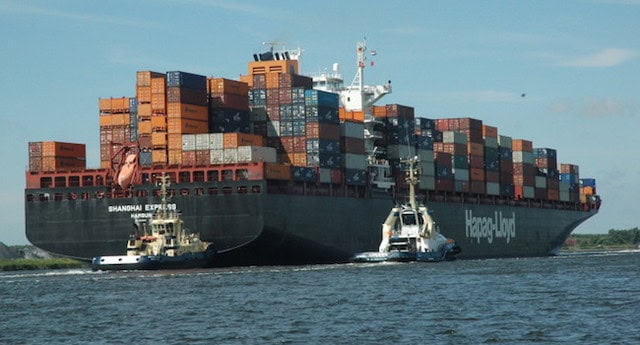
The international shipping company Hapag-Lloyd issued a statement saying the 320-metre Yantian Express was en route to Halifax on Thursday when a fire started inside a container on the ship’s deck.

The company, based in Hamburg, Germany, said no one among the ship’s crew was injured, but the fire had spread to other containers — though the extent of damage remained unclear.

There were eight officers and 15 seafarers aboard the Yantian Express, which was built in 2002 and is capable of carrying 7,510 standard 20-foot containers.

Hapag-Lloyd said the Yantian Express was its way from Colombo, Sri Lanka, to Halifax via the Suez Canal.

A spokesman for the U.S. Coast Guard in Portsmouth, Va., said coast guard officials in Boston received a call for help early Friday. At the time, the ship was 1,800 kilometres southeast of Cape Cod, Mass.

Chief Petty Officer 3rd Class Joshua Canup said he couldn’t comment on the extent of damage to the vessel or the well-being of the crew.

However, he confirmed that a cargo ship from the Netherlands, the MV Happy Ranger, was offering assistance.

“The coast guard continues to monitor the situation and a Good Samaritan vessel is on scene at this time,” he said.

Calgary offices empty

A commercial realtor says a 32 per cent decline in Calgary’s downtown office building property assessment this year will likely translate into lower costs for some tenants, but he doesn’t expect much improvement in the vacancy rate.

Greg Kwong, Alberta managing director for realtor CBRE, says companies will have to start replacing the thousands of energy industry workers laid off following the oil price crash of late 2014 before the city’s downtown vacancy rate will recover from its year-end level of 26.4 per cent.

Calgary Chamber of Commerce spokesman Mark Cooper says lower values in the downtown means property taxes are likely going to have to rise for businesses throughout the city to make up the difference.

He says investor confidence needed for job creation in Calgary is low thanks to Alberta oil prices which failed to keep up with last year’s global oil price rally due to discounts blamed on a lack of export pipeline capacity.

The city says the total assessed value of downtown office properties fell by $5 billion over the past year and now makes up only 18 per cent of the total non-residential base, down from about 32 per cent in 2015.

It says the crescent-shaped Bow Tower, home to oil companies Cenovus Energy Inc. and Encana Corp., lost 18.6 per cent of its value in 2018, falling to about $779 million. In 2015, it was valued at $1.43 billion.

Residential property assessments in Calgary are down one per cent compared with the previous year and retail assessments were little changed.