Archives for January 4, 2019

Idaho denies Hydro One

The Idaho Public Utilities Commission has joined Washington state’s regulator in denying the proposed takeover of Avista Corp. by Ontario-based Hydro One Ltd.

In a 15-page decision issued Thursday, the Idaho commission ruled that the applicants failed to demonstrate that the transaction met the public interest and no-harm tests set out in the state law that limits an electric utility’s ability to sell assets.

The Idaho commission, like its Washington counterpart, raised concerns that the Ontario government, which owns 47 per cent of Hydro One’s shares, might meddle in Avista’s operations. It pointed to Ontario Premier Doug Ford’s move to force former Hydro One CEO Mayo Schmidt to retire, which was followed by the resignation of the entire 14-member board.

The applicants have 21 days to petition a reconsideration, as was done after the Washington Utilities and Transportation Commission denied the application.

Approvals from state regulatory commissions in Idaho, Oregon, Montana, Alaska, and Washington are required for the takeover to go through. Alaska and Montana have approved the transaction, along with various federal agencies.

Hydro One and Avista say they are disappointed by Idaho’s decision and are reviewing the order to determine the appropriate next steps.

Auto sales take tumble

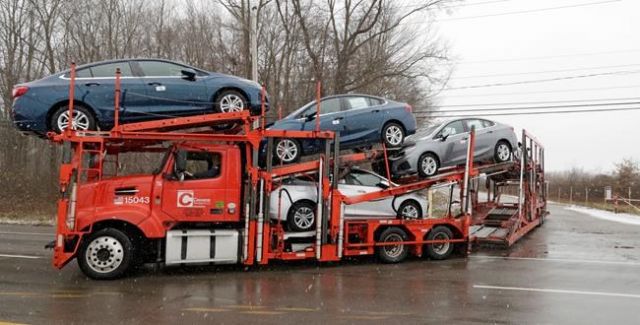
An eight per cent drop in December auto sales solidified last year’s overall decline in light vehicle sales from the record hit a year earlier, said DesRosiers Automotive Consultants Inc. Thursday.

The auto consultant said 114,289 vehicles sold in December, compared with 124,247 in the same month last year, for a 10th straight month of declines including 12.1 per cent for passenger car sales and 6.5 per cent for light trucks.

Total light vehicles sales for 2018 came in at 1.985 million, down 2.6 per cent from the record 2.039 million vehicles sold a year earlier.

The drop is a hit to the market but still shows fairly robust sales, said Dennis DesRosiers, president of the consultancy.

“Any negative is difficult for the market, but to put it into perspective, it was only four or five years ago that if you got to 1.5 million you were nirvana. And now we complain about almost two million.”

The industry should expect a similar drop for this year, likely somewhere between a two and four per cent decline in sales, he said.

“We see no signs of any upside, any positive, be there’s also a lot of potential out there that it’s hard to see any free fall. So we think it will be more of the same next year.”

Light truck sales, which include pickup trucks and various types of SUVs, rose 0.6 per cent in 2018, while generally more fuel efficient passenger car sales dropped 9.7 per cent year over year.

General Motors, which has faced criticism for plans to close its Oshawa Assembly Plant, saw sales drop 30 per cent in December from a year earlier. The automaker came second in total number of vehicles sold for the year.

Fiat Chrysler Automobiles also saw a steep drop in December at 32.5 per cent, while Ford Motor Co. was down 8.4 per cent. Toyota sales were up 28 per cent and Honda sales were up 11.2 per cent.

Ford ended the year as the top-selling brand in Canada with 297,902 vehicles sold, driven by sales of its F-150 pickup truck despite a 3.4 per cent overall decline for the year, said the automotive consultancy.

Volvo had the highest percentage growth in the industry with a 29.8 per cent climb to 9,217 vehicles sold.

800-km detour, ferries down

NM F.-A.-Gauthier

Eastern Quebec drivers seeking to cross the St. Lawrence River will have to take an 800-kilometre detour until next week after mechanical issues forced the suspension of ferry service.

The two ferries linking communities on the north and south shores of St. Lawrence east of Quebec City were out of service as of Thursday, forcing drivers to make the long trek.

The NM F.-A.-Gauthier running between Matane in Gaspe and Baie-Comeau and Godbout on the north shore has been out of commission since Dec. 17 because of a mechanical problem. The disabled ferry is just three years old.

The NM Trans-Saint-Laurent, linking Riviere-du-Loup on the south shore with St-Simeon in the Charlevoix region, ended its season Wednesday. Service on that route does not resume until April, but the ship needs to undergo repairs in Quebec City and is not available to replace the NM F.-A.-Gauthier.

A charter air service has been put in place for ferry users in the Gaspe and Baie-Comeau regions, charging the same fare but leaving users without their vehicles when they reach the other side.

The Crown corporation that oversees ferry service in Quebec said no replacement vessel was available before next Tuesday, when service is expected to resume.

Quebec Transport Minister Francois Bonnardel has previously been critical of the Crown corporation — the Societe des traversiers du Quebec — for failing to find a solution to prevent the interruption of service.

Aside from the inconvenience for commuters, companies that transport goods from one shore to the other say an interruption will come at a high cost.

Peak smartphone reached?

Behind Apple’s disconcerting news of weak iPhone sales lies a more sobering truth: The tech industry has hit Peak Smartphone, a tipping point when everyone who can afford one already owns one and no breakthroughs are compelling them to upgrade as frequently as they once did.

Some manufacturers have boosted prices to keep up profit. But Apple’s shortfall highlights the limits of that strategy. The company said demand for iPhones is waning and revenue for the last quarter of 2018 will fall well below projections, a decrease traced mainly to China.

Apple’s shares dropped 10 per cent Thursday on the news — its worst loss since 2013. The company shed $74.6 billion in market value, amid a broader sell-off among technology companies , which suffered their worst loss in seven years.

Apple’s news is a “wakeup call for the industry,” said analyst Dan Ives of research firm Wedbush Securities.

And it’s not just Apple. Demand has been lacklustre across the board, Ives said. Samsung, long the leading seller of smartphones, has been hit even harder, as its phone shipments dropped 8 per cent during the 12 months ending in September.

“The smartphone industry is going through significant headwinds, “Ives said. “Smartphone makers used to be like teenagers, and the industry was on fire. Now it feels like they’re more like senior citizens in terms of maturity.”

Tech innovations in phones grew in leaps and bounds earlier in the 2010s, with dramatic improvements in screen size, screen resolution, battery life, cameras and processor speed every year.

But the industry is a victim of its own success. Innovation began to slow down around 2014, once Apple boosted the screen size with the iPhone 6 and 6 Plus models. While phones kept improving, new features tended to be incremental, such as a new flash technique to already excellent phone cameras. It’s the stuff consumers won’t typically notice — or want to shell out for.

“Since the iPhone 6 you’ve seen it has been tough to innovate to continue to raise the bar,” Ives said.

Apple customers now upgrade every 33 months on average, longer than the 24 or 25 months three years ago, he said.

Apple’s diminished growth projections, fueled by plummeting sales in China, have reinforced fears the world’s second-largest economy is losing steam. Its $1,000 iPhone is a tough sell to Chinese consumers unnerved by an economic slump and the trade war with the U.S. They also have a slew of cheaper smartphones from homegrown competitors such as Huawei, Xiaomi and Oppo to choose from.

The fact that even Apple’s iPhone juggernaut is suffering cements a larger trend for all major smartphone makers. After a steady rise for a decade, worldwide smartphone shipments fell 3 per cent to 1.42 billion in 2018, the first annual drop, according to International Data Corp., which tracks such movements. IDC estimates that shipments will rebound 3 per cent in 2019 to 1.46 billion, but that still falls short of 2017 levels.

It doesn’t help that top phones come with four-digit price tags — $1,100 for the iPhone XS Max and $1,000 for Samsung’a Galaxy Note 9. The top-end Max model sells for $1,450 in the U.S.

“They’re getting more and more expensive while offering fewer and fewer new, innovative features that I’ll actually use,” said Zachary Pardes, a tech-savvy 31-year-old in Fairfield, Connecticut. “I’ll upgrade when the battery stops working. When I’m forced to buy a new phone, I’ll buy a new phone.”