
Archives for November 20, 2018

A cheaper Pixel is likely coming, and we may know what it looks like

Although Google has not announced a more affordable Pixel 3 variant, hopes remain high, rumors fly, and a Russian tech blog reveals a likely candidate.

This past week, Russian tech blog Rozetked shared images and specs of a phone that looks suspiciously similar to the Google Pixel 3, but this one dons a headphone jack and a different logo.

Nevertheless, the device looks promising to fans everywhere interested in a more wallet-friendly smartphone with some flagship features.

This potential Pixel successor is outfitted in the same cloudy-white glass body as the 3 and 3 XL and even features a vibrantly colored power button on the right-hand side. The display has thicker bezels and instead of a notch at the top of the screen, there’s a black bar resembling that of the chin.

The real kicker, though, is that in the same space on the backside where the Google “G” logo is typically located is a similarly sized and shaped “C” logo; so, even though this device is the embodiment of the rumors that have been circulating since before the flagship phones were even released, we should be skeptical.

Regardless, this device fuels the excitement users have for a potential Pixel variant. For now, we await any sort of indication from the company themselves.


Surge in keyless crime as thieves take advantage of new technology

The advent of electronic fobs, which are used to unlock modern car doors, have led to a rise in ‘keyless’ car crime

Keyless car crime surged last year as industry experts warned that criminals are embracing new technology to break into vehicles.

Insurers paid out a record £271m in theft claims in the first nine months of this year – a 32 per cent increase on the same period last year, according to the Association for British Insurers.

Malcolm Tarling, of the ABI, said keyless car theft was the ‘main driver’ of the increase in thefts.

The advent of keyless technology, which requires drivers to use digital fobs instead of keys to unlock a car’s door and start its engine, has created security problems for car manufacturers.

Thieves are now using readily available technology to launch so-called ‘relay attacks’, in which handheld electronic devices are used to amplify the signal being given off by a digital fob from within a victim’s house in order to fool a car parked outside into opening its door.

Mr Tarling said car manufacturers were in a constant battle to stay ahead of criminals as they employ increasingly sophisticated technology to break into vehicles.

“The industry recognises that car criminals don’t stand still. As cars become better protected, criminals see a challenge to break into them. The sector is always working out how it can ahead.”

The statistics, which show an 11 per cent increase in claims settled over the period, suggest a higher number of high-value vehicles being stolen.

Richard Billyeald, chief technical officer at Thatcham Research, told The Telegraph that relay attacks require a certain level of knowledge and are likely to be carried out by gangs who use the technology to target more expensive vehicles.

“Some level of knowledge is required. Where we’re seeing this is with organised crime groups. It’s not so much opportunistic thefts,” he said.

“This is not off-the-shelf kit – this is specialist and bespoke, made from readily available equipment.”

Mr Billyeald advised car owners to keep their keys away from the front of their houses – and doors and windows in particular – in order to reduce the likelihood of relay attacks.

“A vehicle is a high-value item and owners need to be sure they’re being careful with it. Like all security, there are many layers you can apply. It’s about what you do and don’t do,” he said.

MedMen cuts fundraising round nearly in half, as CFO quits

MedMen’s CFO quit and the company reduced a financing deal to $75 million.

Pot producer reduces financing round to $75 million from $120 million

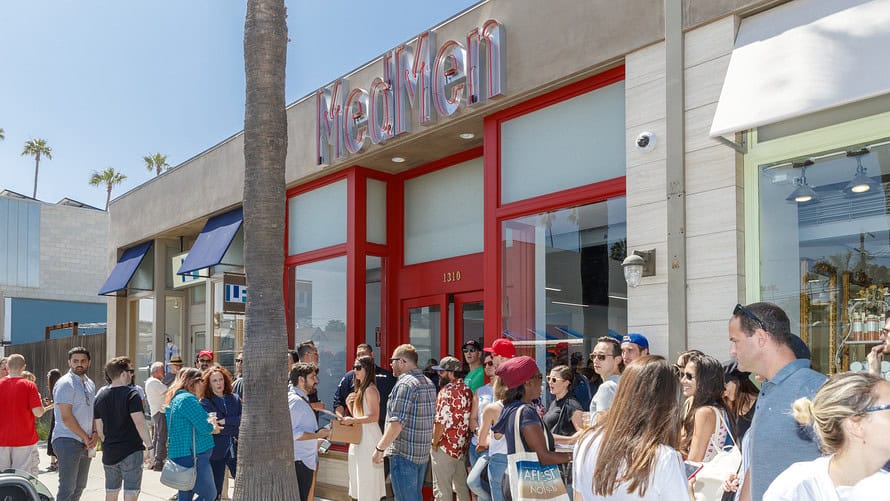
U.S.-based marijuana producer MedMen Enterprises Inc. confirmed Monday that it had reduced a round of funding by nearly half, amid its chief financial officer’s resignation and a punishing week for the stock.

MedMen MMNFF, -3.63% said Friday that CFO James Parker quit and the company planned to reduce the size of its latest round of financing by roughly 40% to $75 million, from the $120 million it had announced Nov. 9. In a statement, MedMen Chief Executive Adam Bierman said the change in the financing was related to a “global market selloff” and declined to comment on the CFO’s departure.

“Shortly after the announcement, the global market experienced a significant selloff, and as we ended last week the investors that bought that deal would have been underwater,” Bierman said. The company appointed the company’s vice president of accounting, Jim Miller, as interim CFO.

In addition to reducing the size of the funding round, MedMen said it was lowering the price of units to $5.50 from $6.80 and altering the warrants that accompany each unit — the strike price was lowered to $6.87 from $10.

MedMen grows, processes and sells pot, and is traded on the Canadian Securities Exchange — major exchanges such as the New York Stock Exchange and the Nasdaq will not allow companies to list if they violate federal laws. MedMen currently has operations in 12 states.

The Culver City, Calif.,-based company’s stock dropped 18% last week, according to Canadian Securities Exchange data, and the stock was halted by the exchange Monday. The ETFMG Alternative Harvest ETF MJ, -5.68% has fallen 7.4% in the past five days, as the benchmark S&P 500 SPX, -1.66% fell 1.3% in the same period.

Home builder confidence tumbles the most since 2014 as housing headwinds catch up

Contractors work on a KB Home project. Builders have started 6.4% more homes so far this year than in the same period last year.

Sentiment didn’t fall this sharply from one month to another even during the worst of the housing crisis

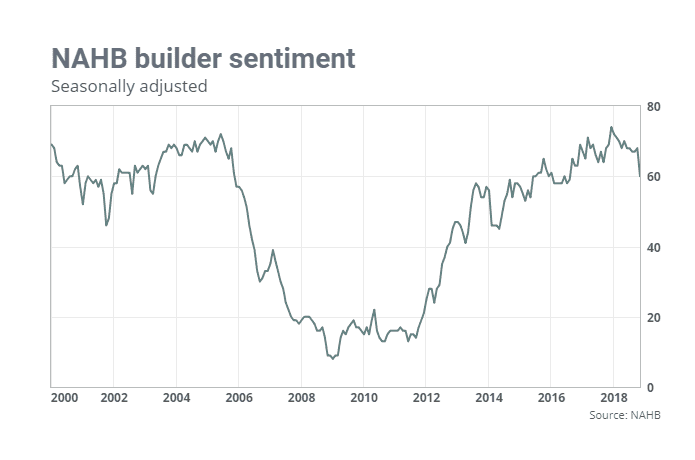
The numbers: The National Association of Home Builders’ monthly confidence index plunged eight points to 60 in November.

What happened: The many headwinds that have been dogging the industry finally showed up in this report. Labor is still expensive, lots are still scarce, lumber is at the mercy of tariff politics, and now, mortgage rates are rising and customers are holding back.

NAHB, the building industry’s Washington lobby, noted in a press release that the reading of 60 is still “positive,” but that “customers are taking a pause.” The eight-point plunge is only reminiscent of the nine-point drop just after the 9/11 attacks and one other instance, a 10-point drop, in early 2014. The overall reading is the lowest since mid-2016. November’s results badly missed the Econoday consensus of a flat reading.

In November, the sub-gauge of current conditions fell seven points to 67, the tracker of expected future conditions plunged 10 points to 65, and the gauge of buyer traffic was down eight points, to 45.

Any reading over 50 signals improvement.

Big picture: The gauge of builder sentiment has long been considered an early read on the pace of construction, an important economic indicator considering how desperately more new homes have been needed.

But such a sharp drop may presage something more sinister than a slower pace of building. Home builders were one of the first groups to feel the top of the market cycle just before the Great Recession. In June 2005, NAHB’s index hit 72, its cycle high. It started to tumble the next month, and by mid-2006 stood in contraction territory.

To be sure, builders may not be the canary in the coal mine now as they were a decade ago. And many economists have called the top of the housing cycle already. Still, such a sharp drop can only seem ominous.

What they’re saying: “Housing is performing at a moderately high level, but it also appears to be settling into a plateau,” Jefferies economists wrote after the NAHB release. “Moderation in housing activity is a blessing that delays what has previously been an inevitable development of excesses. While the pace of housing market activity has decelerated, there are no signs of threatening excesses such as inventory overhangs and a surge in delinquencies.”

The Jefferies economics team also noted that November’s NAHB survey had far fewer respondents than October’s: 315 versus 360. “Some of the volatility in this data can be traced to the month-to-month changes in the sample,” they observed.

Moody’s Investors Service on Monday downgraded its outlook on the U.S. building materials industry, saying that “private residential construction growth is decelerating.”

Market reaction: All the headwinds that builders have been complaining about may already be baked into big-company stocks. Shares of D.R.Horton, Inc. DHI, +0.52% are down 32% in the year to date, while KB Home KBH, +2.53% shares have lost 41% in that time.

Software stocks experience worst selloff in nearly 3 years as tech continues to get beaten up

Software ETF sinks 5.4%, worst day since February 2016

Tech stocks got hammered Monday, leading the broader market lower as the software sector experienced its worst selloff in nearly three years.

On Monday, tech stocks were the worst performing sector of the S&P 500 index’s SPX, -1.66% 11 sectors, dropping 3.8%, as the index closed down 1.7%, and the Technology Select Sector SPDR ETF XLK, -3.81% finished down 3.8%. Tech stocks have had a rough time since the beginning of October as the sector has seen three other sessions of 3%-or-more losses since Oct. 10.

The tech-heavy Nasdaq Composite Index COMP, -3.03% fell 3%. Additionally, the Dow Jones Industrial Index DJIA, -1.56% finished down 1.6%. Common to all those, shares of Apple Inc. AAPL, -2.45% closed down 4% following a report that the company was planning a second round of iPhone production cuts.

The heaviest losses in tech, however, appeared to show up in the software sector. The iShares North American Tech-Software ETF IGV, -5.40% was down 5.4% Monday. One of the hardest-hit stocks in the ETF Monday was Salesforce.com Inc. CRM, -2.82% , which shed 8.7%. For both the ETF and Salesforce, Monday proved to be the worst one-day percentage drop since Feb. 5, 2016, according to FactSet data.

The five heaviest-weighted stocks on the IGV index are Oracle Corp. ORCL, -3.17% , Microsoft Corp. MSFT, -1.41% Adobe Inc. ADBE, -1.50% , Salesforce and Intuit Inc. INTU, -5.77% .

Cybersecurity stocks weren’t faring much better as the ETFMG Prime Cyber Security ETF HACK, -4.66% fell 4.7%, with shares of Zscaler Inc. ZS, -12.08% , Okta Inc. OKTA, -15.66% , Everbridge Inc. EVBG, -12.57% , Splunk Inc. SPLK, -11.19% and Forescout Technologies Inc. FSCT, -6.41% leading the sector lower with sharp losses.

The battered chip sector PHLX Semiconductor Index SOX, -3.86% fell 3.9%, led lower by the bleed-out of shares of Nvidia Corp. NVDA, -4.32% which dropped 12% Monday, following last week’s 20% loss. Nvidia shares are currently down more than 25% for the year and are 51% off their high of $292.76 set on Oct. 2. Advanced Micro Devices AMD, -5.13% shares finished down 7.5%, and Micron Technology Inc. MU, -5.89% shares fell 6.7%,

The First Trust Cloud Computing ETF SKYY, -3.53% which includes VMware Inc. VMW, -2.30% , Cisco Systems Inc. CSCO, -0.46% and Juniper Networks Inc. JNPR, -1.85% , fell 3.6%, while other cloud stocks such as Dropbox Inc. DBX, -7.39% , Box Inc. BOX, -6.93% , Atlassian Corp. TEAM, -8.74% and Workday Inc. WDAY, -7.57% all fell 7% or more Monday.

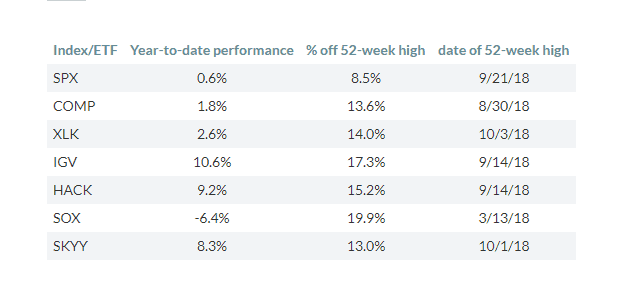
In comparison, here’s how the broader markets and tech areas have fared on the year:

Google parent Alphabet’s stock closing in on first bear market in 7 years

Share of Google parent Alphabet Inc. GOOGL, -1.48% has dropped into bear market territory for the first time in seven years in afternoon trade Monday, amid a broad and sharp selloff in the technology sector. The stock was down 3.6%, on track for the lowest close since May 3, as the SPDR Technology Select Sector ETF XLK, -5.07% shed 3.7%, with all 65 of its components trading lower. The S&P 500 SPX, -1.66% was down 1.8%. Alphabet’s stock’s intraday low of $1,026.86, it was 20.1% below its July 26 record close of $1,285.50; many on Wall Street define a bear market as a decline of 20% or more from a bull-market peak. A close at or below $1,028.40 would mark the end of the current bull market, and start of a new bear market, since it came out of the last bear market on Oct. 14, 2011. The stock was last down 3.7% at 1,029.23. The other three original FANG stocks–Facebook Inc. FB, -1.69% Amazon.com Inc. AMZN, -2.33% and Netflix Inc. NFLX, -2.18% –are already in bear markets, while the honorary FAANG stock–Apple Inc. AAPL, -2.40% also dipped into bear market territory intraday Monday before bouncing back out.