Archives for October 3, 2018

Google and Facebook join rights groups to fight Australia’s encryption bill

Facebook and Google join alliance with rights groups to voice concern about encryption bill.

Unusual alliance calls on government to ‘slow down’ and listen to ‘legitimate concerns’

Tech heavyweights Google and Facebook have joined civil and digital rights groups in an unusual alliance aimed at defeating Australia’s planned encryption laws.

The Alliance for a Safe and Secure Internet brings together the disparate groups in a plea for the government to “slow down” and listen to “legitimate concerns” about its encryption bill.

The alliance includes rights groups such as the Human Rights Law Centre, Digital Rights Watch and Amnesty International, as well as the Communications Alliance – an industry group featuring telcos Optus and Telstra. It also features the Digital Industry Group Inc (Digi), an industry body including Google, Facebook, Twitter and Amazon as members.

Lizzie O’Shea, a spokeswoman for the new alliance, said the group’s membership was diverse and typically did not agree on policy issues. But she said they were united for the first time in their opposition to the government’s encryption bill.

“As a group, we are so concerned by the bill that we feel it is our collective civic duty to use our voices to make sure that the public is aware of the alarming legislation the federal government is attempting to rush through parliament with its assistance and access bill,” she said.

The encryption bill has faced fierce resistance from rights groups and industry since an exposure draft was released last month. The bill gives law enforcement new powers to conduct covert surveillance on electronic devices and compel technology companies to assist in decrypting private communications.

The bill is set to be reviewed by the Parliamentary Joint Committee on Intelligence and Security, but opponents fear the process will be rushed and the bill will become law within two months.

The government has argued the laws are necessary to protect Australians from “those who seek to do us harm”. Former cybersecurity minister Angus Taylor said last month that more than 90% of data intercepted by the Australian federal police used some form of encryption. He said that had “directly impacted around 200 serious criminal and terrorism-related investigations in the last 12 months alone.”

“We must ensure our laws reflect the rapid take-up of secure online communications by those who seek to do us harm,” he said.

Digi has previously voiced concerns about the legislation, saying the government is effectively forcing tech companies to build weaknesses into their systems, which makes user data vulnerable. The legislation gives the government powers to issue “technical capability notices” to tech companies, compelling them to design systems to give assistance to the domestic spy agency, Asio, and other interception agencies.

“The reality is that creating security vulnerabilities, even if they are built to combat crime, leaves us all open to attack from criminals,” the Digi managing director, Nicole Buskiewicz, said.

The Communications Alliance chief executive, John Stanton, said the government was trying to ram its encryption legislation through without proper consultation.

Stanton said the bill gave law enforcement unprecedented powers without proper oversight.

“The scope of this legislation sets a disturbing first-world benchmark and poses real threats to the cybersecurity and privacy rights of all Australians,” he said.

“Instead of trying to ram this legislation through the committee process and the parliament, the government needs to sit down with stakeholders, engage on the details and collectively come up with workable, reasonable proposals that meet the objective of helping enforcement agencies be more effective in the digital age.”


Ending poverty and boosting prosperity through technology and finance

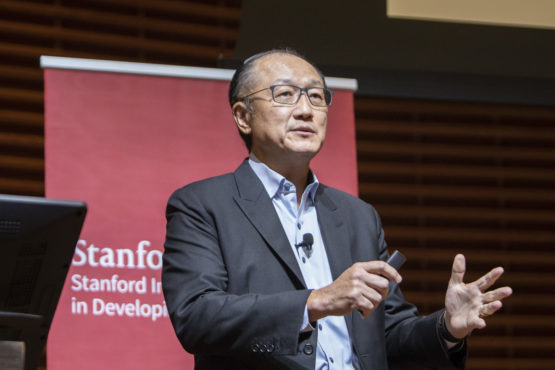
World Bank Group President Jim Yong Kim speaks with Stanford Professor Condoleezza Rice.

Building digital economies for inclusive growth, fostering resilient societies and investing in people are crucial to solving poverty, said World Bank Group President Jim Yong Kim in a talk to Stanford students and community.

How to end extreme poverty and boost prosperity for the world’s most vulnerable populations was the topic of a talk delivered by World Bank Group President Jim Yong Kim on Tuesday at Stanford University.

Following Kim’s talk was a conversation with former U.S. Secretary of State Condoleezza Rice, who is the Denning Professor in Global Business and the Economy at Stanford Graduate School of Business,

In his opening remarks, Kim laid out three crucial steps the World Bank is taking to reach its goals to end extreme poverty by 2030 and boost shared prosperity.

The first step Kim proposed is to grow the economy.

“But in our case, we want equitable, sustainable, economic growth,” Kim said. “You have got to build the economy if you want to create the jobs to create the opportunity,” he said.

The second, which is a new area for the World Bank, is to foster resilience.

“Resilience against climate change, resilience against pandemics, resilience against migration and refugees. And also, resilience for individuals through social protection programs,” said Kim, which brought him to lay out his third ambition: invest in people.

“The health and education of people is far more significant for economic growth than we ever appreciated,” said Kim.

But in the midst of all this, said Kim, is the role of technology, which he sees as a way to help the World Bank move forward in achieving its goals.

For example, in developing countries carbon pollution has been both a health and environmental issue. While advancements have been made in cleaner energies like solar power, the issue of an affordable storage option remains.

Kim laid out three crucial steps the World Bank is taking to reach its goals to end extreme poverty by 2030 and boost shared prosperity.

Technological innovations that create affordable energy storage could be a game-changer, he said.

Kim then turned his attention to other issues developing nations face, such as pandemics and famines. Could this investment model help address these urgent problems?

“Why can’t we do something that will bring funding upstream that can prevent famines in the first place?” Kim asked. He said market tools exist that can ease the financial costs associated with solving these crises, such as insurance instruments that Kim said were successful when dealing with the Ebola crisis in the Congo.

“But we didn’t know when a famine was about to happen,” said Kim. In an age of technological innovations such as artificial intelligence, can there be ways to predict when a famine might happen and intervene there?

The World Bank is partnering with several large technology firms and also with Marshal Burke, an assistant professor in the Department of Earth System Science and a fellow at the Center on Food Security and the Environment at Stanford University, and his students to come up with an artificial intelligence system that could predict up to six months ahead of when a famine might happen.

Kim also discussed concerns about automation.

“What we know is that certain things are definitely changing. Intensive, cognitive and social skills are much more in demand,” said Kim, citing the demand for app developers in India and data laborers in China. These are complicated jobs, he said.

That’s why education and investing in people are so critical, he said.

“What we want in every single country on Earth is to begin debating the quality of their investment in people,” said Kim, who is launching a new Human Capital Index that he says will rank countries in terms of their investment in human capital. The focus will be measuring only outcomes, like education.

“We have got to do something to change what the outcomes really are,” Kim said.

Kim closed his talk by asking for people who are developing technologies to think about the philosophy of technology. You have to think about how it is going to work for the poor, he said.

“Unless you start thinking about how it might be applied to reduce poverty and reduce inequality, you will likely be in a place that makes it difficult for poor countries to take advantage of it.”

The event was hosted by the Stanford Institute for Innovation in Developing Economies (aka Stanford Seed), a group of scholars working to end the cycle of global poverty.

Smart technology for synchronized 3D printing of concrete

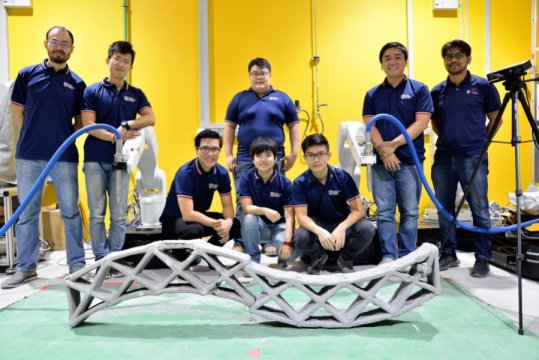
(3rd from left) NTU Asst Prof Pham Quang Cuong with his multidisciplinary team of researchers consisting of roboticists, civil engineers, mechanical engineers and material scientists, with the 3D concrete structure printed by the two robots concurrently in a single print.

Scientists from Nanyang Technological University, Singapore (NTU Singapore) have developed a technology where two robots can work in unison to 3D-print a concrete structure.

This method of concurrent 3D-printing, known as swarm printing, paves the way for a team of mobile robots to print even bigger structures in future.

Developed by Assistant Professor Pham Quang Cuong and his team at NTU’s Singapore Centre for 3D Printing, this new multi-robot technology was published in Automation in Construction, a top tier journal for civil engineering. The NTU scientist was also behind the Ikea Bot earlier this year where two robots assembled an Ikea chair in 8 min 55s.

Using a specially formulated cement mix suitable for 3-D printing, this new development will allow for unique concrete designs currently not possible with conventional casting. Structures can also be produced on demand and in a much shorter period.

Currently, 3D-printing of large concrete structures requires huge printers that are larger than the printed objects, which is unfeasible since most construction sites have space constraints.

Having multiple mobile robots that can 3D print in sync means large structures like architectural features and specially-designed facades can be printed anywhere as long as there is enough space for the robots to move around the work site.

The NTU robots 3D-printed a concrete structure measuring 1.86m x 0.46m x 0.13m in eight minutes. It took two days to harden and one week for it to achieve its full strength before it was ready for installation.

“We envisioned a team of robots which can be transported to a work site, print large pieces of concrete structures and then move on to the next project once the parts have been printed,” explained Asst Prof Pham from NTU’s School of Mechanical and Aerospace Engineering.

“This research builds on the knowledge we have acquired from developing a robot to autonomously assemble an Ikea chair. But this latest project is more complex in terms of planning, execution, and on a much larger scale.”

Printing concrete structures concurrently with two mobile robots was a huge challenge, as both robots have to move into place and start printing their parts without colliding into each other.

Printing the concrete structure in segments is also not acceptable, as joints between the two parts will not bond properly if the concrete does not overlap during the printing process.

This multi-step process starts by having the computer map out the design to be printed and assign a specific part of the printing to a robot. It then uses a special algorithm to ensure that each of robot arm will not collide with another during the concurrent printing.

Using precise location positioning, the robots then move into place and print the parts in good alignment, ensuring that the joints between the separate parts are overlapped. Finally, the mixing and pumping of the specialised liquid concrete mix have to be blended evenly and synchronised to ensure consistency.

Professor Chua Chee Kai, Executive Director of the Singapore Centre for 3D Printing said disruptive Industry 4.0 technologies like additive manufacturing, can be advanced even further when combined with other innovative technologies like robotics, AI, materials science and green manufacturing techniques.

“This multiple robot printing project is highly interdisciplinary, requiring roboticists to work with materials scientists to make printable concrete. To achieve the end result of a strong concrete structure, we had to combine their expertise with mechanical engineers and civil engineering experts.”

“Such an innovation demonstrates to the industry what is feasible now, and prove what is possible in the future if we are creative in developing new technologies to augment conventional building and construction methods.”

This research project was supported by the National Research Foundation, Singapore (NRF Singapore) and Sembcorp Design and Construction, one of the key industry research partners of SC3DP.

Moving forward, the NTU research team will look at integrating even more robots to print larger scale structures, optimising printing algorithm for consistent performance and to improve the concrete material for faster curing.

GMP Securities reveals top picks in technology and healthcare

GMP Securities has announced its “Best Ideas” picks for the next 12 months, with a number of technology and healthcare stocks making the grade of top picks.

Published on a quarterly basis, GMP’s Best Ideas covers stocks they see providing at least a 20-per cent return. The investment banker notes that after outperforming over the second quarter of 2018, Canadian markets were down compared to the US in Q3, with the S&P/TSX falling 1.3 per cent versus a 7.2 increase for the S&P 500.

First up in tech and healthcare is ATS Automation Tooling Systems (ATS Automation Tooling Systems Stock Quote, Chart: TSX:ATA), which saw solid gains of 90 per cent over the past year but is still reasonably priced, says analyst Justin Keywood, who puts a price target of $29.00 on ATA, representing a projected 12-month return of 21 per cent at the time of publication.

“We believe that this strong stock run is not over as elevated organic growth continues, margin expansion initiatives progress and strategic acquisitions loom,” says Keywood. “We continue to hear strong prospects for automation in the healthcare and EV industries as well, consistent with ATS’ views and recent results.”

Keywood also sees value in specialty pharma company HLS Therapeutics (HLS Therapeutics Stock Quote, Chart: TSXV:HLS) which recently completed a REDUCE-IT trial for FDA-approved cardiovascular drug Vascepa by meeting the primary endpoint of demonstrating a 25 per cent relative risk reduction of CV events.

“HLS owns the Canadian rights [to Vascepa], which we value to be worth an extra $4 to $25/share, and our recent discussion with a CV pharmacology expert points to the higher end of this range. The statistical significance of the trial, health of the patient population and a lack of comparable other treatments sets up for Vascepa to be a blockbuster drug,” says Keywood.

The analyst has upped his target for HLS to $21.00, representing a projected return of 52 per cent.

Cannabis company CannTrust Holdings (CannTrust Holdings Stock Quote, Chart: TSX:TRST) gets the nod from analyst Martin Landry who says that even though the stock has performed well over the last three months, there’s further upside ahead. Landry rates TRST a Buy with a target price of $15.50, representing a projected return of 24 per cent.

“CannTrust is expanding its production capacity to 100 tonnes while keeping an impressive discipline on its SG&A spend at a time when the operating expenses of its peers have ballooned. This combined with the potential for a US listing, have led us to lower our discount rate by 100bps to reflect the expected lower cost of equity or debt capital,” says Landry.

Landry also likes Moncton, New Brunswick’s Organigram Holdings (Organigram Holdings Stock Quote, Chart TSXV:OGI), which he sees to be trading at a significant discount to its peers while at the same time it’s likely to achieve positive EBITDA faster than most other licensed producers (LPs) due to its high yields and low cost structure.

“The valuation discrepancy between smaller LPs (market cap sub $2 billion) and the big five has accelerated in recent months,” says Landry. “The five largest LPs trade at a valuation multiple 5x higher than OGI on an 2020 EV/EBITDA basis, vs ~2x just three months ago. This is partly due to US-based retail investors having a better awareness of the big five, something which could change should OGI decide to list in the US.”

Landry gives a 12-month target of $8.50 for OGI, representing a projected return of 23 per cent.

GMP’s Deepak Kaushal says Drone Delivery Canada (Drone Delivery Canada Stock Quote, Chart: TSXV:FLT) could be the first licensed operator for drone delivery in Canada, building a high growth, high margin business with attractive barriers to entry and IP essential to the industry.

“In our view, DDC is executing exceptionally well and has matured their technology, systems and process to a level that can achieve reliable and repeatable drone operations. While development is far from complete, we believe this significantly reduces early-stage technical risk,” Kaushal says.

The analyst has set a target of $2.55, representing a projected return of 76 per cent.

Kaushal also favours crytocurrency merchant bank Galaxy Digital (Galaxy Digital Stock Quote, Chart: TSXV:GLXY), which the analyst sees as the best public market exposure to cryptocurrencies out there.

“We spoke to 20 senior executives at cryptocurrency investment funds, traders, advisors, exchanges and blockchain software companies. Galaxy is widely recognized as a leading brand with strong talent, access to the best deal flow, and a key contributor to the inevitable institutionalization of the sector,” he says.

Kaushal gives Galaxy a $7.10 target price, representing a projected return of 193 per cent.

Finally, media and entertainment company Stingray Digital Group (Stingray Digital Group Stock Quote, Chart TSX:RAY.A) is another GMP Best Idea, says Kaushai, calling Stingray a successful growth-by-acquisition story that’s likely to sustain high grown, profitability and shareholder returns both via acquisitions and organic growth.

“Since 2007, Stingray has made 36 acquisitions and grown revenue 33 per cent annually with an average adj. FCF ROIC of 20 per cent/yr. With the acquisition of [Newfoundland Capital Corporation], Stingray said it can increase its annual M&A target to $10 million EBITDA for $50 million, up from $5 million for $25 million previously. We estimate adding $7 million in EBITDA annually is achievable and estimate this could add $3.82/sh in upside,” says Kaushai.

The analyst sets a 12-month target of $14.50 for Stingray, predicting a return of 65 per cent at the time of publication.

News Corporation (NWS) Moves Lower on Volume Spike for October 02

News Corporation (NWS) traded on unusually high volume on Oct. 02, as the stock lost 1.03% to close at $13.39. On the day, News Corporation saw 1.1 million shares trade hands on 5,341 trades. Considering that the stock averages only a daily volume of 665,756 shares a day over the last month, this represents a pretty significant bump in volume over the norm.

Generally speaking, when a stock experiences a sudden spike in trading volume, it may be seen as a bullish signal for investors. An increase in volume means more market awareness for the company, potentially setting up a more meaningful move in stock price. The added volume also provides a level of support and stability for price advances.

The stock has traded between $17.70 and $12.70 over the last 52-weeks, its 50-day SMA is now $13.93, and its 200-day SMA $15.63. News Corporation has a P/B ratio of 0.84.

News Corp is a diversified media and information services company focused on creating and distributing authoritative and engaging content to consumers and businesses.

Headquartered in New York, NY, News Corporation has 28,000 employees and is currently under the leadership of CEO Robert Thomson.

Markel Corporation (MKL) Moves Lower on Volume Spike for October 02

Markel Corporation (MKL) traded on unusually high volume on Oct. 02, as the stock lost 0.34% to close at $1,177.70. On the day, Markel Corporation saw 54,865 shares trade hands on 3,569 trades. Considering that the stock averages only a daily volume of 30,288 shares a day over the last month, this represents a pretty significant bump in volume over the norm.

Generally speaking, when a stock experiences a sudden spike in trading volume, it may be seen as a bullish signal for investors. An increase in volume means more market awareness for the company, potentially setting up a more meaningful move in stock price. The added volume also provides a level of support and stability for price advances.

The stock has traded between $1,228.32 and $1,049.95 over the last 52-weeks, its 50-day SMA is now $1,192.28, and its 200-day SMA $1,143.72. Markel Corporation has a P/B ratio of 1.73. It also has a P/E ratio of 43.4.

Markel Corp is engaged in the business of property and casualty insurance. It focuses primarily on specialty lines, such as executive liability to commercial equine insurance. It also invests in bakery equipment manufacturing and residential homebuilding.

Headquartered in Glen Allen, VA, Markel Corporation has 15,600 employees and is currently under the leadership of CEO Richard R. Whitt / Thomas S. Gayner.