Archives for September 29, 2018

How Carry-On Bags Save Me Major Money

Several major airlines have announced recently that they’ve increased their checked bag fees — or soon will. That means $30 or more per suitcase. If you have a large family or you’re just not a light packer, these fees can add up quickly.

In the past year, I’ve taken weeklong vacations in the U.S. and Mexico, attended multiday conferences, traveled on cruises and taken extended family visits — and not once have I had to check a bag. In fact, my family has flown several times every year for the past decade, and the only times we have ever checked luggage were to take advantage of duty-free liquor deals or to transport something that was not otherwise allowed in carry-on bags. Here’s how we do it.

Don’t Pack for a Bunch of ‘What Ifs’

man luggage airport plane jeshoots-com-722888-unsplash

Think about the places you’ll go, the weather and any dress requirements you might encounter. I stick to one outfit per day, with an extra undershirt and pair of socks and underwear in the summer. Shorts and jeans are usually the biggest space hogs, so I plan to wear them two to three days each for most trips.

If I need to dress up, I’ll pack one pair of dress shoes, a pair of dress pants and a different dress shirt and tie for each occasion. Depending on how much of the day I’ll be dressed up, I might cut back on casual wear. There’s no sense in bringing two T-shirts that I’ll only wear for two hours each. Bring one, and if you don’t want people to notice you’re wearing the same shirt twice, just wear it again on the flight home.

Understand Packing Science

Worker checking wing as luggage rolls onto airplane© Lester Lefkowitz/Getty Images Worker checking wing as luggage rolls onto airplane

The best method for packing a suitcase is a hotly debated issue. Some swear by vacuum packing. Those vacuum-packing bags are tempting, sure, but just remember that you have to get everything back, too. If you need an actual vacuum to get it all in there, you’ll need the same thing to get it all back.

That’s why I strongly believe that the most efficient way to pack clothes in a suitcase is to roll them into a cylinder shape. And I do this with almost everything.

Roll everything up and pack it as tightly as possible. Pack the big stuff first, and then fit smaller items like underwear or ties in crevices. I find socks are easier to keep flat in some cases, as they can be wedged into places that other rolled clothes won’t fit. If you do all of this carefully, you can avoid wrinkles (even if you don’t, just about anywhere you go is going to have an iron).

If I’m packing another pair of shoes, I will put them in the bottom of the suitcase first, facing opposite directions — the same way you would find them in a shoebox at the store. If I’m really trying to maximize space, I’ll stuff them full of socks to open up more space for other clothes. After all, the socks are going to be in the shoes all day anyway.

Use the Personal Item as Storage
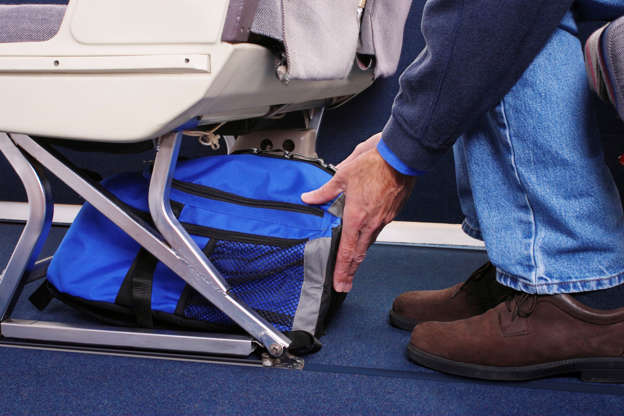
Carry-on Luggage© Gene Chutka/Getty Images Carry-on Luggage

I travel with a reasonably sized backpack. I put my computer, tablet, in-flight entertainment, etc. in there, but I also use it for things like a light jacket, toiletry bag or other awkward items that don’t fit nicely in my suitcase. Women can bring a backpack and put their purse inside of it for the flight to keep within the limit of one personal item. Just be sure to do a test fit before you leave the house.

Backpack pockets are great for jewelry, watches, medications, snacks, extra socks, umbrellas and other items.

Consider Your Airport Wardrobe as Part of Your Packing

Family pushing luggage cart in airport.© Thierry Foulon/PhotoAlto/Getty Images Family pushing luggage cart in airport.

If space is really at a premium, I set aside the bulky items to wear to the airport. For instance, if the nights will be chilly where I’m traveling, I might wear jeans plus a jacket or hoodie on the plane, even though shorts and a T-shirt would be plenty comfortable at flight time. The jacket doesn’t count as a personal item, and the jeans won’t take up valuable real estate in my bag.

I will also wear the bulkier shoes on the plane and put the smaller ones in my bag. Another trick is to tie a pair of shoes to your backpack. A friend of mine recently did this when his bag was just too full to fit anything else. No one said anything about it.

Treat Your Kid Like an Adult

A family packing a mini van before a vacation.© Hero Images/DigitalVision/Getty Images A family packing a mini van before a vacation.

Kids’ mini-suitcases and backpacks are cute, but if you’re traveling with younger children, be sure to bring a full-size carry-on and personal item for them. Since children’s clothes take up less space, you can fill the rest of the suitcase with overflow or toiletry bags for the rest of the family. The airlines want to see one carry-on and one personal item per person, but they don’t require that each person lug their own bags. You paid for the seat, so use all the space you’re entitled to.

A Few Odds and Ends

© iStockphoto/Getty Images

If the place you’re going to has a laundry facility, you can just plan to wash your clothes there. That can significantly cut down the amount of clothing you need to pack.

Also, if you pick up a souvenir or two on your trip and have trouble fitting everything on the way back, remember that the airline is going to charge you $25 to $30 to check a bag. If push comes to shove, you could likely leave your socks or undershirts behind, bring home your new goodies and then buy new socks or undershirts for less than the cost of a checked bag.

Though these tips will help you pack lighter and save money, by far the best part of packing efficiently is that when you walk off the plane, you never have to worry about lost luggage or waiting in the sea of people at the baggage carousel.


They may share love, but many couples don’t share money

Some couples share everything, from homes, to clothes to pets. But there’s one thing many don’t mingle: finances.

In fact, one-in-five people keep and manage their money separately from their partners, according to a new Policygenius survey.

An even greater percentage (24%) don’t share any major financial accounts, including a checking, savings, credit card or mortgage account, while almost 30% of couples don’t even know each other’s salaries.

“It doesn’t surprise me that many people keep their money their own, especially if their partner is in debt,” Michael Kelley, certified financial planner and founder of Kelley Financial Planning, said. “Without transparency in the finance department of your relationship, you could run into some problems.” (Before you get married, make sure you’ve made these money moves.)

Our survey speaks to this common assertion. Among couples who don’t manage money together, 20% say they plan to leave their partner due to financial problems. Compare that to couples who do handle their finances together: Only 4% told us they plan to leave due to their partner’s money issues.

The survey was based on responses from a nationally representative group of 1,526 adults across the United States. It was conducted by Policygenius using Google Surveys between Aug. 28 and Aug. 31, 2018.

Why couples keep money apart

More than half of couples who manage their money separately from their partner don’t share any financial accounts, including checking accounts, savings accounts, mortgages and credit card accounts. Many people who manage money separately don’t have any knowledge of their partner’s finances, our survey shows.

Keeping separate financial beds is partially the product of cultural changes. Young people are getting married later, and waiting until they’ve tied the knot to manage their money together, said Catalina Franco-Cicero, a certified financial planner at Tobias Financial Advisors.

Our survey supports this trend: 54.3% of couples who live together without kids manage money separately, while only 17.4% of couples who are married without kids do.

People “sometimes move in together without considering how finances are going to work,” Franco-Cicero says. “It’s not always equitable.”

Related video: Money mistakes that will ruin your relationship(provided by Money Talks News)

Other societal shifts include an increase in dual-income households. A 2015 survey from Pew Research Center found the share of households in which both parents work full-time has climbed to 46%, up from 31% in 1970. The growth was largely attributed to more women entering the workforce, but is also related to the increase cost of living. Families with two full-time working parents were better off than other families, Pew found.

The survey results could be affected by some people’s proclivity to hide an account or money from their partner, said Dennis Nolte, certified financial planner and vice president of Seacoast Investment Services. People keep secret accounts if they find their partner’s spending habits unsavory and don’t want to give them access to their own money, or their partner is in a lot of debt.

“Lots of people keep things walled off from everyone, even their partner, and finances are no different,” he says. “If you’ve been burned before, you may be even more likely to hide something from your partner.”

The pros & cons of keeping your money apart

Keeping your money separate isn’t always a bad thing — especially, as Nolte mentions, if you just went through a nasty divorce or you have an inheritance you want to protect.

Having some or all of your own financial accounts can foster a sense of security, since you won’t be left in dire straits if your partner leaves you or unexpectedly passes away without life insurance or an estate plan. The former isn’t an unfounded concern: 54% of survey respondents said they didn’t have a life insurance policy in their name. (If this is you, find out how much life insurance coverage you need with this free calculator.)

Plus, in some relationships, keeping separate accounts for discretionary spending can reduce fighting.

“You may just want your own stash of money to keep peace in the marriage,” Franco-Cicero says. “Do what you’re comfortable with — you can have funds separate and be fine.”

Conversely, couples who manage their money separately may be less prepared if financial emergency strikes, since they don’t know how much cash each has on hand or banked away for retirement, said Ashley Folkes, a certified financial planner and Divisional Vice President at AXA Advisors.

That’s why, no matter how you handle your money, communication should come first.

“The perfect formula is, regardless if you keep your money together or not, you need to talk about money,” he says. “When people stop talking about money … there are painful implications. It’s going to destroy your relationship.”

Other financial experts echoed this sentiment.

Paul Morrone, a certified financial planner at U.S. Wealth Management, has worked with clients who hid debt from their significant other, only to later file for bankruptcy and drag their partner down with them.

“Obviously, that’s going to cause relationship strain on the partner who got screwed over,” he says. “I don’t blame them.”

How couples can do money better, together

You don’t necessarily need to go to the bank tomorrow and merge all of your finances. But it helps to talk openly about the status of your financials — good or bad — and set goals for the future.

Morrone doesn’t recommend managing every penny together, but suggests couples keep at least some sort of household budget for shared expenses. As long as financial expectations and goals are roughly aligned, the couple can spend their money how they see fit, he says.

“You need to be somewhat working together,” Morrone said.

Couples who share expenses should have an open discussion about how to split the cost, says Kristi Sullivan, owner of Sullivan Financial Planning in Colorado. For example, if one person makes more money and wants to buy a nicer house than their partner can afford, they need to talk about splitting the cost fairly — not necessarily equally.

“If you’re going to some sort of split for household bills, make it proportionate to what each person makes,” Sullivan said.

Longer-term goals are harder to divvy up. If one partner is a saver and the other is a spender, they might be in very different situations when it comes to retirement.

“That can lead to resentment and a diminished lifestyle in retirement, so long-term goals needs to be agreed upon just like the other bills,” Sullivan said.

It’s also important to talk about money regularly.

Every other Sunday, Kelley sits down with his wife so they can assess their financial health. They goes through their spending and 401(k) contributions and plan financially for any upcoming events. He says this helps him understand “where everything’s at” financially, so there are no surprises.

“It adds a whole new level of transparency,” Kelley says. “It takes a lot of unnecessary stress out of the relationship. It helps you sleep better at night.”

Women are losing sleep over this retirement savings fear

When it comes to retirement savings, living too long can be a blessing or a curse.

For women, who tend to outlive men and spend years caring for family members, it’s a major cause of anxiety. Those were the findings of a recent survey by the Nationwide Retirement Institute.

In February, the institute performed an online poll of 1,007 adults over age 50 with household income of at least $150,000 and 522 adults over age 50 who are or have been caregivers.

Of the participants, 71 percent of women said that they were worried about having enough money to pay for long-term care expenses.

Preparing for the future

Preparing for the future  10:08 AM ET Thu, 27 Sept 2018 | 01:08

That worry was especially keen among caregivers: 3 out of 4 said they were concerned about keeping up with long-term care costs.

Women feel the strain of long-term care keenly, as they tend to be the ones looking after their elderly and infirm parents and spouses.

“Sons want to care for mom and dad and be supportive, but they feel comfortable identifying an expert to navigate that,” said Joanna Gordon Martin, founder and CEO of Theia Senior Solutions.

“Daughters feel that it’s their responsibility to provide care, even if they don’t understand the complexity of the landscape,” she said.

Here’s what women need to know about planning for long-term care.

A slippery slope

It’s no secret that paying for long-term care is a costly endeavor. In 2017, the annual national median cost of bringing in a home health aide was $49,192, according to data from Genworth.

A year’s worth of care in a semiprivate room at a nursing home is even more: $85,775 was the annual national median cost, according to Genworth.

See below for details on assisted living expenses.

Assisted living costs across the nationThe cost of assisted living in 2016, by state.+-30k40k50k60k70kSource: Genworth Financial. Graphic: Nicholas Wells | CNBC. © Natural Earth

Colorado


Annual cost: $48,750
Rank: 15

Recruiting family members to help out with these needs adds on a different kind of cost.

Seven out of 10 of the participants in Nationwide’s study said they would like the option of relying on a family member if they needed long-term care.

Without the appropriate planning in place, things can quickly become overwhelming and may potentially endanger the caregiver’s career.

“It’s a slippery slope,” said Martin. “It starts with ‘I’ll go to one or two appointments’ and then it eventually becomes ‘I’ll fly down to Florida.'”

Indeed, on average, caregivers in Nationwide’s study said they spend 56 hours a week caring for loved ones.

The best laid plans

Caring for elderly patient

Peter Zander | Getty Images

Despite the fact that survey participants had a clear idea of how they wanted to be cared for, few people were talking to their family members about it.

About half of the individuals in the Nationwide study said they were speaking with their spouses about the cost of long-term care. Only 10 percent said they spoke with their kids about it.

“People want a family member to care for them, but they aren’t taking the steps to have the conversation,” said Holly Snyder, vice president of Nationwide’s life insurance business.

Here’s where to begin.

Talk to your spouse and the kids: You can’t prepare your family to provide care if you don’t make your wishes known well ahead of time. Work with your advisor and your family to discuss where and how to receive care, as those choices can be a significant factor in determining the cost.

Bring in your financial advisor: Your advisor can also help you come up with a way to pay for those expenses. Your funding choices for long-term care can include a traditional long-term care insurance policy, a hybrid cash-value life insurance policy to help cover these expenses or self-insuring with your own wealth — as long as you have the money.

Hammer out your legal documents: Head off legal battles at the pass. Get a health-care proxy in place so that you designate a trusted individual to oversee your medical care and ensure that professionals comply with your wishes in case you’re unable to communicate.

Also, consider a power of attorney for your finances. You would select a trusted person to make financial decisions for you and ensure your bills get paid if you’re incapacitated.

Don’t forget the small details: Imagine that your elderly parent has a medical emergency and is on the way to the hospital. Would you be able to answer questions on medications and allergies? Spell out those details in a written plan so that you’re ready.

“It’s not just the financials that are in play, but who are the doctors?” asked Martin. “What are the medications? Who will care for the dog? Have that plan in place.”

The top reason people start a side business may not be what you think

More money.

That’s the plain and simple truth about starting a side business.

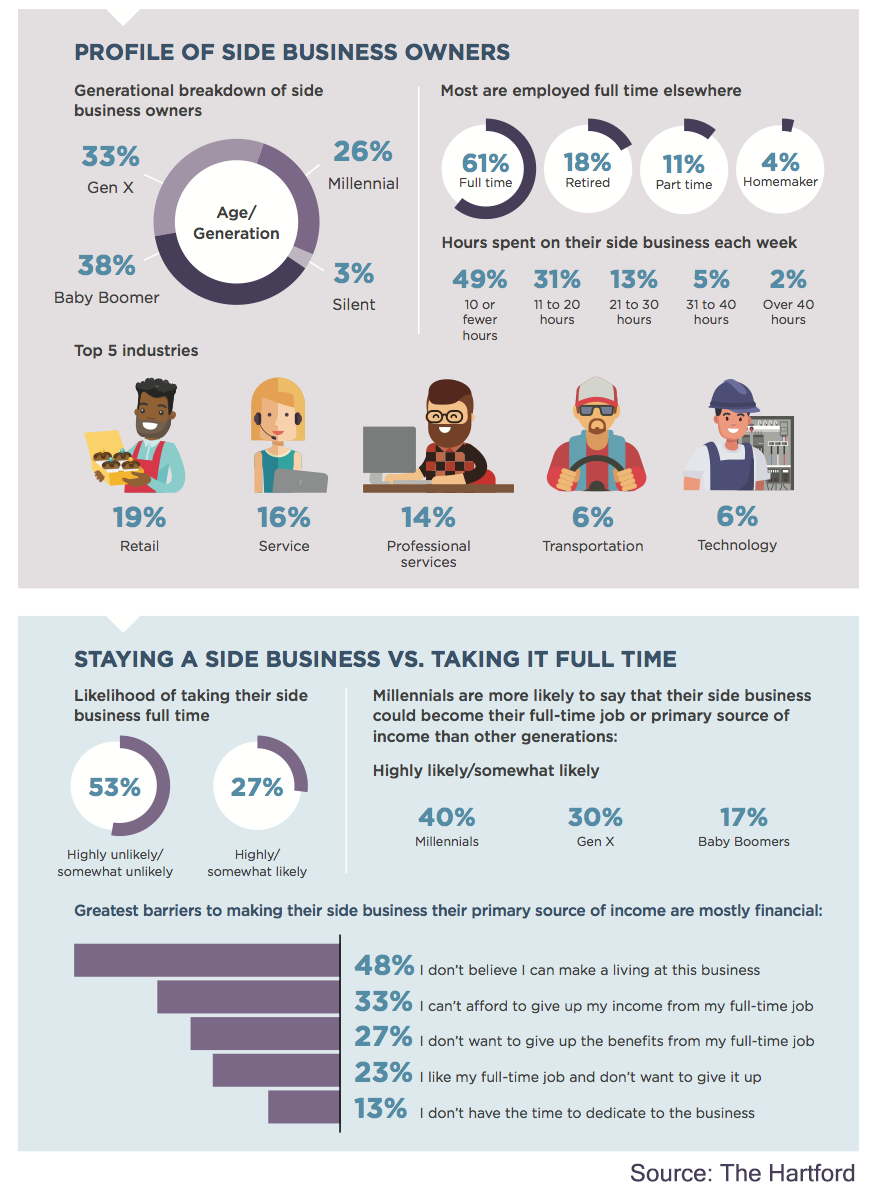
About 57 million Americans have a side hustle, according to The Hartford. The insurance company conducted an online survey of 4,135 U.S. adults in May – 1,033 of whom said they have a side business.

More than half of these part-time business-owners work full-time, and they say it takes about 10 hours or fewer every week. Half of those with a full-time job said at least some of their time off goes to working on the side gig.

But the most interesting finding was, no matter the age of the business-owner, nearly two-thirds said finances were the main driver of starting a side hustle.

So much for passion projects or escaping the rat race.

It makes sense, says Nick Loper, founder of Side Hustle Nation.

He started his first side business for money and it grew into a passion. Actually, Loper’s passion is now side hustling. His site covers myriad aspects of starting a side gig, with lists of ideas, information on affiliate marketing, starting a blog and support for would-be side hustlers.

Loper cites Cal Newport’s “So Good They Can’t Ignore You,” which says following your passion is ridiculous advice.

First, true passion is rare. Second, “there might not be a market around your passion,” Loper said.

Another reason not to start a business around something you love: It can cut into your enjoyment when you find yourself struggling to monetize and scale. You should definitely have some interest and expertise in the area, though.

Loper created a footwear shopping comparison site in 2004 as his original side hustle, and it was not an undying passion project. But it did reflect an interest, and the growth of e-commerce made it a viable business model.

The highest-paying side hustles on Fiverr

The highest-paying side hustles on Fiverr  10:55 AM ET Tue, 1 May 2018 | 01:00

One caveat: “If you’re doing it just for the money, you’re unlikely to have the motivation to keep going if you don’t see immediate results or returns,” Loper said. “Once it starts working, is [the money] enough to keep you going?”

Loper says side hustles should be fun, and it’s best to keep an open mind about the chances of a business working out.

“A lot of people fall into the trap of thinking they need this paradigm-shifting, never-been-done-before idea,” Loper said. “But most business ideas have been done before.”

He points to Google – which was not the first search engine invented – and the proliferation of multiple sushi restaurants in many neighborhoods as proof that a successful business does not need to break new ground.

Try a new business for a limited period of time. “If you see some results, fantastic,” Loper said. If it’s not working, just move on to the next idea on your list.

Although small-business owners want extra income, for most it is not enough to take their business full time, according to The Hartford. Just about 25 percent of side business owners said their business could become a full-time job or primary source of income. And a third said that was highly unlikely.

“It’s empowering to make that first dollar,” Loper said. He quotes a friend who said, “We’re in this transition to a freelance economy. The people who are going to be primed for success are the ones who are already thinking of themselves as entrepreneurs.”

A side-hustle mind-set can fit nicely into an existing 9-to-5 life. “Think of your day job as being your biggest client,” Loper said. “It doesn’t have to be your only client.”

As facial-recognition technology grows, so does wariness about privacy

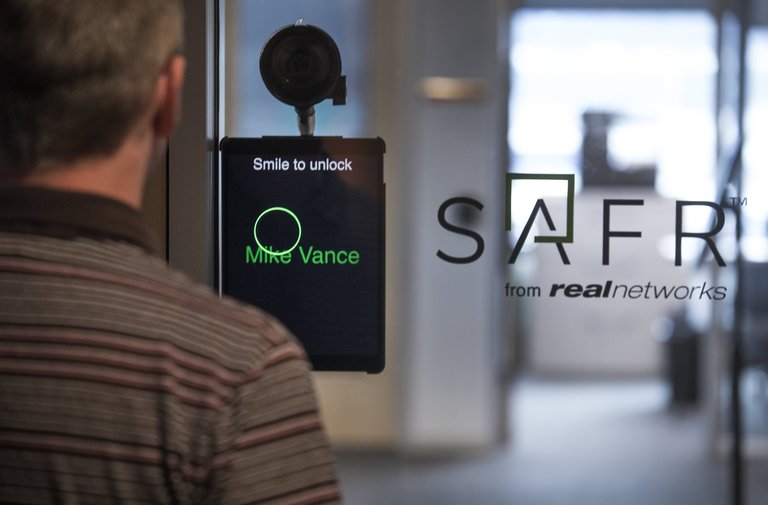
Mike Vance, a senior director at RealNetworks, smiles at the iPad to unlock the door. RealNetworks is promoting facial-recognition technology called SAFR — short for secure, accurate facial recognition — for use in K-12 schools.

RealNetworks is offering schools a new, free security tool: facial-recognition software. But as the technology moves further into public spaces, it’s raising privacy concerns and calls for regulation — even from the technology companies that are inventing the biometric software.

As Mike Vance approaches the glass door that leads to RealNetworks’ engineering office, he smiles slightly at a small camera mounted in front of him. Click. The door unlocks, responding to a command from software powering the camera that recognized Vance’s face and confirmed his identity.

Vance, a senior director of product management at the Seattle tech company, leads the team that created Secure, Accurate Facial Recognition — or SAFR, pronounced “safer” — a technology that the company began offering free to K-12 schools this summer.

It took three years, 8 million faces and more than 8 billion data points to develop the technology, which can identify a face with near perfect accuracy. The short-term goal, RealNetworks executives say, is increased school safety.

“There’s a lot of benefit for schools understanding who’s coming and going,” Vance said.

Most Read Business Stories
Plane crash lands in Pacific lagoon VIEW
A wave of condos is coming to Seattle and Bellevue for the first time since the housing bust
Facebook was hacked. Here are 3 things you should do now.
Boeing wins $9.2B Air Force Trainer program in a big boost for its defense side
British Columbia cracks down on dirty money in real estate market
The software is already in use at one Seattle school, and RealNetworks is in talks to expand it to several others across the country. Looking ahead, RealNetworks — known for video- and music-streaming software introduced in the early 2000s — plans to sell SAFR to various industries, though the company is staying completely mum on the details for now.

The introduction of the technology has thrust RealNetworks into the center of a field that is growing quickly as software gets better at identifying faces. But growing along with it are privacy concerns and rising calls for regulation — even from the technology companies that are inventing the biometric software.

Facial-recognition technology is already common, used in everything from photo apps that sort pictures of people, to unlocking an iPhone, to law-enforcement agencies searching databases of driver’s license photos.

Facial recognition is used, broadly, in two ways, said Oren Etzioni, CEO of Seattle’s Allen Institute for Artificial Intelligence, the sister organization to Paul Allen’s brain science institute. One is consumer convenience, such as grouping photos, and the other is for surveillance and tracking.

The big tech players have been involved for years: Microsoft markets Face API for companies to identify and group similar faces for apps and other products, while Amazon has Rekognition, which came under fire earlier this year when the ACLU asked the company to stop selling it to law-enforcement agencies. Google, Apple and Facebook are also in the game, as tagging and grouping photos on smartphones illustrate.

But now, as RealNetworks’ SAFR shows, the technology has been moving further into public spaces. And with that, privacy advocates wonder if people fully realize how often their faces are being scanned, and advocates and the industry alike question where the line is between the benefits to the public and the cost to privacy.

Learning a face

Facial-recognition technology functions much like fingerprinting — each face has its own unique signature, and companies teach machines to recognize and match people’s unique features.

RealNetworks’ technology maps 1,600 data points on each face it sees. The team has been “training” its machine for about two years, since the launch of RealTimes, its free app that lets people build photo slideshows. Baked into the 3,300-word user agreement for that app is language that allows RealNetworks to use customer photos to train its facial-recognition system.

There’s no panacea here. But I do think that trading some degree of privacy is a reasonable trade-off for saving children’s lives.” – Oren Etzioni

SAFR doesn’t know the identity of people in the RealTimes photos, Vance said — there are no names, addresses or other identifying information in the massive database of 8 million faces. But what it can do is tell if two faces are the same person. It’s gotten so accurate that it can tell identical twins apart and match family photos of the same person even if they were taken decades apart.

SAFR relies on being able to identify people “in the wild,” or acting candidly, not posing.

“The great things about those kinds of faces is that they’re people doing things that they naturally do in life,” Vance said. “They’re not mug shots or canned shots. You can overtrain a system for people looking squarely into the camera. But when you’re walking around here, when you’re walking around a school, you’re not always looking squarely at the camera.”

Many face-recognition technologies can also identify basic demographics of a person. Microsoft’s Face API, for instance, can guess your age with just one photo — a feature that has gotten more accurate since it was first released in 2015 to middling user reviews.

That has led to concerns of bias, though, especially since a study at MIT’s Media Lab found some big tech companies’ facial-recognition apps had error rates up to 35 percent higher when identifying women with darker skin compared to men with lighter skin. Some feared that could lead to misidentifying women and people of color, a troubling issue especially if the systems are used by law enforcement.

Microsoft has acknowledged the bias issues and is taking steps to better identify diverse faces, broadening the database it uses to train its system by adding photos of more diverse people.

RealNetworks, however, hasn’t trained its software to identify someone based on race. You couldn’t, for example, ask SAFR to alert you when a white man walks in a door because it won’t know which faces are white.

The company didn’t see any benefit in teaching the machine to recognize race. “It’s loaded,” Vance said of racial identification.

Boundaries of security

SAFR has been watching over the main entrance gate of Seattle’s private elementary University Child Development School (UCDS) since this spring, buzzing in parents who come to pick up or drop off their kids. The school, where RealNetworks CEO Rob Glaser’s kids were enrolled last year, wanted to try out the system to add to overall security at its University District campus.

It acts as an automatic doorman for parents and staff members — if a parent’s face is recognized by the camera mounted above the front gate, the door opens, reducing the need for someone inside the school to diligently answer a buzzer.

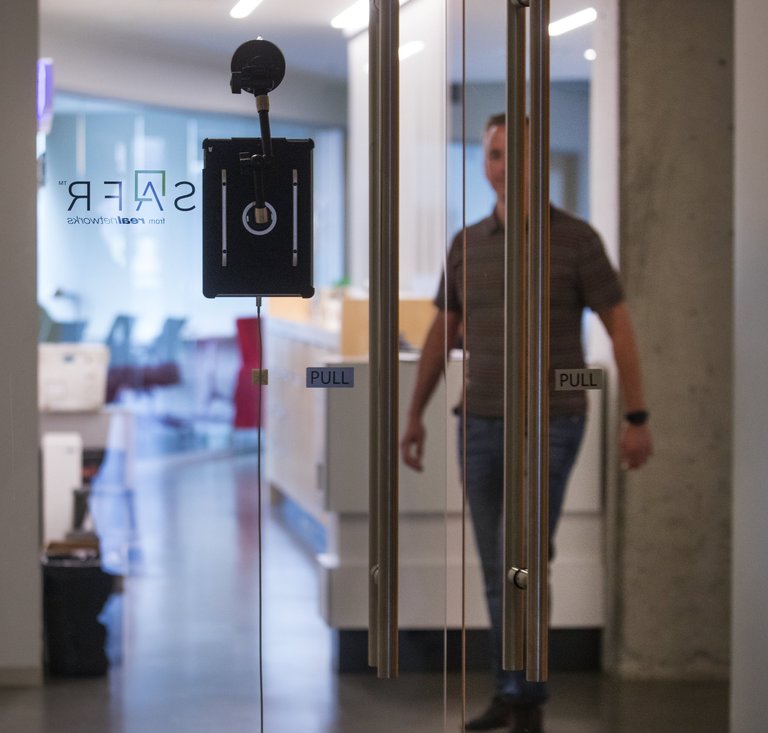
Security doors at RealNetworks use facial recognition to allow access. (Steve Ringman / The Seattle Times)

“It’s very convenient,” said Ana Hedrick, whose daughter is in second grade at the school. “It feels safe.”

The school sent out information about the system to parents and gave them the option of adding their face to the machine’s database — something that Hedrick and about 300 parents and caregivers have done. The SAFR system at the school will identify only adults and rejects the addition of children to the group of identifiable faces (which a few kids have tried to do, unsuccessfully, using the system’s self-add feature).

The school offered to answer questions about privacy concerns, and explained they use the adults’ photos only for their own security system, said another mother, whose kids are in first and third grade at UCDS. “I trust that the school knows what it’s doing,” she said. “Feeling like my kids are safe here is huge.”

RealNetworks plans to keep giving SAFR to schools for free, even as the company expands it to new industries where it will charge for the system, Vance said.

The rash of school shootings across the country has thrust school security into the spotlight. RealNetworks executives said they know SAFR isn’t a fail-safe system, but they figure each little security component helps, especially one that can recognize if a known, unwanted person has attempted to enter school grounds.

“There’s no panacea here,” said the Allen Institute’s Etzioni, who is not involved in RealNetworks’ project. “But I do think that trading some degree of privacy is a reasonable trade-off for saving children’s lives.”

Some critics, however, aren’t so sure such systems in schools will be effective enough to outweigh the privacy costs.

“There’s a general habituation of people to be tolerant of this kind of tracking of their face,” said Adam Schwartz, a lawyer with digital privacy group Electronic Frontier Foundation. “This is especially troubling when it comes to schoolchildren. It’s getting them used to it.”

School security is a serious issue, he agreed, but he said the benefits of facial recognition in this case are largely unknown, and the damage to privacy could be “exceedingly high.”

Call for regulation

Privacy issues have become an increasingly common topic as facial recognition gets more accurate. Big tech companies, including Amazon and Google, faced opposition for selling their systems to law-enforcement agencies, which some fear could lead to a police state and unfair profiling.

But law-enforcement agencies have also used such systems to find missing people and arrest criminals, something that helps public safety.

Some critics believe tech companies should restrict the use of the technology. But its development and its use by law enforcement agencies has reached the point where the federal government should step in and regulate it, Microsoft President Brad Smith argued in a blog post this summer.

“The only effective way to manage the use of technology by a government is for the government proactively to manage this use itself,” he wrote. “And if there are concerns about how a technology will be deployed more broadly across society, the only way to regulate this broad use is for the government to do so.”

More on AI
Aibo the robot dog will melt your heart with mechanical precision | Tech Review
Lockheed Martin partners with ESPN’s Drone Racing League on self-piloting drone competition
Sony is relaunching its Aibo robot dog – and, it hopes, its brand
‘Please do not switch me off!’: Experiment with begging robot shows people hesitate to pull the plug
Robots are getting more social, but are humans ready to accept them?
Toymaker Anki wants its robot assistant to be a pet for adults
RealNetworks is supporting its Redmond neighbor’s call for regulation, Vance said.

Regulations are already in place in Europe, where a recent sweeping privacy law calls for organizations to inform people before collecting their biometric data and tell them what it will be used for, even in stores and businesses.

A few U.S. states also have consent laws regarding the technology. A Washington law passed last year requires companies, before collecting biometric data, to inform people and tell them what their information will be used for. But most states have no mandates and the federal government has yet to address the topic.

Between here and sci-fi

In China, the technology is so common that it can identify people who are jaywalking and display their photos on public digital billboards.

The U.S. isn’t near that level yet of routinely identifying people in public streets or parks, said Clare Garvie, an associate at the Center on Privacy and Technology at Georgetown Law Center, but she finds the lack of transparency into how the technology is being used and the lack of federal laws troubling.

Garvie was on a team that conducted a widespread study that found 54 percent of U.S. residents are in a facial-recognition database accessible by law enforcement — usually in the form of a driver’s license photo. “It is unprecedented to have a biometric database that is composed primarily of law-abiding citizens,” Garvie said.

“The current trajectory might fundamentally change the relationship between police and the public,” she said. “It could change the degree to which we feel comfortable going about our daily lives in public spaces.”

But proper regulation could prevent that, and there’s reason to be optimistic, Garvie said, pointing to Microsoft’s call for such laws.

Use of the technology has been slowed to some extent because it’s still limited in some ways: It isn’t as accurate identifying faces in different lights or in motion, and it takes a tremendous amount of computing power to quickly match faces among billions of photos. But these hurdles are surmountable, said Alessandro Acquisti, a professor of information technology and public policy at Carnegie Mellon University.

He pointed out that facial recognition can be used for good — to combat child trafficking — and for bad — to track law-abiding citizens anywhere they go.

That doesn’t mean it’s neutral, he said. Anonymity is becoming more scare with the proliferation of photos on social media and the technology that can recognize faces.

“Those with unfettered access to your data, and especially those whose usage of your own data you cannot inquire about or limit, have power over you,” he said.

A new era for brokers: how technology is redrawing the blueprint for success

An unprecedented capacity crunch. Archaic processes badly in need of reinvention. New Uber-like technology entrants bent on cutting out the broker. The blurring of asset vs. non-asset providers. Seldom in the brokerage market’s history has there been a time of such massive upheaval—and opportunity.

How do brokers respond, transform and emerge on the other side as stronger competitive forces?

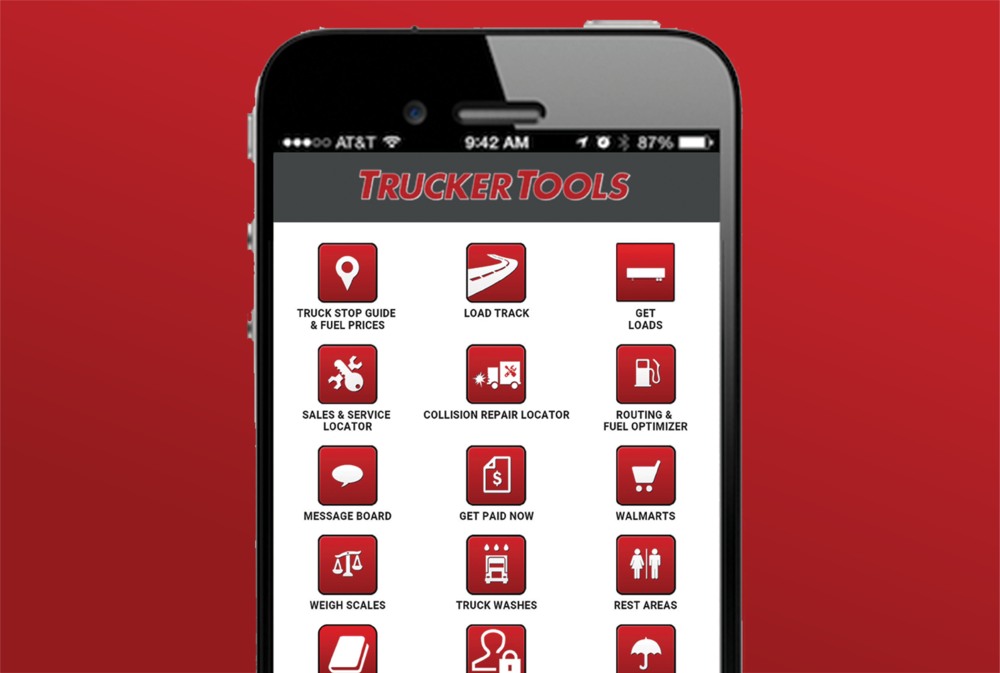
FreightWaves and Trucker Tools partnered for a webinar on Tuesday, September 25 to answer this question and provide brokers with the insights they need to move toward a successful future.

Prasad Gollapalli, Founder and CEO of Trucker Tools spoke with Zak Mattocks, Managing Director– Freight Solutions, FedEx Transportation Management and Michelle Potter, Sr. Director of Strategic Development, England Logistics, Inc to hear their perspectives on the state of the industry. Both FedEx and England Logistics are Smart Capacity users.

“When you look at the 12 months or so, we’ve seen incredibly tight capacity matched with an economy growing at an amazing pace, but we still struggle with inefficiency in the industry” said Gollapalli.

“It’s a fun time to be in the industry based on all of the demand, with a little bit of a reprieve on capacity constraints, and from a technology perspective, the pressure is unmatched. I’ve never experienced this kind of demand surrounding the adoption of technology,” Potter explained. “While we have all of these demands, we still have some things to overcome when it comes to tech adoption for smaller fleets,” said Potter. “It’s compounding the pace at which we all need to be moving,” Potter concluded.

Looking into the peak season ahead, Mattocks anticipates that “the outlook is good for brokerages and 3PLs, fueled by tight capacity. You just have to wonder if the economy will continue to sustain this particular growth.”

With the emergence of technology in the space, there’s a race to find the best digital experience for shippers and carriers and to become the platform of choice. Many of these technologies seek to solve the three biggest drivers of costs in the process of covering freight: stale data, an influx of calls from carriers, and one load wonders.

These inefficiencies can be addressed with technology that focuses on enabling brokers–not disintermediating them. By using constructive disruption to change outdated processes and employ new technologies, productivity and business can benefit, too.

New updates to Trucker Tools’ Smart Capacity technology gives users access to real-time availability based on historical data and using carrier preferences to make smarter matches. The Smart Capacity dashboard is also able to fully integrate with your existing TMS, putting accurate data at your fingertips.