Archives for April 15, 2018

Stranger Things Is Coming to a Theme Park Near You

As a writer, I sometimes get to wonder “what if?” In a previous comparison between streaming pioneer Netflix (NASDAQ: NFLX) and The Walt Disney Company (NYSE: DIS) in 1957, I wrote, “[Netflix] hasn’t yet announced a theme park, but can you imagine an attraction based on Stranger Things? I can — and it would be awesome.”

Seems like I wasn’t the only one that felt that way. Comcast’s (NASDAQ: CMCSA) Universal Studios revealed that the Netflix megahit Stranger Things will be brought to life at its theme parks just in time for Halloween.
Sign reads “Just announced. Stranger Things. Netflix. The Demogorgan in hunting in our world now.”

Stranger Things is now headlining a theme park attraction. Image source: Universal.

The Upside Down

Stranger Things, Netflix’s pop culture phenomenon will be part of Universal’s Halloween Horror Nights event at locations in Hollywood, Orlando, and Singapore. The company partnered with Netflix and the show’s creators Matt and Ross Duffer, and executive producer Shawn Levy, to create mazes that are “authentic representations” of the hit show.

The team is recreating locations that will be familiar to fans of the popular sci-fi horror series.

From the menacing Hawkins National Laboratory, under the U.S. Department of Energy, to the Byers home adorned with an erratic display of flashing Christmas lights and the eerie Upside Down woods oozing a shower of floating orb-like spores, the chilling new mazes will offer surprising twists and unexpected turns around every corner.

Guests will be also be stalked by the Demogorgon, the monster that lives in the alternate reality portrayed in the show.

Show me the merchandise

This announcement is just the latest in a recent string of moves to position the company to reap the benefits of its growing cache of intellectual property.

Early last year, Netflix revealed its licensing aspirations with a job posting seeking to hire a merchandising and promotion manager. The responsibilities of the position would involve the oversight of content distribution and the licensing of toys, comics, books and apparel for its popular programs. At the time, the company said it wanted to use merchandise to “help amplify fervor around key titles.” Netflix even tested a limited assortment of products at cult-retailer Hot Topic before taking the plunge.

The massive popularity of Stranger Things, the nostalgic 80s thriller, persuaded Netflix to delve further into licensing content. Late last year, Netflix executives wore Stranger Things-themed light-up Christmas sweaters during the third-quarter 2017 conference call to discuss the company’s financial results. The purposefully ugly sweaters featured strings of holiday lights over letters of the alphabet, a theme that would be instantly recognizable to fans of the show. The company said this and other products would be available at Target, as it was “learning to do merchandise.”
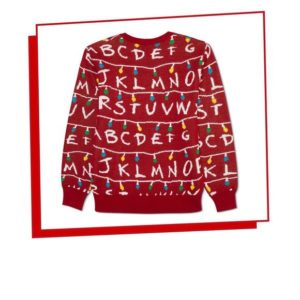
Stranger Things Christmas sweater.

Netflix executives wore this sweater to promote the show and signal the company’s entry into merchandising. Image source: Target.

Not just fun and games

Sales of licensed merchandise totaled $263 billion in 2016 according to the International Licensing Industry Merchandisers’ Association. Those numbers likely crept higher last year, though figures for 2017 are not yet available. It should be no surprise that Disney was the top licensor in 2016, generating $56.6 billion in retail sales. Netflix is following the template laid out by the House of Mouse in many ways, including creating its own content, generating buzz with merchandise, and even acquiring other content creators.

Last year, RBC Analyst Mark Mahaney calculated that Netflix could generate more than $1 billion in revenue by selling merchandise from its hit shows.

This deal with Universal could be the catalyst that drives Netflix even further into merchandising success. Stranger Things is just one of a number of hit shows for the streaming service, though it is surely the most visible. Future programs could capture lightning in a bottle again, and before long, the company could be sitting on a significant additional revenue stream.

Take it from Reed

Earlier this year, Netflix CEO Reed Hastings was asked about the potential for merchandising. He replied, “That’s a big one for us. We’ll be doing more of that over time.”

No time like the present.
3 Things to Know About Procter & Gamble’s New Dividend

Procter & Gamble (NYSE: PG) recently announced an increase to its annual dividend. The fact that the payout rose this year is no surprise. After all, with 62 consecutive yearly hikes under its belt, the consumer goods giant boasts one of the longest-running streaks on the market. And P&G has been paying a dividend for almost 130 years — ever since it was incorporated back in 1890.

Yet while a raise was never in doubt, investors might be surprised by a few other aspects of this dividend news.

Let’s take a closer look.

1. It’s a modest hike

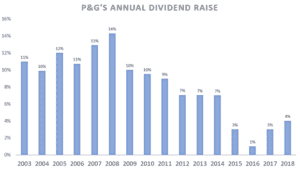
Chart showing annual dividend raises by P&G.

Data source: P&G. Chart by author.

The quarterly dividend payment increased to $0.72 per share from $0.69 per share last year. That equates to a 4% boost, which is the biggest raise that P&G has given its shareholders since 2014. Investors might have expected a larger move, given that reported earnings shot up to $5.80 per share in the most recent fiscal year, up from $3.80 per share.

However, most of that increase came from the sale of its beauty products brands. P&G’s core earnings rose by just under 6% in fiscal 2017, which means this dividend raise modestly trails profit growth. It is also a bit below what investors have seen from industry peers. Kimberly Clark (NYSE: KMB) boosted its payout by 5% in each of the last two years. And Colgate (NYSE: CL) lifted its dividend by 5% in early March, too.

2. P&G can afford the raise

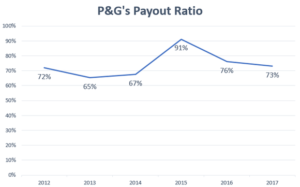
P&G’s payout ratio, or the percentage of earnings allocated to the dividend, has fluctuated quite a bit lately. Huge temporary charges and windfalls, including foreign exchange swings and brand divestments, have caused it to jump to over 80% before collapsing to well below 20% as reported in early 2018.

Chart showing P&G’s dividend payout as a percentage of earnings from continuing operations.

When you use adjusted numbers, though, you’ll find that the answer lies somewhere in between those two extremes. P&G is expecting core earnings to rise by roughly 7% this fiscal year, up to about $4.19 per share, even as reported earnings dive, thanks to the comparison with a prior-year period that included massive gains from brand sales. That translates into a payout ratio of 68% of core profits, which is high but right in line with the company’s recent past.

3. This is a solid yield

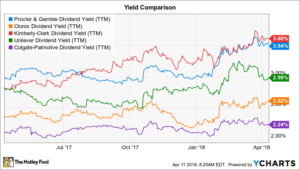
The new dividend keeps P&G’s yield well above 3% (compared to 2% for the broader market) and makes this stock one of the highest-paying in the industry. Sure, Kimberly Clark’s yield is a bit more generous, but that mainly reflects the weak operating trends that have pushed its sales growth to below 1%, or about half of P&G’s expected expansion pace in 2018.

PG Dividend Yield (TTM) data by YCharts.
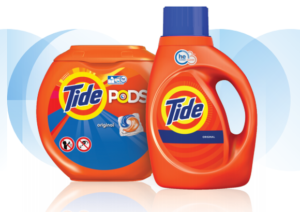
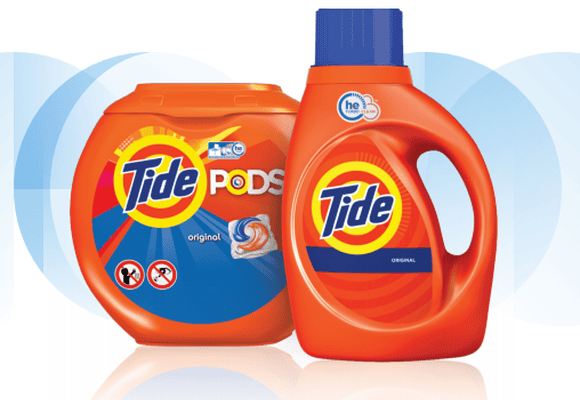
Tide Pods and Tide liquid detergent.

Image source: P&G.

P&G’s dividend announcement came about a week before the release of its fiscal third-quarter results, and so it will be interesting to see how the new dividend fits into management’s updated capital return plans.

After all, CEO David Taylor and his team recently faced opposition from shareholders, who elected an activist investor to the board of directors against management’s wishes.

This upcoming quarterly report will be the first one with the new board in place, which means investors can expect to hear details about executives’ plan to deliver improved returns ahead, likely through the combination of faster growth and increased direct returns via dividends and share repurchases.

3 Top Dividend Stocks to Buy in April

Whether you’re looking for a steady and dependable source of income, potential for big capital growth, or both, these Motley Fool contributors have identified three top dividend stocks that should be at the top of your “buy” list this month.

Their recommendations include a technology leader with a dominant position in its niche in Garmin Ltd. (NASDAQ: GRMN), one of the leading healthcare companies in the world in Johnson & Johnson (NYSE: JNJ), and high-growth, high-yield Pattern Energy Group Inc (NASDAQ: PEGI). Keep reading to discover why these companies caught the attention of three Foolish contributors and what makes them worth buying now.

Stacks of coins next to an hourglass.

Navigate to a 3%-plus yield

Demitri Kalogeropoulos (Garmin): The consumer technology industry can be a brutal place to do business if your product launches fail to keep pace with shifting consumer tastes. Companies like GoPro and Fitbit have firsthand knowledge of that fact, and both stocks are down over 80% in the past three years.

GPS device specialist Garmin, on the other hand, managed to boost sales last year despite challenges in two of its biggest market niches. That success is a testament to a diversified portfolio that includes smartwatches, fitness trackers, dashboard navigation, and equipment for boating and aviation.

The company set a record for profitability in 2017, and management sees another profit margin uptick in the cards this fiscal year as sales inch up to $3.2 billion from $3.1 billion. Meanwhile, its shares are valued at an attractive 19 times the $3 per share Garmin is expected to generate over the next 12 months.


GRMN Dividend data by YCharts.

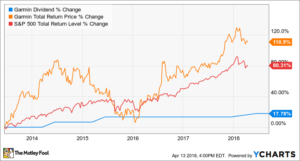
Its dividend, while lacking consistent growth, was recently raised to an over 3.5% yield. That payout should help pad income investors’ returns while they wait to find out whether Garmin’s latest product launches resonate with GPS tech fans, just as most prior releases have done over the last few years.

The best income stock in healthcare

George Budwell (Johnson & Johnson): I think the healthcare behemoth Johnson & Johnson is worth buying this month ahead of the company’s scheduled first-quarter earnings release on April 17th.

Apart from the company’s strong track record of beating analysts’ estimates for its top line, I expect the company to announce a larger than normal hike to its dividend this quarter, thanks to an influx of cash from the Tax Cuts and Jobs Act of 2017.

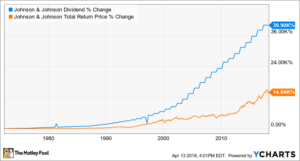
The drugmaker, after all, is due for another dividend hike based on its prior history. Investors have also been clamoring for a healthy hike after last year’s somewhat modest increase. So, in short, J&J could very well end up offering a yield close to 3% later on this year, which would make it one of the most generous income stocks in all of healthcare.

In addition to its juicy yield, J&J is also a great income stock to own because of its 55-year history of consecutive dividend increases, triple-A rated balance sheet, and of course, its top-notch pharma pipeline that’s been ranked the best-in-class by Idea Pharma for five out of the last six years.


JNJ Dividend data by YCharts.

Keeping with this theme, J&J has over 30 drugs in late-stage programs at the moment, and several product candidates with megablockbuster potential. The company also has the financial flexibility to execute value-creating M&A deals to keep its pharma pipeline in tip-top shape moving forward. So, there’s no reason to think that J&J’s fortunes are about to change anytime soon.

In all, J&J should make a great addition to any investor’s portfolio because of the company’s stellar shareholder rewards and proven ability to bring major new drugs to market in a timely fashion.

The reward outweighs the risk

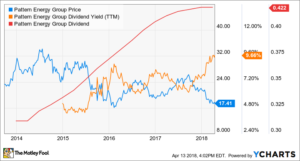
Jason Hall (Pattern Energy Group): Over the past six months, independent renewable energy producer Pattern Energy’s stock price has fallen a painful 33% from its high, pushing the dividend yield up to an insanely high 9.6%. So what’s happening? In short, the market is getting spooked after changes to tax equity investing rules that could lead to reduced access to capital for Pattern and other renewable energy companies. Add in climbing interest rates, and it seems like investors are afraid Pattern’s growth story will end before it really gets going.

This may look like a company that’s heading toward a dividend cut, and there is some risk of that happening if the changes to tax equity investing rules put a squeeze on Pattern’s access to capital. But it wouldn’t be because the company can’t afford the dividend, but rather it needed to reduce the yield in order to issue shares to raise cash at a decent rate of return. But I think that’s a relatively low probability, and the market has already priced that risk into the stock.

PEGI data by YCharts.

Furthermore, Pattern operates in Canada and Japan in addition to the U.S., so U.S. tax equity investors aren’t its only source of capital, and the company’s leadership has decades of experience navigating through changing regulatory and economic cycles. Looking at the big picture, I expect the market’s current reaction will be just a blip on the radar for Pattern, and shareholders who invest at current prices will come out incredibly well over the long term (even if we see a dividend cut in the short term).

Nordstrom Just Opened the First Piece of Its Manhattan Flagship Store

It’s been more than five years since upscale retailer Nordstrom (NYSE: JWN) first announced its plans to open a flagship store in Manhattan. While Nordstrom has several full-line stores in the New York metro area, this was to be its first one in New York City proper. Moreover, Nordstrom executives were determined to make it the company’s best store — and indeed, one of the best stores of any kind in the world.

On Thursday, Nordstrom opened the first phase of its Manhattan flagship: a 47,000-square-foot men’s store at the corner of Broadway and 57th Street, just south of Central Park. This store will serve as a valuable testing ground as Nordstrom prepares for the fall 2019 opening of its main flagship store across the street.

A rendering of the exterior of the future Nordstrom flagship store in Manhattan

A store just for men

Nordstrom didn’t always plan to operate separate men’s and women’s stores in Manhattan. But two years ago, when a sizable retail space became available down the block from its under-construction flagship store site, the company took the plunge and decided to open a stand-alone men’s store in that location. In opting for a separate men’s store, it followed the example of several other upscale New York department stores.

Nordstrom’s first-ever men’s store showcases merchandise covering a broad spectrum of price points. There are mini-shops devoted to several high-end designers, along with smaller displays for many other luxury brands. But there are also plenty of affordable items, including a big selection of Levi’s denim and Nike (NYSE: NKE) merchandise.

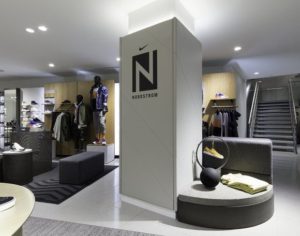
Indeed, Nordstrom has deepened its existing partnership with Nike for the Manhattan men’s store. The new store has a dedicated Nike shop featuring both sneakers and apparel, including some items that are exclusive to Nordstrom.

The Nike shop at the new Nordstrom Men’s Store in Manhattan

Services are the real differentiator

While Nordstrom has put together an impressive merchandise selection for the new men’s store, its vast array of service offerings and experiences really set it apart from competitors.

Some features are familiar, such as a bar and a coffee shop. The store also offers complimentary basic alterations for many purchases and free consultations with a personal stylist. Other offerings are more unique, such as on-site personalization (for example, custom embroidery), same-day delivery from the store, 24/7 pickup for online orders, kiosks near the entrances for quick returns, and something that Nordstrom calls “24/7 Express Services … for fashion emergencies like lost luggage or items that went unpacked.”

The emphasis on services reflects Nordstrom’s goal of creating something that can’t be replicated online. Management understands that Nordstrom needs to up its game to stay relevant, given that consumers can avoid department stores entirely if they want to.

Nordstrom will learn a lot about the New York market

New York is an unusual market for a department store. Consumers have lots of options, and they have particularly high standards for service. Additionally, tourists account for a significant proportion of sales at most of the top Manhattan department stores.

Obviously, Nordstrom wants its new men’s store to be as successful as possible. Yet it’s also treating this store as a laboratory that can help it refine its offerings for the main flagship store (which will house the women’s collections) before that location opens next fall.

With more than 300,000 square feet of space, the main Manhattan flagship store will be more than six times the size of the men’s store. It’s also a much larger investment: Nordstrom has already poured hundreds of millions of dollars into building the main store. That makes it critically important for Nordstrom to get things right the first time.

By contrast, Nordstrom has designed the men’s store to maximize its flexibility to make changes in the future, enabling it to take risks — such as simultaneously introducing a wide variety of unique services. This seems like a smart strategy. Nordstrom will learn a lot about its potential customer base in New York City over the next year, allowing it to refine its plans for the main store — thus maximizing the likelihood that the Manhattan flagship store really will be one of the best stores in the world.

‘Underworld Ascendant’ teaser reveals a reborn dungeon crawler

Ever since veteran developers successfully crowdfunded their spiritual successor to Ultima Underworld, there’s been a looming question: how would the prototypical 3D action RPG translate to the 21st century? You now have an idea. OtherSide and 505 Games have released a teaser trailer for Underworld Ascendant that illustrates how the reborn dungeon crawler will work. More than anything, it’s clear that this isn’t just a hack-and-slash. You’ll be rewarded for ingenuity and stealth, such as building bridges from magic-laced barrels, or using a water arrow to shoot out a light Thief-style. There’s even some wall running for Mirror’s Edge fans.

The graphics have unsurprisingly made leaps and bounds over Ultima Underworld (it was made at a time when any 3D was a novelty), but you might be most interested in the variety. The usual grim dungeons and dark caverns are broken up by underground flora and other signs of the not-so-natural life in the Stygian Abyss.

The teaser still leaves questions unanswered. Does it translate some of the clever role-playing elements (such as learning another species’ language), for example? And how much will it feel like an Ultima game for those who remember the series when it was fresh? Ascendant is still slated to ship in 2018, so you might not have too long to wait to get further answers.

This article originally appeared on Engadget.

Austin test uses blockchain to improve ID for the homeless

Many people take identification for granted, but it’s a serious challenge if you’re homeless. If you lose what’s on your back, you might lose everything — and recovering that ID is much harder when you have no fixed address or easy transportation to government offices. Austin might have a technological solution. The Texas city is piloting a system that uses blockchain identifiers to safeguard the IDs and vital records of homeless people in a way that’s more accessible for service providers.

Similar to Microsoft’s digital ID initiative, the distributed and encrypted nature of blockchain would make records accessible virtually anywhere while preserving security. Workers could verify someone’s ID on the street, for example, while a clinic could quickly check a patient’s history even if it’s their first visit to that location.

There are some security concerns about a system like this. You’d need to be certain when authenticating an ID holder, since a fraudster might have access to a huge range of info. If the pilot is successful in ironing out this and other issues, however, this could be crucial to not only providing better services to the homeless, but helping them escape homelessness. When your identification is safe, you can tap into social assistance and job programs on a consistent basis and focus on creating a better future.

This article originally appeared on Engadget.