Archives for April 7, 2018

Why Square, U.S. Steel, and Conn’s Slumped Today

Wall Street suffered through a tough session on Friday, with the Dow Jones Industrial Average finishing lower by almost 600 points and other major benchmarks enduring declines of 2% to 2.5%. Market participants attributed most of their nervousness to the Trump administration’s decision to fire another salvo in the emerging trade war between the U.S. and China, announcing plans to add further tariffs totaling an extra $100 billion against the Asian economic power. Hawkish comments from Federal Reserve Chair Jay Powell also added to the tension among investors, and many stocks got hit especially hard by the geopolitical rhetoric and other news. Square (NYSE: SQ), U.S. Steel (NYSE: X), and Conn’s (NASDAQ: CONN) were among the worst performers on the day. Here’s why they did so poorly.

Square deals with e-commerce fallout

Shares of Square fell 4.5% after reports surfaced that the payment processing specialist might become the latest victim of the burgeoning e-commerce industry. According to reports from The Wall Street Journal, Amazon.com (NASDAQ: AMZN) is looking closely at creating its own system for making peer-to-peer payments, utilizing its Alexa voice-controlled digital assistant as a potential platform. Square and some of its rivals in the payment space have benefited greatly from the rise of e-commerce, but Amazon’s move could once again change the playing field by bringing another behemoth corporation into the space. Square still has plenty of room to grow, but if Amazon can eliminate part of its addressable market, it would be a blow for the company.

Square logo with concentric squares in black and white and the company name.

U.S. Steel gets ready for (trade) war

U.S. Steel stock dropped 6% in the latest in a series of volatile moves in both directions during recent trading sessions. Investors have been hard-pressed to figure out exactly how the quick-paced volleys in the trade dispute between the U.S. and China will eventually affect its business, initially sending the stock dramatically higher in anticipation of tariffs but then simmering down. Recent indications that Chinese steel prices might fall in the near future could prevent U.S. Steel from getting as much benefit from a 25% steel tariff as it would otherwise get if steel prices in China remained stable. Even with tariffs, U.S. Steel has work to do to maximize its own profit potential.

Conn’s keeps falling

Finally, shares of Conn’s lost 10%. The stock had already fallen by a double-digit percentage on Thursday following a fourth-quarter financial report that included declining revenue and a large 8% drop in same-store sales. Today’s drop followed through on downbeat sentiment about the furniture and appliance retailer, perhaps in part due to the potential impact that escalating trade tensions could have on the retail industry. After suffering through years of difficult industry conditions, Conn’s can only hope that it will be able to turn things around in the coming year and overcome some of the lingering challenges that have held back its growth recently.

3 Reasons Mastercard and Visa Are Still Buys

Since Mastercard Inc. (NYSE: MA) and Visa Inc. (NYSE: V) went public, shareholders have enjoyed returns that have destroyed the S&P 500 index. In May 2006, Mastercard had an initial public offering with the stock valued at a split-adjusted $3.90 per share.Two years later, Visa followed suit and went public at a split-adjusted price of $11 per share. In the past 10 years, Mastercard’s and Visa’s stocks have almost mirrored each other, returning 685% and 667%, respectively, while crushing the market’s return of approximately 100% over the same time span.This incredible growth has not slowed down: Over the past year, Visa has roughly tripled the market’s returns and Mastercard has almost quintupled it!

MA data by YCharts.

Yet the two companies now sport price-to-earnings multiples worthy of young growth stocks. Based on 2017 non-GAAP earnings per share of $4.59, Mastercard’s P/E ratio is close to 38. Similarly, Visa trades at a P/E ratio of almost 33 based on its trailing-12-month adjusted EPS of $3.70.Given the high multiples and the run-up in stock prices, some investors could be tempted to sell now to cash out gains. I don’t share that sentiment, however, and think long-term investors will be richly rewarded for holding on to these two companies for years to come. Here are three reasons why:

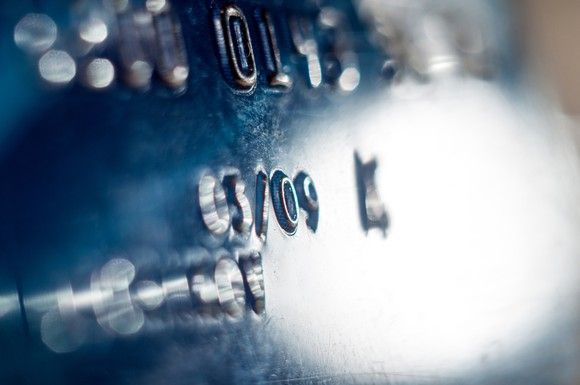
Close-up of a credit card showing the partial number.

Mastercard and Visa stand to benefit from mega trends like e-commerce, mobile commerce, and the lowered cost of card acceptance in emerging markets. Image source: Getty Images.

E-commerce on the rise

In the fourth quarter of 2017, e-commerce sales grew $119 billion, a 16.9% increase year over year. Total retail sales rose only 5.7% over the same time, according to the U.S. Census Bureau.When shopping online, 48% of consumers favor using a credit card over any other method of payment, according to the 2017 Total System Services (TSYS) U.S. Consumer Payment Study. The second most popular form of payment for online shopping is debit cards. Both of these payment types overwhelmingly increase the odds that a Mastercard or Visa account will be used to make the purchase.

If anything, this trend will only accelerate over time. At the 2017 UBS Global Technology Conference, Visa Chief Financial Officer Vasant Prabhu said the rise of e-commerce makes complete business sense for entrepreneurs:

People are not thinking about opening bricks-and-mortar stores if they don’t need to, right? So anybody who has a concept of being a merchant and selling your goods and services, initially, almost anywhere in the world today, thinks about doing it in the digital world rather than in the physical world. So there again, so you immediately start with the growth of retail, if you want to call it that. It’s clearly biased toward e-commerce to begin with. So that’s a phenomenon by itself.

Prabhu added that, for online purchases, “the propensity to use a Visa card is twice as high as [in] a face-to-face transaction.”

Payments on the go

It’s not just e-commerce that is on the rise, however. Mobile commerce, too, is becoming more popular. Consumers are incorporating their smartphones into their daily lives more than ever before. This includes using them to make purchases in-app and at retailers’ checkout counters. In 2017, more consumers than ever before, 66% according to the TSYS payments study, were familiar with making in-app mobile payments. In addition, 44% of consumers used their banking mobile app to pay bills; that’s up from 34% just one year ago.Not only that, but 59% of customers made a purchase using a credit card already on file in the app, thus making it easier and more convenient to use this method to shop. That’s up from just 46% in 2016, according to TSYS’s study.Unsurprisingly, young consumers are most familiar with mobile commerce. In the 18-24 age group, 85% are aware of in-app mobile payments. In the 25-34 age group, that percentage jumps to 88%.

Again, this trend can only benefit Mastercard and Visa.

Lowered cost of card acceptance around the world

With the advancement of mobile connectivity around the world, international retailers no longer need expensive equipment and landline access to facilitate card transactions at the point of sale. While this might not matter too much for domestic vendors, it can make a world of difference for merchants in emerging economies.

In fact, with QR code technology, retailers can start accepting payments within minutes of downloading an app — and no equipment is needed beyond a smartphone and a printed QR code.Last month, Mastercard acquired South African mobile-payments start-up Oltio to help facilitate mobile payments in emerging economies. The lowered expense of card acceptance is certainly leading to an increase in card terminals. For instance, India saw more acceptance-point growth in the past year than it did the previous five years combined.

The final takeaway

Long-term investors in Mastercard and Visa have been richly rewarded, but that doesn’t mean the ride is over — or that it’s too late for other investors to partake. The rise of e-commerce is a trend that will only accelerate in the years ahead, and should provide both Mastercard and Visa opportunities to facilitate transactions without competing against cash or checks. As younger consumers use their phones more for in-app purchases, they are charging their 16-digit accounts already saved on file. Finally, with the advance of mobile technology, card and digital acceptance is finally feasible for merchants in emerging economies.

These catalysts are already manifesting themselves in the companies’ fundamentals. In Mastercard’s 2017 fourth quarter, net revenue rose to $3.3 billion, a 20% increase year over year, and adjusted earning per share rose to $1.14, an even more robust 33% increase year over year. These strong numbers were fueled by a 17% increase in switched transactions, the number of purchases made using a Mastercard account.Similarly, Visa saw a 26% increase in adjusted earnings per share powered by a 12% increase in payment volume, the total dollar amount of the purchases made across Visa’s network, and a 12% rise in processed transactions.The strong growth and future catalysts all point to years of more market-beating returns ahead.

2 Initiatives That Will Boost Synchrony Financial’s Returns

Sometimes, a small drift in closely watched measurements can shed light on powerful trends in a business. During the fourth quarter of 2017, Synchrony Financial (NYSE: SYF) reported slight but significant declines in its credit-quality metrics. Net charge-offs reached 5.78% of total loan receivables, an increase of 113 basis points over the fourth quarter of 2016. The company bumped its allowance for loan losses as a percentage of total receivables to 6.8%, a rise of roughly 1 percentage point against the prior-year quarter. And customers took more time to make payments on their accounts: Loans 30-plus days past due at period-end ticked up slightly to 4.67%, versus 4.32% in Q4 2016.

All of the changes above can be traced to “credit normalization,” which management has discussed in detail in recent earnings conference calls. As revolving credit becomes more easily available to consumers in the current economic cycle, default risk is ticking up.

Young man paying for fries with credit card at food kiosk.

Image source: Getty Images.

Accordingly, Synchrony has shored up its resources to manage risk. While net interest income after retailer share agreements has increased 29% over the last two years, the company’s annual provision for loan losses, which increases balance sheet reserves against bad debts, has ballooned by nearly 80%. This provisioning has trimmed Synchrony’s overall profitability, and it’s the primary factor behind a drop in net earnings of roughly 13% between 2015 and 2017. The trend of higher provisions against expected losses is easier to see in the table below:

Metric                                                          2017                   2016                  2015
Net interest income,

after retailer share arrangements          $12,079               $10,628               $9,355
Provision for loan losses                          $5,296                    $3,986              $2,952
Net interest income                                   $6,783                  $6,642                $6,403

Data source: Synchrony Financial 2017 10-K SEC filing.

The credit-quality metrics, described above, affect the provision for loan losses. It’s important to note that a company’s loss provision reflects both current trends in customer credit quality and the forecast for delinquencies and charge-offs 12 months after a balance sheet date. In other words, the provision is a forward-looking adjustment on the income statement to make sure balance sheet reserves are robust.

I’ve highlighted the 2016 and 2017 provisions to illustrate the burgeoning trend. These higher adjustments to absorb risk cause earnings pain in the present, but they signal better margins ahead. And to some extent, the widening of loss provisions can be traced to two important initiatives that should directly impact Synchrony’s already-impressive profitability.

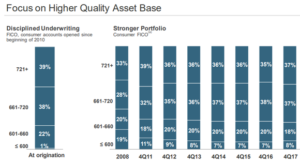
The first trend is a general improvement in underwriting quality. Synchrony is seeking to lend to customers with higher credit quality within its three primary businesses — retail card partnerships, retailer big-ticket “payment solutions,” and healthcare-oriented “care credit.” The following chart, from the company’s most recent earnings presentation, displays Synchrony’s rising tendency to lend to consumers with upper-tier credit scores:

Chart of quarterly credit portfolio quality as determined by FICO score distribution.

Image source: Synchrony Financial fourth-quarter 2017 investor presentation.

As the company gradually shifts to a more credit-worthy customer, it will winnow out some of its highest-risk accounts. This generates some losses on a portion of Synchrony’s credit portfolio, as marginal accounts are written off and replaced with those pegged to low-risk borrowers.

The second initiative driving bigger loss provisions is Synchrony’s expansion of its credit receivables. This portfolio of loans to credit card customers is characterized as an asset on the company’s balance sheet. Growth in loan receivables automatically results in a higher provisioning — size is one variable that will always increase the provision, even when credit quality doesn’t change.

Investors should welcome adjustments generated by growing receivables balances, because additional receivables provide higher net interest income. Synchrony has expanded its loan receivables balance at a compound annual growth rate of 9.4% over the past four years.

The company has achieved this rate primarily through striking up partnerships with retailers. But executives have also demonstrated an appetite for significant bolt-on transactions. A case in point is Synchrony’s pending $6.8 billion purchase of PayPal’s (NASDAQ: PYPL) consumer credit receivables portfolio (slated to close in the third quarter of this year).

Through this mammoth transaction, which extends an existing partnership, Synchrony becomes the exclusive issuer of PayPal’s online consumer financing program, PayPal Credit. U.S. consumer credit represents roughly 2% of PayPal’s annual total payments volume, or TPV, a measure of transaction volume facilitated on PayPal’s platform.

Interestingly, PayPal has increased its TPV at a torrid rate in recent years — it improved this metric by 24% last year. Thus, Synchrony isn’t just purchasing a book of receivables; it’s buying a portfolio that will expand largely through PayPal’s efforts, and at a double-digit rate at that, for the foreseeable future.

To sum up, while Synchrony’s loss provisioning has accelerated in recent years, it’s not completely the result of credit normalization. The growth initiatives of higher credit quality and receivables expansion are pushing loss reserves higher in the near term, but these two synchronous objectives should pad profits for years to come.

3 Warren Buffett Stocks to Buy in April

To quote the old proverb, April showers bring May flowers. If you’re a shareholder of Warren Buffett’s investment vehicle Berkshire Hathaway (NYSE: BRK-A)(NYSE: BRK-B) they’ll probably continue to bring the returns too. The company’s renowned equity portfolio keeps growing; the total market value of its top equity positions was nearly $171 billion at the end of 2017, well higher than the $122 billion at the close of 2016.

A clutch of those stocks have good potential to rise over the course of 2018. With that in mind, here is a trio of noted Berkshire titles to consider buying this month.

Warren Buffett

Bank of America

What a difference a decade makes. Bank of America (NYSE: BAC) was a shell-shocked basket case of a lender in the wake of the financial crisis, to the point where it required one of the largest bailouts from the government’s TARP program.

It’s a confident and prosperous bank these days. A strong efficiency push, in which branches were shuttered and online/mobile interfaces enhanced, reduced its efficiency ratio by 8 percentage points — a significant improvement for such a huge institution. And the bank has managed to boost its total loans (by 3% year over year in the most recently reported quarter) and deposits (4%), which helped improve revenue and profitability.

A humming economy and the near certainty of continued Fed interest rate hikes augur well for the proximate future of Bank of America, not to mention the government’s recent big-company-friendly tax reform. The company has a nice streak of earnings beats behind it, so a fresh surprise on the upside would be entirely in character when the bank reports its Q1 2018 earnings on April 16.

Apple

Since Berkshire started accumulating shares of Apple (NASDAQ: AAPL) in 2016, it has continued to increase its holding. The mighty tech company is now the largest position in Berkshire’s equity portfolio.

The company looks poised to keep performing well for several reasons despite the concern that it’s still too dependent on iPhone sales. Its services revenue is growing considerably — at an 18% clip in the most recent quarter — outpacing the products category.

Also, the company’s customer foundation is getting ever stronger; the installed base of its devices has risen by 30% over the course of two years (to 1.3 billion gadgets in total). This is even more impressive when considering the iPhone’s age and the company’s lack of a world-shaking, revolutionary new product.

On top of that, Apple is a cash-generating machine, with free cash flow rising 7% to a very meaty $25.5 billion in the prior quarter. That’s enough to boost the company’s dividend, which has been continuously fattened with an annual raise since it was reintroduced in 2012.

SiriusXM

Buffett loves the idea of an economic moat so much, he actually coined the phrase.

In the broadcasting world, there aren’t many moats wider than that of Sirius XM Holdings (NASDAQ: SIRI). The company is the market for satellite radio, holding a nearly impossible-to-break grip on this rising business.

This powerful position, combined with auto sales that have been robust over the past few years, keeps lifting the company’s results higher. For its fiscal 2017, Sirius XM managed to expand its subscriber base by 4% over the previous year to almost 33 million listeners. This helped improve revenue and adjusted EBITDA notably by a respective 8% and 13%, respectively, for the year. Both line items notched new all-time records for the company.

Although some experts are fretting that auto sales have either peaked, or will soon, the impact probably won’t be too hard for Sirius XM. After all, with nearly 270 million cars on American roads against that nearly 33 million customer base, there are plenty of autos that could use an upgrade from traditional radio to satellite.

Analysts are expecting per-share net profit growth of around 25% in Sirius XM’s Q1 of 2018. The company will release that quarter’s results on April 25.

Growing season

As of Berkshire’s latest 13F regulatory filing, which details the contents of its equity portfolio, the company held positions in nearly 50 stocks. So there are more than these three winners on its hands (and at least a few clunkers, to be even-handed about it). Still, each member of this trio has excellent potential going forward. Let’s see how high they grow during this fertile time of the year.

Google’s self-driving Waymo cars will be picking you up soon

AUSTIN — A self-driving car from Google (GOOG, GOOGL) may be coming to a street near you. But you won’t be able to buy it, and you’ll have to wait longer to get a ride if snow regularly features in your city’s winter forecasts.

John Krafcik, CEO of of Google’s self-driving car unit Waymo, laid out the company’s ambitions and its potential obstacles in two SXSW appearances at SXSW, an onstage interview with Vice News correspondent Evan McMorris-Santoro and an evening chat with comedian Adam Carolla recorded for Carolla’s podcast.

The potential promise here is huge — safer roads for everyone, and consequence-free napping behind the wheel for people willing to pay about what a human-driven Uber or Lyft costs today. But you may need to get over the notion of traditional car ownership along the way.

The promise of self-driving cars

“We’re working to build the world’s most experienced driver,” Krafcik said in opening his sales pitch. “Everything that we learn in one of our cars gets passed to all of our cars.”

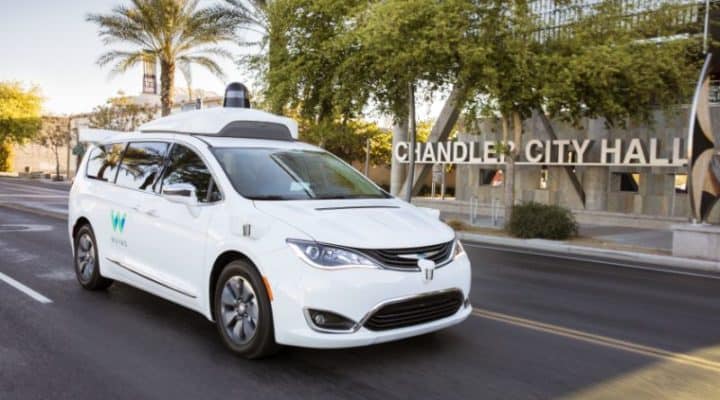
Waymo’s software has already driven 5 million miles in U.S. cities, including an “early rider” test in Phoenix using modified Chrysler (FCAU) Pacifica minivans that began taking signups last April. Waymo has since grown confident enough to remove the self-driving-car equivalent of training wheels: a human “safety driver” at the wheel as a backup.

Powering the vehicle’s self-driving capabilities is an array of cameras, radar and Lidar sensors, many on the car’s roof, which detect everything nearby from other vehicles and pedestrians to cyclists.

At the evening event, Krafcik displayed a Lidar view of the event venue, a bar on the east side of Austin, showing people as glowing outlines. Seeing himself lit up as if by radiation, Carolla joked “I think I just got testicular cancer, so thanks for that.”

In both talks, Krafcik emphasized that Waymo’s cars aren’t connected — they don’t need a 5G wireless link to go anywhere. “The car has everything it needs to drive on the car itself,” he told McMorris-Santoro. “There are no signals coming from outer space or something telling it to turn right.”

The resulting ride may not be too exciting but is safe. “It doesn’t speed,” Krafcik added. “It’s very persnickety about following the rules.”

The Waymo system also thinks well ahead, which he said invalidated the question of how a car would decide which pedestrian to hit in a crash. “We can see three football fields down the road,” he said. “We would come to a stop before we ran into these folks.”

He added that the software does have “a hierarchy of concern” about the relative vulnerability of other road users. Presumably, an awareness that humans are squishier than cars would at least direct it to take out a Prius before a pedestrian.

Tuesday evening, Krafcik cited another benefit. “Just a few of those cars provide a really good example for human drivers to follow,” he said, citing studies showing people drove better after the addition of autonomous cars.

When and how much

Waymo’s system represents a major advance over the semi-autonomous systems of Tesla (TSLA) and GM’s (GM) Cadillac subsidiary, both of which demand continued human attention. Krafcik said passengers quickly set aside hangups over needing to trust a computer completely — a Waymo clip shows Phoenix testers taking selfies and naps.

Waymo plans to have service in every major metropolitan area by 2028, with thousands of cars driving themselves by 2020.

Its rollout will begin across sunnier climates first, though. “Snow and ice are challenging for our current system.” Krafcik said Tuesday morning. For example, the car’s sensors don’t have defrosters, although the next revision will add them.

But even then, Krafcik cautioned that Waymo cars won’t be able to cope with the sort of weather — blizzards, torrential rain storms — that keep self-aware humans off the roads.

In the same vein, he asked that states refrain from regulating Waymo’s software more strictly than the human sort, notwithstanding anxiety about artificial intelligence. “Hold us to the same standards as human drivers,” he requested.

Waymo will offer these cars as a service, telling Carolla that a ride would cost about the same as an Uber or Lyft: “a couple of bucks a mile.”

Waymo has no plan to make or sell cars itself. “We’ve always considered ourselves, in this space, as enablers of the incumbents,” Krafcik said in the morning. For instance, Avis (CAR) and AutoNation (AN) help to maintain the company’s minivans.

The overall economics argue against people owning self-driving cars–why would you want to keep one parked when it can go somewhere else on its own, and if it doesn’t need to stay at home each night why bother keeping it? Waymo and other firms banking on a self-driving future don’t see much room for individual car ownership, as much as that may dismay auto enthusiasts.

Human factors

In both talks, Krafcik kept coming back to the complexities of how people deal with their cars.

For example, he noted in the morning that Waymo had to change how cars pick up at grocery stores — the most efficient spot, outside the store exit, left other drivers waiting and left passengers feeling “a little bit guilty.” Now cars meet passengers at a shopping-cart corral.

Privacy is another issue Waymo will have to address, since their cars will know volumes about the whereabouts of passengers. Krafcik’s vague answers–for instance, “it’s something that we’re working on”–didn’t go far enough.

And because so much of our lives happen on four wheels, Waymo and other self-driving companies will have to be prepared for any aspect of human experience. Two in particular came up yesterday.

In the evening, Consumer Technology Association Gary Shapiro asked during the audience Q&A how the car would react if a passenger keeled over from a heart attack.

“We drive you straight to the grave!” Carolla replied, launching into a riff on how the car includes a “morgue mode” for this eventuality. Eventually, Krafcik added that in reality, the cars have a help button.

And in the morning, McMorris-Santoro relayed a query from friends who were unusually curious about date-night Waymo use. “I think their question was, can they have sex in a Waymo?” he asked.

Somebody in the audience shouted “Answer the question!” as Krafcik contemplated the matter.

Then replied: “We’ve done thousands of rides in Phoenix, and that hasn’t happened yet.”

Watch your lawn mower cut your grass – while you sit on your front porch sipping a beer

robot-lawnmowers-are-making-their-way-onto-american-grass

When it comes to robot lawnmowers, the United States is behind several other countries including Germany, Sweden, and England. That could be because Americans tend to have much larger yards, or because there’s something relaxing about riding a John Deere tractor, especially during the spring and fall. But 2018 is shaping up to be the year of the robot mower in the U.S., thanks in part to the Husqvarna Group’s Automower line.

While the easiest way to explain what a robot lawnmower does is to say it’s like a Roomba for your grass, Husqvarna’s Automowers actually pre-date robot vacuum cleaner technology. The first Automower rolled off the Swedish assembly line back in 1998 after several years of development as a solar-powered mower. The concept was dreamed up in the early ‘90s, while iRobot’s Roomba debuted in 2002.

The robot lawnmower was slow to take off in the early part of that first decade, Husqvarna Group president Sascha Menges told Digital Trends, but by 2005 the concept began to take hold in several European countries, most notably Sweden. As new technology allowed for prices to come down, sales increased. Husqvarna celebrated one million units sold in January 2017, the majority of which are in Europe. Now, the company wants to grow its North American business.

Roomba-ing your lawn

Unlike a traditional tractor or push mower, the concept for the robot mower isn’t to cut the entire yard all at once like you might do on a Saturday morning. Instead, the robot takes 48 hours of day and night cutting — with built-in breaks for charging — for an entire lawn to be cut the first time. Once the desired grass height has been achieved, the automower uses razor blades to shave millimeters of grass daily. This acts as a composter and fertilizer, which in turn helps the lawn look greener and healthier without any grass clumps or weeds. In theory, your lawn will always look the same – like a golf course – because the robot is always cutting it in random patterns to eliminate tracks. It even works in the rain, which is something traditional mowers can’t do.

Installed underground barrier lines guide the auto mower on where to go and is used to keep it away from trees, foliage, driveways and other obstacles. There’s also a smart guide wire that offers the most efficient pathway back to the charger. The charger plugs into electricity, allowing the mower to juice up when it’s not in use. It takes approximately 60 minutes for a full charge.

The automower connects to your smartphone, allowing you to see where it is at any time.

Husqvarna has a line of six Automowers, which range in price from $1,500 for a quarter acre cutting capacity to $3,500 for a full acre. That puts these robots in the same price range as ride-on motors, although the company touts the savings in gas, fertilizer and weed-killing sprays as good reasons to invest in a robo mower instead. They’re also extremely quiet (only 56 decibels), which means you won’t ever hear the robot doing its job, and it’ll make those weekends at home a lot more peaceful.

According to Glen Instone, vice president of sales and service at Husqvarna Group, the global lawnmower business is currently around $8.6 billion, with ride-on devices making up 60 percent of those sales. Gas and electric push mowers fall into second, and robot mowers account for just six percent of sales. Husqvarna executives think that that will change, especially as prices come down over the coming years and more bells and whistles like voice technology is added.

“Alexa, Cut the Grass”

Husqvarna is targeting the American smart home audience with Automowers that will communicate with Amazon Alexa beginning in September of this year. Petra Sundstrom, director of idea and innovation management at Husqvarna Group, said the goal is to expand to other voice technology like Google Assistant afterward.

“Over the next three years, voice will fit into the way we communicate with more machines,” Sundstrom told Digital Trends. “According to ABi Research, global smart living is expected to grow from $41.1 billion in 2017 to $125.3 billion in 2022. And voice control is the land grab.”

Sundstrom said that Husqvarna automower owners will allow the user to communicate with their devices from both the inside and outside of the home. For example, Amazon Alexa will be able to update you on the robot mower’s schedule, and you will be able to ask the mower to start or stop at any time via Alexa.

Customers with an Amazon Echo device will be able to communicate with the Automower with commands like “start,” “stop,” and “park,” as well as get updates on things like how much grass it has mowed that day.

“We’re developing internal artificial intelligence to allow users to name their mower and speak directly to it without asking Alexa,” Sundstrom said. “So far our experiment works now in simple form, but it behaves like a three-year-old where you have to be firm and it doesn’t always listen.”

A potential use case for these smart connected outdoor robots is being able to use the camera technology built into the robots to show real-time updates from your lawn – even while you’re away on vacation and checking in via your smartphone.

Sundstrom sees other potential for the smart mower that goes well beyond manicuring your lawn. The device could also serve as a video watchdog, an outside Wi-Fi hub for any devices outside of a the house, as a way to record and keep track of how your roses and other plants are growing, or to inspect and manage the watering system.

Flying Drone Mowers

Automowers are kept within boundaries by smart wires, which are laid underground by dealers that create a barrier for the robots. It’s the same concept as the electric dog fence. Setting up the boundaries takes about a half-day to set up, and can add a couple hundred dollars to the price of your Automower. But in the future, Sundstrom sees drone technology as a way to allow for aerial reconnaissance of a yard, eliminating the ground borders. Using sensors, flying drones can speak to a fleet of small robot mowers that can power through a yard in record time.

While currently only in concept form, the Husqvarna Solea is one way that large parks, football or soccer fields and other open spaces could be maintained. The concept video even shows rooftop lawns being mowed by these flying mowers.

“This Solea concept is as far as we go conceptually when we don’t have a prototype, but we’re already extracting characteristics like flying drones and robots working together,” Stefan Grufman, R&D manager at Husqvarna Group, told Digital Trends.

Issues with flying robot lawn mowers include the lack of battery power and powerful enough AI, although other industries such as autonomous vehicles are helping to push these things forward.

Regardless of current challenges, Husqvarna thinks that the future of mowing our lawns eventually won’t require us to do much more than tap a couple buttons on our smart phones.

“Thirty years from now our grandchildren will ask us if we really mowed our lawns,” Instone said.