
Archives for April 5, 2018

Why the Best Is Yet to Come for Caterpillar

Investors in Caterpillar Inc. (NYSE: CAT) will need little reminding that, as I write, their stock is down around 6.5% on a year-to-date basis. Given such a price move, it’s a good idea to take a step back and examine whether the underlying fundamentals have gotten better or worse for the company. I think they’ve improved, and the recent move lower is making the stock more attractive. Here’s why.

Commodity prices and interest rates

There’s little doubt that rising interest rates cause concern for equity investors — higher interest rates make bonds relatively more attractive when compared to equities. For example, the U.S. 10-year Treasury yield was at 1.5% just last year but now stands at around 2.7%. Moreover, the Federal Reserve target funds rate has risen to 1.75% from 0.25% in 2015, and most investors are expecting more rate hikes to come, so there is definitely pressure on equities.

A backhoe on a construction site with a cloudy sky and setting sun

While this is not the place for an equity vs. bonds discussion, it’s worth pointing out two factors that mean Caterpillar can do relatively well in this environment:

  • Rising rates are usually in response to accelerating economic growth and go hand in hand with inflationary pressure. This is not necessarily bad news for cyclical companies like Caterpillar, especially for its construction-related sales.
  • Much of the inflationary pressure has come from commodity prices, and rising oil and mining metal prices are good news for the company.
    As you can see below, Caterpillar’s key commodity prices continue to move in the right direction.
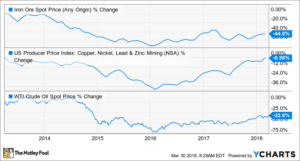
Iron Ore Spot Price (Any Origin) data by YCharts.

The beginning of an extended up cycle in mining capital spending?

Caterpillar’s resources industries segment (mining) is probably the key swing factor for its earnings in the next few years. As you can see above, underlying mining metals prices are moving in the right direction, and the major mining companies expect their spending outlook to improve.

Here’s a look at four of the largest mining companies and their capital expenditure plans for 2018. The total of their planned expenditures for 2018 is around $21 billion, representing a near 20% increase over 2017. If mining metal prices continue to increase, then you can expect more growth in the coming years.
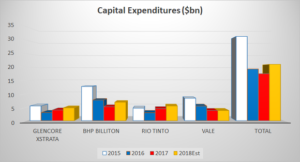
Chart showing major mining companies’ capital spending plans

Construction machinery outlook

Caterpillar’s construction industries segment provided the majority of the company’s profit increase in 2017, and the outlook for the industry is improving in 2018. Indeed, a look at Caterpillar’s peer, Deere & Company (NYSE: DE), only serves to confirm this idea. While Deere is more of an agricultural equipment company, its construction and forestry segment outlook is highly relevant to Caterpillar. The good news is it looks set for a hefty increase in sales and profit in its fiscal 2018.

For example, in its first-quarter 2018 earnings release in mid-February, Deere’s management raised its full-year 2018 net sales growth forecast for its construction and forestry segment to 22% compared to a previous forecast of 14% (both figures exclude acquisitions and foreign exchange). Moreover, Deere increased its forecast for housing starts and total construction investment in the U.S. –both very good signs for Caterpillar. Deere is an attractive company in its own right, but its construction outlook is also good news for Caterpillar.

Caterpillar retail sales

The themes discussed above are all borne out when looking at Caterpillar’s retail sales figures. As you can see below, resource industries sales are finally catching up with construction industries sales.
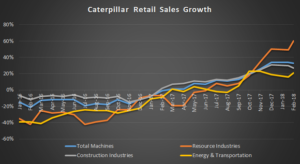
Chart showing Caterpillar retail sales growth by segment

What it means for Caterpillar investors

No one likes buying a cyclical company at the peak of its cyclical growth, particularly when interest rates are rising. However, Caterpillar’s upcycle appears poised to continue, not least from an improving outlook for U.S. construction spending and rising commodity prices. Meanwhile, if the cause of rising interest rates is mostly related to raw material price increases such as oil & mining commodities — end markets that Caterpillar has heavy exposure too — then it’s reasonable to argue that Caterpillar is a net winner in this environment. All told, Caterpillar’s outlook appears to be improving.


This Oil Giant Continues to Quietly Strengthen Its Core

U.S. oil giant ConocoPhillips (NYSE: COP) has jettisoned assets left and right during the past few years, paring its portfolio down to a stronger core. The proceeds from those sales significantly bolstered the company’s balance sheet, and enabled it to jump-start its share repurchase program as well. Those catalysts helped fuel a nearly 30% gain in the stock since it launched its transformational initiative back in November 2016.

While most investors have focused on the assets exiting the company’s portfolio, it’s worth noting that ConocoPhillips also quietly bought several oil and gas properties this year — purchases that strengthened its positions in two core areas and added to its upside potential. These less-noticed moves could turn out to be important value creators in the coming years.

Drilling rig among agricultural fields.

Details on the latest deal

Earlier this week, ConocoPhillips provided an update on its asset sale program. It noted that it closed or signed agreements to sell $250 million of non-core assets in the first quarter, including several small land packages in the red-hot Permian Basin, as well as some undeveloped land in South Texas. When last transaction closes this quarter, that will be a wrap for the company’s ambitious portfolio transformation, under which it unloaded more than $16 billion worth of assets in fiscal 2017 alone — more than twice the value it initially planned to sell.

However, embedded in the most recent update was news that ConocoPhillips also purchased land in two emerging resource plays. First, it scooped up 245,000 acres in the Austin Chalk play of central Louisiana at a very low cost. That gives it a prime position in what it believes could be a high-upside opportunity. The oil giant plans to drill several exploration wells on that land this year.

In addition, it picked up another 35,000 acres in the Montney shale play of Canada for $120 million. The acreage is adjacent to ConocoPhillips’ prior stake in the liquids-rich shale play, and boosts its total position there to 140,000 acres. While it’s not as well known as some shale regions in the U.S., the area has become a key growth driver for Encana (NYSE: ECA) — that company’s liquids output from Montney doubled over the past year. Encana forecasts its fast-paced growth there continuing this year, with high-margin liquids output doubling again by the fourth quarter.

Pump jack and engineer on a winter sunset sky background.

Taking control of the future

These two recent acquisitions followed a similar one by the company earlier in 2018. Along with reporting fourth-quarter results in early February, ConocoPhillips noted that it had purchased a package of assets from Anadarko Petroleum (NYSE: APC) in Alaska for $400 million. The properties included Anadarko’s 22% interest in the Western North Slope of Alaska, as well as its stake in the Alpine pipeline. The transaction enabled ConocoPhillips to gain full control over this core asset for a low price while providing Anadarko with some additional cash to pay off debt and buy back shares.

The deal also gave ConocoPhillips total control over 1.2 million acres of development and exploration land, including the Willow discovery. That find could turn out to be a needle-mover for the company, which believes Willow could hold as much as 300 million barrels of recoverable oil, making it a potential multibillion-dollar investment that could eventually produce up to 100,000 barrels of oil per day. The downside is that the company won’t see a drop of that oil until 2023 at the earliest, given the time required to obtain permits and build out the infrastructure necessary to access that resource. However, that timing meshes well with when some forecasters predict a potential gap in the world’s oil supply.

Going off the beaten path to create value

While most of its rivals are focused on scooping up as much high-priced acreage in the Permian Basin as they can, ConocoPhillips is content to cash in on some of its land holdings so it can quietly buy properties in overlooked areas where it sees some high-upside potential. These deals have not only firmed up its core positions, but have given the company some compelling growth drivers. It’s a bit of a contrarian approach that could pay big dividends in the coming years.

Amazon Has More Music Subscribers Than You Think

When you think of music streaming, Amazon.com (NASDAQ: AMZN) is unlikely to be one of the companies that first comes to mind. The market for paid music-streaming subscriptions is largely dominated by freshly public Spotify and Apple, which have approximately 75 million and 38 million paying subscribers, respectively. You might think that Amazon is a small fish in the music-streaming market.

You’d be wrong.

Echo on a bookshelf next to a pile of books and a framed photograph

Amazon has “tens of millions” of music subscriptions

Billboard reports that Amazon has finally shared some details regarding the size of its music-streaming business. In classic Amazon fashion, the e-commerce giant says it now has “tens of millions” of paid subscriptions. Keep in mind that Amazon offers two separate music streaming services. There’s Prime Music, which includes just 2 million songs and is included with Amazon Prime, and then there is Amazon Music Unlimited, which is more comprehensive and is comparable to Spotify or Apple Music, including tens of millions of songs.

Amazon Music Unlimited offers a couple pricing tiers, including an Echo Plan that only streams to a single Echo device for just $4 per month. An individual plan is $8 per month ($79 per year if billed annually) for Prime members, or $10 per month for non-Prime members. There’s also a family plan for $15 per month.

The “tens of millions” statement appears to include both services, although Amazon says that the number of Amazon Music Unlimited subscriptions has doubled in the past six months.

Given Amazon’s top dog status in smart speakers, it should come as no surprise that Echo devices are driving much of this growth, Apple Music chief Steve Boom told the outlet. Smart speakers are where all the growth in Amazon Music Unlimited is coming from, with Echo devices bringing new users into the market for paid streaming. That includes demographics and genres that have been slow to transition to streaming: older listeners and country-music listeners.

I’d be interested to know if the affordable Echo plan is coaxing users into trying out the service, and if those listeners subsequently upgrade to full-featured plans to utilize it across devices. However, I wouldn’t expect that level of granular detail from a company that is demonstrably averse to investor transparency.

It’s safe to say that Amazon is currently the No. 3 player in the paid music-streaming market behind Spotify and Apple. Last summer, boutique media and technology analysis company MIDiA estimated that Amazon had approximately 16 million music subscribers between Prime Music and Amazon Music Unlimited. That estimate would have put Amazon as the No. 3 player at the time, and the user base has only grown since then.

Why Micron Technology Remains a Buy After Its Latest Earnings Report

The Micron Technology (NASDAQ: MU) juggernaut isn’t showing any signs of stopping, as it thumped Wall Street’s expectations with a solid fiscal second-quarter earnings report and good forward guidance. The memory specialist’s strong showing wouldn’t have surprised investors as it has been enjoying favorable pricing conditions in the DRAM (dynamic random access memory) market.

Still, shares of the chipmaker fell after the earnings report as investors were possibly expecting bigger guidance numbers. But a closer look at Micron’s results, guidance, and memory market conditions indicate that it is capable of sustaining its impressive rally in the future, and there’s no reason for investors to panic.

Hand drawing a stock chart and indicating more upside.

Terrific growth once again

Micron’s fiscal second-quarter revenue shot up 58% year over year to $7.35 billion, and its net income more than tripled to $3.5 billion. The company enjoyed such massive growth thanks to the strong demand for its DRAM and NAND flash memory chips. More specifically, DRAM shipments increased in the mid-single-digits, while the average selling prices were up in the low double digits as compared to the first quarter.

This boosted Micron’s DRAM revenue by 14% on a sequential basis and 76% as compared to the year-ago period. The sequential rise in DRAM pricing and demand suggests that this market is in great shape, which is good news for Micron investors as this segment supplies 71% of the total revenue.

What’s more, the favorable pricing conditions boosted DRAM non-GAAP gross margins by a whopping 22% from the prior-year period. Similarly, the NAND flash business, which accounts for a fourth of the top line, also reported substantial growth. Gross profit margins in this segment increased 16% year over year on the back of a 28% increase in the revenue.

However, while demand looks strong there were mixed indications on the pricing front. Though NAND shipments increased in the low double digits sequentially, average selling prices dropped in the mid-teens. Micron has put the blame for this price drop on a shift in the mix of product sales and a higher proportion of “last-time purchase of higher price MLC NAND” in the previous quarter. Investors shouldn’t panic just yet as Micron expects the long-term scenario in the NAND industry to play out in its favor.

Why Micron isn’t done growing yet

Micron expects $7.4 billion in revenue and $2.83 per share in earnings during the current quarter that ends in May. Both these numbers are comfortably above consensus estimates and the company’s last year’s revenue and earnings per share of $5.57 billion and $1.62 per share, respectively.

The latest memory price boom seems to be different than what we have seen previously as there are now more avenues for sales of DRAM and NAND products. These memory products used to be primarily used in personal computers, so increased production created an oversupply as PC demand has been tumbling. The situation is different now as DRAM and NAND memory products are being used across a wide range of applications such as servers, smartphones, and solid-state drives (SSDs), among others. For instance, Micron’s server revenue was up 30% sequentially last quarter thanks to the increasing adoption of this memory in data centers.

Looking ahead, these segments should lead to improved demand for Micron’s memory chips. Global server shipments are estimated to grow at an annual rate of 6.5% over the next five years, according to DigiTimes Research. This should lead to higher demand for DRAM chips as each datacenter required around 10 million gigabytes (GB) to 20 million GB of data on an average, according to DRAMeXchange. Not surprisingly, server DRAM demand is expected to soar close to 30% this year, and the market should sustain this momentum thanks to secular datacenter growth.

Any increase in memory chip supply will be lapped up by the existing demand in the end-markets. This is exactly what Micron management stated on the latest conference call. The company believes that the 45% increase in NAND bit supply this year will go toward fulfilling demand across enterprise and cloud applications. On the other hand, DRAM prices should also continue increasing as supply is expected to grow 20%, while the market’s overall revenue could increase 30%.

The negative reaction to Micron’s latest quarterly report and guidance is uncalled for, especially considering its cheap valuation. Analysts expect the chipmaker’s earnings to grow at a CAGR (compound annual growth rate) of 27% over the next five years. This makes the stock an enticing choice given a low price-to-earnings ratio of just 9. Investors should treat any pullback in Micron shares as a buying opportunity.

Google bought more renewable energy than it needed last year

Since 2017, Google pledged to power its data centres and offices with 100 percent renewable energy.

Now the tech company said it’s surpassed that, announcing in a blog post that it purchased more power from solar and wind than was used by its operations globally last year. Google said it’s the first company of its size to reach that goal.

Of course, Google isn’t completely powered by solar and wind.

For every kilowatt hour of electricity the company consumes, it purchases a kilowatt hour of renewable energy to replace it, which is sourced from a wind or solar farm built specifically for its needs.

Google said it has contracts to purchase three gigawatts (3GW) of output, but that it’s not yet possible to power itself fully with renewable energy. The company hopes that one day it reaches that goal, but said its initiatives helped to spur new wind and solar developments.

“What’s important to us is that we are adding new clean energy sources to the electrical system, and that we’re buying that renewable energy in the same amount as what we’re consuming, globally and on an annual basis,” Urs Hölzle, Google’s SVP for technical infrastructure, said in the post.

In 2015, only 44 percent of Google’s energy needs came from renewables. That improved to 57 percent by 2016, before it covered all its needs come 2017.

As Google leaps ahead, other tech companies have also pledged to become powered by green energy.

Apple Park is entirely run by renewables, as are many of its facilities around the world. Amazon is working to build dozens of wind farms, and its U.S. fulfilment centres are powered mostly by solar. Facebook aims to have 50 percent clean and renewable power in its energy mix this year.

Watch Boeing refuel a huge military tanker mid-flight

Boeing successfully refueled a KC-46 Pegasus tanker from a fellow tanker — mid-air.

Boeing transferred 146,000 pounds of fuel from one plane to another after taking off from Boeing Field, near Seattle.

The fuel exchange was part of the Federal Aviation Administration’s Supplemental Type Certificate, or STC, testing. The military tanker hit a “major certification milestone” during the flight, which lasted thee hours and 48-minutes, according to Boeing. The craft proved it could handle receiving fuel from three tankers — the KC-46, KC-135, and KC-10. For those tests, a total of 540,600 pounds of fuel was exchanged.

This is part of a series of tests to certify the craft as a military tanker. The plane, which is a commercial 767-2C with military systems added on, has already flown 2,700 hours and made refuels with many other aircrafts beyond the tankers, like the F-16, as part of testing.

The KC-46 will be used in the U.S. military for refueling and taking on extra fuel. It will also carry passengers and cargo. The plane is supposed to be ready by October, but it looks like issues developing a new tanker will delay that delivery date.

The tanker took its maiden flight for the U.S. Air Force in December.