Archives for March 25, 2018

Money saving tips for healthy eaters

If you’d like to clean up your diet without spending a fortune, here are six tips you can try.

1. Identify key ingredients:

Let’s talk strategy. By choosing a few main ingredients to use in meals all week long, you’ll save yourself from buying dozens of different things and having inevitable leftovers that go to waste. Plan your meals in advance. Say it’s chicken week: Buy a big bag of chicken breast and use it to make chicken tacos, chicken salad, chicken and veggies etc. You can also bake up a big spaghetti squash, and use that as the base for your lunches and dinners. It’s great hot or chilled. If you can buy your key ingredients in bulk – they’re often less expensive this way, and with your menu laid out, nothing will go to waste. Now that’s a win win!

2. Try the less expensive cuts of meat:

Look for cheaper cuts of meat you love. For example, if you’re into steak, go for lean beef sirloin. Which is less expensive than other cuts. And ground meat tends to be cheaper than cutlets and filets. Try extra-lean ground beef and lean ground turkey. Bone-in pork chops are another smart choice. Also, butchers get the entire animal, so ask them what cuts they have leftover and can sell to you for a good deal. Just check that the meat isn’t too fatty before they wrap it up!

3. Cook up big batches:

If you pick a recipe that makes multiple servings, you can prepare several meals all at once. This will cost you less money than going out and buying the ingredients for a slew of different recipes. And, it saves you a lot of time. (Who doesn’t love that?) Slow cookers are great for this. If you whip up some delicious and healthy slow cooker recipes, you’ll be happy to have the leftovers.

4. Go vegetarian a few days a week:

Save money by ditching the meat! Done right, vegetarian food can be tasty, low in calories, and a fraction of the price of meat-based meals. Just focus on veggies and plant-based proteins, not empty carbs like pasta and pizza! Eating this way a few days a week can be really cost effective.

5. Take home restaurant leftovers:

Restaurants are notorious for serving extra-large portions. You can save cash and calories by turning in your membership card to the clean-your plate club and splitting that meal in two. Before the server even brings out your food, ask that they wrap up half of your entrée. Save it for lunch or dinner the next day. You’re basically getting two meals for the price of one! Genius! And that’s just one of my tips for navigating restaurants

6. Watch for sales on pantry staples:

Grab your supermarket’s circular, and scan it for deals on shelf-stable items that you use regularly. Things we always keep in our pantry. Nonstick spray, old-fashioned oats, pouched tuna, and canned pumpkin, to name a few. Being in the know can save some serious bucks. And having a well stocked pantry will make your regular grocery shopping so much simpler.

Top 5: Financial tips international college students should know

Studying abroad can be an exciting and fresh new experience for international students, but managing money can be a big challenge.

In fall 2017, some 1,323 undergraduate students from foreign countries were attending the University of Massachusetts Amherst and 389 of them are freshmen, according to UMass At A Glance. For most of these students, it’s their first time dealing with debit card issues and foreign money transactions, and language barriers often make this process even harder.

If you are an international student that suffers from money management, here are some useful tips for you to make saving money less painful.

1. Avoid transaction fees as much as you can

Whenever you need to pay something online that involves a transaction fee, don’t rush to click the “pay” button. Scroll through the payment methods and you are very likely to find one called “eCheck” which is an electronic version of a paper check. This transaction method works almost the same as a real check (and helps save the environment, too).

Zhi Wang, a senior management major at UMass and foreign exchange student from China had to pay not only his tuition fee but also a $995 transaction fee during his freshman year, which he could have saved by using eCheck.

“I didn’t notice that there was an option called eCheck. I wish I could have asked someone before I made the payment, ” said Wang.

Transaction fees also occur when you transfer money to a different bank. One way to avoid transaction fees is to use an app called Venmo. The online service owned by PayPal allows you to make transactions with your debit card or bank account for free. You can pay and request money with a message or some emojis, which makes the process much more fun and interactive.

2. Separate tuition fees from others

Due to the inconvenience of the transaction process in a foreign country, international students are likely to have a large amount of money in their bank accounts to cover their living expenses and tuition for months, or even years. The problem is, how do you resist the temptation of using next year’s tuition to buy yourself some nice clothes and shoes?

Banks offer a tool called a Certificate of Deposit (CD) for people to set aside their savings and earn more interest. By opening a CD, you are putting your money into a bank with a fixed maturity date and an interest rate that is higher than the one your regular savings account offers. If you withdraw money before it matures, you have to pay penalties. These vary depending on the maturity of the CD — for example, the cost for early withdrawal of a 6-month CD is equal to three months interest. However, you can have a better idea of how much money is left for your daily expenses when your tuition and other inevitable costs are in a separate account.

3. Get the most from your rewards credit card

If you have a social security number, then congratulations, you are eligible to apply for a credit card! The next step is to learn how to use your credit card efficiently and wisely.

Cecilia Huang, a junior hospitality and tourism management major at UMass and foreign exchange student from China said she received $90 as a cashback reward last year after spending more than $100 on her Discover credit card.

The $90 reward is a combination of a $20 cash back on purchases, a $50 statement credit for referring a friend and a $20 cashback bonus as a good grade reward for maintaining her GPA above 3.0. Hard work literally “pays off” in such way, right?

The reward programs may vary within different banks so remember to choose the one that best fits you.

4. Take advantage of online communities

This semester, Hyejeong Kim, a sophomore management and accounting double major at UMass and foreign exchange student from Korea spent $388 on textbooks and an iClicker. She said college students in Korea could buy cheap used textbooks from others in online communities, and she was unsure if she could do the same thing in the United States.

Nowadays, you can find everything that you can think of on social media. If there is an online community in Korea, it’s possible that there is one here as well. You can go to your Facebook page and search: “your school’s name” with “free and for sale.” For UMass students, the group is called “UMass Free And For Sale.” Joining the group allows participants to browse items such as cheap microwaves, cameras and even inexpensive lease deals! It’s also a great opportunity to connect with others.

5. Ask the right person

If you have questions about finance, the International Programs Office is a great place to go. Students can consult with UMass’ S.A.M., or “Smart About Money,” a student-run group established to promote financial literacy on campus.

The S.A.M. program holds several events throughout the year to help students. Last November, it organized free rides for students to wherever they needed to go on campus, and the drivers, members of S.A.M., provided financial advice along the way. Not only can international students without cars benefit from a free ride, but the financial advice is equally as helpful. Check out their site for upcoming events.

Managing money may be a topic that sounds overwhelming, but whenever you have a problem, don’t hesitate to ask people.

Erin Zuzula, the bursar of UMass, advises every student to come to the bursar’s office for any questions.

“We are not here to just collect the money. We are here to help in any way we can,” said Zuzula.

Musician and entrepreneur Jon Bon Jovi: This is the key to succeeding in business

Bon Jovi’s latest project is launching a unique wine label with his son, Jesse Bongiovi

Over the past three decades, Jon Bon Jovi has sold more than 130 million albums, earned a place in the Songwriters Hall of Fame in 2009 and his his Grammy-winning band, Bon Jovi, will be inducted into the Rock and Roll Hall of Fame in April 2018.

He’s also “a shrewd businessman,” Bon Jovi biographer Bryan Reesman tells Forbes.

If you want to be successful in business, “don’t chase fads or fashions,” Bon Jovi tells CNBC Make It. He gives the example of Scott Boilen, the man behind the Snuggie: “The guy that created the Snuggie showed that that was his creation. Don’t try to create the Snuggie 2 because you saw someone be successful at it.”

You have to “believe in what it is you’re selling,” he says. “Whatever it is that you’re going to do, do it because you believe in it. And then success is just a matter of time.”

The rock icon has co-owned an Arena Football League team, founded the Jon Bon Jovi Soul Foundation, a non-profit that focuses on hunger and homelessness in the U.S. and even launched a side-career as an actor, appearing in movies and television shows. Today, while Bon Jovi is still touring, his latest endeavor has been the launch of a rosé wine label with his son, Jesse Bongiovi.

The father-son team have been working on their rosé, Diving into Hampton Water, for the past two years with French winemaker Gérard Bertrand. It recently hit the shelves in New York and New Jersey and will be available all along the east coast later this year.

Bon Jovi is the first to admit that his son is in charge. “I work for Jess,” he tells CNBC Make It. “This isn’t my thing.”

That said, Bongiovi is taking advantage of the unique opportunity he has to work alongside his highly successful dad. The 23-year-old admits that his instinct was to launch the wine company “as fast as possible. I get kind of worked up on things and my dad has always been there to say: ‘Don’t just do it fast. Do it right. Make sure that this is going to be the absolute best that it can be because, once it’s out, there’s no taking it back.’”

The Fed just raised interest rates—here are 4 steps you can take to protect your money

On Wednesday, the Federal Reserve raised interest rates by a quarter of a point. That’s the sixth rate hike since it began raising rates from when they were at near-zero in December 2015, and there are three more increases predicted for 2018.

Why does this matter outside of the finance world? Because, simply put, when interest rates rise, the price of money rises too, Greg McBride, chief financial analyst at Bankrate.com, tells CNBC Make It: “That ripples out to every business, every consumer, every municipality, even other governments all over the world.”

For the average consumer, it means that lots of things can become more expensive. And especially for those saddled with variable-rate debt, like credit-card debt, it can seem alarming. But don’t panic.

“At this point, a rate hike is a vote of confidence in the economy and reflection of the fact that the economy is doing better,” McBride explains.

Plus, there’s plenty you can do to protect your own finances. Right now, “worry is not the right word,” McBride says. Instead: “Take action.”

Here are four ways you can insulate yourself from rising interest rates.

Switch to a fixed-rate mortgage

If you have an adjustable-rate mortgage, now is the time to try and switch over to a fixed-rate one, so you aren’t as susceptible to further increases. “If you have an adjustable-rate mortgage, you could be in for a doozy of a payment increase at the next reset,” McBride says.

Say you lock in a 30-year fixed rate mortgage today at the average rate of 4.58 percent. If rates rise again later this year, your rate won’t jump up to 4.75 or 5 percent.

That’s because damage to your wallet from rate hikes happens cumulatively, McBride points out. Although your bills might not change too much after Wednesday’s bump, things can start to add up after a few more.

Pay off credit card debt

Anyone with debt will see an increase on their monthly bill within the next cycle or two. The best way to combat this, as well as the effect of future rate hikes, is to pay off as much outstanding debt as possible now.

Try reading up on the most effective strategies for paying off debt. Here are some tips and tricks to get you started.

You can also take inspiration from this man who paid off $116,000 to become debt-free by 30 and this couple who eliminated $127,000 worth of debt in four years.

Keep some money liquid

Although most savings won’t increase dramatically, some online banks are beginning to offer rates as high as 1.75 percent. To find the most competitive offers, check out Bankrate’s comparison tool.

However, if you choose to take advantage of these higher rates, be mindful of how long you’re signing on for. “Don’t lock your money up for too long or you won’t benefit from further interest rate increases,” McBride says. “Keep your money in short-term or very liquid accounts like savings accounts or short-term CDs.”

Don’t make impulsive decisions

As interest rates rise, it’s normal to see volatility in the stock market. However, “don’t get too wrapped up in that — focus on the long term,” McBride says.

Avoid buying impulsively or selling out of fear. During times of volatility, seasoned investors Warren Buffett and Ray Dalio agree that it’s best to stay calm and stick to the basics.

“Don’t watch the market closely,” Buffett told CNBC in 2016 amid wild market fluctuations. “If they’re trying to buy and sell stocks, and worry when they go down a little bit … and think they should maybe sell them when they go up, they’re not going to have very good results.”

McBride offers similar advice. “The bottom line is, interest rates are going up because the economy is better,” he says. “It’s that better economy that’s ultimately good for corporate profits and stock prices. It just might be a bumpy ride in the meantime.”

5 Reasons to Buy Apple Stock and Hold for the Long Term

When Apple (NASDAQ: AAPL) released its most recent financial results, the numbers were scrutinized by Wall Street. Even in light of its record-breaking performance, investors appeared to want even more. That may have been the result of some confusion about year-over-year unit sales comparisons, as one fewer week in the current-year quarter distorted the results compared to the prior year.

Apple generated $88 billion in revenue, up 13% year over year, and earnings per diluted share of $3.89, up 16% over the prior-year quarter. Both numbers exceeded analysts’ expectations, yet concerns regarding slowing sales of the flagship iPhone remain.

There are still plenty of reasons to like Apple over the longer term.

The upcoming AirPower mat, charging an iPhone, Apple Watch, and AirPods simultaneously

1. A growing ecosystem of products

In the most recent earnings conference call, Apple CEO Tim Cook revealed a seldom-reported metric for the company: Apple’s active installed base grew to an all-time high of 1.3 billion devices in January, up 30% in just two years. Each device provides a built-in market for Apple’s other products and services — funneling customers to the App Store and to subscription services like Apple Music.

2. How can I be of service?

Early last year, Apple CEO Tim Cook said that the company’s goal was to double the size of its services business in the following four years. At the time of that pronouncement, services had generated revenue of $25.5 million in the preceding four quarters. In order to hit Cook’s goal, the segment would have to produce nearly $51 million in annual revenue by the end of 2020. That may sound ambitious, but just 12 months later, services revenue has grown by nearly 19% year over year, to $31.3 million. If that growth rate continues, Apple will achieve Cook’s goal with room to spare.

3. It can still command higher premiums

Michael Walkley, an analyst for Canaccord Genuity, estimates that Apple’s flagship iPhone commanded 87% of the profits in the smartphone industry, despite selling only 18% of the total units in the fourth quarter of 2017. This stark reality is the result of Apple’s long-standing ability to command a premium for its products. That was on full display with the release of the iPhone X, which helped the company increase its average selling price (ASP) for the iPhone to $796, up from just $695 in the prior-year quarter. While future year-over-year ASP changes will likely be far less dramatic, it does illustrate the company’s ability to command higher premiums for its products.

Two iPhones shown back to back

4. A compelling valuation

Those looking to buy a stock at a bargain need look no further than Apple, which is trading at a significant discount to the broader market. Investors can pick up shares for just 18 times trailing earnings, and an even lower 15 times forward earnings estimates. By comparison, the S&P 500 has a trailing price-to-earnings ratio of 26 and a forward valuation of 18.

Those numbers don’t take into account Apple’s massive cash balance, either. As of its last financial release, the company had about $285 billion in cash on the balance sheet, with the vast majority of that held overseas. Apple recently announced that it would be repatriating those funds under U.S. tax reform, paying an estimated $38 billion in taxes in the process.

Backing out the net cash on its balance sheet, which is approximately $125 billion after subtracting the expected tax payment, Apple’s valuation becomes even more attractive, with trailing and forward P/E ratios of 15 and 13 respectively.

5. It’s shareholder-friendly

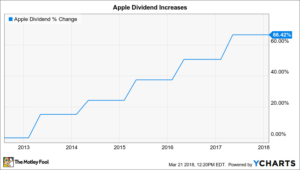
In the Steve Jobs era, Apple was content to stockpile cash for a rainy day. That cash pile continues to grow, but soon after Tim Cook became CEO, Apple instituted a massive capital return program. In early 2012, the company announced that it would begin paying a dividend for the first time since 1995. Apple has raised its payout every year since, increasing the total by 66%, and paying $64 million in dividends during that time.

AAPL Dividend data by YCharts.

Apple didn’t stop at dividends, either. Since instituting a share buyback plan in late 2012, the company has spent a massive $176 million repurchasing shares, and lowering its share count by more than 22% in the process.

All told, Apple has returned a whopping $248 million to shareholders, and many expect the company to announce its next dividend increase in May. That dividend currently yields 1.4%, with a payout ratio just over 25%, giving Apple ample room to continue to increase its payout for the foreseeable future.

One more thing

Apple investors have long been concerned that the iPhone is the company’s swan song. Every product the company has released since has been compared to its flagship device, always with the conclusion that “it’s no iPhone.” Now that it’s produced two category-killers — the now defunct iPod, and the iPhone — investors somehow believe that Apple will never have another device to rival its cash cow.

Remember, though, that many companies are extraordinarily successful without ever having produced a category-killer. Apple continues to innovate, introducing new products like the HomePod and AirPods; while those products may not be the “next iPhone,” they’ll help Apple continue to grow both its top and bottom lines. We may yet see another category-killer — but that isn’t necessary for the company to thrive.

I think Apple will continue to generate impressive results for shareholders for many years to come.

3 Stocks That Look Just Like eBay in 1998

When eBay held its initial public offering in 1998, investors rightly embraced the company as the world’s most dominant online marketplace in the early days of the internet. And even now, eBay is trading close to its all-time highs after posting record holiday results and five straight quarters of accelerating marketplace volume growth.

All told, eBay stock has soared nearly 4,800% over the past two decades — and that doesn’t count its spinoff of PayPal in 2015, which gave investors one share of PayPal for each share of eBay they owned at the time.

But that raises the question: Are there any stocks on the market today that look like eBay did in 1998?

We asked three Motley Fool investors exactly that. Here’s why they singled out Impinj (NASDAQ: PI), Universal Display (NASDAQ: OLED), and Mazor Robotics (NASDAQ: MZOR).

A man in tan khakis and light blue shirt standing on a stepladder drawing a yellow chart on a red brick wall.

A huge rebound in the making

Anders Bylund (Impinj): Twenty years ago, eBay was a tiny niche business trying to make a business out of this newfangled internet thing. As we all know, that idea worked out nicely and shareholders reaped some massive rewards in the process.

Today, I get a very similar vibe from Impinj. Only time will tell whether the RAIN radio-frequency ID specialist’s future returns will match eBay’s early days, but the stock stands a good chance of doing so from the highly spring-loaded current position.

The rampant revenue growth that helped Impinj shares triple in value in its first 11 months on the public markets has stalled in recent quarters. As a result, the stock has lost its high-growth valuation multiples and share prices have tumbled a heart-stopping 77% below those summer highs. These days, you can buy Impinj shares at just 2.4 times the company’s book value — a bargain-basement price usually reserved for either deep-discount value stock or impending bankruptcy disasters.

CEO Chris Diorio argues that Impinj’s troubles are temporary in nature. A handful of huge customers built their RFID tag supplies much too quickly in early 2017 and still have to work through those bulging warehouse shelves before placing any new orders. That situation should reverse somewhere in the back half of 2018, opening the door to fresh growth in Impinj’s largest segment again.

Meanwhile, the company’s unique and cutting-edge RFID readers and data analysis systems are receiving interest from brand new markets. Diorio sees an opportunity to turn several entire industries upside down and inside out by providing tools to run the business in a more efficient way. These opportunities include healthcare, airlines, automotive computing, and laundry services.

Two decades from now, I’m sure that RFID tags will be all around us. Impinj is still a leader in this evolving space and stands a great chance of emerging at the clear long-term winner. There will always be speed bumps and short-term challenges, but there’s nothing wrong with Impinj’s actual business. So if you get started with this potential long-term winner at today’s low, low prices, I think you’ll give eBay’s golden years a run for the money.

Take advantage of this pullback

Steve Symington (Universal Display): Maybe Universal Display doesn’t look exactly like eBay did shortly after its IPO in 1998. After all, Universal Display technically went public two years earlier. The organic light-emitting diode (OLED) specialist, though, didn’t truly start to gain traction with many investors until it signed a long-term license and material supply agreement with its largest customer, Samsung Display, in 2011 — an agreement that the two companies only just renewed last month. Also more recently, Universal Display struck long-term deals with the likes of LG Display and China-based BOE. So its flagship technology is found in millions upon millions of OLED smartphones, televisions, and wearable devices.

But I also know that eBay has endured its fair share of nasty pullbacks en route to rewarding patient, long-term shareholders. As it happens, after hitting an all-time high of $209 per share in January, Universal Display stock has since fallen nearly 50% for two reasons: First, almost exactly a month ago, shares plunged when the company announced strong fourth-quarter 2017 results, but followed with seemingly conservative guidance for the coming year due to earlier-than-expected inventory building efforts from certain customers. As I wrote at the time, however, Universal Display is still early in a multiyear growth cycle, so shifting some revenue from quarter to quarter shouldn’t negatively affect its long-term story.

Then a few days ago, Universal Display stock dropped yet again on reports that Apple is developing its own displays with competing technology that could replace the OLED displays that it’s currently sourcing from Samsung Display for its high-end iPhones. Here again, however, those reports note that Apple is in the early testing phases of the technology and nearly discontinued the project given manufacturing difficulties. And even if it does succeed, we won’t see a finished product for several years yet, and Apple is likely to keep the technology to itself.

Finally, as Anders wrote a few months ago, Universal Display investors should be even more excited for the potential of OLED lighting, which promises to grow into a multibillion-dollar business opportunity for the company in the coming years.

Long story short, nothing has happened over the past couple of months to break Universal Display’s long-term story. And I firmly believe that its steep drop is a golden opportunity for investors to open or add to their positions.

A ramp up in robotics

Todd Campbell (Mazor Robotics): If you’re thinking robotic surgery is science fiction, you’re wrong. Robots are already being used to assist surgeons in many procedures, and while Intuitive Surgical is a Goliath in laparoscopic surgery, a partnership with Medtronic PLC is establishing Mazor Robotics a standard in spine surgery.

Mazor Robotics manufacturers the Mazor X, a system used in spine and brain procedures that can limit surgical errors and improve recovery times.

A co-marketing relationship with Medtronic expanded last year, leaving Medtronic with sole responsibility for marketing the Mazor X globally. Mazor Robotics couldn’t hope for a better partner. Medtronic is a surgical products giant with a team of specialists that already calls on spine surgeons.

It appears Medtronic’s hit the ground running.

In 2017, full-year sales jumped 78% year over year to $64.9 million, including sales of $17.4 million in Q4, up 38% year over year. In Q4, Medtronic sold 21 Mazor X systems and thanks to more systems being in place, Mazor Robotics revenue from high-margin consumables used inMazor X procedures soared 107% year over year.

The Q4 sales growth and declining operating costs due to transferring its sales team to Medtronic allowed Mazor Robotics to turn the corner to profitability, too. EPS clocked in at $0.01 in Q4, and in 2017, the company’s non-GAAP net loss per share improved to $0.12 from $0.36 in 2016.

Admittedly, Mazor Robotics isn’t a cheap stock. But it’s early innings yet for the company and profitability should increase as more systems get used in more procedures. If I’m right, then Mazor Robotics could grow into its valuation in the same way that eBay did over the past 20 years.

Oh, and one more thing: There’s also an outside shot at an acquisition. As part of their agreement, Medtronic already owns 10.6% of Mazor Robotics and it has warrants that eventually could increase its ownership stake to 14.2%.

The bottom line

It’s impossible to guarantee that these three stocks will be able to duplicate eBay’s incredible post-IPO returns. But Universal Display, Impinj, and Mazor Robotics are all promising businesses operating in the earliest chapters of their respective long-term growth stories. For investors willing to buy now and watch those stories play out, we think the chances are high that you’ll be more than pleased with your decision years from now.